


Every missed opportunity, every delayed delivery, and every extra hour your team spends fixing avoidable issues quietly chips away at your profit and too often, the reason isn’t strategy, talent, or market conditions, it’s disconnected systems that fail to communicate effectively. Think about it: in your organization, multiple platforms, legacy software, and cloud applications often operate in isolation, creating hidden inefficiencies that slow decision-making, increase costs, and risk lost opportunities. Even if your business hasn’t relied heavily on technology in the past, integration is now essential to remain efficient, competitive, and relevant in your industry.
System integration is more than just a technical upgrade; it’s a strategic lever for your business. When your systems work together seamlessly, you gain real-time visibility, actionable insights, workflow optimization, and automation, enabling you to make informed decisions faster. Every process you optimize through integration reduces waste, accelerates delivery, minimizes errors, and protects revenue. It’s not just about technology, it’s about empowering you and your team to operate at peak efficiency and make every decision count.
As you plan for 2026, the question isn’t whether you need integration; it’s how quickly you can unify your systems to turn operational complexity into clarity, inefficiency into productivity, and fragmented processes into a competitive advantage. By reading this blog, you will gain practical insights, proven integration strategies, and actionable guidance to streamline your operations, protect revenue, and future-proof your business.
What system integration actually means
System integration is the deliberate coordination of multiple systems, business processes, and data so they operate as an integrated system rather than a collection of disconnected tools. At its core, integration ensures seamless communication between applications, enables reliable data flows, and allows the organization to function as a coordinated whole. Information moves smoothly across departments, workflows remain connected end to end, and leaders gain a unified view of the business that supports confident, informed decisions.
Importantly, system integration is not a tactical IT fix or a one-time integration project. It is a strategic discipline that defines how efficiently your organization operates in a dynamic business environment, day to day and at scale.
Integration as a strategic enabler, not a technical patch
When systems are not integrated, teams are forced to work around technology instead of being supported by it. Disconnected or disparate systems often require manual data entry, repeated processes, and informal workflows that rely heavily on human intervention. This increases human error, introduces inconsistencies, and makes it difficult to maintain an accurate view of operations.
Over time, these inefficiencies drive up operational costs, slow execution, and weaken risk management, especially when data is spread across different systems with limited visibility or weak access controls. A well-designed system integration process eliminates this fragmentation by enabling systems to share data automatically, enforce security protocols, and enable enterprise workflow automation, reducing manual steps, standardizing processes, and ensuring consistency across departments.
The result is not just smoother operations, but significant cost savings, improved operational efficiency, and stronger business agility, allowing the organization to scale without adding unnecessary complexity.
Scope and organizational impact across the enterprise
The scope of system integration extends far beyond IT infrastructure. Most enterprises rely on a combination of legacy system modernization initiatives, outdated systems, cloud applications, ERP systems, and custom-built solutions, often connected through heterogeneous or proprietary interfaces.
A successful system integration project connects these disparate applications so that different subsystems and other subsystems can operate together with shared context. Finance depends on consistent, real-time data from sales and operations. Operations teams require synchronized workflows across the supply chain and fulfillment. Customer-facing teams need consistent information across CRM, support, and marketing platforms. Leadership relies on an integrated ecosystem to allocate resources effectively and guide business growth.
Without integration, each function operates in isolation. With integration, the organization gains a centralized, reliable flow of information, often enabled through a centralized platform, that aligns technology with real business requirements.
Components that enable system integration
At the heart of every agile and competitive organization lies system integration, but its real value comes from the components that make it work. Understanding these core elements helps turn isolated processes into a unified system that saves time, cuts costs, and gives your business a clear edge.
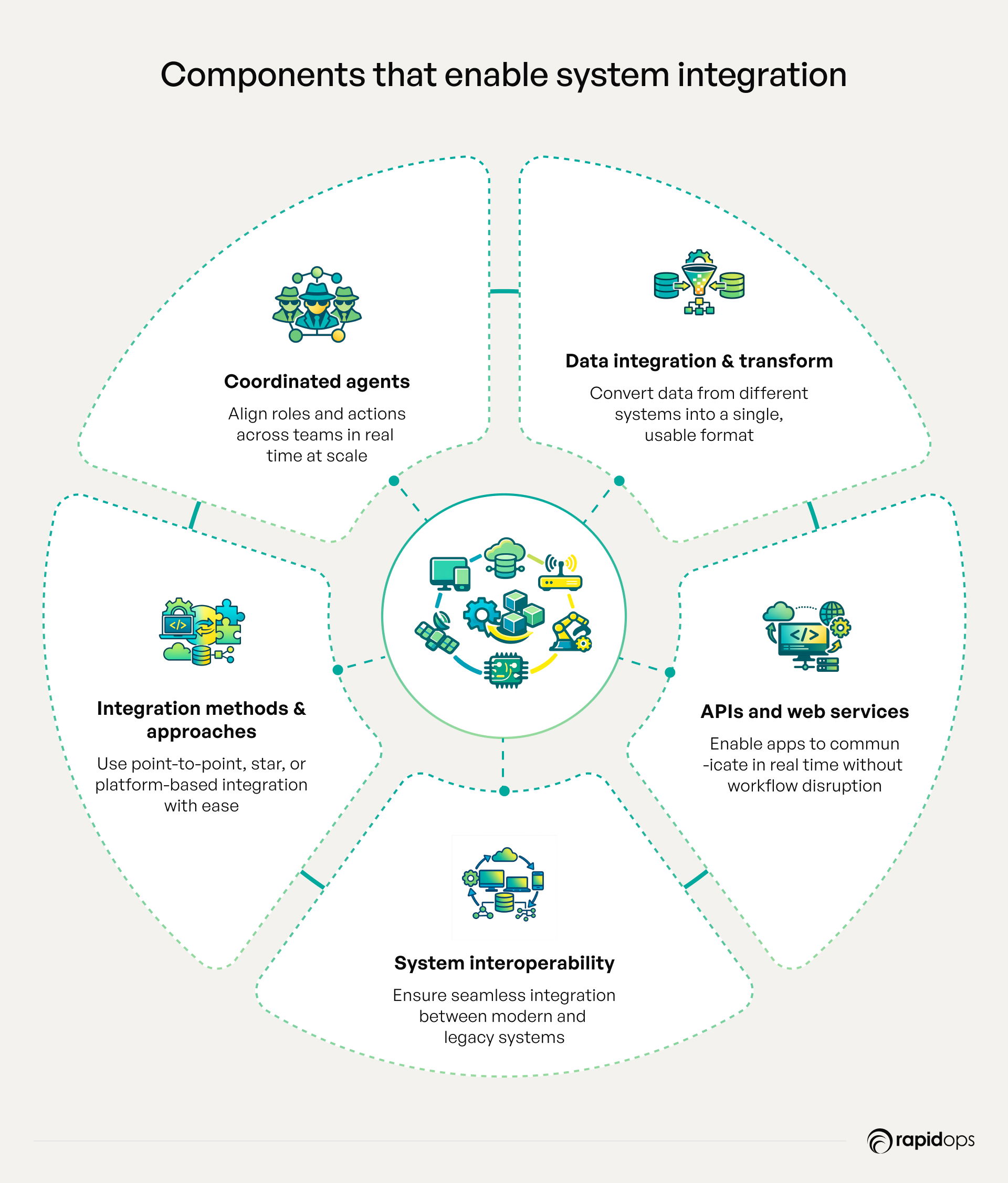
- Data integration and data transformation ensure information from various systems is converted into a common data format, even when systems use proprietary interfaces or store data differently
- APIs and web services enable real-time communication between applications and help integrate applications without disrupting existing workflows
- Middleware and an integration platform act as the orchestration layer, managing complexity and enabling scalable integration solutions
- Interoperability ensures systems, whether modern or legacy, can work together as subsystems cooperating within the same ecosystem
Depending on architecture and scale, organizations may use different integration methods, including point-to-point integration, star integration, or platform-based approaches using pre-built connectors. Each method supports the same goal: enabling systems to function together rather than as isolated units.
From fragmented systems to an integrated ecosystem
Ultimately, system integration defines how an organization functions as a whole. It connects individual systems, aligns subsystems, and ensures that every specialized component contributes to overall performance and business objectives. When executed thoughtfully, integration eliminates silos, standardizes workflows, and provides a centralized flow of reliable information across departments.
A key aspect of modern integration is AI integration, which enables organizations to embed intelligent automation, predictive analytics, and real-time decision-making into existing systems. By incorporating AI, businesses can not only streamline operations but also gain actionable insights, optimize resource allocation, and respond faster to market changes.
Properly designed integration, including AI capabilities, enhances efficiency, strengthens data security, reduces reliance on manual processes, and provides the flexibility to adapt as software evolves or new technologies emerge. System integration transforms fragmented technology into a scalable, resilient foundation that supports sustainable growth, protects margins, and ensures the organization remains competitive as complexity increases.
Why do we need system integration in 2026
After grasping what system integration is and how data integration, APIs, middleware, and interoperability create a cohesive framework for multiple systems, it’s impossible to overlook why understanding the dynamics driving integration has become increasingly urgent for 2026 enterprises.
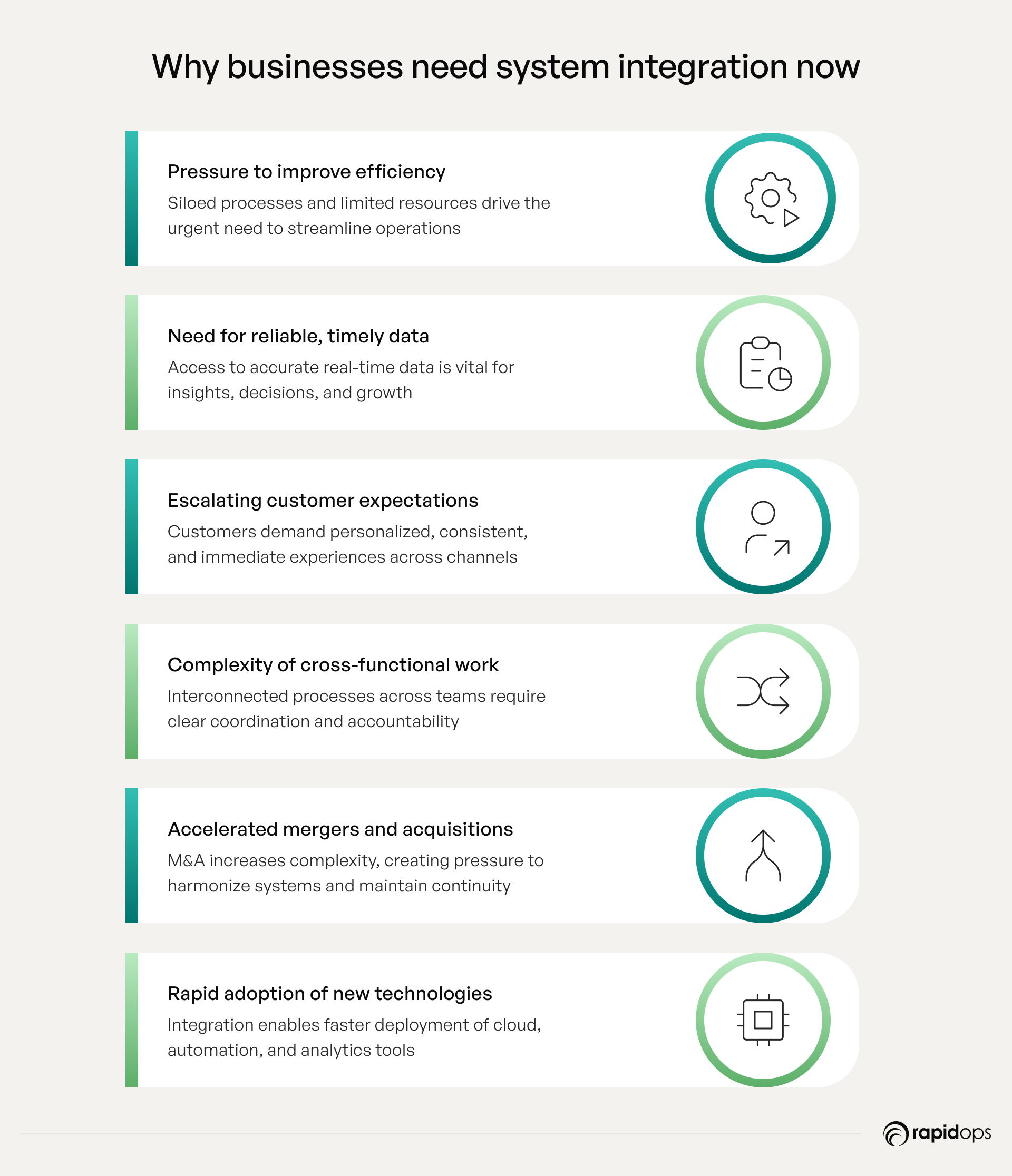
1. Intensifying pressure to improve operational efficiency
Enterprises are constantly challenged to achieve more with constrained resources. Siloed departments generate duplicated tasks, fragmented reporting, and slowed execution, amplifying operational strain. Rising costs, staffing limitations, and competitive pressures create an urgent need to streamline processes and optimize resource allocation.
The decision to pursue integration is rooted in this operational reality: businesses are motivated by the necessity to reduce inefficiencies, align activities across functions, and maintain scalable, sustainable performance in an increasingly demanding business landscape. Effective B2B digital transformation strategies often highlight how integrated systems are essential to achieving operational excellence, enabling enterprises to coordinate workflows across departments and optimize resources in real time.
2. Growing need for reliable and timely data
Every moment counts in 2025, delayed or inconsistent data can cost enterprises critical opportunities, hinder decision-making, and amplify operational risks. Organizations face growing pressure to access accurate, real-time information that connects teams, highlights emerging trends, and enables proactive, insight-driven actions. Disconnected systems create blind spots, slow responses, and increase operational uncertainty, making integration an urgent necessity.
The need is further intensified by AI adoption, which relies on unified, high-quality data to generate actionable insights and support strategic decisions. By following expert AI adoption practices, enterprises can leverage integrated systems to turn fragmented information into a reliable, decision-ready foundation, driving agility, resilience, and sustainable growth.
3. Escalating customer expectations
Modern customers expect consistent, personalized, and immediate experiences across multiple channels. Fragmented systems hinder organizations from fully understanding customer behavior, interactions, and preferences, creating friction and missed opportunities. Rising expectations around responsiveness, personalization, and seamless service act as a primary driver for integration. Organizations are compelled by these pressures to create internally coordinated processes, anticipate customer needs, and maintain satisfaction and loyalty, highlighting the external forces motivating integration adoption rather than the technical solutions themselves.
4. Complexity of cross-functional processes
Enterprises today rely on workflows that interconnect finance, operations, HR, marketing, and supply chain functions. Misaligned responsibilities, unclear communication, and delayed handoffs introduce inefficiencies, errors, and resource strain. This complexity exerts continuous pressure on organizations to achieve operational coherence and synchronized execution. The driver for integration lies in the need to manage this complexity, ensure accountability across teams, and align cross-functional objectives, illustrating how organizational challenges, rather than technology features, push enterprises toward integrated frameworks.
5. Accelerated mergers and acquisitions (M&A) activity
M&A activity compounds operational and technological complexity, as organizations consolidate diverse legacy systems, ERPs, and processes. This introduces risks, inefficiencies, and the potential for lost synergies during critical transitions. Executives feel pressure to maintain continuity, operational stability, and effective coordination post-merger. Integration is pursued not for its own sake but as a response to these tangible pressures, organizations are motivated by the necessity to harmonize structures, protect data integrity, and ensure seamless collaboration across newly combined teams.
6. Demand for rapid adoption of new technologies
Digital transformation accelerates the need to implement cloud applications, automation platforms, and advanced analytics tools. Fragmented infrastructure limits flexibility, slows adoption, and reduces return on investment. Enterprises face pressure to remain agile, innovative, and competitive in a fast-evolving landscape. The driver for integration is the strategic requirement to enable technology adoption without disrupting existing operations, emphasizing organizational necessity and market-driven urgency over technological features, reinforcing why integration is increasingly unavoidable.
By focusing on these key drivers, organizations can synchronize multiple systems and subsystems, streamline data flows, and build a resilient operational framework that supports decisive, insight-driven leadership in complex business environments.
System integration approaches and the types of systems they can integrate
Every enterprise relies on a mix of applications, legacy systems, cloud platforms, and departmental tools to run operations. Yet when these systems operate in isolation, workflows stall, decisions lag, and opportunities slip away.
Understanding the key system integration approaches and the types of systems they can connect allows leaders and decision-makers to uncover clear pathways for seamless data flow, coordinated processes, and efficient collaboration across the entire technology ecosystem. This knowledge empowers you and your organization to explore integration strategies with precision, focusing on tangible business outcomes and unlocking the full potential of existing systems.
1. Point-to-point integration
Point-to-Point integration establishes direct, custom connections between two systems, creating a tightly coupled architecture. It is particularly effective for small-scale integration needs or focused workflows requiring real-time connectivity.
How it works
Point-to-point integration connects two systems directly through custom-built connectors, which act as dedicated bridges allowing seamless data flow. Each connector ensures that data is transformed into the correct format, validated for accuracy, and monitored for errors, making the integration reliable and consistent. Communication is usually synchronous, so updates in one system are reflected immediately in the other, enabling real-time workflows such as order tracking, invoicing, or approvals.
In practice, this means that, for example, a CRM system can instantly update a finance module when a new order is placed, or an HR system can automatically send payroll data to the finance system without manual intervention. Each connection is purpose-built, ensuring precision, but as more systems are added, complexity grows. Every new system requires its own dedicated link, which can make scaling challenging if not carefully planned and managed.
Despite these challenges, point-to-point integration is ideal for focused, small-scale workflows where speed, accuracy, and real-time data exchange are critical. Proper planning, clear mapping of workflows, and monitoring strategies can maximize its efficiency while avoiding bottlenecks.
Systems it can integrate
- Small-scale enterprise applications: ERP ↔ CRM, HR ↔ Payroll, Finance modules
- Legacy or proprietary systems via custom connectors
- Departmental tools and reporting platforms, including specialized subsystems for operations, sales, and logistics
- Limited cloud/SaaS applications for specific workflows
- Individual automation scripts or RPA bots to reduce manual data entry
- Targeted business processes such as invoicing, approvals, order tracking, and customer onboarding
Point-to-Point integration delivers fast implementation for focused scenarios but may create complexity when scaling across multiple subsystems.
2. Middleware / ESB-based integration
Middleware or an Enterprise Service Bus (ESB) provides a centralized integration layer that orchestrates communication between multiple systems, ensuring robust governance, data consistency, and operational control.
How it works
Middleware or an Enterprise Service Bus (ESB) acts as a central hub that connects multiple systems through a standardized message exchange layer. Each system can publish messages to the middleware or subscribe to receive messages, allowing data to flow reliably between different applications, databases, and devices. The middleware handles routing, ensuring each message reaches the correct destination, transforms data to match the format required by the receiving system, and validates messages to prevent errors. It also orchestrates workflows, enabling complex, multi-step business processes, while monitoring performance and logging events for governance and auditing.
This setup supports both synchronous (real-time) and asynchronous (delayed or queued) communication, making it suitable for a variety of enterprise scenarios. For example, when a new order is placed, the middleware can simultaneously update the ERP, notify the warehouse management system, trigger invoicing in finance, and send an alert to the CRM system, all without direct point-to-point connections between each system.
While middleware centralizes integration and simplifies governance, error handling, and resource allocation, it must be carefully designed and maintained to avoid complexity or operational cost escalation. Proper mapping of system interactions, workflow orchestration, and monitoring strategies ensures reliable, scalable, and efficient integration across the enterprise.
Systems it can integrate
- Enterprise applications: ERP, CRM, HRMS, SCM, Finance, Supply Chain modules
- Legacy and proprietary systems: ensuring older systems remain functional alongside modern platforms
- Databases and data warehouses, including structured and unstructured data stores
- Departmental workflows: HR, Procurement, Sales, Operations, and Finance
- On-premise and hybrid cloud environments, connecting SaaS tools and internal applications
- Hardware/software components: IoT devices, production machines, sensors, and specialized subsystems
- Cross-functional business processes, ensuring subsystems cooperate and maintain consistent information
Middleware centralizes integration, simplifies governance, reduces human error, and supports resource allocation, but must be carefully engineered to avoid operational cost escalation.
3. API-led integration
API-led integration is a modular, service-oriented approach that exposes system capabilities through standardized APIs, enabling real-time, event-driven, and reusable integration across diverse environments.
How it works
API-led integration connects systems through modular, standardized APIs, which act as controlled interfaces exposing specific system capabilities. Each application interacts with other systems by calling these APIs at defined endpoints, without needing to understand the internal workings of the underlying system. This abstraction allows data to flow consistently across platforms, ensures that transformations are applied correctly, and supports governance through authentication, throttling, and monitoring.
APIs can operate synchronously, delivering real-time responses, or asynchronously, handling events and queued requests, enabling both immediate actions and background processes. For example, when a customer updates their profile on a web portal, an API can instantly update the CRM, trigger workflow actions in a marketing automation platform, and log the change in an analytics engine, all without hard-coded connections between the systems.
This approach promotes reusability, as the same API can serve multiple applications, and scalability, since new systems can be integrated simply by consuming the existing APIs. With proper governance, version management, and security, API-led integration supports rapid innovation, cross-platform workflows, and agile business operations.
Systems it can integrate
- Cloud-native and SaaS applications: Salesforce, ServiceNow, HubSpot, Microsoft 365
- Mobile and web applications: customer portals, employee apps, partner dashboards
- Microservices architectures and containerized applications (Docker, Kubernetes)
- Legacy systems via API adapters, including ERP, HRMS, and payroll systems
- Partner and third-party platforms in finance, supply chain, or logistics
- Analytical engines, AI/ML modules, and IoT systems
- Cross-departmental business processes: marketing automation, sales pipeline management, and operational workflows
API-led integration supports business agility, innovation, and scalable workflows, but requires strong governance and version management to mitigate system integration challenges.
4. Hub-and-spoke integration
The Hub-and-Spoke model leverages a central hub to manage communication between multiple systems (spokes), reducing the complexity of direct point-to-point connections and improving operational control.
How it works
In the Hub-and-Spoke model, a central hub acts as the core communication and orchestration point between multiple connected systems, called spokes. Each spoke interacts only with the hub, rather than forming direct point-to-point connections with other systems. This centralization simplifies integration, reduces duplication, and ensures consistent handling of data across the enterprise.
The hub manages routing, sending messages to the appropriate systems; transformation, converting data into formats compatible with each spoke; validation, ensuring data accuracy; and monitoring, tracking performance and errors. It supports both real-time communication for immediate updates and batch processing for scheduled or large-volume workflows.
For example, when a new customer order is placed, the hub can simultaneously update the ERP system, notify the warehouse management system, trigger invoicing in finance, and log the transaction in reporting and analytics tools, without each system having to connect to every other system individually.
While this model simplifies governance, monitoring, and workflow orchestration, it requires careful hub design. Poorly optimized hubs can become bottlenecks, affecting performance and reliability. Proper planning, workflow mapping, and resource management ensure that Hub-and-Spoke integration delivers efficient, coordinated, and scalable operations.
Systems it can integrate
- Enterprise applications across ERP, CRM, HRMS, SCM, Finance, Operations
- Legacy and proprietary systems, ensuring older systems remain functional
- Databases, reporting platforms, and BI tools
- Departmental and cross-departmental tools: HR, Procurement, Sales, Operations
- On-premise and hybrid cloud platforms, connecting internal tools with SaaS platforms
- Specialized subsystems: manufacturing, logistics, and customer service systems
- Automation engines and workflow tools to reduce manual data entry and improve data accuracy
Hub-and-Spoke integration simplifies monitoring and governance, providing a unified view of operations, but the central hub can become a bottleneck if integration processes are not carefully designed.
5. Hybrid integration
Hybrid integration combines multiple approaches, Point-to-Point, Middleware, and API-Led, into a comprehensive, flexible strategy, capable of connecting complex, heterogeneous enterprise environments.
How it works
Hybrid integration combines multiple integration approaches, Point-to-Point, Middleware/ESB, and API-led, to create a flexible, enterprise-wide ecosystem. The system orchestrates connections based on the specific needs of each application: APIs can handle real-time interactions with cloud or SaaS platforms, middleware can manage workflows for legacy systems, and point-to-point links can support specialized, small-scale processes.
This approach allows all systems, cloud, on-premise, SaaS, and legacy, to work together seamlessly. The integration layer ensures routing, transformation, validation, and monitoring are applied appropriately for each type of connection. Communication can be synchronous for immediate updates or asynchronous for batch or event-driven processes.
For example, when a new sales order is placed:
- The cloud CRM updates customer data via an API.
- The legacy ERP system processes the order through middleware.
- The finance and warehouse subsystems receive notifications via point-to-point links.
This coordination ensures that all systems remain synchronized, workflows are automated, and data integrity is maintained across the enterprise. While hybrid integration provides maximum flexibility and supports complex digital transformation initiatives, it requires careful planning, governance, and monitoring to avoid unnecessary complexity or operational overhead.
Systems it can integrate
- Cloud and on-premise platforms, spanning ERP, CRM, HRMS, SCM
- Legacy, proprietary, and specialized subsystems, maintaining continuity while modernizing workflows
- SaaS platforms integrated with internal applications and databases
- Business processes spanning departments: Finance, HR, Procurement, Operations, Marketing
- Microservices, IoT devices, and event-driven systems
- Analytical engines, dashboards, and reporting platforms
- Automated workflows reduce manual data entry and support subsystem cooperation
Hybrid integration provides maximum flexibility, supports complex digital transformation, and mitigates risks associated with relying on one system. Proper governance and planning are essential to fully realize operational efficiency and sustained business growth.
Choosing the right integration approach is critical for enterprise success. Each method of Point-to-point, Middleware/ESB, API-Led, Hub-and-Spoke, and Hybrid, offers distinct mechanisms, systems integration capabilities, and executive benefits.
By understanding how each approach works, the types of systems it can integrate, and the challenges it addresses, organizations can:
- Streamline workflows and minimize manual data entry errors
- Ensure seamless communication across enterprise platforms
- Optimize hardware and software investments
- Reduce operational risks and avoid dependency on one system
- Achieve operational efficiency, accurate insights, and sustainable business growth
A well-executed integration strategy transforms disparate systems and processes into a coordinated, expert-level ecosystem, empowering leaders to make informed decisions and operate at peak efficiency.
Core benefits of system integration
After mapping how different systems, applications, and workflows connect, it becomes evident that system integration is far more than a technical exercise; it is a strategic enabler that shapes the way enterprises operate. Understanding its role sets the stage for exploring the core benefits, showing how integrated systems transform complexity into a cohesive, intelligent, and agile ecosystem, where legacy systems, cloud applications, ERP platforms, and specialized subsystems work together seamlessly.
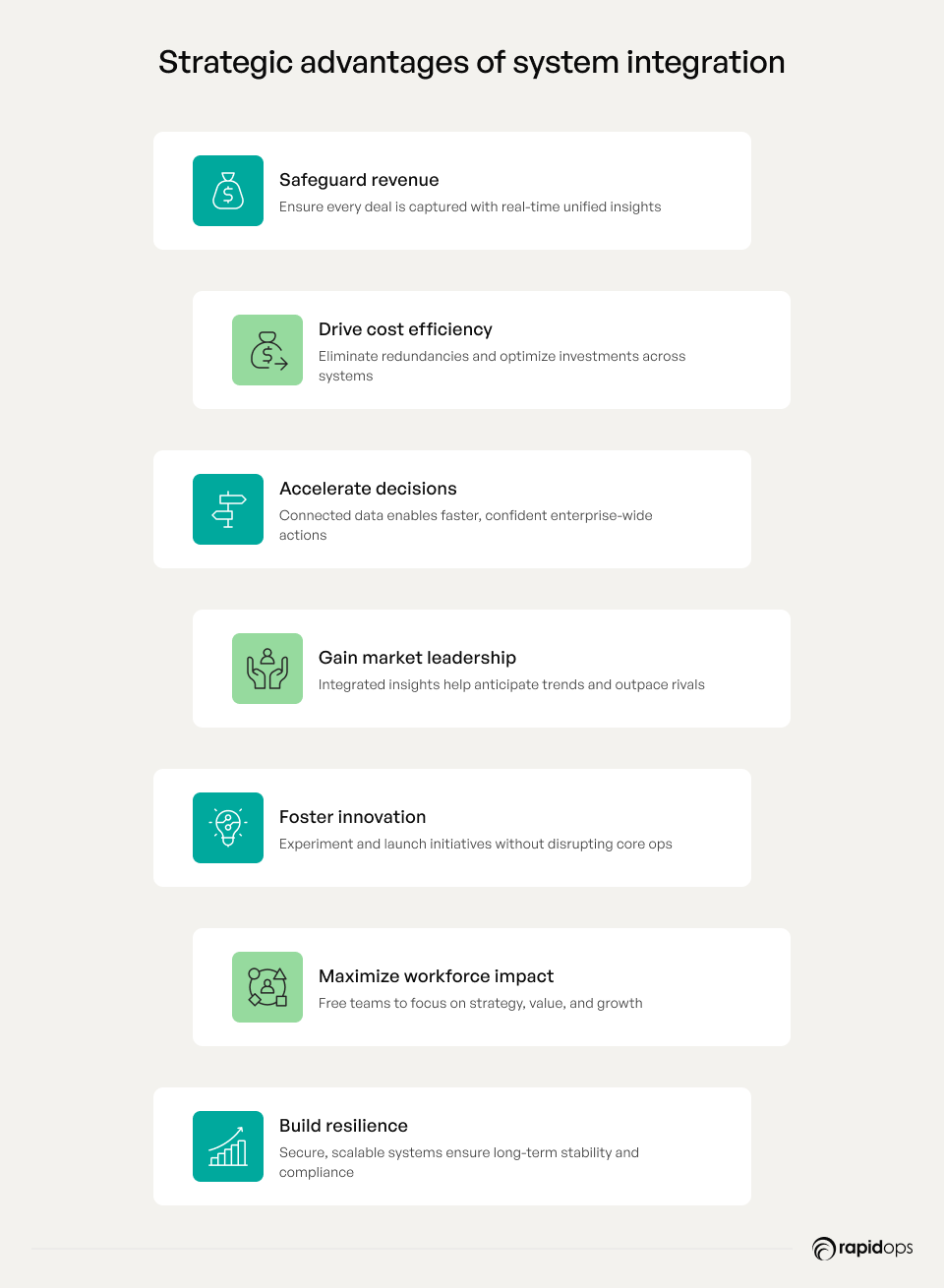
1. Safeguard opportunities and prevent deal loss
Integrated systems provide teams with real-time access to consistent, accurate data across all subsystems and applications. By eliminating reliance on manual entry, fragmented workflows, and disconnected information, sales, customer service, and support teams can act decisively, engage more effectively, and capture opportunities before they slip away. This coordination creates a single source of truth, transforming siloed operations into a proactive system that enhances revenue outcomes and strengthens customer relationships. Leveraging customer intelligence analytics further amplifies this impact by turning integrated data into actionable insights for smarter decision-making.
2. Unlock substantial cost savings
Strategic system integration streamlines redundant platforms, overlapping licenses, and inefficient processes, delivering tangible cost efficiencies. By harmonizing legacy systems, cloud applications, ERP systems, and specialized subsystems, repetitive tasks are automated, resources are optimized, and operational overheads are minimized. A unified platform not only ensures predictable costs and operational clarity but also frees up capital for strategic investments, innovation, and technology upgrades. Coupled with insights from supercharging operational efficiency with data analytics, organizations can identify hidden inefficiencies, prioritize high-impact initiatives, and convert cost management into a competitive advantage.
3. Accelerate time-to-action across the enterprise
System integration eliminates bottlenecks from fragmented workflows, manual reconciliations, and disconnected systems, enabling seamless data flow across departments. Teams gain access to accurate, real-time insights that support faster decision-making and proactive execution. By combining integrated systems with approaches like AI-driven automation, organizations can streamline repetitive tasks, enhance operational responsiveness, and focus on high-value strategic initiatives. This alignment not only improves agility and coordination but also empowers enterprises to act decisively in dynamic markets, turning information into timely, actionable outcomes.
4. Gain a strategic competitive edge
Connecting multiple systems and subsystems creates a unified view of operations, customers, and market dynamics, empowering leaders to anticipate trends, act proactively, and mitigate risks. Integrated workflows enhance business agility, operational efficiency, and informed decision-making, providing a decisive advantage over competitors operating in fragmented environments. With a coordinated ecosystem, organizations can align processes with strategic goals and seize emerging opportunities faster.
5. Drive innovation through connected systems
System integration establishes a flexible, scalable ecosystem where cloud applications, ERP platforms, and custom solutions work in harmony. With consistent data flow and coordinated subsystems, organizations can safely experiment with new tools, test analytics frameworks, and scale creative initiatives without disrupting core operations. This collaborative environment turns innovative ideas into actionable outcomes, accelerates product launches, and enhances service delivery, demonstrating how connected systems are central to achieving digital transformation success and sustaining long-term business growth.
6. Maximize human potential and talent impact
By automating repetitive tasks and ensuring accurate data across multiple systems, integration allows teams to focus on strategic problem-solving, analytics, and customer-centric initiatives. Eliminating manual entry, inconsistent information, and siloed workflows ensures talent is applied where it creates the highest business impact. Optimized integration processes boost productivity, engagement, and organizational capability, turning human resources into a strategic growth lever rather than a routine cost center.
7. Build resilience and sustainable growth
Fully integrated enterprises reduce exposure to data breaches, human error, and operational inefficiencies. Standardizing security protocols, access controls, and workflows, while connecting disparate applications and subsystems, establishes a future-ready, resilient ecosystem. This resilience allows scalability, adapts to new technologies, and supports sustainable growth. By harmonizing systems and processes, organizations ensure long-term operational stability, regulatory compliance, and readiness for fast-evolving business challenges.
Common misconceptions about system integration
System integration is often misunderstood, even at the executive level. Misconceptions can lead to misaligned expectations, poorly scoped projects, or underutilized integration solutions. Clarifying these myths helps organizations approach integration strategically, maximize benefits, and build resilient, future-ready ecosystems.
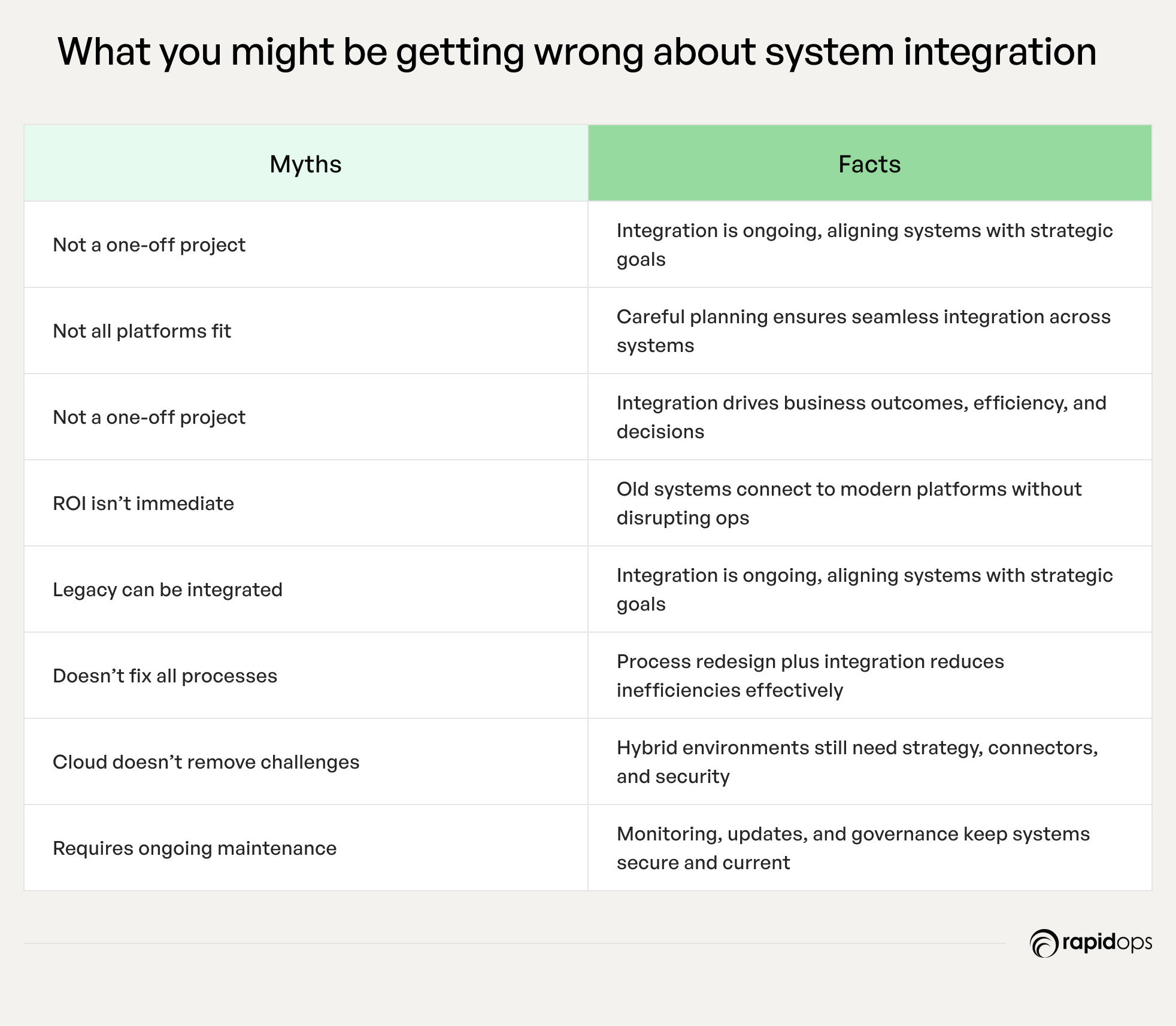
Myth 1: Integration is a one-off IT project
System integration is a continuous strategic process, not a single integration project. Ongoing updates, governance, and coordination across multiple systems ensure that the entire ecosystem functions cohesively. A dedicated system integrator often plays a critical role in maintaining alignment with business objectives.
Myth 2: Any platform or software integrates seamlessly
Integration requires careful planning and evaluation of integration platforms, proprietary interfaces, and heterogeneous systems. Even cloud applications or custom-built solutions may demand data transformation services and pre-built connectors to ensure accurate, consistent information across all subsystems.
Myth 3: Integration is purely a technical exercise
While technical execution is necessary, integration drives tangible business outcomes. Enabling subsystems to cooperate, share data efficiently, and streamline business processes, it improves operational efficiency, enhances resource allocation, and supports informed decision-making.
Myth 4: Integration guarantees immediate ROI
Significant benefits emerge over time. Achieving measurable cost savings, improved data security, and enhanced efficiency requires strategic alignment, continuous monitoring, and optimization of integration processes across legacy systems, ERP systems, and other subsystems.
Myth 5: Legacy systems can’t be integrated
Legacy systems often hold vital business data, but integration is possible. Connecting them with modern platforms ensures smooth data flow, reduces errors, and maintains overall operational efficiency. Using APIs, middleware, or connectors, businesses can unify legacy and current systems without disrupting workflows.
Myth 6: Integration eliminates all process inefficiencies automatically
Integration facilitates seamless communication and better workflow orchestration, but cannot replace process redesign. Successful integration depends on combining integration solutions, star integration methods, and careful change management to reduce manual data entry and operational costs.
Myth 7: Cloud or SaaS adoption removes integration challenges
Hybrid or multi-cloud environments still require an integration strategy. Web services, custom-built solutions, and data transformation services remain essential to connect various systems, ensure a unified view, and maintain security protocols and access controls across the enterprise ecosystem.
Myth 8: Once integrated, systems require no maintenance
Integration is ongoing. Continuous monitoring, updates, and governance safeguard against data breaches, human error, and disruption in workflows. System integrators often oversee integration methods to ensure that the integrated system evolves alongside business growth and operational requirements.
Dispelling these misconceptions emphasizes that system integration is not just a technical task but a strategic enabler. A mature integration approach combines planning, technology, and governance to transform disparate applications and subsystems into a coordinated whole, delivering sustainable value, resilience, and business agility across the organization.
Real-world applications of system integration
1. ERP and CRM integration
For a retail or distribution executive, disconnected systems often mean delayed insights, lost opportunities, and reactive decision-making. ERP and CRM integration changes that dynamic by connecting sales pipelines, inventory levels, financial data, and customer information into a single operational backbone.
With this integration, executives gain a real-time view of demand patterns, enabling precise forecasting and strategic stock allocation. Marketing and sales teams can align campaigns with inventory availability, while finance sees immediate impacts on revenue and margins.
The outcome is not only operational efficiency but also data-driven decision-making across the organization. Integrated ERP-CRM systems empower leaders to move from managing chaos to orchestrating growth, providing clarity that strengthens competitiveness and builds confidence in every strategic choice.
2. Omnichannel retail system integration
Customers now interact across stores, websites, apps, and social channels, expecting consistency and speed. Omnichannel integration links POS, eCommerce, inventory, and CRM systems to provide executives with a 360-degree view of operations and customer behavior. Retailers can synchronize stock across channels, reducing out-of-stock scenarios, while analytics reveal patterns in customer purchasing and engagement. Sales, marketing, and operations teams operate with unified data, enabling faster response to demand shifts and enhanced customer satisfaction.
By leveraging integrated systems, leaders can turn data into action, allocating inventory strategically, optimizing promotions, and ensuring every touchpoint reflects the brand promise. The result is seamless experiences, improved retention, and measurable business impact that executives can directly link to strategic objectives.
3. Supply chain and warehouse management integration
Distribution efficiency depends on a supply chain that reacts in real-time to market demands. Integrating procurement, warehouse management, logistics, and order fulfillment systems provides executives with full visibility into inventory flow and operational bottlenecks.
Predictive alerts highlight potential delays, allowing proactive rerouting or supplier adjustments. Warehouse operations become optimized, with reduced stockouts and faster fulfillment cycles, directly affecting customer satisfaction and profitability.
By analyzing integrated data, executives can balance capacity, allocate resources dynamically, and make decisions rooted in operational intelligence rather than assumptions. The insight gained transforms the supply chain from a reactive cost center into a strategic advantage, enabling leaders to consistently deliver on service promises while controlling costs.
4. Manufacturing and production systems integration
Operational downtime in manufacturing translates directly into lost revenue and inefficiency. Integrating production machinery, MES, and ERP systems provides executives with real-time visibility into production schedules, machine health, and resource utilization.
Predictive maintenance algorithms detect anomalies before they disrupt operations, while production can be adjusted dynamically in response to demand or inventory levels. The integration aligns shop floor activities with strategic objectives, ensuring optimal throughput and minimal waste. Leaders gain a clear understanding of operational performance and capacity, enabling informed decisions that enhance efficiency and resilience.
This system integration turns complex manufacturing processes into a cohesive, intelligence-driven operation, where every action contributes to both productivity and strategic growth.
5. Data-driven analytics for operations
Integrated systems generate vast amounts of actionable data, but only when consolidated and analyzed effectively. By unifying retail sales, manufacturing output, and distribution performance into advanced dashboards, executives can identify trends, predict disruptions, and optimize operations across the enterprise.
NLP-powered insights even convert unstructured data from customer feedback, supplier communications, or social channels into meaningful intelligence. Leaders can make strategic decisions grounded in evidence, aligning operational performance with business objectives.
This level of insight transforms executives’ ability to navigate complexity with confidence, turning raw data into foresight, and ensuring that each decision is precise, timely, and measurable. Integrated analytics creates an environment where strategy is informed, operations are agile, and outcomes are continuously improved.
Key challenges in system integration in 2026
As enterprises continue to expand their digital footprint, system integration in 2026 faces a unique set of challenges. While integration promises operational efficiency, enhanced agility, and unified workflows, organizations must navigate technological, organizational, and strategic hurdles to realize these benefits fully. Understanding these challenges helps leaders anticipate risks, optimize integration strategies, and design systems that support long-term business growth.
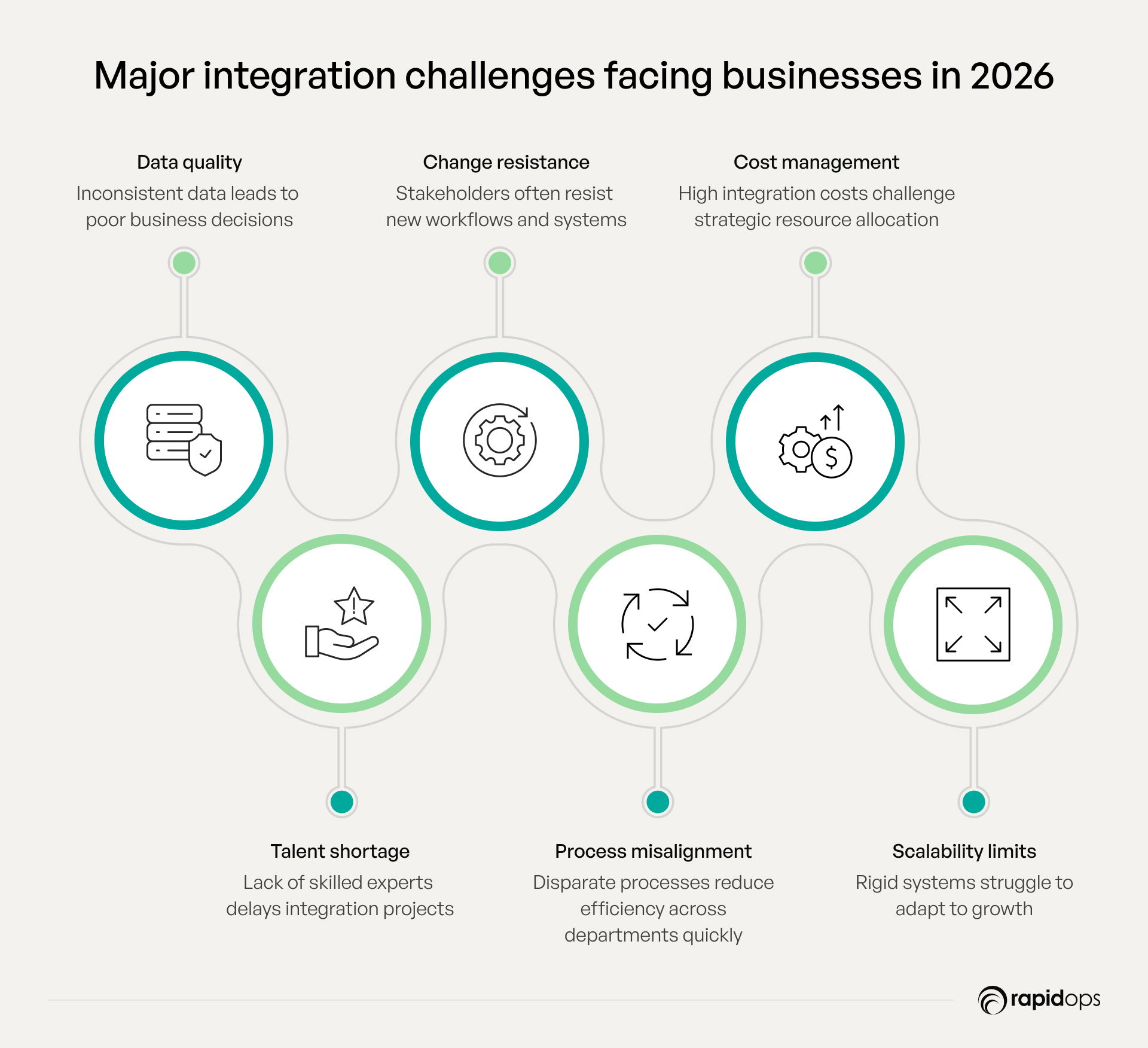
1. Managing data quality and consistency across systems
Maintaining common data formats and ensuring accurate views across disparate systems is a persistent challenge. Poor data quality can lead to misinformed decisions and undermine the benefits of integration. Robust data transformation services, master data management, and continuous monitoring of data flows help sustain high-quality, actionable information across the enterprise ecosystem.
2. Finding the right technical expertise
One of the foremost challenges in system integration is sourcing professionals who possess the precise combination of skills needed for complex projects. Organizations often struggle to find experts experienced in integration platforms, legacy systems, cloud applications, and data transformation services. Without the right technical knowledge, projects risk delays, data inconsistencies, and suboptimal integration outcomes, making this a critical hurdle to address.
3. Overcoming stakeholder resistance and change management issues
Successful integration is as much a business process challenge as a technical one. Resistance from teams accustomed to manual workflows or point-to-point integration can stall projects. Engaging stakeholders, communicating the strategic value, and demonstrating how integrated systems improve resource allocation and operational efficiency are critical for adoption and long-term success.
4. Standardizing processes across departments
Integration often reveals inconsistencies in business processes, workflows, and subsystems' functions. Aligning different subsystems, automating redundant manual data entry, and standardizing procedures across finance, operations, HR, and marketing are essential to achieve a unified view and drive enhanced efficiency throughout the organization.
5. Balancing integration costs with strategic value
While the long-term benefits of integration are substantial, organizations must manage operational costs, licensing, and investment in integration platforms carefully. Prioritizing projects based on strategic business requirements, potential significant benefits, and ROI ensures resources are allocated effectively without compromising ongoing operations.
6. Building integration that can scale and adapt to future needs
Enterprises often struggle when integration architectures cannot accommodate growth, evolving technologies, or new business requirements. Rigid or monolithic systems force costly rework, cause downtime, and create operational inefficiencies. The challenge is to design modular, scalable platforms and flexible ERP systems that can seamlessly incorporate new applications, tools, or subsidiaries, enabling the organization to evolve without major disruptions.
Build a unified, intelligent enterprise ecosystem today
Now that you’ve explored the essentials of system integration, its types, strategic value, core benefits, and common challenges, it’s clear that integration is more than a technical requirement. It transforms fragmented systems into a coordinated, intelligent enterprise ecosystem with smooth data flows, unified workflows, and stronger security across legacy platforms, cloud applications, ERP systems, and specialized subsystems.
Many organizations struggle to connect outdated and modern systems, standardize disparate applications, reduce human error, and maintain efficiency across departments. Without the right integration strategy, these challenges slow decision-making, increase operational costs, and limit agility.
At Rapidops, we help you turn disconnected systems into a unified, high-performing ecosystem. With years of hands-on integration experience, we bring together your legacy platforms, cloud applications, and enterprise software so your teams can work faster and make decisions with real-time clarity. Our experts combine great technical skill with business insight to automate workflows, eliminate silos, and build scalable, governed integrations that deliver measurable impact. With Rapidops, integration becomes a growth accelerator, not a technical hurdle.
Book a free call with one of our integration experts to explore the best ways to modernize your legacy systems without disrupting your current operations.
Frequently Asked Questions

What’s Inside
- What system integration actually means
- Why do we need system integration in 2026
- System integration approaches and the types of systems they can integrate
- Core benefits of system integration
- Common misconceptions about system integration
- Real-world applications of system integration
- Key challenges in system integration in 2026
- Build a unified, intelligent enterprise ecosystem today

Let’s build the next big thing!
Share your ideas and vision with us to explore your digital opportunities
Similar Stories
- Transformation
- undefined Mins
- March 2022


- Transformation
- undefined Mins
- March 2020

Receive articles like this in your mailbox
Sign up to get weekly insights & inspiration in your inbox.