


Take a moment to visualize how your business runs, every decision and process drives outcomes. Every deal your sales team closes, every product your operations team ships, every strategic decision your executives make, every customer interaction your support team manages, it all happens on the foundation of digital systems, data, and automation. Remove that foundation, and the complexity, inefficiency, and friction become impossible to ignore. Business doesn’t just use technology; it runs on it. Today, technology is woven into every process, decision, and outcome.
Most organizations have already embraced digital transformation, and the results are undeniable. They move faster, make smarter decisions, innovate without friction, and pivot ahead of the market. If your business hasn’t fully made the shift yet, this isn’t just a nudge; it’s a final call. Delay any longer, and catching up may become far more costly, disruptive, and difficult than you imagine.
The challenges ahead are unlike anything we’ve faced before, and understanding them is non-negotiable. Awareness is what separates organizations that adapt and thrive from those that fall behind. Recognizing urgency allows leaders to make informed decisions, prioritize initiatives that truly matter, and guide their teams through transformation with clarity and confidence. Ignoring the signals isn’t an option; it risks stalling progress before real value is realized.
These aren’t minor hurdles; they’re the precise reasons why so many digital transformation initiatives fail to deliver the impact they promise. And that’s why this guide matters.
In the sections ahead, you’ll discover practical strategies, actionable steps, and proven tools to tackle digital transformation challenges head-on. By the end, you’ll know exactly what to prioritize, how to act, and how to guide your team confidently, turning complex challenges into measurable digital transformation success and ensuring your organization not only keeps pace but leads in 2026 and beyond.
Why digital transformation is non-negotiable in 2026
The speed of change has never been this relentless. Customers, competitors, and technology are reshaping markets at an unprecedented pace. In 2026, companies that delay digital transformation risk not only losing ground, they risk irrelevance. The organizations that act decisively leverage digital as a competitive advantage, turning disruption into growth.
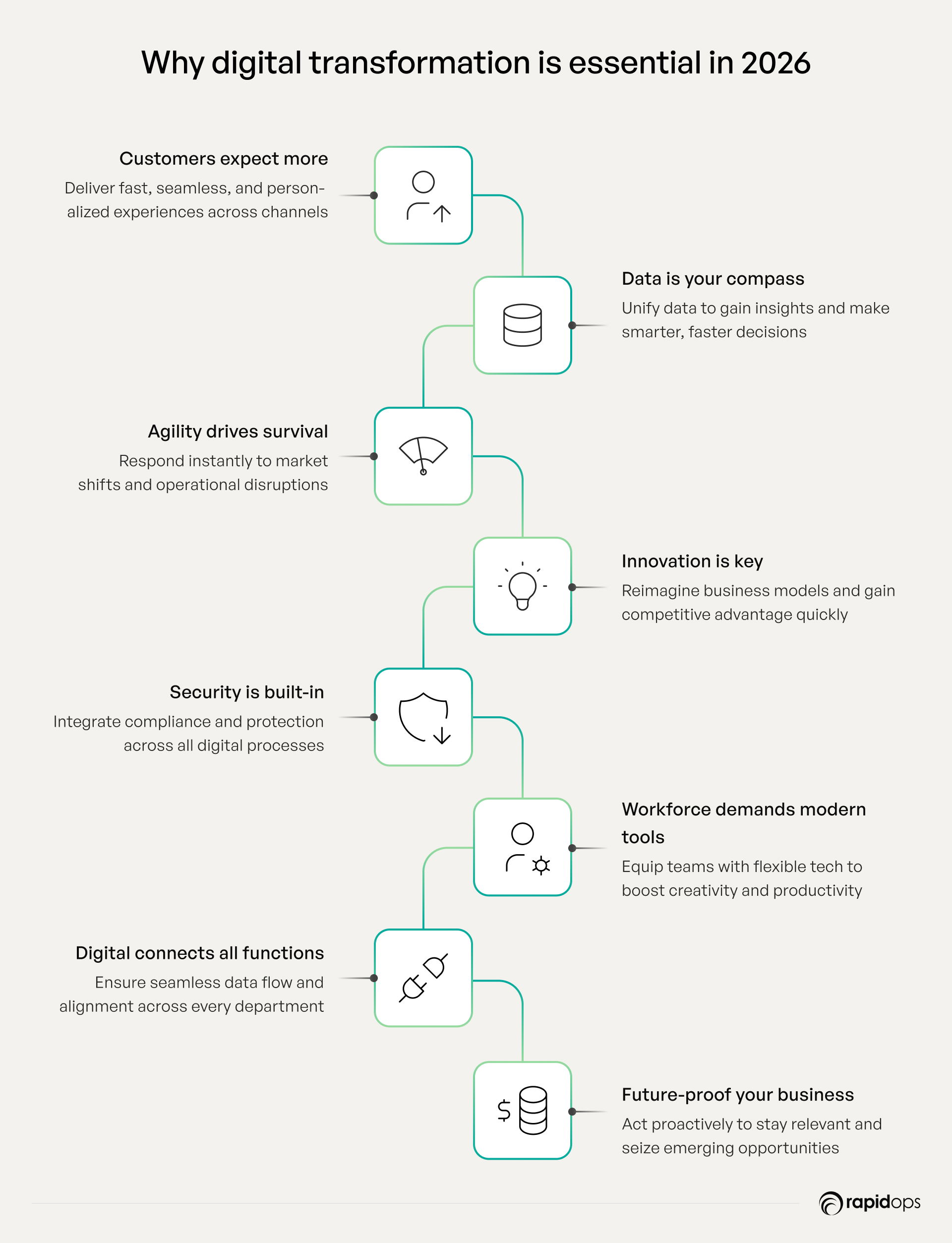
1. Customers expect more, much more
Your customers are no longer satisfied with standard experiences. They expect interactions that are fast, seamless, and personalized across every channel. Imagine a client visiting your platform: are you able to recognize their preferences instantly, anticipate their needs, and deliver exactly what they want before they ask? Companies that fail here aren’t just losing sales, they’re losing trust, loyalty, and advocacy. Digital transformation allows you to leverage AI development services, predictive analytics, and intelligent automation to deliver experiences that feel personal and effortless, making your brand indispensable.
2. Data isn’t optional, it’s your strategic compass
You likely have mountains of data, but do you truly see the story it tells? Siloed systems and outdated processes obscure insights, slowing decisions and leaving opportunities unexplored. Modern digital tools unify your data, transform it into actionable intelligence, and empower you to make decisions that are faster, smarter, and strategically aligned. Unifying customer data is one of the most tangible wins in any transformation effort. Platforms like HubSpot's Customer Platform are designed to consolidate marketing, sales, and service data in one place. This is vital to help teams move away from fragmented systems without a massive implementation lift. In 2026, your ability to act on insight is more valuable than any product or service you offer.
3. Agility determines survival
Disruption is constant, whether from market shifts, technological breakthroughs, or sudden regulatory changes. The question is: how quickly can your organization pivot? Legacy systems slow response times and increase risk. Digital transformation introduces operational agility, automation, and real-time visibility, allowing you to respond immediately to change, protect your business continuity, and turn challenges into opportunities.
4. Innovation is the new competitive advantage
Efficiency alone is no longer enough. Companies embracing digital are reimagining business models, entering new markets, and redefining customer expectations. The speed at which you innovate directly impacts your market position. Every delay in transformation gives competitors a head start, making early adoption not just advantageous, but critical.
5. Security and compliance are embedded, not afterthoughts
Increased digital adoption inevitably brings greater risk of cyber threats, data breaches, and regulatory scrutiny can derail growth. Transformation allows you to integrate security, compliance, and privacy into every process, system, and interaction. When your digital ecosystem is secure by design, you safeguard both your operations and your brand reputation.
6. Your workforce demands modern tools
The talent of 2026 expects intelligent, collaborative, and flexible work environments. When you equip your teams with modern digital tools, you unlock creativity, innovation, and productivity. Organizations that resist modernization risk disengaged employees, higher turnover, and lost intellectual capital. Transformation isn’t just technology; it’s empowerment for every individual in your organization.
7. Every function relies on technology; your backbone is digital
Finance, HR, sales, operations, and customer experience are all interdependent. Any disconnect between them creates inefficiencies, errors, and missed opportunities. Digital transformation ensures these functions are harmonized, data flows seamlessly, and processes scale effortlessly. When technology becomes the connective tissue of your organization, everything runs smarter, faster, and more strategically.
8. Future-proofing is imperative, not optional
Here’s the critical insight: waiting to act on digital transformation is a risk you can’t afford. The pace of change in 2026 rewards proactive organizations and penalizes hesitation. By adopting a transformative mindset today, you position your business to anticipate shifts, seize opportunities, and maintain relevance, even in the most volatile market conditions.
The question isn’t whether digital transformation is necessary; it’s how quickly you can implement it. Every delay allows competitors to innovate faster, capture more market share, and redefine customer expectations. Acting decisively now doesn’t just ensure survival; it secures your position as a market leader, empowering you to innovate, scale, and deliver unmatched value to your customers.
The most critical challenges businesses face in 2026
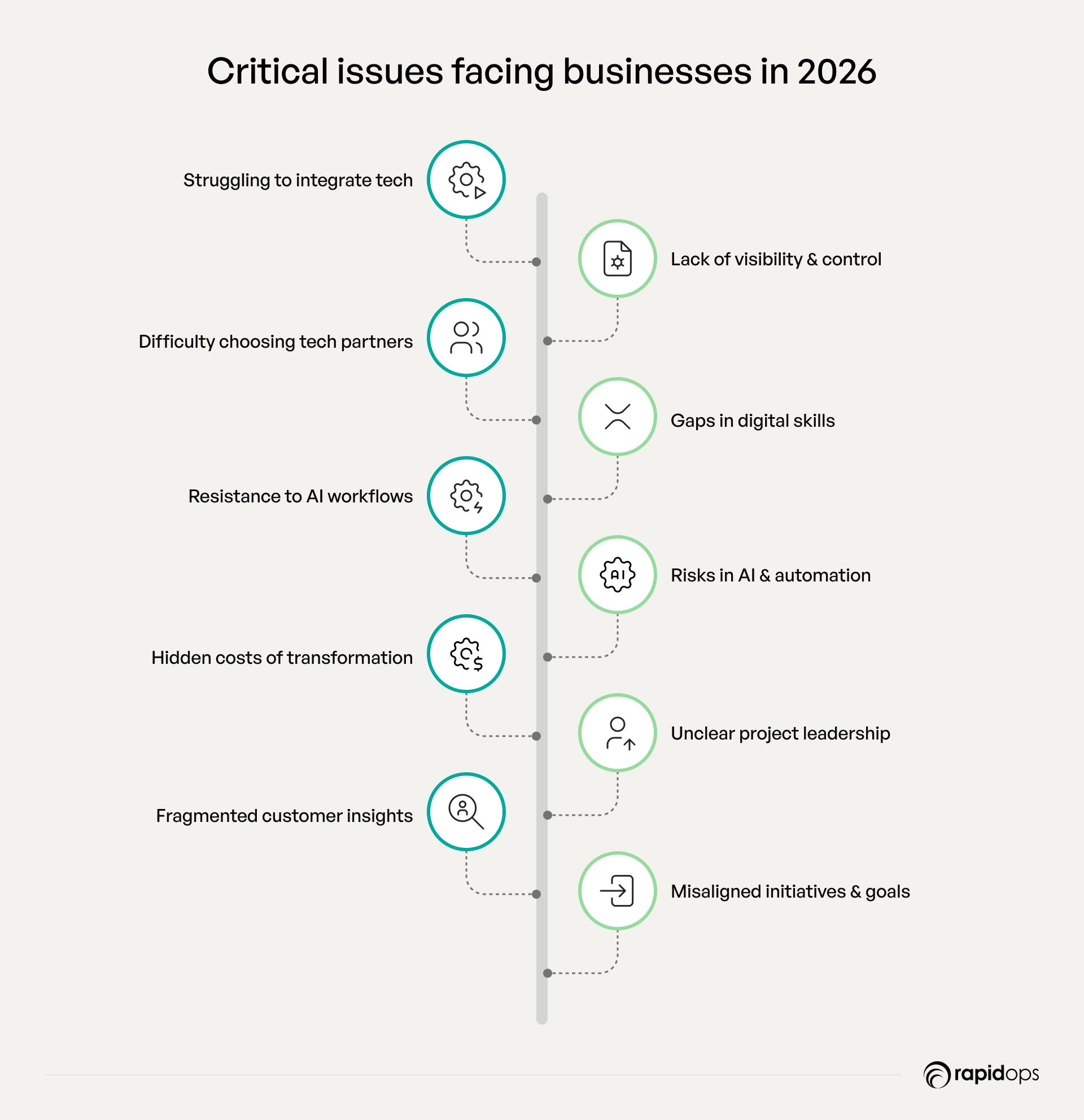
1. The struggle to integrate advanced technologies with legacy systems
In 2026, legacy systems remain the backbone of enterprise operations, supporting critical workflows, data management, and business logic that have evolved over decades. Yet these systems were never designed to accommodate modern demands such as AI, automation, real-time analytics, and cloud-native applications. Integrating advanced technologies into legacy infrastructure is a multifaceted challenge: technical incompatibilities, fragmented architectures across departments, varying security protocols, and inconsistent data standards create a web of complexity.
Uncoordinated modernization can lead to downtime, operational disruption, or data corruption, which in turn affects decision-making, customer experience transformation, and revenue. Organizations also face strategic risk when investments in new technology fail to integrate with legacy processes, resulting in wasted resources. Addressing this challenge requires a deep understanding of system interdependencies, careful sequencing of upgrades, and strict governance to maintain operational continuity. Successfully navigating this integration transforms rigid legacy systems into agile, adaptive platforms, enabling enterprises to leverage advanced technologies effectively while ensuring scalability, real-time insights, and operational stability in an increasingly competitive 2026 landscape.
2. Limited visibility into processes and operational inefficiencies
A major hurdle in digital transformation is the lack of end-to-end clarity on how business operations truly function. Over the years, organizations accumulate layers of legacy systems, siloed departments, undocumented workflows, and manual workarounds. This creates hidden complexities that obscure inefficiencies, bottlenecks, and dependencies across teams, processes, and systems. Without a clear line of sight, even experienced leaders make decisions based on assumptions rather than precise operational data.
The consequences are significant. Leaders cannot prioritize initiatives confidently, budgets may be misallocated, and digital transformation roadmaps risk misalignment with strategic objectives. Teams face friction in everyday operations, slowing adoption of new tools and processes. Projects often stall or fail because investments are applied where they deliver minimal value, while critical inefficiencies remain unaddressed.
Beyond operational delays, this lack of visibility undermines strategic foresight, organizational agility, and risk management. Executives are unable to anticipate cascading impacts of changes, managers struggle to optimize and automate workflows, and employees encounter friction that technology alone cannot resolve. In 2026, transformation without operational clarity is like navigating a complex landscape blindfolded. Only by uncovering hidden inefficiencies, mapping interdependencies, and fully understanding processes can organizations make informed decisions, achieve measurable outcomes, and secure sustainable competitive advantage.
3. The pitfalls of selecting the right strategic technology partner
Digital transformation in 2026 relies heavily on external technology partners, yet selecting and managing them is a high-stakes challenge. Misaligned vendors can stall projects, inflate costs, compromise scalability, and disrupt operational continuity. The complexity arises not only from assessing technical expertise but also from evaluating strategic alignment, integration capability, adaptability, and cultural fit.
Additionally, enterprises must establish structured governance frameworks, monitor performance through KPIs and SLAs, and maintain joint strategic roadmaps to ensure partnership efficacy over time. Poorly managed partnerships can result in fragmented execution, slow adoption of new capabilities, and dilution of internal control.
Organizations that navigate this challenge successfully are able to leverage external expertise to accelerate transformation while maintaining operational oversight and strategic coherence. In 2026, strategic partner management is not a transactional exercise; it is a critical lever for enabling enterprise innovation, ensuring scalability, and maintaining competitive advantage in a rapidly evolving technology ecosystem.
4. Digital skills gaps are slowing transformation
Digital transformation is as much about people as it is about technology. In 2026, one of the most critical digital transformation challenges organizations face is the widening digital skills gap, not the lack of new technologies. While companies continue to invest in AI, automation, cloud platforms, and advanced digital tools, many employees struggle to keep pace. This mismatch limits adoption, slows transformation efforts, and reduces the expected business impact of digital initiatives.
The challenge becomes even more visible in cross-functional collaboration, where teams must work across systems, understand data flows, and align around shared business objectives. Employees who are not confident using new digital tools or interpreting data often create unintentional bottlenecks that block progress. These skills gaps lead to errors, inefficiencies, and missed opportunities, ultimately affecting business outcomes and delaying the overall digital transformation journey.
Even the most advanced digital transformation strategy cannot succeed without a workforce capable of executing it. Many organizations underestimate how much change management, training, and capability development is required to support new systems and operating models. As a result, transformation efforts fail not because of poor technology choices but because employees are not prepared to fully leverage modern solutions.
Building a digitally fluent workforce is a strategic priority. When employees use technology confidently, from analytics to automation to AI, the organization becomes more agile, innovative, and competitive. Closing digital skills gaps is now a core driver of successful transformation in 2026 and beyond.
5. Overcoming resistance to AI-driven and automated workflows
Resistance to change remains a fundamental barrier in 2026, especially in implementing AI-driven and automated workflows. Employees may fear job displacement, reduced autonomy, or disruption of established processes, while leaders may hesitate to adopt fully automated decision-making due to uncertainty or cultural inertia. Such resistance often results in partial adoption, inconsistent execution, and diminished operational efficiency. Studies indicate that human resistance contributes to underperformance in over 60% of AI initiatives.
The challenge lies in aligning organizational culture, workforce behavior, and process design to integrate automation seamlessly without compromising engagement or operational continuity. Behavioral patterns, habitual processes, and organizational norms require careful consideration to prevent friction. Successfully overcoming this challenge ensures that automation enhances productivity, supports strategic objectives, and drives measurable outcomes.
In 2026, enterprises that can navigate cultural resistance not only implement AI and automation effectively but also build a workforce that embraces innovation, enabling faster adoption, higher efficiency, and stronger alignment between technology and business priorities.
6. Managing AI, automation, and ethical technology risks
In 2026, AI and automation have become integral to enterprise operations, but they introduce complex operational, ethical, and reputational risks. Poorly governed algorithms can produce biased or inaccurate outcomes, creating compliance violations, regulatory scrutiny, and damage to stakeholder trust. Automation errors can cascade across interconnected systems, disrupting critical workflows and exposing enterprises to financial and operational loss. Studies indicate that governance gaps are responsible for over half of AI implementation failures, highlighting the critical importance of oversight.
The challenge lies in ensuring transparency, accountability, and alignment with organizational goals throughout the technology lifecycle. Enterprises must monitor algorithmic performance continuously, maintain human oversight, and adhere to ethical standards while scaling AI deployment. Mismanagement not only undermines operational effectiveness but can erode market credibility, hinder adoption, and impede long-term strategic objectives.
Successfully addressing this challenge enables organizations to harness AI and automation effectively, delivering operational efficiency, enhanced decision-making, and sustained trust, while positioning the enterprise as a responsible and forward-looking leader in the competitive digital landscape of 2026.
7. Controlling hidden and continuous transformation costs
By 2026, digital transformation will have become a continuous journey, but one of the most pressing digital transformation challenges is managing the high upfront investment alongside hidden and recurring costs. Beyond the initial deployment of new technologies, digital tools, and cloud platforms, enterprises must account for AI model updates, cybersecurity measures, system maintenance, and ongoing employee training. Many organizations underestimate these costs, leading to budget overruns, delayed transformation efforts, and diluted business outcomes.
The complexity of these costs is compounded by the need to balance rapid adoption with financial sustainability. Hidden and recurring expenses can limit operational flexibility, erode competitive advantage, and strain strategic resources if not carefully monitored. Addressing this challenge requires a clear digital transformation strategy, rigorous financial oversight, continuous tracking of digital investments, and accurate forecasting of long-term expenses. Phased implementation approaches and cost-control measures help maintain scalability while minimizing budget surprises.
Enterprises that successfully manage high upfront investments in digital transformation ensure technology adoption is efficient, systems remain scalable, and strategic initiatives continue delivering measurable business impact. Organizations that can master this challenge can confidently innovate, enhance operational agility, and maintain long-term resilience, thereby maximizing the return on their digital transformation efforts.
8. Identifying the right project leads and stakeholders
One of the most critical yet often overlooked digital transformation challenges is appointing the right individuals to lead initiatives and serve as accountable stakeholders. Technology alone cannot drive successful digital transformation; it requires capable leadership that can navigate organizational complexity, motivate employees, and align transformation efforts with business objectives. Assigning the wrong project leads or stakeholders can stall adoption, create misaligned priorities, and erode team confidence, ultimately impacting business outcomes.
The challenge is multifaceted. Effective leaders must combine technical understanding, strategic insight, and organizational influence to make informed decisions and drive execution. Similarly, engaging the right stakeholders, those who can champion change, allocate digital investments, and coordinate cross-functional collaboration, is essential to maintain cross-functional alignment, resolve conflicts, and ensure timely delivery. In large, geographically distributed enterprises, unclear roles or insufficient authority can lead to bottlenecks, redundant work, and competing agendas that undermine the digital transformation journey.
Addressing this challenge is not merely a managerial task; it is a strategic imperative. Enterprises that identify and empower capable project leads, stakeholders, and teams with the right digital skills can accelerate adoption, foster collaboration, and ensure that transformation efforts deliver measurable business impact. In 2026, this capability separates organizations that successfully translate digital technologies and new systems investments into tangible business outcomes from those that struggle to move beyond pilot projects.
9. Fragmented customer insights and engagement channels
A persistent digital transformation challenge in 2026 is the fragmentation of customer insights and the lack of cohesive engagement across channels. Enterprises often collect vast amounts of data from multiple systems, cloud platforms, and digital tools, yet fail to unify it into a comprehensive view. The result is inconsistent experiences, delayed responses, and underutilized opportunities to enhance business outcomes.
This fragmentation often stems from transformation efforts that are siloed across departments. Marketing, sales, and support teams may operate independently, using new systems or advanced technologies without cross-functional alignment. Without integrated processes, organizations struggle to understand customer behavior, make informed decisions, and coordinate engagement strategies effectively.
Addressing this challenge requires a structured digital transformation strategy that prioritizes data consolidation, actionable insights, and measurable key performance indicators (KPIs). Equipping employees with the right digital skills ensures that teams can analyze insights and act on them efficiently. By linking digital investments to strategic business objectives, organizations can unify engagement channels, improve personalization, accelerate adoption of digital tools, and drive measurable business impact. Ultimately, connecting data and channels transforms insights into innovation, operational agility, and long-term customer loyalty.
10. The risk of misaligned digital initiatives and business outcomes
In 2026, enterprises are investing heavily in digital transformation, but a critical digital transformation challenge lies in ensuring that these efforts deliver tangible business impact. Too often, organizations adopt new technologies, digital tools, and advanced technologies without clearly linking them to measurable outcomes such as revenue growth, operational efficiency, customer experience, or strategic differentiation. Misalignment between digital transformation efforts and business objectives can result in wasted resources, fragmented systems, slowed innovation, and frustration across teams and leadership.
The challenge is multidimensional. Success requires defining clear, quantifiable key performance indicators (KPIs), continuously monitoring progress, and recalibrating initiatives as market dynamics, customer expectations, and organizational priorities evolve. Digital transformation strategy cannot succeed in isolation; every project must be closely integrated with enterprise strategy, supported by cross-functional alignment, robust governance, and change management practices.
Ignoring alignment risks dilutes ROI, compromises strategic goals, and creates organizational uncertainty. Conversely, when enterprises intentionally link digital investments and new systems to business outcomes, they maximize the value of technology, strengthen operational and strategic agility, and drive measurable transformation results. Maintaining a business-first perspective ensures that transformation efforts are not just technical projects but a coordinated digital transformation journey that reinforces competitiveness, innovation, and sustainable growth across the enterprise.
Myths about digital transformation
Digital transformation is often misunderstood. Missteps in expectations, planning, or execution can cost your business time, money, and competitiveness. To navigate it successfully, you need to separate myth from reality. Here are 10 critical misconceptions you must understand, each explained with strategic insight and real-world context.
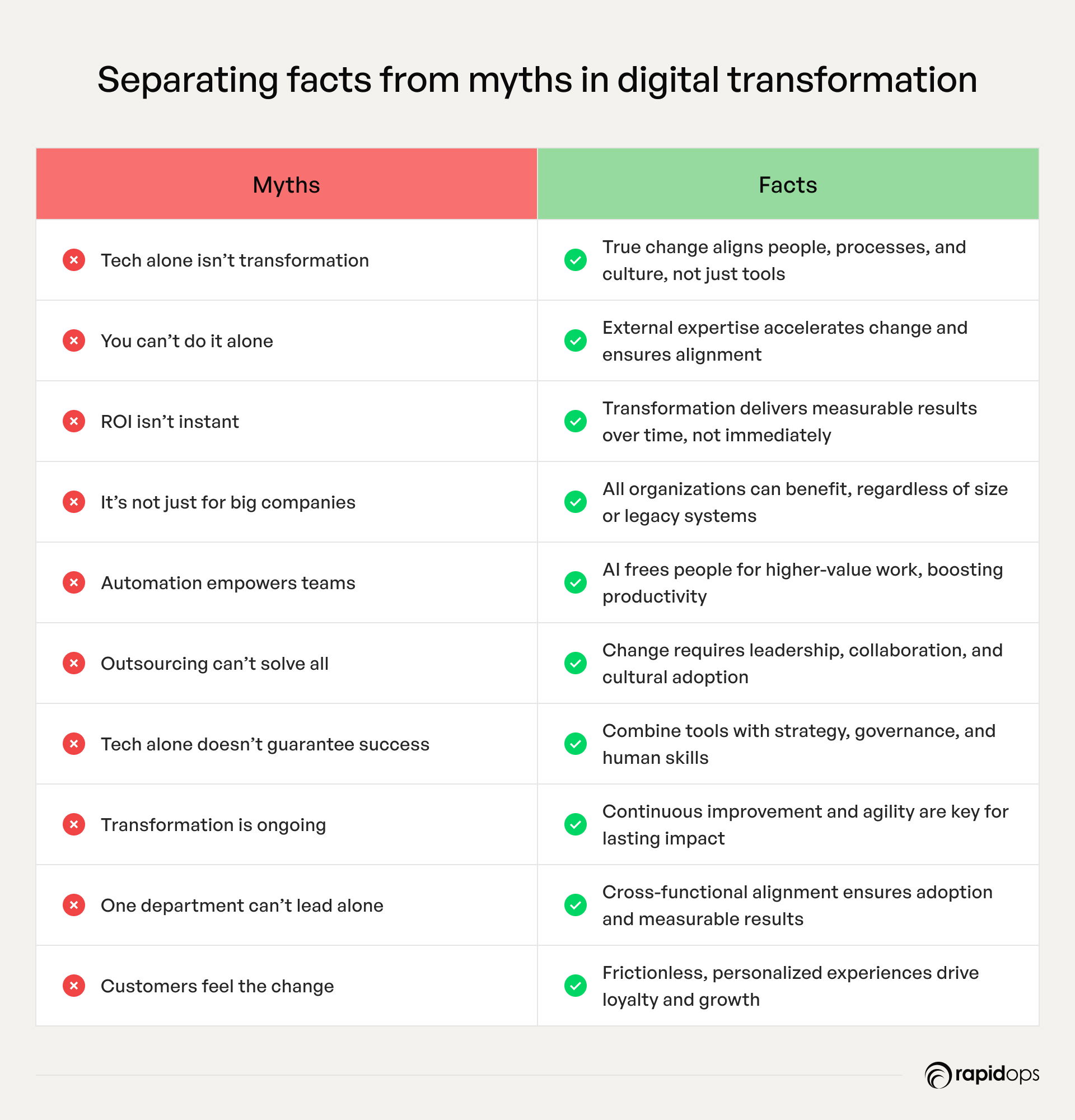
1. Transformation means just adding technology
Many believe installing new software, AI tools, or automation equals digital transformation. The truth is, technology is a tool, not a solution. Real transformation requires aligning your people, processes, and culture around the new ways of working. Without this, even expensive investments may fail to deliver results. Think about your workflows, how can technology empower your teams and improve customer value rather than just exist on your IT stack?
2. We’ll transform on our own
Relying solely on your internal teams to drive transformation is a common trap. While ownership and leadership are critical, external expertise provides frameworks, governance, and acceleration strategies that ensure initiatives don’t stall. Without guidance, your organization risks misaligned priorities, slow adoption, and fragmented implementation. True transformation happens when your leadership is paired with expert support, turning vision into a measurable impact.
3. Immediate ROI will follow every initiative
Expecting instant results from digital projects is unrealistic. Transformation is a journey: from pilots to enterprise-wide adoption, measurable outcomes often appear over 12–36 months. Short-term ROI can be misleading, failing to capture long-term gains in efficiency, innovation, and market responsiveness. You need to set clear phased KPIs and view ROI as cumulative, ensuring every investment contributes to sustainable growth rather than temporary wins.
4. Digital transformation is only for big companies
Many assume digital transformation is for Fortune 500 companies. In reality, your organization, regardless of size, can gain a disproportionate advantage. SMEs often move faster, adapt more easily, and implement tools with fewer legacy constraints. Leveraging cloud, automation, and AI strategically lets you scale, improve customer experiences, and compete with larger rivals. Transformation is about survival and growth, not company size.
5. Automation will replace your people
It’s natural to fear that AI and automation will eliminate jobs. In truth, automation frees your teams from repetitive, error-prone work so they can focus on strategy, creativity, and higher-value activities. When paired with training and skill development, automation becomes a force multiplier, boosting productivity, engagement, and innovation. Transformation isn’t about cutting your workforce; it’s about empowering them to achieve more.
6. Outsourcing transformation can solve everything
Some leaders believe consultants or vendors can handle the transformation entirely. While external support accelerates implementation, ownership stays with you. Sustainable change requires your leadership, collaboration across teams, and cultural adoption. Organizations that rely solely on outside experts risk low adoption, misaligned priorities, and initiatives that never integrate into daily operations. Success comes from combining your strategic vision with expert guidance.
7. Emerging technology alone guarantees success
AI, cloud computing, IoT, and analytics are powerful, but technology by itself won’t deliver transformation. Your success depends on combining tech with process redesign, governance, and human skills. Focusing solely on tools risks creating a tech-heavy environment without meaningful impact on revenue, efficiency, or customer experience. The right balance of strategy, culture, and technology ensures your transformation actually drives results.
8. Transformation can be a one-time project
Digital transformation isn’t a project; it’s a continuous journey. Markets, customer expectations, and technology evolve constantly. Treating transformation as a one-off initiative leads to stagnation and missed opportunities. Embedding agility, iterative improvement, and feedback loops into your organization ensures you stay ahead of change. By committing to continuous evolution, you transform a sustainable part of your company’s DNA rather than a temporary effort.
9. A single department can lead it alone
IT, operations, or marketing can’t carry transformation by themselves. It requires enterprise-wide alignment, from strategy and finance to HR and operations. Clear governance, cross-functional collaboration, and shared accountability are essential. Engaging all units ensures adoption, fosters ownership, and amplifies impact. When transformation becomes a company-wide initiative, you create integrated systems, streamlined workflows, and measurable business outcomes.
10. Transformation doesn’t affect your customers
Some assume that digital upgrades are internal only. In reality, your customers notice every friction point. Frictionless omnichannel experiences, fast response times, and personalized service differentiate leaders from laggards. Ignoring customer impact risks lost trust and market share. Prioritizing seamless experiences turns transformation into tangible growth, boosting loyalty, revenue, and your brand reputation in a digital-first world.
Digital transformation is a multi-dimensional, strategic journey, not a superficial tech upgrade. By understanding these myths, you can make smarter decisions, align technology with your people and processes, and drive measurable outcomes. The organizations that navigate these misconceptions successfully gain resilience, agility, and a competitive edge in 2026 and beyond.
How companies overcome digital transformation challenges
1. Fragmented procurement and delivery tracking: Cook & Broadman
Cook & Broadman, a mid-size distribution and retail firm, struggled with fragmented ERP systems across procurement, inventory management, and delivery tracking. Manual ordering processes, limited visibility into shipments, and disconnected workflows created inefficiencies, errors, and delays that impacted both operations and customer satisfaction.
Recognizing that these challenges were hindering their vision of a connected digital ecosystem, where all systems could seamlessly communicate, the company embarked on a comprehensive ERP modernization initiative.
Automated procurement workflows and integrated delivery tracking provided end-to-end visibility from suppliers to customers, while advanced analytics offered actionable insights into inventory trends, shipment performance, and order fulfillment efficiency.
Following implementation, Cook & Broadman experienced faster order processing, fewer manual errors, and stronger collaboration with suppliers. Executives could proactively manage logistics, optimize procurement cycles, and reduce operational costs. Customers benefited from accurate delivery estimates and reliable service, strengthening loyalty and trust. This example demonstrates that addressing legacy system fragmentation through integrated digital solutions is critical for operational efficiency, data-driven decision-making, and sustained business growth in 2026.
2. Siloed fitness app data in retail: Under Armour
Under Armour, a global athletic brand, faced a significant digital challenge: its fitness applications, including MyFitnessPal and MapMyRun, were unable to synchronize efficiently with the company’s ERP and customer management systems. This disconnect created isolated pockets of data, preventing the company from delivering personalized recommendations, targeted promotions, and consistent omnichannel experiences.
In an era where customers expect instant, hyper-personalized interactions, these siloed systems limited engagement and hindered growth. To address this, Under Armour implemented an integrated digital strategy that connected mobile applications with cloud-based ERP and CRM platforms, establishing a centralized data hub. By incorporating AI-driven analytics, the company could translate raw activity and purchasing data into actionable insights for marketing, product development, and customer engagement.
The impact was profound: Under Armour enhanced customer loyalty through personalized experiences, increased app engagement, and improved sales conversions. The integration also provided a comprehensive 360-degree view of customer interactions, exemplifying how resolving data silos transforms operational efficiency and customer satisfaction.
2. Overseas production lead times in apparel: Marais USA
Marais USA, a mid-size apparel company, grappled with extended lead times from overseas suppliers that impeded its ability to respond to fluctuating retail demand. These delays caused inventory mismatches, missed sales opportunities, and operational bottlenecks, highlighting a critical challenge in agile supply chain management. To overcome this, the company implemented a digital supply chain management system that provided real-time visibility into supplier production status and shipping timelines.
By combining this with predictive analytics, Marais USA could forecast demand accurately and make proactive adjustments to production schedules and shipping priorities. Integration with the internal ERP and inventory systems allowed seamless communication between procurement, production, and distribution teams, reducing human errors and delays.
As a result, the company decreased supply chain delays by 30 percent, improved inventory turnover, and strengthened relationships with wholesale and retail partners. The transformation enabled the firm to operate more efficiently and responsively, demonstrating that supply chain digitization and predictive data use are essential for mid-size enterprises to remain competitive and resilient in 2026.
Accelerate your transformation journey with proven guidance
Now that you’ve explored the real challenges, uncovered the myths, and gained clarity on what it truly takes to succeed in digital transformation, one thing is clear: this journey is not just about technology, it’s about people, decisions, and the courage to evolve. Every executive, every team, every process feels the pressure, and the path to transformation can often seem overwhelming.
At Rapidops, we understand this firsthand. For over a decade, we’ve partnered with organizations navigating the same high-stakes landscape. We’ve seen leaders wrestle with fragmented data, legacy systems, and cultural resistance, and we’ve helped them turn those hurdles into stepping stones for growth. By combining deep industry insight with practical, hands-on solutions, we’ve guided businesses to innovate faster, empower their teams, and make transformation feel not just possible, but achievable.
Digital transformation doesn’t have to be a struggle. With the right strategy, the right partners, and the right mindset, it can become the force that propels your organization forward.
Book a one-on-one consultation with our digital transformation specialist to understand where your business currently stands, uncover a feasible roadmap, and explore what’s possible with technology to drive growth in your complex organization.


Let’s build the next big thing!
Share your ideas and vision with us to explore your digital opportunities
Similar Stories
- Transformation
- undefined Mins
- March 2022


- Transformation
- undefined Mins
- March 2020

Receive articles like this in your mailbox
Sign up to get weekly insights & inspiration in your inbox.