

You’ve likely experienced automation at a basic level in systems that handle repetitive tasks, route approvals, or reduce human error. You understand the efficiency it brings. But what you may not yet see is how AI-driven automation transforms the everyday work of your employees, letting them focus on tasks that truly require human judgment while routine processes happen automatically.
This is where automation moves from simple task execution to practical empowerment: AI-driven systems handle mundane processes data entry, report generation, order processing, and standard approvals accurately, consistently, and at scale, while keeping humans in the loop for exceptions or tasks requiring expertise. Every repetitive action your staff handles today is an opportunity for AI to streamline, simplify, and accelerate their workflow.
Think about your operations: how much time is spent on manual, low-value work that slows progress and introduces errors? AI-driven automation reduces human effort, ensures consistency, and lets employees perform their roles more efficiently. Integrated thoughtfully, it becomes a day-to-day productivity tool, performing routine work at the push of a button while leaving humans free to focus on creativity, problem-solving, and higher-value tasks.
By diving into this guide, you’ll see how AI-driven automation can transform everyday processes into practical productivity tools, enabling your employees to accomplish more, reduce errors, and focus on the work that truly requires their skills and expertise.
What AI-driven automation really is (and what it is not)
AI-driven automation is a solution built on the capabilities of artificial intelligence, designed to handle repetitive, mundane, and rule-based tasks that consume time and effort in everyday operations. By combining machine learning, natural language processing, computer vision, and predictive analytics, these systems can execute routine work accurately, consistently, and at scale, freeing employees to focus on tasks that require human judgment, creativity, and problem-solving.
At its core, AI-driven automation connects data across systems, identifies patterns, and orchestrates routine tasks such as invoice processing, report generation, order updates, and approvals, without manual intervention. It continuously learns from past activities and operational feedback, improving efficiency, reducing errors, and maintaining consistency across repetitive workflows. This makes AI-driven automation a practical tool for teams to streamline day-to-day work and reduce manual effort, while humans remain in the loop for exceptions or tasks that need expertise.
It is equally important to understand what AI-driven automation is not. It is not a replacement for employees, nor is it intended for complex decision-making or strategic planning. It is not simply a faster version of traditional automation; its real value comes from adapting to routine workflows, learning from operational feedback, and optimizing repetitive processes continuously.
When implemented effectively, AI-driven automation becomes a force multiplier for the workforce, transforming time-consuming tasks into automated workflows, reducing errors, improving consistency, and creating capacity for employees to focus on higher-value work. In short, it is a tool that enhances everyday operations, turning repetitive work into reliable, self-optimizing processes that support efficiency, accuracy, and measurable improvements across the enterprise, delivering significant business benefits of AI.
Why AI-driven automation has become unavoidable in 2026
By 2026, enterprises face operational environments that are exponentially more complex, dynamic, and interconnected than ever before. Traditional automation and manual processes can no longer keep pace with the speed, scale, and accuracy required to remain competitive. For you and your teams, this means that without AI-driven automation, routine and repetitive tasks bottleneck workflows, slow operations, and tie up human resources in work that could be automated, limiting the focus on high-value initiatives.
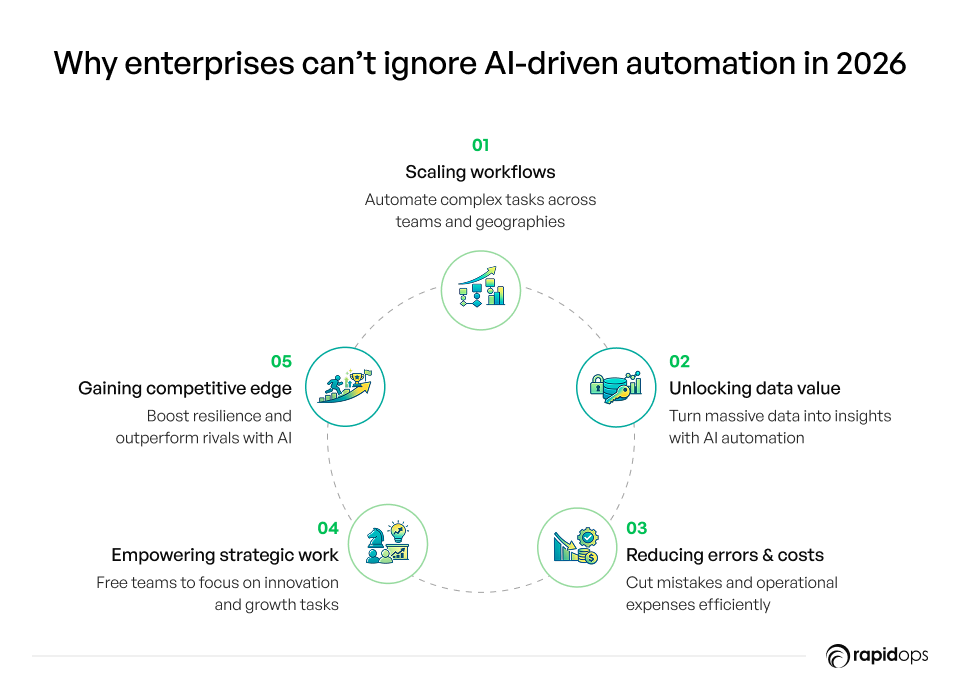
Scaling complex workflows beyond human capacity
Your organization’s workflows now span multiple departments, geographies, and business units, often with interdependent approvals and recurring operational tasks. AI-driven automation is unavoidable because it allows enterprises to orchestrate these repetitive and rule-based workflows at scale, ensuring operations continue seamlessly even as complexity grows. Companies report up to 66% productivity gains and 60–70% reduction in manual processing time when AI systems handle repetitive work, freeing teams to focus on tasks that require human expertise and creativity.
Unlocking value from massive and unstructured data
Enterprises generate unprecedented volumes of structured and unstructured data emails, invoices, contracts, IoT logs, images, and videos. AI-driven automation integrates machine learning, natural language processing, and computer vision to process this data efficiently, converting repetitive data-handling tasks into automated workflows. For your teams, this means faster identification of patterns, anomalies, and operational insights, while minimizing time spent on routine data management.
Reducing human error and operational costs
Repetitive, high-volume tasks are often prone to errors, which can cascade across operations and impact profitability. AI-driven automation can reduce errors in processes such as invoice processing, regulatory documentation, and quality inspections by up to 90%. Operational costs drop 10–50%, with ROI typically realized within 6–12 months. By automating mundane tasks, your teams can rely on consistent, predictable outcomes while focusing on higher-value responsibilities.
Empowering teams to focus on strategic work
AI-driven automation does not replace your workforce; it liberates it. By handling repetitive, low-value work automatically, your teams can dedicate more time to innovation, problem-solving, and initiatives that drive business growth. Enterprises leveraging AI in this way report measurable gains in productivity, efficiency, and employee satisfaction, as people are no longer tied to manual tasks that can be done automatically. For guidance on implementing AI effectively, see AI adoption expert tips.
Delivering competitive advantage and operational resilience
Adopting AI-driven automation strengthens your enterprise by automating repetitive processes while enabling real-time operational awareness and continuous improvement. Examples include:
- Customer service automation handles routine inquiries, allowing teams to focus on complex cases.
- Predictive maintenance reduces downtime by 30–50%.
- Intelligent quality control lowers defect rates by 25%.
By removing manual effort from repetitive work, your organization becomes faster, more reliable, and better equipped to respond to market demands, giving you a measurable competitive edge.
Algorithms: The backbone of AI-driven automation
At the core of every AI-driven automation system are algorithms, the rules and instructions that tell AI how to process information, detect patterns, and perform tasks. Simply put, an algorithm is a structured set of steps that guides the AI model in completing specific activities reliably and consistently. In AI-driven automation, these algorithms are designed to handle repetitive, mundane, and rule-based tasks, ensuring accuracy, efficiency, and scalability across workflows.
Algorithms are carefully defined and trained using historical data and operational examples. Machine learning models learn from this data to recognize patterns and predict outcomes for recurring tasks, such as invoice validation, report generation, order processing, or data entry. Each algorithm sets boundaries and logic for the AI system, determining what actions to take, in what order, and under which conditions, essentially providing an automation blueprint. For more on how AI models are built and trained, see a detailed guide to AI model development.
Creating these algorithms involves:
- Data analysis: Understanding existing processes, identifying repetitive tasks, and collecting relevant data.
- Defining rules and patterns: Translating real-world processes into structured instructions the AI can follow.
- Training and testing: Using historical examples to teach the AI how to execute tasks correctly, detect errors, and improve over time.
- Continuous refinement: Monitoring outcomes, learning from exceptions, and adjusting the algorithm to optimize performance and reduce errors.
Algorithms are the backbone of AI-driven automation because they determine exactly how the system executes work. Without well-defined algorithms, AI cannot process tasks reliably or handle the repetitive work that drives efficiency. When implemented effectively, these algorithms ensure that routine tasks are performed accurately, consistently, and at scale, freeing employees from mundane work and allowing them to focus on higher-value responsibilities.
In essence, algorithms transform AI-driven automation from a concept into a practical, everyday tool for enterprises guiding the system to execute, learn, and improve tasks that otherwise consume valuable human effort.
How AI-driven automation works at an enterprise level
At the enterprise level, automation has evolved beyond simply executing repetitive tasks. Today, AI-driven automation creates intelligent systems that analyze, adapt, and optimize operations across your enterprise in real time. By combining AI systems, machine learning, predictive analytics, computer vision, and intelligent document processing, these platforms transform traditional workflows into self-learning, context-aware processes. Here’s how it works in practice.
1. Enterprise-wide data integration
AI-driven automation begins by connecting and harmonizing data across your enterprise systems, CRM platforms, ERP applications, IoT devices, cloud environments, customer interactions, and legacy databases. This integration ensures the platform processes structured, semi-structured, and unstructured data simultaneously, providing a 360-degree view of operations. With real-time access to enterprise data, the system understands context and automates routine, repetitive tasks across business processes, freeing your teams from manual work and reducing errors.
2. Analytical intelligence and pattern detection
Once data is unified, machine learning algorithms and AI models analyze it to detect trends, anomalies, and hidden patterns. The system learns how your operations truly function, identifying where repetitive tasks can be automated, where human intervention is required, and which processes can be optimized. At this stage, predictive analytics and intelligent document processing begin driving insights that improve operational efficiency and anticipate equipment failures across finance, sales, and supply chain operations.
3. Real-time, context-aware automation
Embedded AI capabilities allow the platform to evaluate multiple pathways simultaneously and automate routine tasks based on historical data, real-time inputs, and evolving business rules. This eliminates manual approvals, reduces human error, and speeds up operational processes. Whether it’s invoice processing, customer interactions, or predictive maintenance, AI-driven automation ensures tasks are executed accurately, consistently, and efficiently, freeing your teams to focus on higher-value work instead of repetitive manual operations.
4. Autonomous execution across enterprise systems
Once tasks are identified, AI-powered automation executes actions seamlessly across interconnected applications and workflows. Records are updated automatically, multi-step processes are triggered, resources are allocated, and stakeholders are notified without manual intervention. Execution is consistent, auditable, and scalable, allowing your teams to focus on higher-value work instead of repetitive, routine, or manual operations.
5. Closed-loop feedback and continuous optimization
The system continuously monitors outcomes and feeds results back into AI models, improving future performance. This continuous improvement loop reduces process variance, shortens cycle times, and enables intelligent automation to adapt to evolving conditions. By learning from unstructured data, human interactions, and operational signals, the platform evolves over time, increasing operational efficiency, quality control, and decision-making precision.
The power of AI-driven automation lies in its ability to learn, adapt, and act autonomously. Unlike traditional automation or RPA, it transforms rigid processes into intelligent operations, capable of responding dynamically to change.
By integrating AI systems, predictive analytics, computer vision, and machine learning, your enterprise moves from simple efficiency gains to continuous innovation, operational intelligence, and scalable impact enabling your organization to unlock competitive advantage, measurable cost savings, and smarter decision-making in 2026 and beyond.
Traditional automation vs RPA vs AI-driven automation
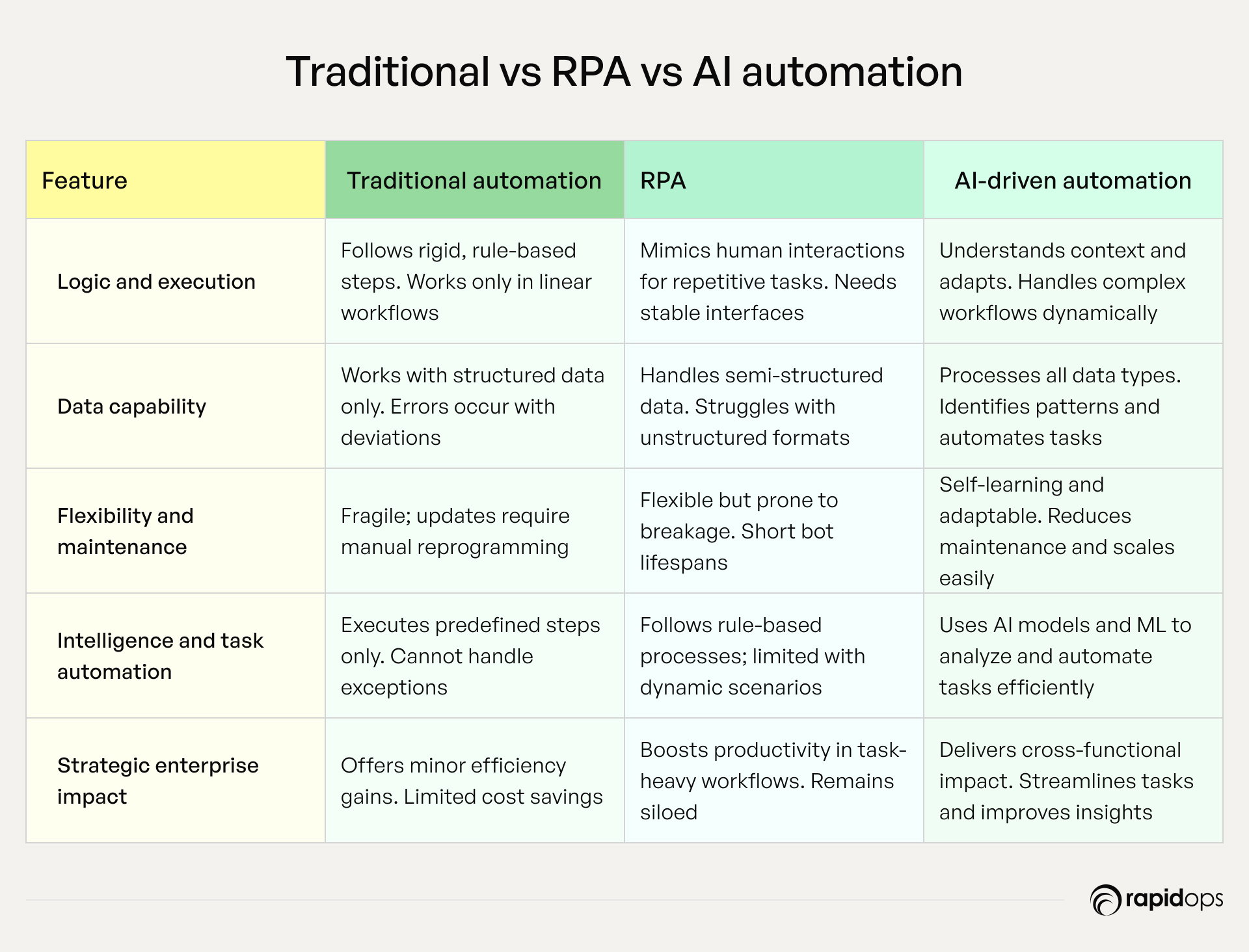
As your organization scales in 2026, it’s critical to understand that not all automation is created equal. Traditional automation, RPA (Robotic Process Automation), and AI-driven automation differ in intelligence, adaptability, and business impact, shaping how your enterprise executes processes, manages risks, and leverages data. The right choice can reduce operational costs, enhance decision-making, and unlock competitive advantage.
1. Logic and execution
Traditional automation: Operates on rigid, rule-based logic, executing repetitive tasks exactly as programmed. It cannot adapt to changing business processes or ambiguous situations, making it suitable only for linear workflows.
RPA: Mimics human interactions, handling repetitive tasks like invoice processing, clicks, and form fills. While efficient, it depends heavily on static interfaces and often requires human intervention when workflows or UIs change.
AI-driven automation: Goes beyond simple instruction-following. Leveraging AI systems, machine learning algorithms, and natural language processing, it understands context, handles repetitive and unstructured tasks, and dynamically adapts workflows in real time. This allows your teams to focus on higher-value work instead of manual, routine operations.
2. Data capability
Traditional automation: Works only with structured data; errors occur when formats deviate.
RPA: Handles semi-structured data using OCR or NLP add-ons, but struggles with truly unstructured data without heavy configuration.
AI-driven automation: Processes structured, semi-structured, and unstructured data from documents and emails to audio files and transactional logs. By analyzing historical sales data, customer records, and operational metrics, AI-driven systems identify patterns, flag anomalies, and automate repetitive tasks, enhancing accuracy, consistency, and operational efficiency.
3. Flexibility and maintenance
Traditional automation: Fragile. Any update in systems or processes requires manual reprogramming, increasing maintenance costs.
RPA: More flexible but prone to breakage with system updates, leading to short bot lifespans.
AI-driven automation: Inherently adaptable, learning from new data and system behavior. By integrating AI capabilities, it reduces maintenance, supports continuous monitoring, and scales across enterprise systems, enabling resilient operations in dynamic environments.
4. Intelligence and task automation
Traditional automation: Executes predefined steps; cannot analyze data, adapt to context, or handle exceptions.
RPA (Robotic Process Automation): Can follow rule-based processes but struggles with ambiguity, unstructured data, or dynamic scenarios.
AI-driven automation: Leverages AI models, machine learning, computer vision, and intelligent document processing to analyze data, recognize patterns, and automate repetitive tasks. It optimizes complex workflows, reduces human error, and enhances operational efficiency. Applications include predictive maintenance, invoice processing, and customer service automation—freeing IT teams and staff to focus on higher-value work instead of manual, routine operations.
5. Strategic enterprise impact
Traditional automation: Offers incremental efficiency gains and limited cost savings.
RPA: Increases productivity in task-heavy workflows, yet remains siloed, limiting enterprise-wide impact.
AI-driven automation: Delivers transformative, cross-functional impact. It streamlines repetitive and routine tasks, supports business process management, and enhances operational efficiency. By integrating AI tools and intelligent automation, your organization can achieve predictable outcomes, cost savings, and faster operational insights, all while enabling teams to focus on higher-value work that requires human expertise.
Relying solely on traditional automation or RPA means your organization can execute tasks but cannot think, adapt, or evolve. AI-driven automation bridges this gap by turning routine tasks into intelligent operations, enabling automated operations, improving customer satisfaction, and providing real-time insights across complex processes. Adopting AI-driven automation transforms operations and enables strategic growth. Discover the full impact of intelligent automation in our intelligent business process automation blog.
Key benefits of AI-driven automation for enterprises
AI-driven automation is not just a point solution; it’s an enterprise-wide capability that transforms the way organizations operate. Embedding AI systems, machine learning, natural language processing, and intelligent automation into business processes drives operational efficiency, decision-making, and strategic agility across functions. Here are the eight most critical benefits for enterprises in 2026.
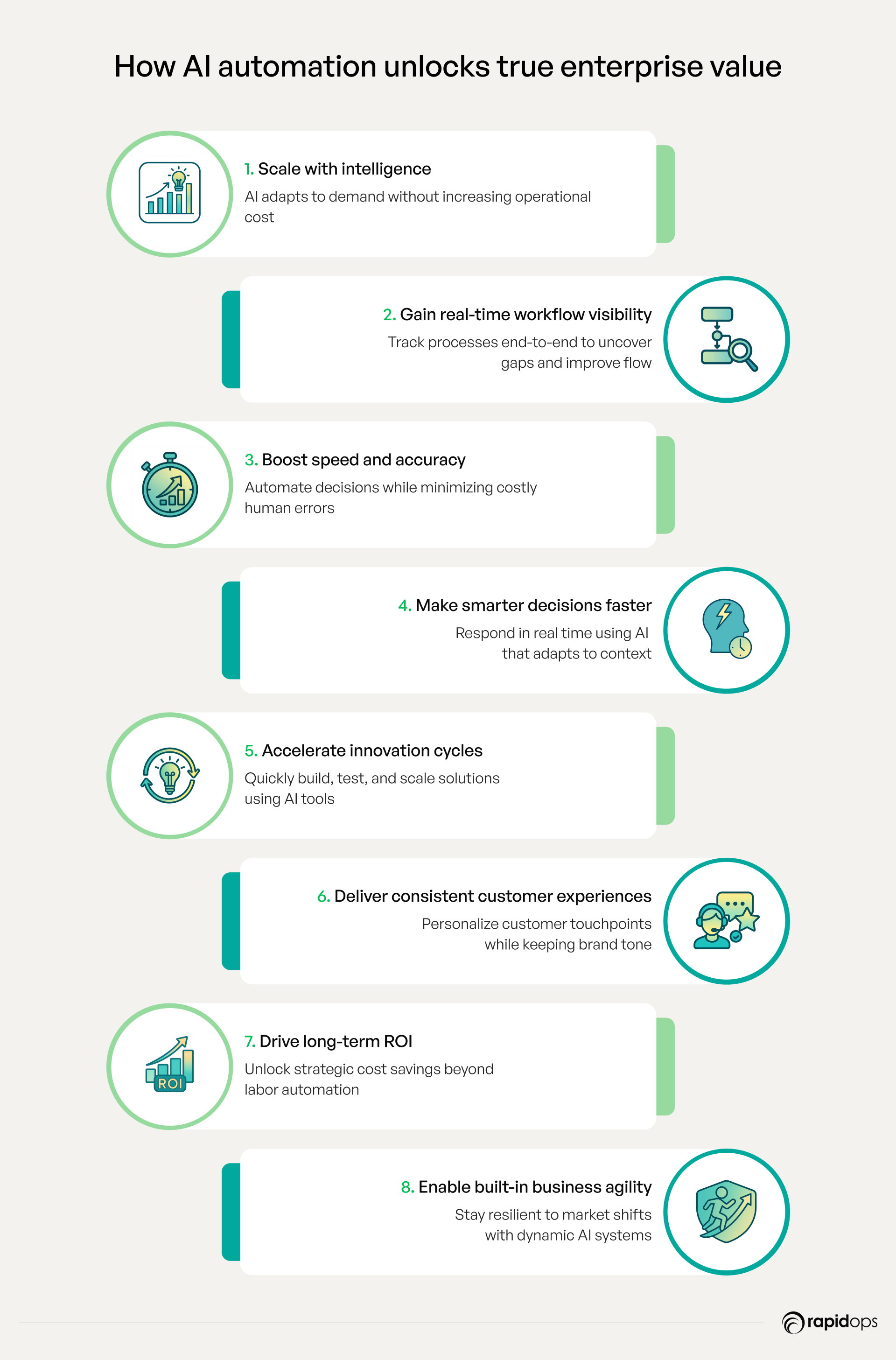
1. Intelligent scalability across functions and complexity
AI-driven automation scales far beyond traditional automation and RPA. It adapts dynamically to variable business processes, unstructured data, and complex workflows, enabling elastic operations without replicating cost structures. Whether managing customer interactions, invoice processing, or global supply chains, AI-powered automation adjusts in real time, ensures continuity, reduces reliance on manual labor, and supports enterprise growth efficiently under fluctuating demand.
2. End-to-end process visibility and optimization
Unlike siloed automation systems, AI-driven automation delivers full visibility across enterprise systems, connecting CRM, ERP, IoT, and legacy platforms. Using process mining, predictive analytics, and workflow intelligence, it identifies inefficiencies, recommends improvements, and orchestrates intelligent operations. Leaders can now optimize resource allocation, reduce cycle times, and enhance collaboration across finance, HR, supply chain, and customer service, creating transparent, data-driven workflows.
3. Precision, accuracy, and operational assurance
By leveraging AI models, intelligent document processing, and predictive analytics, enterprises can eliminate human error and improve quality control across complex processes like claims handling, financial reconciliation, and compliance checks. These systems validate inputs, detect anomalies, and execute with precision. The result is reduced operational risk, higher audit accuracy, and reliable outcomes, giving leaders confidence in automated operations across the enterprise
4. Contextual, real-time automation at scale
AI-driven automation enables real-time, context-aware execution of repetitive and rule-based tasks across your enterprise. By continuously analyzing historical data, current metrics, and external signals, systems dynamically adjust actions for inventory management, pricing updates, fraud checks, and customer service workflows. This transforms enterprises from reactive responders to proactive organizations that automate routine work, reduce errors, and optimize operations, all without constant human intervention.
5. Accelerated innovation and continuous adaptability
AI-driven platforms integrate low-code tools, AI agents, and machine learning algorithms, enabling enterprises to rapidly model, test, and deploy new workflows. Teams can experiment with variations, integrate new data sources, or respond instantly to policy or market changes. This accelerates continuous improvement, shortens time-to-market, and fosters a culture of iterative innovation while reducing IT bottlenecks.
6. Enhanced customer and partner experience
With AI-powered automation, enterprises can deliver personalized, context-aware engagement across channels voice, chat, email, and mobile. AI agents recognize intent, anticipate needs, resolve issues autonomously, and suggest next-best actions. From onboarding to support to purchases, this approach improves customer satisfaction, builds trust, and strengthens long-term relationships with partners and clients alike.
7. Strategic cost optimization with sustainable ROI
AI-driven automation goes beyond reducing operational costs from labor efficiency. By optimizing business processes, automating repetitive tasks, and minimizing downtime, it increases throughput, eliminates waste, and frees capital for growth or innovation. The system continuously learns, improving ROI over time and reducing reliance on human intervention, delivering significant cost savings and measurable enterprise value.
8. Enterprise resilience and future readiness
AI-driven systems make enterprises resilient to uncertainty. By continuously monitoring data streams, predicting anomalies, and adapting workflows, they respond to supply chain disruptions, cyber risks, and shifting customer behavior without manual intervention. This ensures operational continuity, regulatory compliance, and the ability to pivot strategically. Enterprises achieve future-ready operations, capable of thriving in rapidly evolving environments.
Core technologies in AI-driven automation
Your organization’s data holds answers, but only if you know how to use it. This section reveals the core technologies behind AI-driven automation, showing how AI learns from patterns, anticipates risks, and empowers teams to act with confidence, turning operational complexity into strategic advantage.
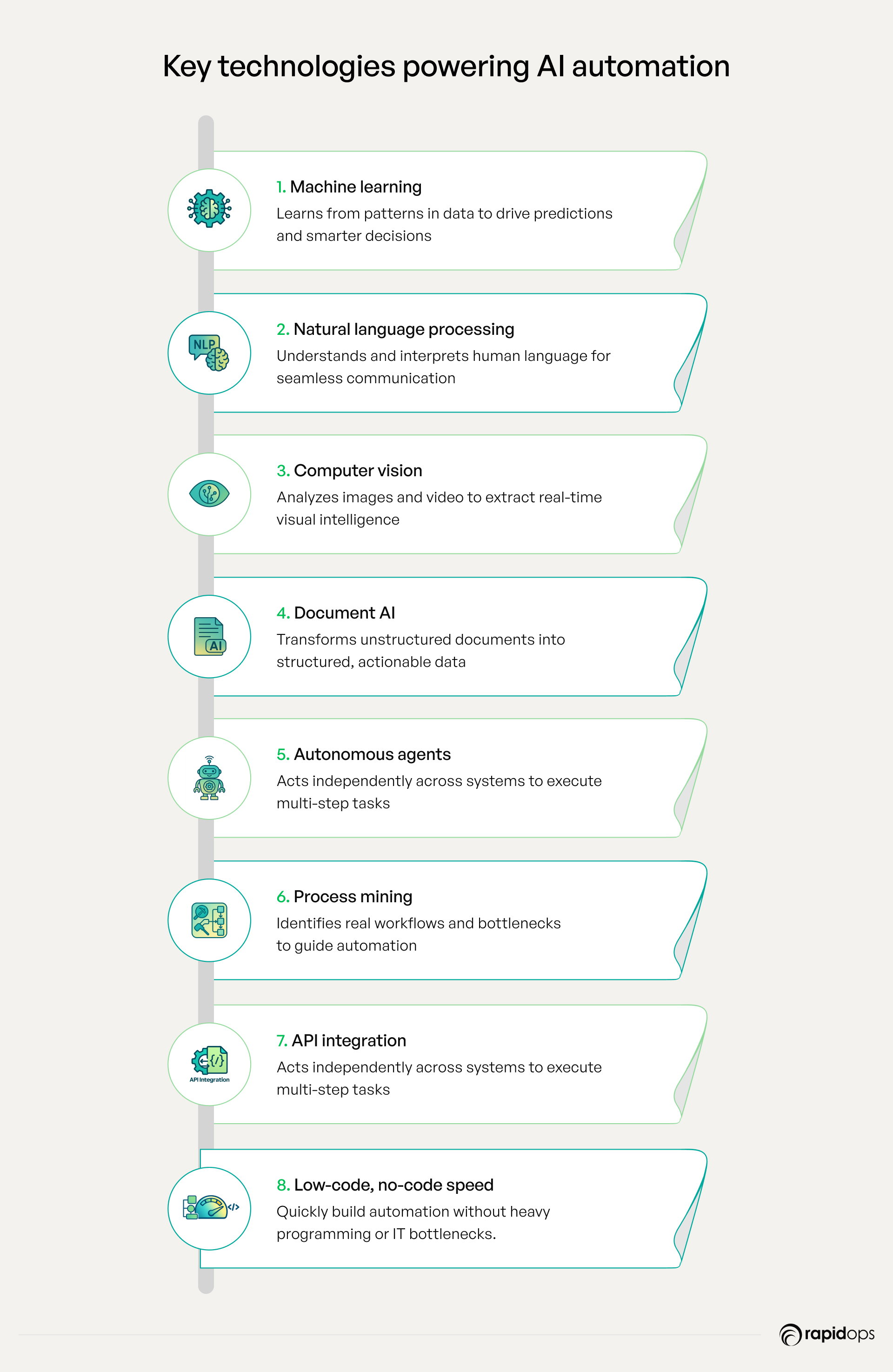
Machine learning (ML): The intelligence engine
Machine learning serves as the brain behind AI-driven automation, enabling systems to learn from data and continuously improve outcomes. Unlike traditional automation, which executes fixed rules, ML can detect patterns in structured, semi-structured, and unstructured data, predict trends, and optimize decisions in real time. Within enterprise workflows, ML minimizes human error, accelerates routine and complex processes, and enhances predictive capabilities such as predictive maintenance, resource allocation, and anomaly detection.
Its ability to adapt autonomously ensures automation scales effectively across departments, from finance and HR to supply chain and customer operations, supporting resilience, operational intelligence, and measurable efficiency gains.
Natural language processing (NLP): Understanding human intent
NLP enables AI systems to interpret and act on human language, transforming emails, documents, chat transcripts, and voice interactions into actionable insights. By processing unstructured data with contextual understanding, NLP extends automation into knowledge-intensive functions such as compliance, customer service, procurement, and legal review.
Enterprises can deploy NLP to enhance intelligent document processing (IDP), AI-powered chatbots, and conversational AI agents, ensuring consistent, accurate, and scalable operations. By converting linguistic information into structured intent, NLP allows your enterprise to automate repetitive tasks while retaining critical context, improving efficiency, accuracy, and responsiveness.
Computer vision: Interpreting visual information
Computer vision adds visual recognition capabilities to AI-driven automation, enabling systems to process images, videos, and scanned documents as actionable data. It bridges physical and digital operations by detecting defects in manufacturing, verifying identities in security workflows, or classifying documents in administrative processes.
By integrating computer vision, enterprises can automate routine quality checks, reduce manual inspection, and minimize human intervention in repetitive tasks. This capability allows operations to scale intelligently, incorporating real-world inputs into complex workflows and delivering actionable insights in real time.
Intelligent document processing (IDP): Automating document-heavy workflows
IDP leverages OCR, ML, and NLP to extract structured information from complex documents such as invoices, contracts, and purchase orders. By enabling straight-through processing, it eliminates manual labor in document-intensive processes, accelerates decision cycles, and improves accuracy.
Across finance, legal, HR, and procurement, IDP reduces human error and operational delays while enabling predictive analytics and data-driven decision-making. In combination with AI-driven automation, IDP transforms document workflows into adaptive, intelligent systems, freeing your teams to focus on strategic initiatives rather than routine data handling.
Robotic process automation (RPA): The execution layer
RPA executes rule-based tasks, and when paired with AI, it becomes an intelligent executor of automated processes. RPA bots can perform repetitive actions such as data entry, workflow updates, and ERP or CRM interactions based on AI-derived instructions.
By integrating RPA with AI models and predictive analytics, enterprises extend automation across legacy systems without requiring extensive system rewrites or manual oversight. This combination allows organizations to scale automation across complex workflows, reduce human error, and achieve measurable efficiency gains in operationally critical processes.
Process mining and task mining: Visibility and insight
Process and task mining provide the empirical foundation for automation by capturing user-level actions and reconstructing end-to-end workflows from system logs. These technologies deliver fact-based insights into how work is actually performed, highlighting inefficiencies, bottlenecks, and high-volume repetitive tasks ideal for automation.
By analyzing operational logs, system events, and historical data, enterprises can optimize workflows, prioritize automation initiatives, and maximize efficiency, reduce manual effort, and improve operational outcomes. This ensures AI-driven automation is grounded in real-world processes.
Low-code and no-code platforms: Speed and accessibility
Low-code and no-code platforms empower both business and IT teams to design, deploy, and adapt automation workflows quickly without heavy programming. By providing intuitive visual interfaces, these platforms accelerate the adoption of AI-driven automation, enable iterative process testing, and reduce dependency on scarce technical talent. This approach supports strategic initiatives by allowing enterprises to respond to policy changes, experiment with workflow variations, and scale automation rapidly while maintaining governance, security, and compliance across the organization.
API integration and iPaaS: Seamless interoperability
API and iPaaS tools are essential for connecting fragmented enterprise systems, allowing AI-driven automation to function across ERPs, CRMs, cloud platforms, and external partners. By enabling real-time data exchange, workflow triggering, and system interoperability, these technologies ensure that AI systems are embedded throughout enterprise operations, not siloed within isolated tools.
This integration allows predictive analytics, automated operations, and intelligent decision-making to occur across business processes, supporting operational continuity and enhancing enterprise-wide efficiency.
Industry-wise use cases of AI-driven automation
Retail: From fragmented data to smart revenue
Retail leaders are no longer constrained by demand; they are constrained by fragmentation. Customer data sits across multiple channels, inventory signals lag real demand, and operational tasks consume valuable time. Traditional automation can handle repetitive tasks like order processing, data entry, or reporting, but it cannot unify workflows or handle complex, cross-channel processes. AI-driven automation addresses this by integrating insights and executing routine tasks across systems, reducing manual effort, improving accuracy, and enabling teams to focus on higher-value work that drives business growth.
Hyper-personalized customer journeys driven by continuous learning
AI-driven automation enables retailers to move from static personalization to adaptive customer intelligence. Machine learning models continuously analyze structured and unstructured data—click behavior, transaction history, customer service interactions, and sentiment to build evolving customer profiles. These AI systems do not rely on predefined segments; they identify patterns and adjust engagement logic dynamically.
The result is automation that decides what to present, when to present it, and through which channel, without human intervention. This directly improves customer satisfaction, reduces churn, and increases lifetime value, while eliminating manual campaign tuning and rule maintenance.
Autonomous inventory and merchandising decisions at scale
Inventory inefficiency is one of retail’s highest operational costs. AI-driven automation transforms inventory management by analyzing historical sales data, real-time demand signals, supplier constraints, and local market behavior simultaneously. Instead of relying on periodic forecasts, automated systems continuously rebalance inventory across locations and channels.
This intelligence extends into merchandising. AI automation tests layouts, product placement, and assortments in real time, learning which configurations maximize conversion. Retailers using AI-powered automation reduce excess inventory, avoid stockouts, and unlock significant cost savings across business operations.
Real-time pricing and promotion optimization
Pricing decisions in retail involve complex trade-offs between margin, demand elasticity, and inventory risk. AI-driven automation replaces rule-based pricing with context-aware decision making. Predictive analytics models evaluate competitor pricing, customer sensitivity, and channel performance continuously, adjusting prices and promotions autonomously.
This capability reduces human error, accelerates response to market shifts, and allows pricing teams to focus on strategic initiatives instead of manual overrides.
Manufacturing: Intelligent production powered by continuous optimization
Manufacturing in 2026 demands resilience, precision, and speed under constant variability. AI-driven automation transforms factories from rule-based environments into self-optimizing systems. By embedding intelligence into quality control, maintenance, and planning, manufacturers reduce dependency on manual oversight and reactive decision making. Production systems learn from real-time data, adjust autonomously, and improve continuously. This shift enables higher throughput, lower downtime, and consistent quality, while allowing human teams to focus on process innovation rather than operational firefighting.
Closed-loop quality assurance
Manual inspection and post-production checks introduce delays and inconsistency. AI-driven automation uses computer vision and anomaly detection to inspect every unit in real time, identifying defects at a granular level. Crucially, detected issues trigger automatic adjustments in machine parameters, preventing recurrence. This closed-loop feedback ensures consistent quality without slowing production. Manufacturers reduce scrap, rework, and compliance risk while maintaining traceability across the production lifecycle.
Predictive maintenance at scale
Unexpected equipment failure disrupts production schedules and revenue forecasts. AI-driven automation predicts failures by analyzing sensor data, usage patterns, and maintenance history, helping businesses minimize downtime and protect profitability. Just as wage statement generators streamline payroll accuracy and compliance, predictive maintenance tools streamline operations by reducing risk and improving efficiency across critical systems. When risk thresholds are detected, systems automatically schedule maintenance, reorder parts, and rebalance workloads. This minimizes unplanned downtime and extends asset life. Maintenance shifts from reactive intervention to proactive orchestration, improving overall equipment effectiveness across plants.
AI-optimized production planning
Production planning complexity increases with global operations and frequent demand changes. AI-driven automation continuously recalculates schedules by synthesizing demand forecasts, capacity constraints, material availability, and workforce data. When disruptions occur, plans are adjusted in real time without manual coordination. Manufacturers achieve higher throughput, faster changeovers, and greater responsiveness without destabilizing operations.
Distribution: AI-driven automation that protects revenue and unlocks growth
In 2026, distributors face constant pressure to deliver more value to customers while protecting margins and driving growth. AI-driven automation is helping companies stay ahead by providing actionable insights, highlighting high-priority opportunities, and enabling proactive decision-making.
The following three use cases show how AI can enhance the effectiveness of sales teams, safeguard revenue, and unlock growth opportunities, helping distributors operate smarter and more strategically in a competitive market.
1. Dynamic pricing for maximum margin
Distributors face constant pressure to protect margins while staying competitive. AI-driven dynamic pricing analyzes customer behavior, order history, competitor rates, and real-time demand to recommend optimal pricing at the moment of sale. Sales teams can confidently offer deals that win business without eroding profit, while executives monitor revenue impact across accounts. This ensures distributors capture every opportunity, maintain profitability, and respond instantly to market fluctuations, all without distracting from their primary focus: driving sales and maintaining customer trust.
2. Customer churn prediction to protect revenue
Retention is critical in a sales-driven distribution model. AI monitors purchasing patterns, order frequency, and engagement signals to flag customers at risk of switching to competitors. Sales teams receive early alerts and actionable recommendations to re-engage these accounts proactively. By addressing churn before revenue is lost, distributors preserve recurring sales, strengthen long-term relationships, and maintain predictable growth. AI turns hidden signals into strategic insights, helping distributors focus on maintaining and growing their customer base, not on operational tasks.
3. Revenue and sales opportunity prioritization
Distributors often miss growth opportunities because high-value accounts are underserved, while low-return customers consume sales time. AI analyzes account potential, order history, and market signals to prioritize which customers and opportunities deserve focus. Sales teams can target high-impact accounts, optimize follow-ups, and allocate resources efficiently. The result: more revenue per rep, better customer engagement, and growth without increasing headcount. AI empowers distributors to act strategically, ensuring every sales decision drives revenue and competitive advantage.
Critical considerations for successful AI-driven automation
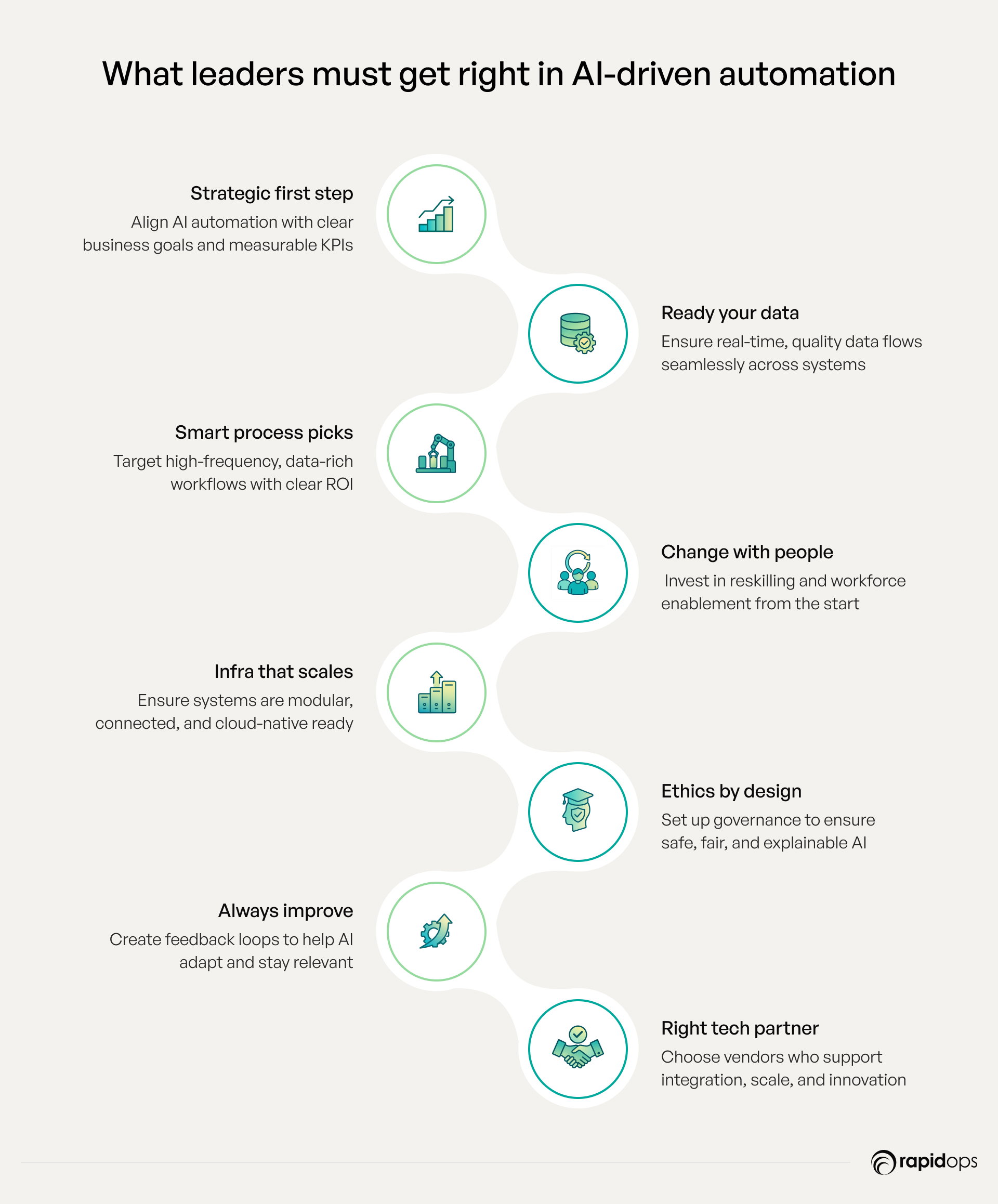
For enterprises, AI-driven automation is not merely a technical upgrade—it’s a strategic transformation that reshapes how value is created, delivered, and scaled. Yet, many initiatives fail because they focus narrowly on tools rather than on foundational enablers. Achieving success requires a comprehensive, cross-functional approach that aligns strategy, data, processes, people, and systems to generate measurable, sustainable outcomes.
Here are the critical considerations every enterprise must evaluate before scaling AI-driven automation.
1. Strategic alignment and outcome definition
AI-driven automation should always start with clarity, not technology. You must define the strategic objectives that your automation initiatives aim to achieve whether it’s improving operational efficiency, accelerating time-to-market, reducing human error, enhancing customer satisfaction, or mitigating compliance risk. Each initiative should map to measurable KPIs and long-term value drivers across business processes.
By aligning AI automation with your enterprise goals, you ensure that your investments deliver tangible business outcomes, not just technical outputs. This also sets the stage for scalable, intelligent automation that grows with your organization rather than creating isolated efficiencies.
2. Enterprise data readiness and accessibility
AI systems rely on high-quality, real-time data to function effectively. Success demands more than large volumes of data it requires accurate, relevant, and integrated data across ERP, CRM, legacy databases, IoT, and other enterprise systems.
Assess the state of your data pipelines, metadata management, and API-based connectivity to ensure seamless access. AI-driven automation thrives when systems can ingest structured, semi-structured, and unstructured data, enabling context-aware decisions and predictive insights. Without robust data foundations, even the most advanced AI models cannot deliver value.
3. Process intelligence and automation suitability
Not all workflows are ready for AI-driven automation. Conduct process intelligence assessments to identify high-frequency, data-rich, and rule-based processes that will yield the greatest impact.
For more complex or unstructured workflows, consider phased implementations or hybrid human-AI models. Understanding where AI automation adds strategic advantage ensures your initiatives focus on high-value processes, minimize risk, and maximize efficiency gains.
4. Organizational change and workforce enablement
AI-driven automation reshapes how work is performed and by whom. Successful adoption requires proactive change management. Invest in reskilling programs, role redefinition, and employee engagement strategies to empower teams to collaborate effectively with AI systems.
By positioning your workforce as co-creators of intelligent processes, you not only reduce resistance but also amplify human value, allowing your teams to focus on strategic decision-making and complex problem-solving while AI handles repetitive and low-value tasks.
5. Infrastructure and interoperability readiness
True automation maturity depends on a modular, scalable technology architecture. AI-driven systems must integrate seamlessly with legacy platforms, cloud-native services, and external ecosystems.
Focus on API connectivity, event-driven orchestration, and edge computing readiness to support dynamic business environments. A resilient infrastructure enables AI automation to function across enterprise systems, streamline complex workflows, and scale rapidly as operational demands evolve
6. Governance, ethics, and risk management
AI-driven decisions must be transparent, auditable, and compliant. Establish governance frameworks that enforce ethical AI practices, regulatory adherence, and robust model monitoring.
Include human-in-the-loop oversight, automated fallback protocols, and explainable AI mechanisms to mitigate bias and minimize risk. Strong governance ensures trust in automated systems and provides accountability across all critical business processes.
7. Continuous learning and adaptive feedback loops
AI-driven automation is not a one-time deployment; it is a continuously evolving system. Embed monitoring, performance tracking, and feedback loops to ensure models adapt to new data, changing business conditions, and evolving regulations.
Continuous learning allows AI systems to optimize decisions, reduce human error, and enhance operational efficiency, creating a self-improving enterprise capable of responding in real time to market and operational shifts.
8. Strategic vendor alignment and platform extensibility
Selecting the right AI automation partner is a long-term strategic decision. Evaluate vendors not only on product capabilities but also on integration maturity, domain expertise, roadmap alignment, and support for co-innovation.
Open and extensible platforms enable you to integrate new AI capabilities, scale across enterprise systems, and future-proof your automation strategy. Partnering with the right vendor ensures your investment delivers measurable ROI, reduces operational costs, and supports innovation for years to come.
Successfully scaling AI-driven automation requires more than deploying advanced technology. It demands strategic alignment, robust data foundations, process intelligence, workforce readiness, resilient infrastructure, ethical governance, continuous learning, and the right partnerships.
When all these considerations are addressed, enterprises can achieve intelligent, adaptive, and scalable automation that drives operational excellence, strategic agility, and sustainable growth in 2026 and beyond.
Turning AI potential into real business impact
By now, you’ve seen what AI-driven automation really means, how it works, the technologies behind it, and the ways it’s already transforming industries. But understanding the “how” is only part of the story. The bigger question is: what does it mean for your business? How can you take these innovations and turn them into smarter operations, more empowered teams, and decisions that actually move the needle? Every business is different, and the path from possibility to impact isn’t always obvious.
Making it happen can feel complex. Your workflows, priorities, and risks are unique, and knowing where to start or which processes to modernize first can feel like navigating a maze. Achieving measurable results requires more than just technology; it requires clarity, strategy, and a partner who understands your challenges and your goals.
That’s where Rapidops comes in. Our expertise isn’t just in AI technology; it’s in understanding your business and making AI work for you. We help you identify where automation can deliver the most value, design intelligent systems that learn and improve, and integrate them seamlessly into your daily operations. From strategy and development to implementation and ongoing support, our solutions are tailored to solve real challenges, empower your teams, and produce results you can measure.
Curious how AI can work for you? Book a free consultation with our AI experts to find the best approach for your goals.

What’s Inside
- What AI-driven automation really is (and what it is not)
- Why AI-driven automation has become unavoidable in 2026
- Algorithms: The backbone of AI-driven automation
- How AI-driven automation works at an enterprise level
- Traditional automation vs RPA vs AI-driven automation
- Key benefits of AI-driven automation for enterprises
- Core technologies in AI-driven automation
- Industry-wise use cases of AI-driven automation
- Critical considerations for successful AI-driven automation
- Turning AI potential into real business impact

Let’s build the next big thing!
Share your ideas and vision with us to explore your digital opportunities
Similar Stories
- AI
- 4 Mins
- September 2022


- AI
- 9 Mins
- January 2023

Receive articles like this in your mailbox
Sign up to get weekly insights & inspiration in your inbox.