

We’ve all been hearing about artificial intelligence for quite some time, yet many business leaders still hesitate when it comes to adopting it meaningfully within their organizations. In contrast, retailers that recognized AI’s potential early have already moved beyond experimentation, embedding AI across their operations and achieving measurable, business-defining results.
By 2026, the global AI in retail market is projected to reach approximately USD 4.87 billion, reflecting steady and focused adoption across personalization, supply chain optimization, analytics, and customer engagement. AI is no longer limited to isolated use cases; it has become a core operational capability, powering recommendation engines, marketing automation, demand forecasting, and real-time decision-making across the retail value chain.
The impact is tangible. AI-driven personalization and predictive intelligence are directly influencing growth and efficiency. Product recommendation engines now contribute up to 35 % of online revenue, while advanced forecasting models significantly improve inventory accuracy, reducing stockouts and improving inventory flow. Retailers leveraging AI consistently report 5–15 % revenue growth, alongside meaningful cost efficiencies across logistics, merchandising, and operations, demonstrating AI’s ability to strengthen both customer experience and profitability.
AI’s value extends beyond digital channels into physical retail environments as well. From automated checkout and visual search to dynamic pricing and personalized in-store promotions, intelligent technologies are enhancing convenience and responsiveness at every customer touchpoint. As shopper expectations increasingly center on relevance, speed, and personalization, AI has become a strategic enabler of modern retail experiences, not merely a supporting technology.
To help you understand what effective AI adoption looks like in practice, we’ve curated this list of the top 10 real AI retail success stories. These proven examples highlight how retailers are using AI to drive measurable outcomes, elevate customer engagement, and transform operations, offering practical insights you can apply to your own AI strategy as you move toward sustained growth and competitive advantage.
What are AI retail success stories
AI retail success stories are real-world examples where artificial intelligence has moved from potential to measurable business impact, delivering tangible outcomes across operations, customer experience, and revenue growth. Unlike AI use cases, which describe what AI can do, such as predicting demand, optimizing inventory, or personalizing recommendations, success stories demonstrate what AI has achieved: reduced stockouts, minimized surplus, enhanced customer loyalty, and measurable financial gains. They highlight how leading retailers have integrated AI thoughtfully across functions, turning complex data into actionable insights that drive both operational efficiency and strategic advantage.
For this article, the top 10 AI retail success stories were selected using rigorous criteria focused on strategic impact, measurable results, and innovative application. Each example illustrates how AI was applied end-to-end from predictive inventory management and dynamic pricing to hyper-personalized customer interactions, showing not just theory but proven, scalable outcomes. These stories provide actionable lessons for business leaders, demonstrating how to deploy AI effectively, measure impact rigorously, and achieve sustainable growth in a rapidly evolving retail landscape.
What AI in retail looks like in 2026
What if your retail operations could anticipate demand, adjust inventory, optimize pricing, and personalize promotions automatically? By 2026, AI will enable exactly this. This section explores how retailers can harness real-time data and predictive intelligence to make smarter decisions, enhance customer experiences, and achieve operational excellence in a rapidly evolving market.
1. AI knows what customers want before they ask
In 2026, top retailers use anticipatory intelligence, AI that predicts customer behavior before it occurs, by synthesizing signals from multiple sources, including:
- Clickstream behavior: Pages visited, time spent, and search queries
- Historical transactions: Purchase history, returns, and frequency
- Contextual factors: Device type, location, time of day, and seasonal trends
- Cohort analysis: Behavior patterns from similar users or segments
This enables AI to proactively tailor product displays, recommendations, and content in real time. Retailers using AI‑driven personalization see up to ~35 % of eCommerce revenue generated from smart recommendations, and customers are 50 % more likely to buy when offered contextually relevant personalization.
AI models continuously update themselves with live behavioral feedback, ensuring that predictions remain precise and aligned with changing customer intent. This anticipatory mechanism accelerates decision‑making for consumers, reduces bounce rates, and elevates overall engagement.
On the operational side, improved predictive accuracy, frequently reaching 90–95 % in demand forecasting, minimizes inventory waste while maximizing availability.
2. Every digital touchpoint is personalized in real time
Personalization in 2026 extends far beyond recommendations to encompass the entire customer journey, from the first impression to checkout and post‑purchase engagement. AI enables retailers to tailor experiences through:
- Dynamic content adaptation: Homepages, offers, and messaging change based on behavior and context
- Behavioral segmentation: Real‑time clustering of users by engagement, purchase propensity, and loyalty
- Cross‑channel integration: Seamless personalization across mobile apps, web, email, and in‑store digital touchpoints
- Adaptive experimentation: AI conducts multivariate tests to optimize layouts, messaging, and recommendations continuously
Retailers investing in AI personalization see 20–30 % higher conversion rates and 35 % improved customer retention, while 58 % of shoppers prefer brands that use AI to personalize their experience.
AI further strengthens customer lifetime value (CLV) by continuously learning preferences and aligning future interactions, making every engagement feel tailored and thoughtful, a key driver of long‑term loyalty.
3. Pricing and promotions are dynamically optimized
AI‑driven pricing has become a real‑time, intelligence‑led system that responds to market conditions, customer demand, inventory shifts, and competitive pricing. Key components include:
- Elasticity modeling: AI determines demand sensitivity to price adjustments
- Contextual promotions: Offers customized based on segmented behavior and regional trends
- Competitive benchmarking: Automated analysis of competitor prices
- Inventory‑aware pricing: Dynamic adjustments based on stock levels and product velocity
Nearly 45 % of retail chains now use AI for pricing optimization, and retailers leveraging AI pricing engines often see 10–20 % increases in profit margins by aligning prices with demand and inventory contexts.
Dynamic pricing systems also help retailers avoid unnecessary markdowns and better manage seasonal cycles, enabling them to maintain margins without compromising relevance or competitiveness.
4. Inventory, fulfillment, and delivery are AI‑orchestrated
By 2026, AI will integrate front‑end demand forecasting with back‑end execution, creating a synchronized retail supply chain. AI‑enabled capabilities include:
- Predictive inventory allocation: SKU‑level and regional forecasts match anticipated demand
- Dynamic fulfillment routing: Real‑time selection of optimal distribution centers and delivery paths
- Real‑time inventory visibility: Accurate stock statuses visible to customers and operations teams
- Operational optimization: Workforce scheduling, warehouse throughput, and delivery optimization
AI‑enabled inventory management systems help reduce stockouts by 30 %, cut inventory carrying costs by 40 %, and enhance forecasting accuracy up to 95 %, improvements that translate into lower logistics costs and higher customer satisfaction.
For example, major chains deploying AI inventory counting systems have achieved eightfold increases in stock count frequency, ensuring critical products are consistently available without tying up capital in overstock.
These efficiencies extend to fulfillment, where AI dynamically adjusts delivery routes and partner selection, reducing lead times and improving first‑mile/last‑mile performance, a crucial competitive edge in omnichannel retail.
5. AI copilots empower retail teams
In 2026, AI works alongside human teams as strategic copilots, augmenting human decision‑making instead of replacing it. These AI assistants provide:
- Merchandising planning: Predictive insights on demand shifts and assortment mix
- Marketing optimization: Real‑time campaign performance and ROI predictions
- Operational decision support: Early detection of anomalies and bottlenecks
- Scenario simulations: Forecasting pricing, promotion, and layout impacts before execution
AI copilots reduce analytical workload, allowing teams to focus on strategic execution. Retailers with advanced AI adoption report smoother cross‑functional collaboration and faster response to market changes, translating to improved operational efficiency and reduced decision latency.
This symbiosis of human expertise and AI intelligence enables retailers to scale insight generation, scenario planning, and performance optimization without overwhelming internal resources.
6. Responsible AI safeguards trust and brand equity
As AI becomes embedded in every retail process, ethical, transparent, and compliant AI practices are crucial in maintaining consumer trust and regulatory compliance. Key aspects of responsible AI include:
- Bias detection and mitigation: Algorithms are monitored to prevent unfair or discriminatory personalization outcomes
- Explainability: Clear rationale for pricing, recommendations, and segmentation decisions
- Consent management: Adherence to global privacy standards like GDPR and CPRA
- Auditability: Decision logs and model trail records ensure accountability and compliance
Academic research emphasizes that consumer concerns around privacy and fairness are significant barriers to trust, making responsible AI both an ethical necessity and a competitive differentiator.
Retailers that prioritize transparency and fairness not only protect brand reputation but also build deeper, trust‑based customer relationships in an era where data ethics can directly influence purchase behavior.
7. From initiative to infrastructure: AI as the operating system
By 2026, AI has matured from isolated initiatives to core infrastructure across digital commerce operations, functioning as:
- A predictive layer for consumer behavior and demand signals
- A personalization engine delivering dynamic, contextual experiences
- An operational optimizer aligning inventory, labor, and fulfillment
A strategic partner augmenting human decision‑making while ensuring compliance and transparency
Industry data shows that 85 % of retail executives consider AI essential for future growth, and 80 % of companies have increased their AI investments in recent years, reflecting strategic prioritization of AI across business models.
Retailers that treat AI as core infrastructure can anticipate market shifts, personalize at scale, optimize operations, and sustain customer trust, establishing a competitive advantage that is increasingly difficult for late adopters to replicate.
By embedding AI across operations, retailers in 2026 can anticipate demand, enhance engagement, and optimize every touchpoint, turning intelligence into tangible business outcomes and establishing enduring market leadership.
Core technologies behind successful AI retail implementations
In modern enterprise AI, technology itself is the strategic differentiator. Success depends on well-orchestrated, scalable, and resilient technology stacks that enable intelligence to operate continuously across distributed systems. Each layer, from data foundations to advanced orchestration, must function cohesively, providing predictable performance, robust integration, and operational observability. Understanding these layers is critical for designing AI systems that are future-ready, auditable, and capable of delivering measurable value.
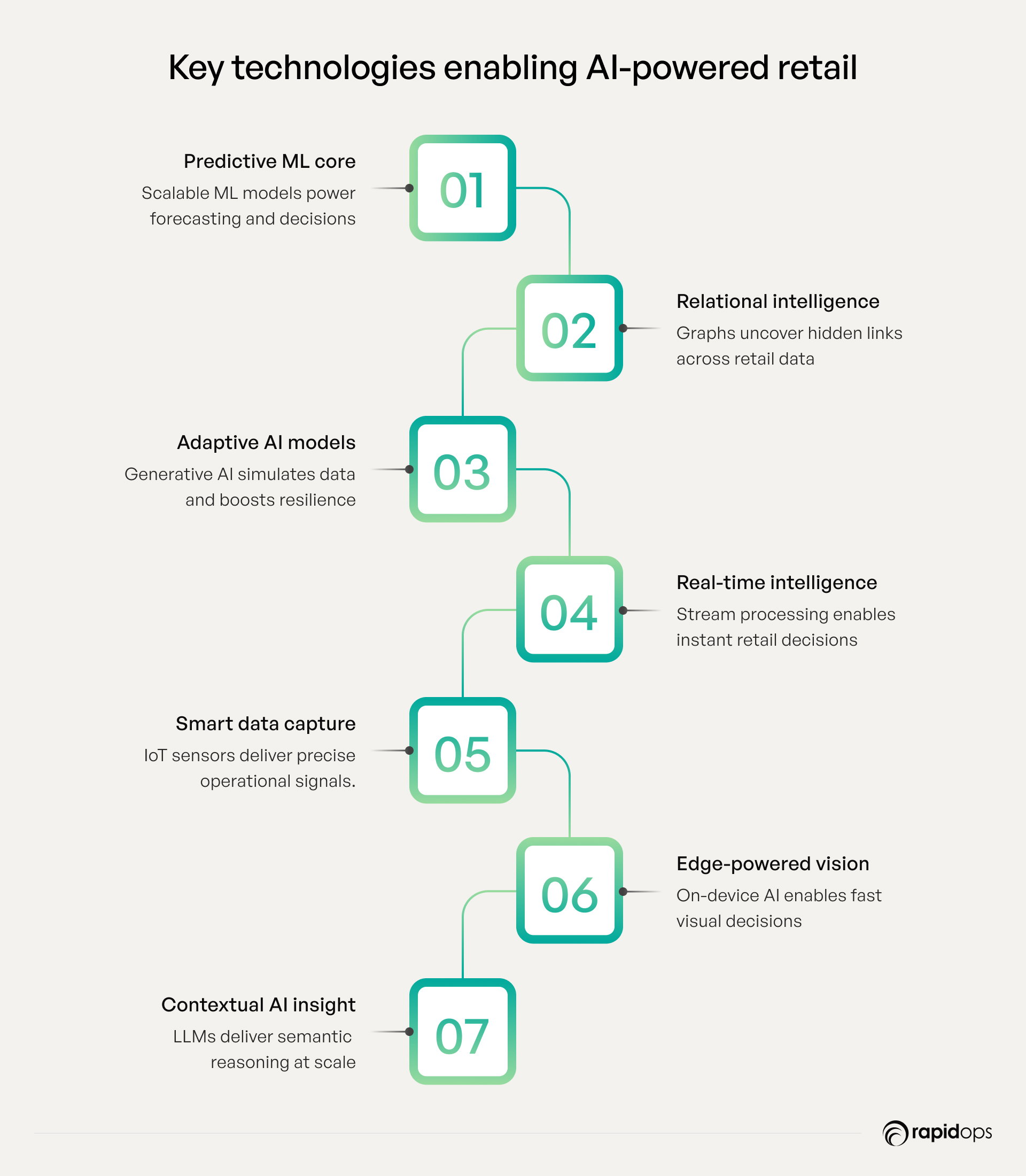
1. Machine learning and deep learning frameworks power predictive intelligence
Machine learning (ML) and deep learning (DL) frameworks serve as the computational core of AI, converting vast quantities of raw data into actionable insights and predictive models. These frameworks provide the flexibility and scalability necessary for AI to operate across complex retail operations.
- Frameworks: TensorFlow, PyTorch, and JAX offer modular architectures that support distributed model training and deployment.
- Optimizations: Techniques such as transfer learning, ensemble modeling, and multi-task learning enhance model performance and robustness.
- Deployment tools: ONNX and TorchScript ensure low-latency inference and portability across environments.
ML and DL frameworks enable AI systems to identify trends, forecast demand, optimize inventory, and support operational decision-making. They transform data into reliable, enterprise-scale intelligence, forming the foundation for AI-driven retail innovation.
2. Graphs and knowledge networks enable relational intelligence
Retail environments involve highly interconnected elements: products, customers, suppliers, and operational workflows. Graphs and knowledge networks allow AI systems to model these complex relationships, uncover hidden dependencies, and reason across multi-dimensional datasets.
- Graph databases represent entities as nodes and relationships as edges, enabling AI to perform multi-step relational analysis and detect patterns across the network.
- Knowledge graphs integrate heterogeneous datasets into a unified semantic layer, facilitating automated inference and contextual reasoning.
By leveraging these networks, AI can identify intricate relationships that traditional data structures cannot capture. Graphs and knowledge networks form the intelligence layer of AI retail systems, enabling informed decision-making and the development of advanced predictive models.
3. Generative AI platforms enhance predictive and adaptive capabilities
Generative AI expands the capabilities of traditional predictive models by creating synthetic data, simulating complex scenarios, and augmenting model learning.
- Architectures: Transformers, GANs, and diffusion models facilitate the generation of high-fidelity synthetic datasets and predictive simulations.
- Optimizations: Model pruning, quantization, and caching strategies enable efficient, high-throughput inference at scale.
Generative AI increases the adaptability and resilience of AI models, allowing them to maintain predictive accuracy in dynamic environments. This technology provides a forward-looking layer of intelligence, ensuring AI systems remain robust under changing retail conditions.
4. Real-time data processing engines enable instantaneous intelligence
The ability to process and act on data in real time is critical in modern retail. Real-time data processing engines allow AI systems to analyze streaming data continuously, delivering immediate insights that drive operational responsiveness.
- Platforms: Apache Kafka, Flink, Pulsar, and AWS Kinesis support continuous data ingestion, stateful computations, and event-driven analytics.
These engines ensure that AI decisions are timely and operationally relevant, supporting dynamic pricing, inventory management, and customer interaction at the speed of business. They form the backbone for instantaneous, actionable intelligence in retail environments.
5. IoT and sensor networks provide high-fidelity data acquisition
IoT devices and sensor networks act as the data collection layer for AI, capturing granular signals from stores, warehouses, and logistics networks.
- Devices: RFID tags, motion sensors, optical and environmental sensors deliver high-resolution operational and behavioral data.
- Protocols: MQTT, CoAP, HTTP/2, and 5G ensure reliable, low-latency transmission.
- Edge integration: Local preprocessing optimizes data flow and reduces central computational load.
High-fidelity data from IoT and sensor networks is essential for accurate predictions, operational monitoring, and responsive AI systems. These technologies ensure that AI operates on precise, real-world data, forming a foundational layer for intelligent retail operations.
6. Computer vision and edge AI enable localized real-time intelligence
Edge AI combined with computer vision allows AI systems to process visual and spatial data near the source, reducing latency and enabling autonomous decision-making.
- Hardware: NVIDIA Jetson, Intel OpenVINO, Qualcomm AI chips provide distributed computational capacity.
- Software: TensorRT and ONNX Runtime, with model optimizations such as pruning and quantization, allow efficient on-device inference.
This technology ensures AI operates with speed, precision, and autonomy, allowing real-time decision-making for inventory monitoring, traffic analysis, and operational optimization. Edge AI extends intelligence to the point of data generation, enhancing the immediacy and accuracy of insights.
7. Large language models provide contextual and semantic intelligence
Large language models (LLMs) bring advanced natural language understanding and contextual reasoning to AI systems, allowing them to interpret and synthesize unstructured data at scale.
- Architecture: Transformer-based architectures with multi-head attention capture intricate semantic and contextual relationships.
- Capabilities: Enable reasoning, text analysis, and context-aware insights.
LLMs elevate AI systems from pattern recognition to contextual intelligence, enabling nuanced understanding of text, semantic reasoning, and insight generation. They form a critical layer for AI systems that require deep contextual awareness, bridging raw data and strategic decision-making.
Together, these technologies allow retailers to process data intelligently, generate actionable insights, and operate at predictive and operational speed. Mastery of this ecosystem is essential for building scalable, intelligent, and future-ready AI retail systems, delivering measurable business impact and securing a sustainable competitive advantage.
How retailers are creating tangible business value with AI
As AI adoption becomes universal in the retail landscape, execution determines winners. Retailers integrating AI solutions, machine learning, and supply chain efficiency gain higher revenue, operational efficiency, and a significant competitive edge. This section highlights how AI-powered analytics transforms retail from reactive management to data-driven leadership.
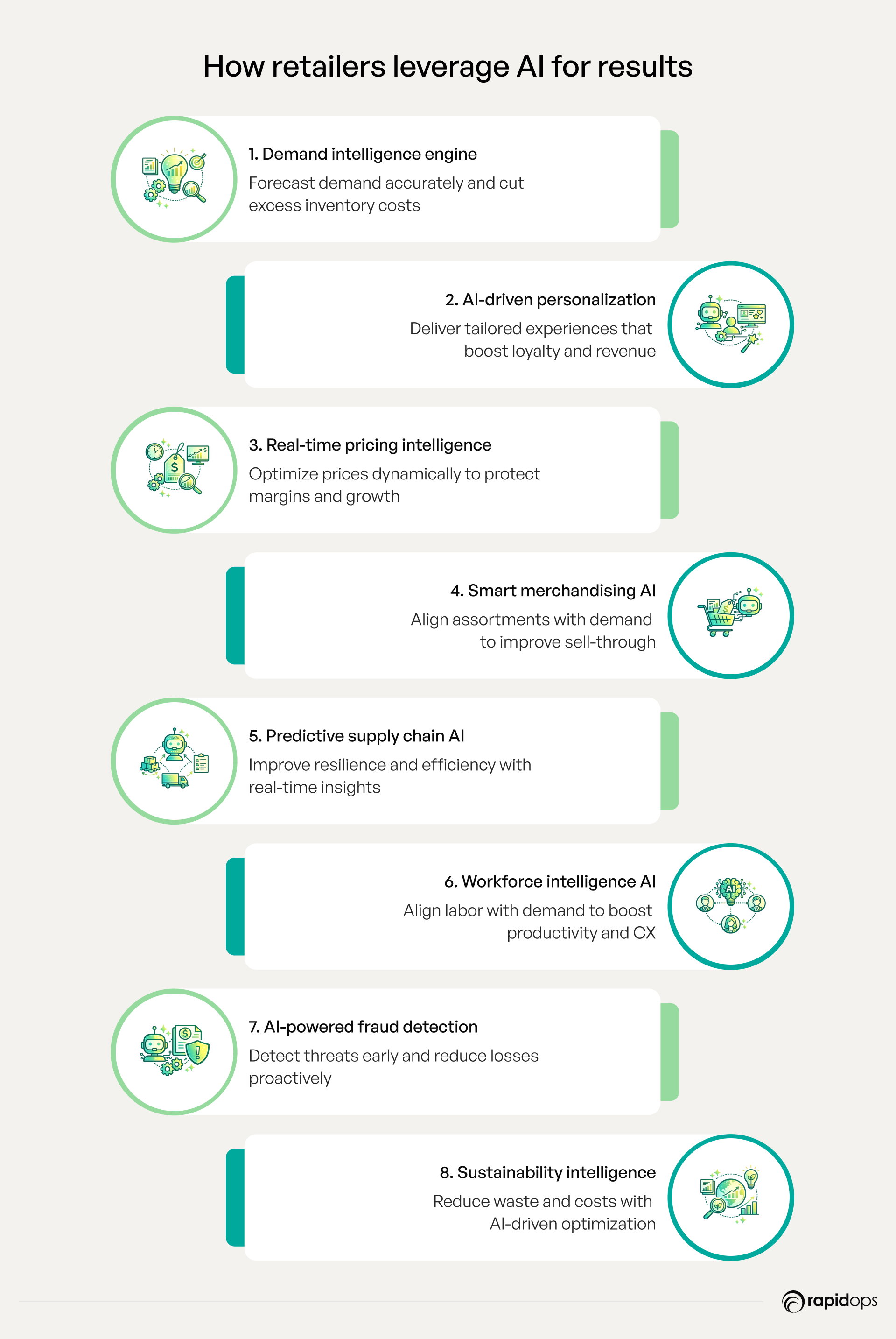
1. Demand intelligence as a profitability and waste-reduction engine
Demand intelligence has become one of the most powerful AI solutions in modern retail. By combining historical sales data, purchase history, seasonal trends, real-time data, and external factors such as market volatility or regional events, AI-powered demand forecasting systems continuously refine predictions at SKU, store, and channel levels.
Unlike legacy forecasting models, machine learning adapts dynamically to demand fluctuations, enabling retailers to forecast demand with greater precision. This directly improves inventory accuracy, supports smart inventory decisions, and significantly reduces excess inventory and excess inventory costs. Retailers leveraging demand intelligence consistently improve inventory turnover, optimize inventory levels, and protect margins by minimizing last-minute markdowns.
At scale, demand intelligence is no longer a planning tool; it is a capital efficiency engine that strengthens supply chain efficiency and supports data-driven insights across the organization.
2. Personalization as a sustained revenue growth and loyalty driver
AI-powered personalization has evolved beyond simple recommendation engines. Modern AI systems analyze customer data across online store behavior, in-store interactions, customer preferences, and customer interactions, to create continuously learning engagement models.
By interpreting customer behavior rather than static demographics, retailers can personalize customer interactions at every touchpoint. This drives higher customer engagement, increased customer satisfaction, and improved customer retention. Retailers report not only revenue uplift, but also deeper emotional loyalty as customers experience relevance and consistency across channels.
From an executive perspective, personalization now represents a structural revenue multiplier, one that improves customer experience, increases lifetime value, and strengthens brand differentiation in a crowded retail landscape.
3. Pricing intelligence as a real-time revenue optimization system
Pricing has become one of the most AI-powered decision areas in retail. Advanced pricing intelligence platforms analyze demand forecasting outputs, inventory levels, competitor pricing, and customer sensitivity simultaneously, enabling real-time price adjustments within defined brand guardrails.
This capability allows retailers to respond instantly to market changes, rather than reacting after margin erosion has already occurred. AI-powered analytics help retailers avoid unnecessary discounting while maximizing sell-through and revenue yield. Over time, pricing intelligence contributes directly to improved customer satisfaction by maintaining price fairness and availability without constant promotions.
In practice, pricing intelligence transforms pricing from a reactive function into a proactive, data-driven growth lever.
4. Merchandising optimization through probabilistic decision-making
Merchandising decisions increasingly rely on AI models that evaluate probability rather than intuition. These systems analyze customer behavior, customer preferences, demand signals, and historical sales data to determine which assortments are most likely to perform by region, channel, and customer segment.
This approach enables retailers to identify trends earlier, improve inventory optimization, and reduce capital locked in slow-moving SKUs. By aligning assortments with actual demand, retailers improve inventory turnover and reduce excess inventory across categories.
AI-driven merchandising shifts the function from subjective judgment to repeatable, evidence-based execution, significantly enhancing both profitability and operational discipline.
5. Supply chain intelligence as a resilience and efficiency accelerator
AI-powered supply chain intelligence brings predictive analytics into supply chain operations. By continuously analyzing supplier performance, logistics constraints, demand forecasting data, and external disruptions, AI systems enable proactive decision-making rather than reactive firefighting.
Retailers using AI in supply chain management report improved supply chain efficiency, lower logistics costs, and faster recovery from disruptions. Dynamic inventory rebalancing across networks ensures inventory levels align with real demand, supporting both availability and cost control.
As volatility becomes the norm, AI-driven supply chain intelligence is emerging as a strategic capability, one that protects revenue while improving operational efficiency.
6. Workforce intelligence as scalable operating leverage
AI-powered workforce intelligence enables retailers to align labor with real demand patterns. By analyzing customer interactions, traffic patterns, and operational complexity, AI systems optimize scheduling, task prioritization, and workload distribution.
This allows retailers to automate routine tasks, support human agents with AI-powered assistants, and deploy staff more effectively without increasing headcount. The result is improved customer satisfaction, higher productivity, and better service consistency.
From an executive lens, workforce intelligence transforms labor from a fixed cost into a scalable performance lever that directly impacts customer experience and profitability.
7. Fraud intelligence as proactive loss prevention
Retail fraud has become more sophisticated, spanning digital and physical channels. AI-powered fraud intelligence uses machine learning and real-time data analysis to detect anomalies, analyze data patterns, and respond before losses escalate.
Unlike rule-based systems, adaptive AI models continuously learn from emerging threats, reducing false positives while strengthening data security. This improves customer trust, protects inventory levels, and reduces operational friction for legitimate customers. experimentation
Fraud intelligence is no longer defensive; it is a value-preserving capability that safeguards margins and customer relationships simultaneously.
8. Sustainability intelligence as a data-driven efficiency strategy
AI is increasingly enabling sustainability intelligence by optimizing energy usage, logistics routing, and inventory flows. By aligning demand forecasting with production and distribution, retailers reduce excess inventory, waste, and unnecessary transportation.
This supports ESG goals while also lowering operating costs and improving supply chain efficiency. Sustainability, powered by AI technology, becomes a source of data-driven decisions rather than a compliance exercise.
For executives, this represents a rare alignment: cost reduction, regulatory readiness, and brand trust delivered through a single AI-driven capability.
From enterprise-wide value realization
The most compelling AI retail success stories share a common trait: AI is embedded, not isolated. Retailers that integrate AI solutions across inventory management, customer experience, supply chain operations, and pricing consistently outperform peers on revenue growth, operational efficiency, and customer satisfaction.
As AI adoption accelerates across the retail industry, competitive advantage will depend on execution depth. Those who treat AI as just the beginning of a broader transformation, rather than a one-time initiative, will define the next era of retail economics.
AI retail success stories transforming the shopping experience
Retail success in 2026 hinges on understanding AI’s potential. These AI retail success stories illustrate how predictive insights and intelligent systems create richer customer experiences, higher revenue, and lasting brand trust, empowering executives to make data-driven, human-centered decisions.
1. AI personalization transforms a leading U.S. grocery retailer
One of the largest grocery retailers in the U.S., operating over 2,800 stores and serving 11 million customers daily, found itself at a digital crossroads. While its physical scale provided reach, its online experience lacked the intelligence and agility today’s shoppers expect. Product discovery felt generic, repeat engagement was declining, and fulfillment inefficiencies were impacting customer satisfaction. With competition rising and customer behavior rapidly shifting, the brand needed more than incremental change; it needed a digital reinvention.
To meet these challenges head-on, the retailer embraced AI not as a side project, but as a core enabler of its digital commerce strategy. The transformation began with a powerful AI-driven recommendation engine that continuously learned from customer behavior, transaction patterns, and context to provide personalized product suggestions in real-time. This enabled deeply relevant experiences across more than 30 categories, turning browsing into discovery and driving stronger cross-sell and upsell opportunities.
Search was also reimagined. Traditional keyword-based tools have been replaced with natural language processing, enabling customers to express themselves naturally while still finding exactly what they need. This shift significantly reduced zero-result queries, improved product findability, and made shopping faster and more intuitive.
On the operational side, machine learning models optimized inventory planning by analyzing product velocity, regional trends, and seasonal demand. This led to improved stock accuracy and fewer fulfillment gaps, particularly during periods of high demand.
What made the shift remarkable was the speed. In just four weeks, AI was fully deployed across web and mobile, supported by agile teams and scalable data infrastructure. The models continued to improve post-launch, learning from live customer interactions.
The impact was immediate:
- 10% increase in daily orders
- 1.5x boost in customer loyalty
- 5% improvement in order accuracy
- Personalized experiences scaled across 30+ categories
For this grocery leader, AI wasn’t an experiment; it became the engine behind a smarter, faster, more connected customer experience.
2. AI reinvents luxury experiences at Diamonds Direct

Diamonds Direct, a leading U.S. jewelry retailer with 22 showrooms and a growing eCommerce footprint, set out to solve a problem common in modern luxury retail: how to offer truly personalized, high-touch experiences at scale across both digital and physical channels.
Despite their strong brand presence, their legacy systems and disconnected customer data made it difficult to understand evolving preferences or deliver consistent engagement. Luxury, by its nature, demands intimacy. But without unified intelligence, personalization remained out of reach.
To change this, Diamonds Direct embraced a strategic AI-led transformation. The journey began with unifying their customer data into a modern CRM, creating a real-time 360° view of each individual, merging in-store visits, digital interactions, purchase history, and marketing engagement. This foundation powered AI models that could anticipate needs and respond in the moment.
From intelligent product recommendations online to predictive search, dynamic merchandising, and context-aware marketing campaigns, every touchpoint became more tailored. In-store, associates were equipped with real-time insights enabling them to deliver highly personalized consultations that mirrored the intelligence of the digital experience. Even back-end teams benefited: AI helped merchandisers anticipate seasonal trends, optimize assortments, and improve inventory decisions, all driven by real-time demand signals.
The impact was unmistakable:
- 40% growth in revenue, driven by smarter engagement and upselling
- 30% increase in customer retention, thanks to hyper-personalized journeys
- 90% improvement in digital performance, with faster load times and deeper on-site engagement
Diamonds Direct’s story shows how AI, when strategically embedded, becomes more than a tool; it becomes the connective tissue of a truly modern luxury experience.
3. Ulta Beauty: AI-driven personalization anticipating customer needs

Ulta Beauty has transformed AI from a digital enhancement into a strategic growth engine that simultaneously drives customer engagement, operational efficiency, and profitability. By leveraging purchase history, loyalty program interactions, browsing behavior, and contextual signals, Ulta’s AI anticipates customer preferences in real time. This allows recommendations, promotional offers, and digital content placements to feel intuitive and highly personalized, creating a seamless experience across online and in-store channels.
Beyond front-end personalization, Ulta embeds AI insights into operational intelligence, optimizing inventory levels, SKU allocation, and store replenishment. By analyzing historical sales patterns, seasonal trends, and live customer interactions, the system reduces excess stock, minimizes markdowns, and ensures that high-demand products remain consistently available. Marketing campaigns are similarly enhanced, with AI identifying high-value customers and delivering tailored outreach that strengthens engagement, retention, and lifetime value. The integration of predictive analytics across operations ensures that every decision, from merchandising to marketing, is informed by real-time data.
The measurable outcomes underscore the impact: Ulta has reported a 15% increase in average basket size due to precise product recommendations, a 20% improvement in repeat purchase rates through personalized engagement, and a 10% reduction in inventory write-offs through predictive inventory management. Customer satisfaction and loyalty are elevated as the experience becomes consistently relevant, convenient, and rewarding.
Ulta’s success demonstrates that AI is not merely an incremental tool; it is economically foundational. By connecting insights across the customer journey and operational processes, mid-sized retailers can emulate this approach to embed AI strategically, turning predictive personalization into a driver of growth, operational efficiency, and sustainable competitive advantage.
4. H&M: Localized AI decisions driving inventory precision and sales growth

H&M operates across diverse geographies where consumer preferences vary by region, season, and cultural trends. To navigate this complexity, the company deploys AI-powered demand forecasting that integrates historical sales, competitor pricing, real-time customer behavior, and local market trends. This granular insight enables H&M to predict store-specific demand accurately, informing inventory allocation, pricing strategies, and promotional campaigns with a precision that was previously unattainable.
The AI system also drives localized marketing, analyzing engagement data and seasonal behaviors to tailor campaigns for maximum relevance. Customers receive promotions and recommendations aligned with their specific preferences and location, improving conversion rates and retention. On the operational side, AI dynamically optimizes supply chain processes, balancing inventory across stores, automating replenishment cycles, and improving warehouse throughput. This minimizes stockouts, shortens lead times, and reduces operational costs, allowing the company to scale efficiently without compromising customer satisfaction.
The impact is significant: H&M has achieved a 12% reduction in excess inventory and markdowns, a 9% increase in store-level revenue through tailored assortments, and improved operational responsiveness across its retail network. Customers benefit from consistently available, relevant products and marketing campaigns that resonate more effectively.
H&M exemplifies how end-to-end AI adoption, spanning demand forecasting, inventory management, and marketing personalization, transforms insights into tangible business outcomes. By linking localized decision-making with operational execution, retailers can improve efficiency, engage customers meaningfully, and sustain competitive advantage in a rapidly evolving market.
5. Stitch Fix: Algorithmic personal styling with machine learning

Stitch Fix has reinvented the traditional personal styling model into a scalable, data-driven operation by embedding AI and machine learning across its customer experience and operational processes. Combining customer preferences, purchase history, and behavioral signals, Stitch Fix predicts which products each customer is most likely to purchase, curating highly personalized styling boxes that feel individually tailored.
The AI system continuously refines its recommendations using feedback loops from returns, ratings, and customer interactions. This iterative process enhances SKU-level demand forecasting, minimizes inventory errors, and ensures that each shipment aligns with individual tastes and seasonal trends. Operationally, AI optimizes warehouse fulfillment, automates packing prioritization, and schedules deliveries efficiently, ensuring timely fulfillment while minimizing overhead costs.
The business outcomes are compelling: Stitch Fix achieves 25% higher conversion rates compared to traditional eCommerce, an 18% reduction in returns through accurate personalization, and improved inventory turnover by aligning stock with predicted demand. Moreover, customer engagement and loyalty are strengthened as the AI system learns continuously, creating a more contextual and satisfying shopping experience.
For mid-sized retailers, Stitch Fix demonstrates that AI-powered personalization is not limited to marketing; it can drive operational efficiency, revenue growth, and customer loyalty simultaneously. By integrating predictive analytics, real-time data, and machine learning, retailers can create individualized experiences at scale, turning backend processes and customer-facing interactions into mutually reinforcing levers for business success.
6. Zara: AI for demand forecasting and inventory efficiency
Zara operates in the fast-fashion industry, where responsiveness to trends and precise inventory management are critical to success. The company leverages AI-powered demand forecasting, combining historical sales, real-time customer behavior, competitor pricing, and seasonal trends to accurately predict SKU-level demand across stores. These insights enable dynamic inventory allocation, ensuring that popular items are available while reducing overstock and markdowns.
AI also informs pricing, promotions, and product assortment decisions at the store level, allowing each location to tailor offerings to local preferences. Behind the scenes, AI optimizes supply chain operations, including warehouse routing and transportation scheduling, which reduces lead times, enhances operational efficiency, and lowers logistics costs. This integration ensures that stores remain responsive to market shifts while maintaining a consistent and satisfying customer experience.
The results are tangible: Zara achieves a 15% reduction in inventory waste and markdowns, a 10% increase in sell-through rates, and improved customer satisfaction due to product availability and tailored assortments. Supply chain operations are streamlined, reducing delays and operational friction.
Zara’s approach highlights that AI in retail is most effective when it integrates forecasting, inventory management, and customer insights into a cohesive strategy. By converting operational intelligence into real-time, actionable decisions, retailers can respond faster to trends, maximize sales, and create a competitive advantage that blends efficiency with customer experience.
7. Weis Markets: AI‑powered checkout and intelligent inventory management

Weis Markets, a regional grocery chain operating nearly 200 stores across the U.S. mid‑Atlantic, illustrates how mid‑market retailers can harness AI to transform both customer experience and core operations. Facing competitive pressure to improve checkout speed and reduce shrinkage, Weis implemented an AI‑enhanced self‑checkout system that automatically identifies produce and detects potential scanning errors or theft at scale. By integrating computer vision and predictive analytics, this system removes friction at check‑out while strengthening loss prevention, delivering a smoother experience for customers, and greater accuracy for the business.
Yet the innovation doesn’t stop there. Weis also deployed AI‑driven inventory intelligence to address the perennial grocery challenge of perishable goods. Traditional forecasting often leads to over‑ordering or spoilage, but Weis’s AI models ingest sales patterns, seasonality, local demand signals, and promotional impacts to predict product demand with much higher precision. This enables automatic replenishment recommendations and optimized stock levels across categories. The result is a significant reduction in waste, improved freshness on shelves, and better alignment between supply and customer demand.
Beyond internal metrics, these advancements translate into real customer value. Shoppers experience faster, more intuitive checkout; products are more reliably available; and promotions reflect real preferences rather than guesswork. Operationally, Weis has reduced spoilage, improved inventory turns, strengthened loss control, and freed store staff to focus more on service and less on exception handling.
By connecting frontline customer interactions with backend predictive systems, Weis Markets demonstrates that AI can elevate both experience and efficiency simultaneously, offering a blueprint for mid‑size retailers striving to compete with larger national players without sacrificing operational excellence.
8. SPAR Austria: AI‑driven supply chain precision and freshness optimization

SPAR Austria, part of the SPAR global retail network, faced a complex challenge: ensure optimal product availability while minimizing waste, especially for fresh and perishable goods. Traditional supply planning models often rely on static historical assumptions that fail to adapt to real‑time demand shifts. To overcome this, SPAR deployed an AI‑powered supply chain platform that ingests data from multiple sources historical sales, weather trends, local events, promotions, and customer behavior, to generate high‑fidelity demand forecasts at the store and SKU level.
This AI system does more than predict demand; it dynamically adjusts recommended deliveries based on evolving signals, reducing lead times for fresh products and eliminating common mismatches between stock and demand. Stock planners receive real‑time insights into where to allocate inventory, which items require urgent replenishment, and when to downsize orders to avoid overstock. The result has been an inventory accuracy rate exceeding 90% and unsold grocery waste reduced to approximately 1%, a remarkable achievement in fresh‑food categories where margins are thin and spoilage risk is high.
Beyond forecasting, the AI solution optimizes the routing and timing of deliveries, tailoring replenishment runs based on localized demand rather than rigid schedules. This not only cuts transportation costs but also ensures that products arrive when and where they’re most likely to sell.
For retailers, the lesson from SPAR Austria is clear: AI can unlock operational agility at scale, turning supply chain complexity into a measurable advantage. By aligning inventory and delivery precision with customer demand patterns, SPAR has strengthened customer satisfaction, reduced waste, and improved bottom‑line performance, demonstrating how intelligent supply chain orchestration is essential in competitive retail markets.
9. Sav‑Valeu Inc.: AI‑powered dynamic pricing for revenue and margin leadership

Sav‑Valeu Inc., a mid‑size retail chain with roughly 200 stores and $750 M in annual revenue, turned to artificial intelligence to address one of the most challenging aspects of retail management: dynamic pricing in a volatile marketplace. Traditional pricing strategies can quickly become obsolete in the face of real‑time competitor movements, shifting customer demand, and changing inventory levels. To stay agile, Sav‑Valeu implemented an AI‑driven pricing engine that continuously analyzes competitor prices, demand elasticity, seasonality, inventory status, and customer buying behavior to recommend optimal prices at the SKU and regional level.
Unlike static rule‑based pricing, the AI model recalibrates recommendations in real time, using machine learning to identify patterns that human models cannot perceive. This enables Sav‑Valeu to adjust prices automatically across channels, maximize margins, and respond to market conditions with precision. Within months of deployment, the retailer reported 12% improvement in profit margins, 8% revenue uplift, and a 25% reduction in excess inventory—clear evidence that pricing, when backed by AI analytics, becomes a strategic lever rather than a blunt instrument.
The system also enhances promotional effectiveness by identifying which price changes will drive the best balance between margin and volume. This helps marketing teams design offerings that resonate without eroding profitability and gives pricing analysts deeper insights into price sensitivity across segments.
For mid‑sized retailers competing against e‑commerce giants and large brick‑and‑mortar players, Sav‑Valeu’s AI experience demonstrates how data‑driven pricing can level the playing field, turning pricing strategy into a competitive advantage that strengthens both customer relevance and financial performance.
10. Starbucks: AI‑enhanced ordering and personalized engagement at scale

Starbucks has long been at the forefront of using technology to deepen customer engagement, and its AI investments demonstrate how intelligent systems can elevate everyday experiences into meaningful brand interactions. Central to this is “My Starbucks Barista,” an AI‑enabled voice and conversational ordering feature within the Starbucks mobile app. Powered by natural language processing and machine learning, the system interprets spoken or text‑based orders, recognizes individual preferences, and predicts customer needs with growing accuracy. Customers can place complex, customized orders through simple conversation, an experience that blends convenience with personalization.
But Starbucks’s AI strategy extends beyond ordering. The company’s platform uses predictive analytics to tailor offers and recommendations based on loyalty profiles, purchase history, and contextual signals such as time of day and past behavior. This results in highly relevant promotions that drive both loyalty engagement and incremental sales. Behind the scenes, Starbucks applies AI to demand forecasting, inventory planning, and staff allocation, ensuring peak periods are handled efficiently, and product availability aligns with customer flows.
Starbucks reports that AI‑enhanced personalization increases engagement in its rewards ecosystem, improves promotional ROI, and strengthens repeat purchasing behavior. The convergence of voice ordering, personalized offers, and operational forecasting showcases how AI can unify diverse retail functions into a cohesive, value‑driven experience.
For retailers of any size, the Starbucks approach underscores that AI is not just a cost‑saving tool, it’s a strategic amplifier of customer connection, operational execution, and long‑term loyalty.
Top 5 AI use cases transforming retail in 2026
AI now drives how retail leaders respond, price, scale, and serve. These 10 use cases solve specific, high-stakes challenges that demand shifts, margin compression, workforce agility, and content velocity. In an environment where execution defines advantage, these are the AI levers delivering measurable impact now.
1. AI-powered product discovery
Shoppers often abandon online or in-store journeys when they cannot quickly find the right products. Traditional search bars and static menus fail to anticipate intent, causing lost sales and lower engagement. AI-powered product discovery solves this by analyzing real-time browsing behavior, purchase history, and contextual signals using natural language processing (NLP), visual search, and recommendation algorithms to dynamically surface the most relevant products.
Implementation requires a comprehensive, end-to-end integration with eCommerce platforms, inventory systems, and merchandising tools. Retailers begin by aggregating structured and unstructured data across digital and physical touchpoints, then train AI models to identify patterns in behavior, intent, and contextual factors. Next, algorithms are continuously refined through A/B testing and KPI monitoring tracking click-through rates, conversion, and engagement metrics, to ensure relevance and responsiveness. Cloud-based AI or on-premise ML models scale the system across multiple channels, enabling seamless predictive discovery for millions of shoppers simultaneously.
The result: conversion rates increase by 10–20%, average order value rises 15–25%, engagement deepens, and merchandising teams can focus on strategic initiatives.
2. Product recommendation
Every click, scroll, and session carries hidden signals about what a shopper truly wants—but static product lists and generic suggestions miss these cues. AI-powered product recommendation engines transform this raw data into highly personalized suggestions, analyzing purchase history, browsing patterns, session activity, and demographics in real time. Using machine learning, collaborative filtering, and contextual modeling, these systems ensure every recommendation is relevant, timely, and aligned with evolving customer preferences.
Implementation goes beyond technology: retailers integrate AI engines with eCommerce platforms, mobile apps, email campaigns, and in-store systems, consolidate structured and unstructured data, and train models to recognize nuanced behavioral patterns. Recommendations are continuously refined through A/B testing and KPI monitoring, tracking conversions, click-through rates, and average order value. Scalable cloud or on-premise solutions ensure seamless personalization across channels.
The impact is tangible: higher conversions, increased average order value, reduced cart abandonment, and stronger customer loyalty. AI-driven recommendations are no longer optional; they are a strategic differentiator for growth and engagement.
3. Conversational AI for customer engagement
Modern shoppers expect instant, accurate, and personalized support across channels. Conversational AI addresses this by providing human-like interactions via chat, voice, and messaging, handling inquiries, product guidance, returns, and personalized recommendations in real time.
Powered by natural language processing and sentiment analysis, these systems adapt tone, context, and suggestions dynamically, while advanced agents proactively re-engage users, recover abandoned carts, and guide discovery journeys. Implementation involves connecting AI assistants to CRM, eCommerce, and knowledge management systems, training models on historical interactions, and continuously monitoring performance through KPIs like resolution time, engagement, and satisfaction.
The result is a 24/7 scalable support layer, reducing operational costs while enhancing customer experience. By consistently delivering contextually relevant, responsive, and personalized engagement, retailers improve retention, deepen loyalty, and free human teams to focus on high-value interactions, making conversational AI a strategic pillar of modern retail operations.
4. AI-powered demand forecasting
Retailers frequently face inaccurate forecasts due to reliance on static historical models that fail to capture market volatility. AI-powered demand forecasting leverages machine learning and predictive analytics to incorporate real-time variables such as promotions, competitor activity, seasonality, weather, macroeconomic signals, and behavioral shifts.
Implementation involves connecting AI with ERP, supply chain, inventory management, and eCommerce systems, ingesting continuous data streams, and retraining models dynamically. These forecasts inform procurement, inventory allocation, pricing, and staffing decisions, reducing overstock, stockouts, and markdown losses. Retailers adopting AI forecasting experience enhanced operational resilience, improved cost efficiency, and faster response to peak periods, product launches, or disruptions.
By continuously refining predictions, AI transforms planning from reactive to proactive, providing executives with high-confidence, data-driven insights that align inventory and operational strategies with fluctuating consumer demand, ultimately improving profitability and customer satisfaction.
5. Dynamic price optimization
In highly competitive retail markets, static pricing strategies fail to maximize revenue or respond to shifting demand. AI-powered dynamic pricing uses machine learning, reinforcement learning, and real-time analytics to evaluate demand, inventory, competitor pricing, seasonality, and customer behavior, recommending optimal prices at SKU, bundle, and segment levels. Implementation involves connecting AI engines with POS, eCommerce platforms, pricing management tools, and CRM systems, automating price adjustments, personalized discounts, flash promotions, and markdowns.
By continuously testing and refining strategies, AI ensures pricing is both competitive and profitable. The strategic impact includes increased conversion rates, improved margins, better revenue predictability, and enhanced pricing agility, enabling retailers to respond quickly to peak periods, promotions, and market shifts.
By embedding AI-driven pricing across all channels, retailers transform pricing from a reactive function into a strategic lever for revenue growth and competitive differentiation.
Key considerations before adopting AI in retail
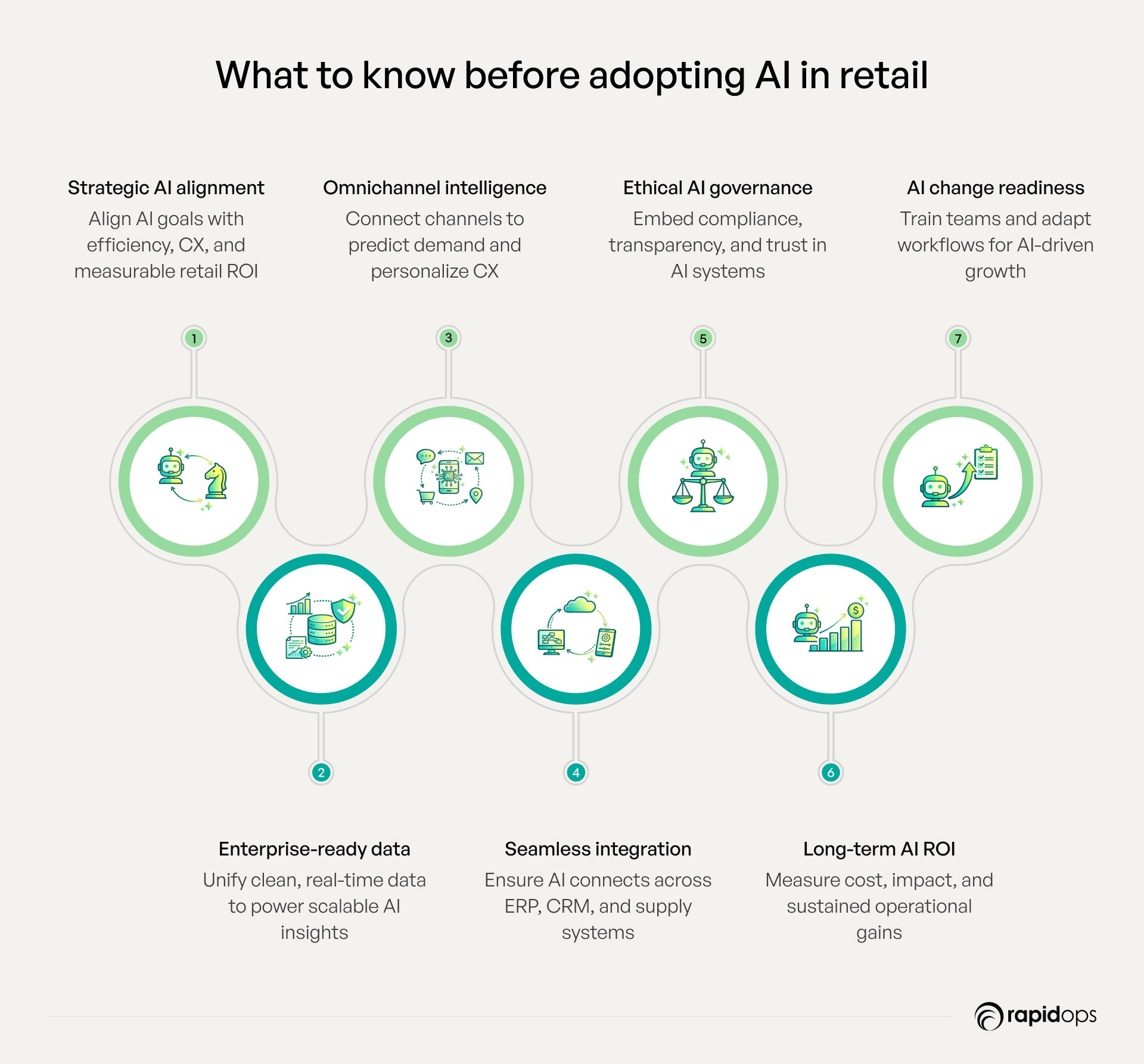
Before integrating AI into retail operations, business leaders must recognize that technology alone is not enough. Success hinges on aligning AI initiatives with strategic objectives, building enterprise-ready data foundations, managing omnichannel complexity, ensuring seamless system integration, embedding ethical governance, and preparing the organization for change. Understanding these core considerations equips leaders to unlock tangible value, drive operational efficiency, and create superior customer experiences while mitigating risk.
1. Establish clear business alignment
AI delivers tangible value when directly aligned with enterprise objectives. Organizations must define what success looks like in terms of operational efficiency, customer satisfaction, inventory management, and supply chain efficiency.
- Map AI initiatives to retail business priorities, such as forecasting demand, optimizing inventory levels, or improving customer retention.
- Focus on customer engagement, loyalty, and personalized interactions to generate measurable ROI.
- Ensure alignment across marketing, operations, and supply chain teams to maximize impact and sustain long-term success.
Strategic alignment ensures AI becomes a decision-enabling system, not a technology experiment.
2. Ensure data foundations are enterprise-ready
Data is the foundation of AI success. Fragmented or inconsistent datasets limit model accuracy and scalability.
- Consolidate customer data, historical sales data, and purchase history into unified platforms to support data-driven decisions.
- Build modern data pipelines and governance structures to maintain data security, quality, and traceability.
- Ensure access to real-time data, real-time data analysis, and demand forecasting signals to drive inventory accuracy, smart inventory, and reduce excess inventory.
Robust data foundations enable AI-powered analytics and ensure operational efficiency across retail operations and supply chain operations.
3. Account for omnichannel complexity
Modern retail spans physical stores, online stores, mobile apps, marketplaces, and social platforms, requiring AI to process complex customer behaviors.
- Integrate AI systems to capture customer preferences, behavior, and interactions across channels.
- Factor in external factors, seasonal trends, and demand fluctuations for inventory optimization and competitor pricing strategies.
- Deliver personalized customer interactions that enhance customer experience and make the shopping experience smoother.
Omnichannel-aware AI enables predictive analytics, forecasts demand, and improves customer satisfaction while maintaining long-term customer loyalty.
4. Assess integration across enterprise systems
Retailers operate in hybrid environments combining legacy systems, cloud platforms, and third-party solutions.
- Evaluate AI tools for compatibility with ERP, CRM, CMS, and supply chain systems.
- Prioritize modular, API-first architectures for seamless integration and minimal disruption.
- Ensure AI adoption supports inventory turnover, operational efficiency, predictive analytics, and supply chain efficiency.
Seamless integration allows AI models to deliver insights across retail business units and major brands, enhancing competitive edge.
5. Embed ethical governance and transparency
AI directly impacts pricing, merchandising, inventory, and customer engagement, requiring responsible implementation.
- Implement bias detection, explainable AI, and audit trails to maintain trust and regulatory compliance.
- Align AI with GDPR, CPRA, and industry-specific standards to safeguard data security.
- Ethical AI protects brand reputation, supports long-term success, and ensures sustainable AI adoption.
Transparent governance enhances AI’s ability to support personalized customer interactions and actionable insights across the enterprise.
6. Evaluate total cost and long-term ROI
AI adoption extends beyond technology; it includes infrastructure, workforce enablement, model training, and ongoing optimization.
- Quantify near-term gains: improved conversion rates, reduced stockouts, optimized inventory levels.
- Measure long-term impact on operational efficiency, supply chain operations, and retail operations.
- Include AI investments, AI implementation costs, and potential competitive edge when calculating ROI.
Clear ROI frameworks enable business leaders to make informed decisions, justify funding, and drive enterprise-wide adoption.
7. Prepare the organization for change
AI transforms workflows, decision-making, and employee roles.
- Invest in training, change management, and intuitive AI tools to empower staff.
- Equip human agents with insights to enhance customer experience, personalize customer interactions, and support increased customer satisfaction.
- Establish feedback loops so AI evolves with retail operations and customer behavior, driving long-term success.
Organizational readiness ensures AI moves from technology adoption to strategic enabler, delivering measurable business value.
AI isn’t the future of retail. It’s the new operating system
Throughout this piece, we’ve explored how AI in retail has moved from isolated experimentation to integrated execution, transforming how enterprises engage customers, optimize operations, and unlock growth. From hyper-personalization to autonomous supply chains, the leading retailers of 2026 aren’t just using AI, they’re being redefined by it.
But here’s the deeper truth: The advantage is no longer in knowing what’s possible; it’s in how you execute. And execution requires more than just tools. It demands experience. Strategy. And a partner who can bridge the gap between AI ambition and real-world retail transformation.
At Rapidops, we bring 16 years of proven expertise in helping mid-to-large retailers turn complex challenges into AI-powered, data-driven solutions. Our experience spans merchandising optimization, inventory management, omnichannel operations, supply chain intelligence, and personalized customer experiences. By implementing scalable and actionable AI systems, we help your business translate insights into action, driving measurable results such as higher revenue, operational efficiency, improved customer loyalty, and a sustainable competitive advantage.
So the question isn’t whether to adopt AI.
It’s whether you’re ready to lead with it before your competitors do. If you’re exploring how to modernize core retail functions, unlock value from your data, or scale intelligent experiences across channels and teams. Schedule a 1:1 session with our AI experts to map out what’s possible and what’s next for your retail business.
Frequently Asked Questions

What’s Inside
- What are AI retail success stories
- What AI in retail looks like in 2026
- Core technologies behind successful AI retail implementations
- How retailers are creating tangible business value with AI
- AI retail success stories transforming the shopping experience
- Top 5 AI use cases transforming retail in 2026
- Key considerations before adopting AI in retail
- AI isn’t the future of retail. It’s the new operating system

Let’s build the next big thing!
Share your ideas and vision with us to explore your digital opportunities
Similar Stories
- AI
- 4 Mins
- September 2022


- AI
- 9 Mins
- January 2023

Receive articles like this in your mailbox
Sign up to get weekly insights & inspiration in your inbox.