


What if the data your business already runs on decades of operational records, customer interactions, and performance metrics could do more than just keep things moving and actually work for you? Today, much of that data is trapped in legacy systems built for stability, not agility. Each siloed database, ERP platform, or departmental application slows decisions, limits visibility, and keeps insights just out of reach.
Legacy systems have provided operational reliability for years, but fragmented data now creates strategic friction. According to Gartner, over 60% of enterprise data remains in legacy systems, leaving leaders with incomplete visibility, slower decision-making, and constrained innovation. For executives, these blind spots affect not only efficiency but also growth, market responsiveness, and competitive positioning.
This is why data integration has become a business imperative. In 2026, disconnected systems can no longer support timely, insight-driven decisions. Unified data flows enable real-time insights, predictive analytics, and actionable intelligence, transforming historical and operational data into measurable business value while maintaining continuity of existing systems.
Modern data integration opens the door to practical approaches for connecting legacy systems with today’s analytics and reporting tools. By streamlining data flows and improving accessibility, organizations are discovering ways to make historical and operational data work harder, without overhauling existing systems.
We’ve highlighted the best possible ways to integrate data within your legacy systems, solutions that are feasible in most business infrastructures and have delivered measurable results for organizations that applied them. By applying these solutions, businesses have been able to turn legacy data from a limitation into a valuable asset, unlocking insights, improving decision-making, and driving tangible business outcomes.
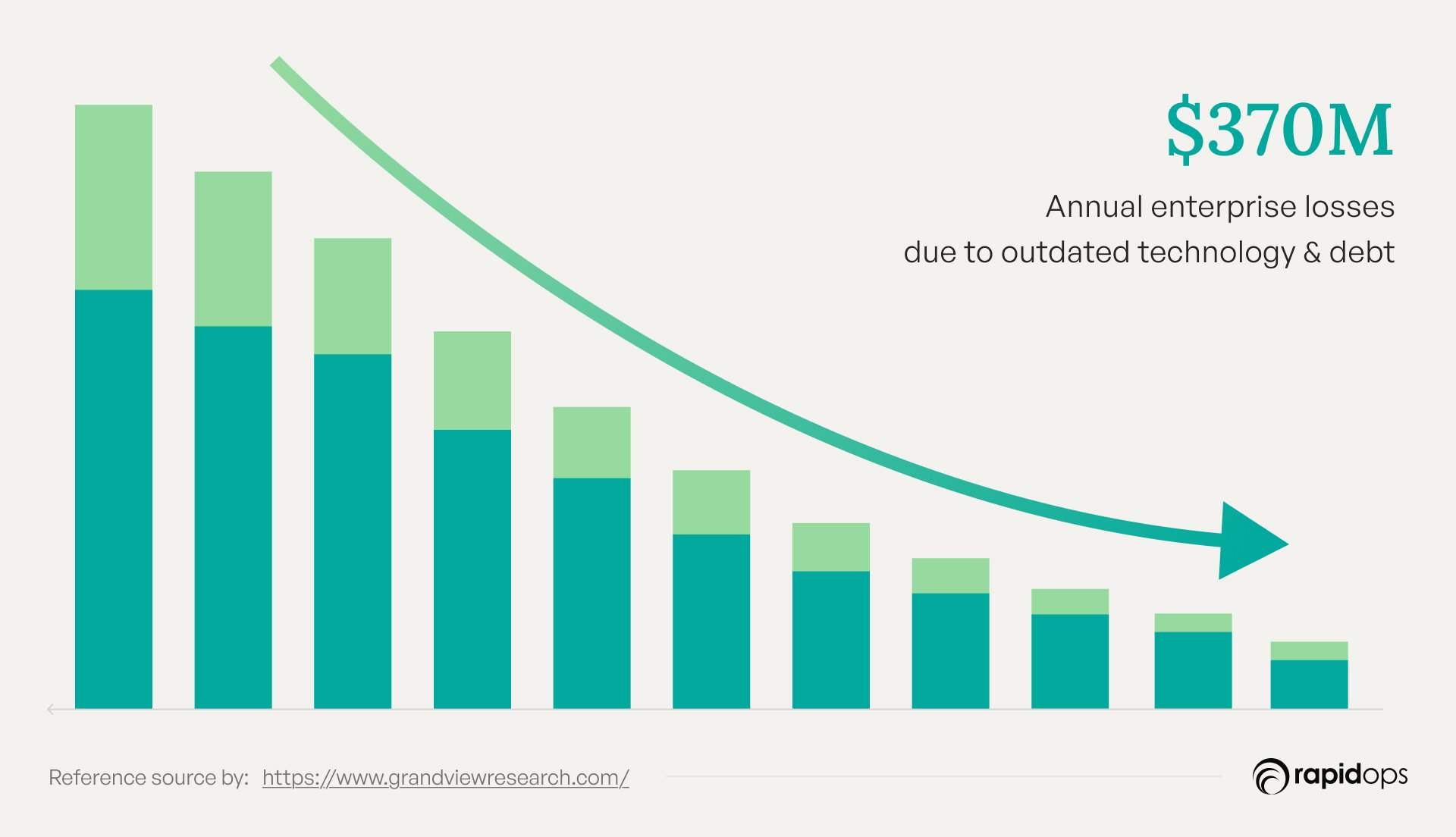
Why your organization can’t ignore modern data integration
Every decision you make relies on data, but what happens when that data is fragmented, outdated, or inconsistent across systems? Each gap or delay quietly slows operations, creates errors, and limits insight, leaving leaders reacting instead of acting. In a world where speed and insight define success, ignoring the risks of disconnected information becomes a strategic liability; how your organization handles data today determines whether it thrives, falters, or falls behind tomorrow. To examine these realities in depth, this piece provides a comprehensive look at data analytics challenges and benefits.
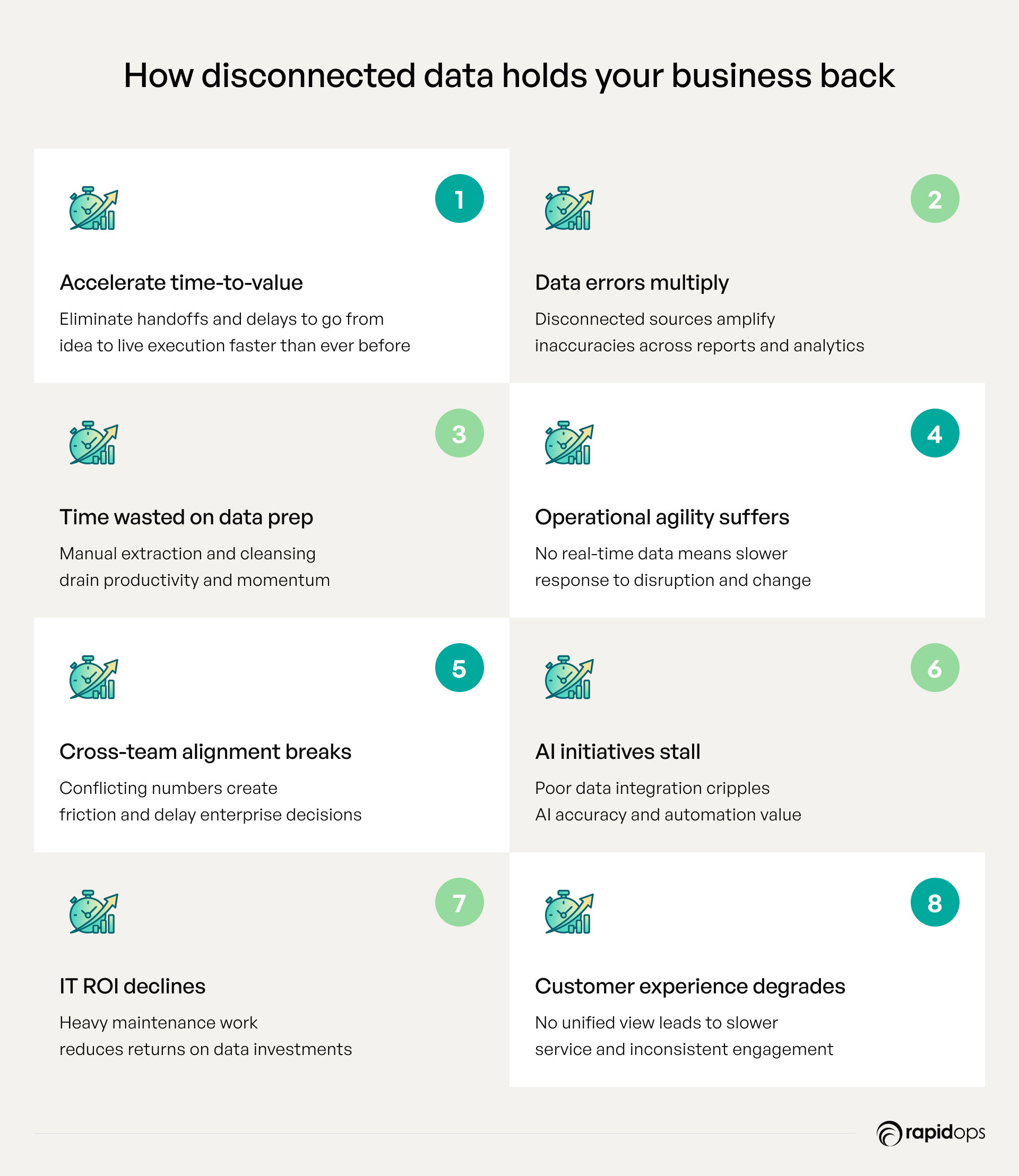
Fragmented insights block decisions
When data from multiple sources remains siloed across data warehouses, data lakes, and operational systems, executives face incomplete insights. Fragmented data prevents a unified view, slowing critical decisions. Studies show 68% of enterprise data goes unanalyzed, and organizations can lose up to 30% of revenue annually due to siloed information. Without integration, leaders are forced to guess, risking strategy and operational direction.
Data errors multiply
Unintegrated raw data from different systems breeds errors that cascade across reports and analytics. 70% of enterprise data is inaccurate or incomplete, costing organizations $12.9–$15M annually. Without data integration platforms or ETL/ELT processes, these errors escalate, misguiding strategy and operational execution. Each unverified dataset increases financial exposure, erodes trust in reporting, and makes analytics unreliable for leadership decisions.
Time wastage increases
Employees spend excessive hours manually extracting data, cleansing, and transforming datasets, rather than analyzing them. Analysts spend up to 80% of their time on preparation, while knowledge workers waste 50% of their work hours finding relevant data. Without modern integration, repetitive data replication, batch processing, and manual reconciliation slow projects, delay decisions, and reduce productivity, turning hours into hidden operational and financial costs.
Operational agility suffers
Disconnected data integration systems block real-time visibility across operational, financial, and customer data. Without real-time data integration or data virtualization, organizations cannot respond quickly to supply chain disruptions, market changes, or internal bottlenecks. As enterprise data doubles every 12–18 months, operational delays compound, creating inertia. Teams face slower forecasting, longer production cycles, and reduced responsiveness, directly impacting revenue and market competitiveness.
Cross-functional alignment falters
Siloed customer, financial, and operational data creates conflict between departments over which figures to trust. Teams spend time reconciling inconsistent datasets, delaying decisions by days or weeks. Poor data governance and mapping undermine collaboration, misalign goals, and diminish productivity. With fragmented insights, cross-functional initiatives stall, employees lose confidence in reporting, and the organization struggles to execute strategy effectively across divisions.
AI and automation stall
Advanced analytics and machine learning depend on integrated, high-quality datasets. Disconnected data from different sources leads to 80% of AI project failures, with model performance dropping up to 40%. Only 13% of organizations report AI-ready data. Without modern data integration, predictive maintenance, automated decisioning, and real-time analytics stall, leaving strategic initiatives reactive instead of predictive.
IT investments underperform
Expensive cloud data warehouses, BI tools, and storage systems underdeliver when data is fragmented. IT teams spend up to 44% of their time maintaining pipelines, mapping, and cleansing data instead of innovating. Without data integration solutions or connectors, ROI on technology investments drops, technical debt rises, and internal resources are consumed by repetitive tasks rather than value-added analytics and decision support.
Customer experience suffers
Fragmented customer data impedes personalization and responsiveness. Agents, marketing, and sales teams cannot access a unified view, resulting in slow service and inconsistent experiences. Resolution times can increase by 40% when systems are disconnected, reducing customer satisfaction, loyalty, and lifetime value. Without integrated customer, operational, and transactional data, organizations risk churn and fail to deliver the seamless omnichannel experiences that modern customers expect.
Competitive agility falls behind
Organizations ignoring modern integration cannot detect trends, analyze insights, or pivot strategies quickly. Fragmented data from multiple sources slows innovation, limits advanced analytics, and reduces adaptability to market changes. Competitors leveraging cloud data integration, real-time analytics, and unified data platforms gain a decisive advantage, capturing opportunities. At the same time, slower organizations lose market share, strategic flexibility, and overall competitiveness in a rapidly evolving business landscape.
Ignoring modern data integration is not a technical issue; it’s a strategic risk. Fragmented insights, poor data quality, wasted time, stalled AI, regulatory exposure, and weakened customer experience cascade to threaten operations, profitability, and competitive advantage. Organizations must integrate data across systems to enable informed decisions, operational resilience, and sustained market leadership.
The role of legacy systems in modern data integration
Legacy systems serve as strategic repositories of operational data, storing decades of trusted customer information, financial data, and business process details. Even in 2026, 62% of enterprises rely on these systems for core operations. Their disparate data structures and existing data silos, however, make it challenging to access data quickly and integrate it with modern analytics or cloud platforms.
Modern data integration transforms this challenge into an opportunity. Using data ingestion, extract, transform, and load (ETL) processes, data replication, and data migration, organizations can consolidate data from multiple sources, combining data from legacy systems with real-time operational data. This enables a unified view across systems, reduces manual data entry, improves data quality, and supports advanced analytics and machine learning initiatives.
By applying robust integration strategies, enterprises can leverage legacy systems as active contributors rather than obstacles. This approach ensures regulatory compliance, accelerates decision-making, and unlocks tangible benefits, from actionable insights to improved operational agility. It also highlights the importance of legacy system modernization, allowing legacy and modern platforms to work together seamlessly for strategic advantage.
Why legacy systems remain indispensable
Legacy systems persist not because enterprises resist change, but because these platforms embed decades of business logic, regulatory compliance, and operational nuance. Replacing them is risky, costly, and can disrupt revenue-critical operations.
Consider the numbers: enterprise research indicates that legacy transformation projects cost $134 million annually, with an additional $56 million in ongoing maintenance and integration costs.
These investments are justified. Legacy systems store historical operational data and enforce compliance rules that modern systems often cannot replicate immediately. Attempting to bypass or replace them without a clear integration strategy can jeopardize operations and compromise regulatory adherence, especially in industries like finance, healthcare, and logistics.
Technical realities that shape integration
Integration challenges are rooted in the design of legacy systems themselves. Built for stability rather than adaptability, they often rely on monolithic architectures, batch processing, and proprietary formats, with minimal support for modern APIs or cloud-native protocols.
- Integrating legacy systems with modern platforms can increase performance variability by 165%, with nearly 50% of transactions exceeding acceptable latency thresholds under peak loads.
- Legacy systems frequently lack documentation, making it challenging for integration teams to understand data flows, dependencies, and constraints, increasing the risk of errors during modernization initiatives.
These technical realities underline why understanding the architecture, workflows, and limitations of legacy systems is a non-negotiable first step in modern data integration.
Financial and strategic implications
The cost of ignoring legacy system realities is steep. Analysis shows that up to 60–80% of IT budgets are spent simply maintaining these systems, leaving only a fraction for innovation or modernization.
From a strategic standpoint, these systems present a paradox: they are critical for business continuity but resist modern agility. Enterprises that fail to carefully assess legacy systems before integration risk data inconsistencies, project delays, and unplanned costs, potentially undermining the value of modern data platforms.
By understanding the strategic role, technical constraints, and operational nuances of legacy systems, enterprises can turn potential obstacles into enablers. This insight allows organizations to protect critical data, minimize risk, and build a strong foundation for modern data integration, ensuring that legacy and contemporary systems work together to deliver real business impact.
What is modern data integration
Modern data integration is about connecting, harmonizing, and making sense of data across diverse systems, especially in enterprises where legacy platforms remain critical. It ensures that data from legacy systems, cloud applications, databases, and external sources can flow seamlessly into a unified, trusted framework for operational and analytical use.
Unlike traditional batch-oriented ETL, modern integration emphasizes real-time or near-real-time processing, hybrid connectivity, and automation, allowing enterprises to maintain agility without disrupting core operations. The global data integration market is experiencing explosive growth, projected to increase from $15.18 billion in 2026 to $30.27 billion by 2030, with streaming analytics alone expected to reach $128.4 billion by 2030, reflecting rising demand for hybrid integration, cloud adoption, and AI-driven insights.
Core capabilities of modern data integration
- Hybrid & multi-cloud connectivity: Connects on-premises systems and multiple cloud platforms seamlessly, enabling unified governance and accessibility. This is one of the key types of system integration used in modern enterprises.
- Real-time & event-driven data processing: Supports streaming and event-driven data pipelines for live analytics, operational dashboards, and faster decision-making.
- Embedded data quality & observability: Automated validation, cleansing, and lineage tracking ensure data reliability and trustworthiness.
- API-first and modular architecture: API and microservices allow flexible, reusable API integration patterns, simplifying the onboarding of new data sources. For more advanced approaches, learn about the types of API integration
- AI-augmented automation & low-code interfaces: AI-assisted mapping, transformation, and workflow automation reduce manual effort and enable business users to participate in integration tasks.
Modern integration in the context of legacy systems
For enterprises with legacy systems, modern data integration provides a non-disruptive bridge. Instead of replacing legacy platforms, it enables existing databases and applications to feed unified, real-time views, supporting analytics, AI, and reporting without operational disruption. However, these investments don’t automatically translate into success. IBM’s Institute for Business Value (IBV) found that more than 53% of surveyed executives reported that difficulties integrating AI infrastructure with legacy systems derailed target outcomes, highlighting the critical role of modern integration in bridging these gaps.
Advanced integration techniques, such as data virtualization, event-driven pipelines, and hybrid connectors, allow enterprises to combine historical legacy data with real-time streams. This approach maximizes the value of existing investments while enabling modern capabilities, making legacy systems active contributors rather than obstacles.
How modern data integration transforms operations and strategy
You’ve seen the chaos of fragmented systems, missed deadlines, delayed orders, and teams scrambling for the right data. But what if every system, from legacy ERP to modern cloud tools, could speak the same language? Modern data integration makes it possible, transforming operations, predicting bottlenecks, and enabling strategic pivots, turning scattered data into unified, actionable intelligence that powers smarter decisions and faster growth.
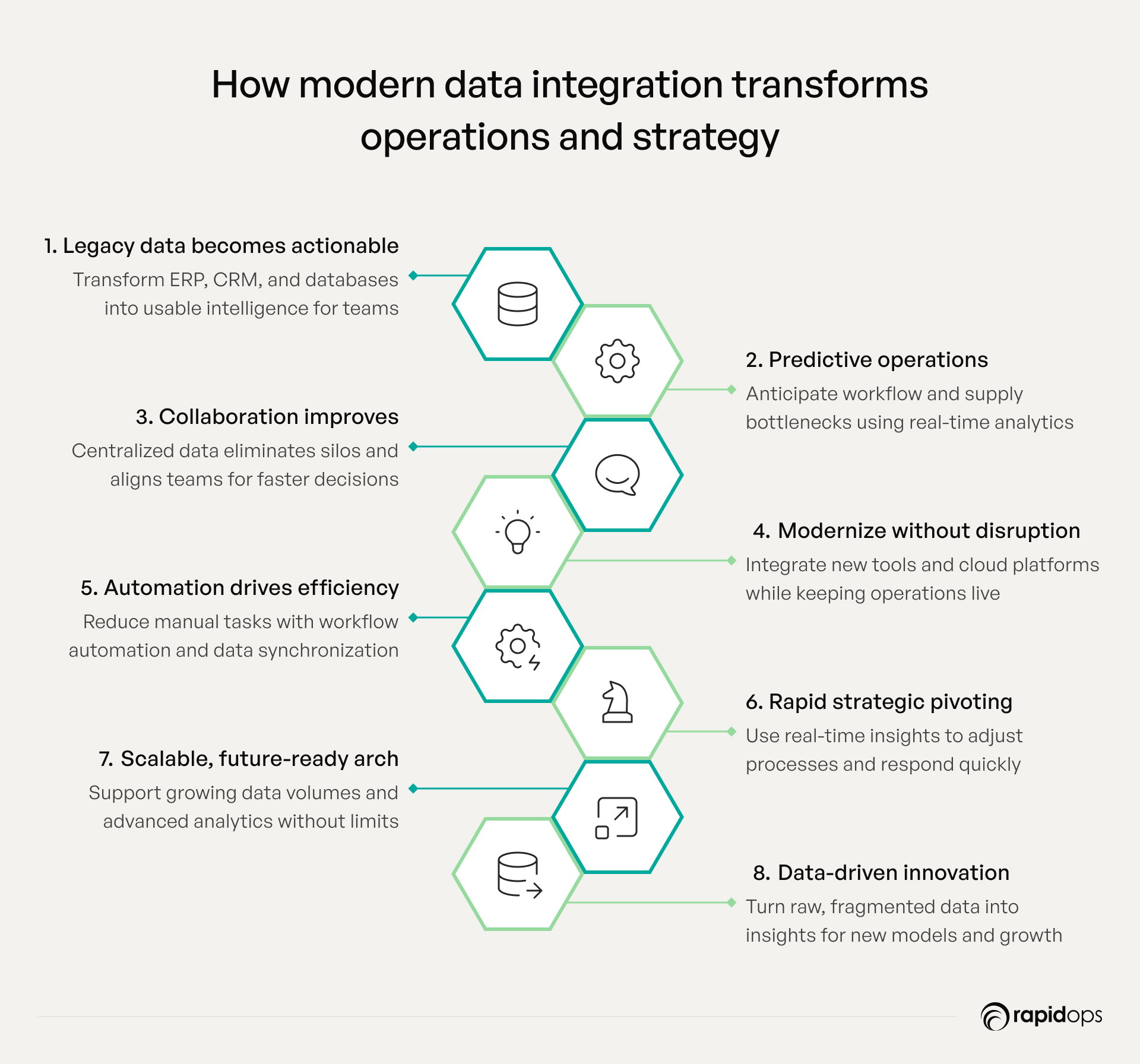
Legacy data becomes actionable
Data integration enables legacy systems such as ERP, CRM, financial databases, and product catalogs to become sources of actionable intelligence. Through ETL (Extract, Transform, Load) or ELT (Extract, Load, Transform) processes, organizations can extract data from multiple sources, transform it for accuracy and consistency, and load it into a target system or data warehouse.
Tools like cloud data integration and data virtualization allow for a unified view without moving physical data, providing a single, reliable dataset for analytics and reporting. This approach improves data quality, reduces errors from manual data entry, and ensures historical and operational data drives supercharge your operational efficiency with data analytics across teams.
Predictive operations anticipate bottlenecks
Modern data integration supports real-time data integration and data streaming, enabling predictive operations that anticipate workflow and supply chain bottlenecks. By combining operational data from multiple data sources with analytics, organizations can identify patterns and predict delays before they disrupt performance. Industries such as manufacturing leverage predictive maintenance by analyzing sensor data to prevent equipment failure, while financial services detect fraud by combining transaction logs and historical data in real time. These capabilities allow organizations to act proactively, reducing downtime, improving throughput, and ensuring smooth operations.
Collaboration across teams improves
Integration creates a centralized data store that consolidates data from different sources, eliminating data silos and improving collaboration across departments. Sales, operations, finance, and service teams all access consistent, high-quality data, enabling them to make coordinated decisions. Retail organizations, for example, integrate customer data from online, mobile, and in-store interactions to provide an omnichannel experience, while healthcare systems merge real-time patient data from IoT devices with historical records for improved care. Unified access ensures all teams operate on the same reality, enhancing efficiency and alignment.
Modernization occurs without disruption
A modern data integration platform allows businesses to modernize systems without halting existing operations. Middleware and integration layers enable application integration between legacy systems and new tools, while cloud data integration supports hybrid infrastructures. This seamless connection lets organizations adopt AI, analytics, or data lakes gradually, maintaining daily operations while enhancing insights. Companies such as Paycor and the University of New Orleans demonstrate that cloud-enabled integration automates ETL processes and standardizes analytics without disrupting workflows, providing measurable ROI and compliance benefits.
Automation drives efficiency
Automated data integration processes reduce reliance on manual data entry and improve operational efficiency. Data replication, data synchronization, and workflow automation allow organizations to continuously process and transfer data across systems. Tasks like reporting, alerts, exception handling, and inventory updates are executed automatically, minimizing human error. Automation not only accelerates business processes but also frees teams to focus on strategic analysis, while integrated governance tools ensure compliance and maintain high-quality data for analytics and decision-making.
Rapid strategic pivoting is enabled
Integrated data provides leadership with real-time insights to maximize business impact with decision intelligence. By analyzing operational, financial, and customer data from multiple sources, decision-makers can adjust resources, optimize processes, and respond to market or operational shifts immediately. Organizations can simulate scenarios using advanced analytics and data virtualization, reallocating efforts where needed and ensuring strategy remains responsive.
Scalable, future-ready data architecture
Modern integration solutions build scalable, future-ready architectures that support increasing volumes of operational and analytical data. By consolidating data from multiple data sources into data warehouses, data lakes, or virtualized layers, organizations can onboard new systems and analytics tools without overhauling infrastructure. Scalable architectures support advanced analytics, machine learning, and hybrid cloud environments while maintaining data governance and security standards. This ensures that businesses can grow, innovate, and adopt emerging technologies without being constrained by legacy limitations.
Data-driven innovation is unlocked
Finally, modern data integration unlocks data-driven innovation by transforming raw and fragmented data into insights that fuel new business models, services, and operational efficiencies.
By combining operational data, customer data, and data from different sources, organizations can apply machine learning and advanced analytics to optimize performance, identify opportunities, and improve customer experiences. Integrated data enables continuous improvement, predictive insights, and experimentation, turning data into a core strategic asset for innovation and competitive advantage.
The modern data integration solution for unified systems and insights
As we’ve discussed, the most effective way to bridge fragmented systems and unlock actionable insights is through a modern data integration approach, one designed to streamline operations, reduce errors, and establish a single, reliable source of truth.
In environments where legacy platforms and modern applications must coexist, this approach relies on an architectural connective layer that coordinates how data moves across systems without disrupting existing operations. This is where middleware quietly plays its role: not as a replacement, but as the mechanism that enables systems to communicate, align, and operate as one unified ecosystem.
How middleware bridges legacy and modern systems seamlessly
Understanding this solution requires looking at how middleware orchestrates data movement, controlling what information flows between systems, in what format, and at what moment, so legacy and modern platforms operate as a single, coordinated environment.
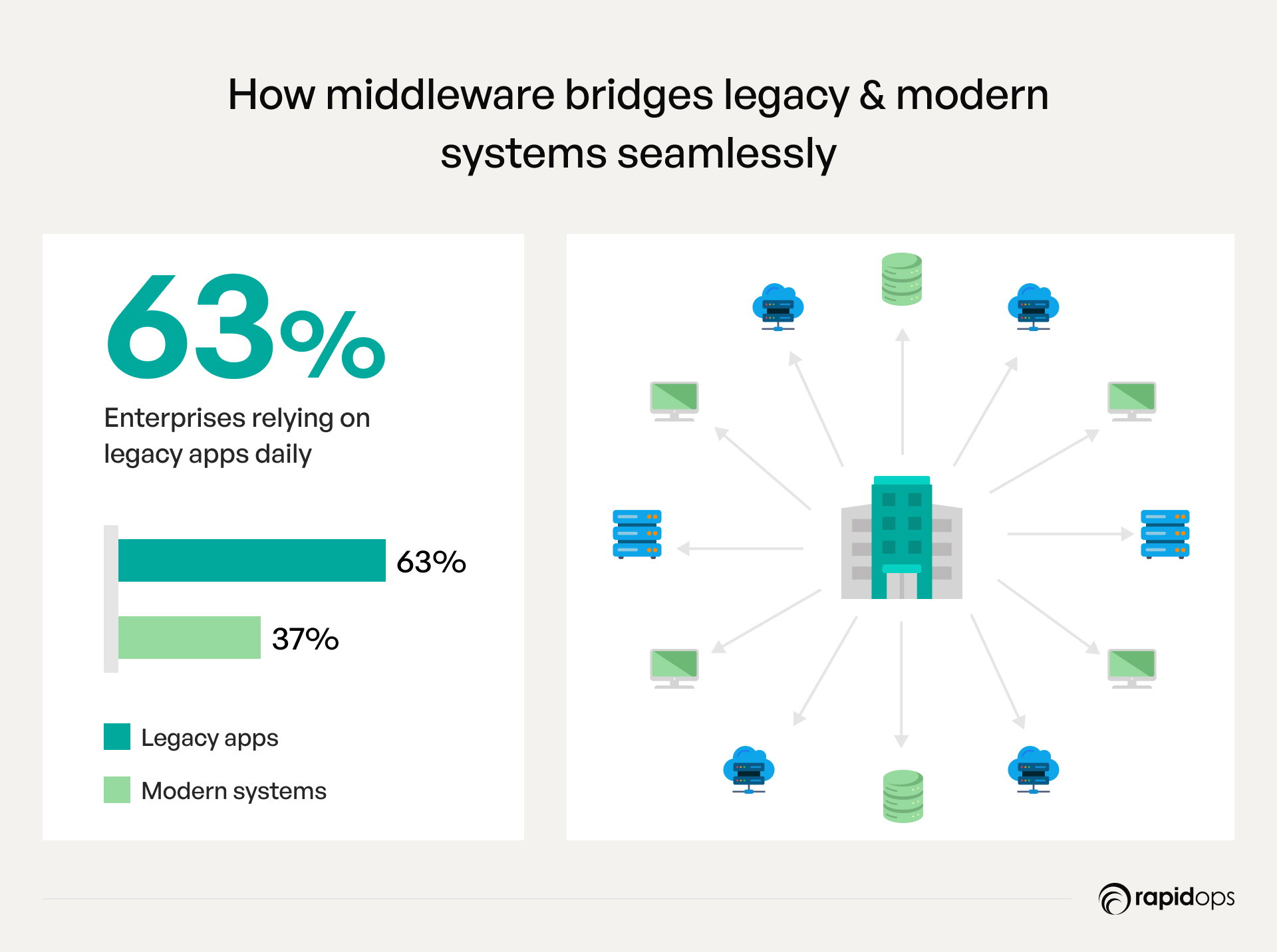
How middleware connects:
Data moves systematically through middleware: ERP → Middleware → CRM → Analytics Platform → Operational Tools → Cloud Applications. Middleware ensures each system receives the data it needs in real time, eliminating gaps and bottlenecks.
- Middleware as a translation engine: Each system “speaks its own language.” Middleware interprets, transforms, and routes data automatically, converting formats, units, and protocols so that every system understands and processes the information accurately.
- Workflow orchestration: Middleware intelligently decides what data goes where, when, and in what format, enforcing business rules, validation standards, and consistency checks across systems. This ensures all operations remain synchronized, from order processing to financial reporting.
- Integration platform support: Middleware works in tandem with APIs, connectors, and mapping tools to unify structured and unstructured data streams, providing a scalable framework that supports future system additions, cloud adoption, and advanced analytics platforms without disrupting existing workflows.
By connecting systems automatically, middleware eliminates manual reconciliation, reduces errors, ensures all teams see the same accurate information, and accelerates operational execution. Sales, operations, finance, and strategy teams gain a shared, real-time view of enterprise data, enabling better coordination and faster decisions.
Key outcomes for executives:
- Reliable connectivity: Continuous, automated flow between all legacy and modern systems.
- Data integrity: Validation and transformation rules ensure accurate, trustworthy information.
- Operational efficiency: Fewer manual steps, reduced errors, faster execution.
- Scalable architecture: New tools, platforms, or cloud services can be added seamlessly.
Middleware and integration platforms transform a fragmented technology landscape into a connected, intelligent ecosystem, forming the foundation for enterprise resilience, operational clarity, and strategic agility.
Steps to integrate data across systems
While middleware and data integration platforms form the backbone of unified systems, successful data integration follows a structured sequence to ensure reliability, accuracy, and scalability. Understanding these steps helps organizations bridge legacy and modern platforms systematically, rather than relying on ad hoc solutions. Modern enterprises leverage real-time data integration, cloud data integration, and automated data governance tools to maximize the value of both operational data and customer data.
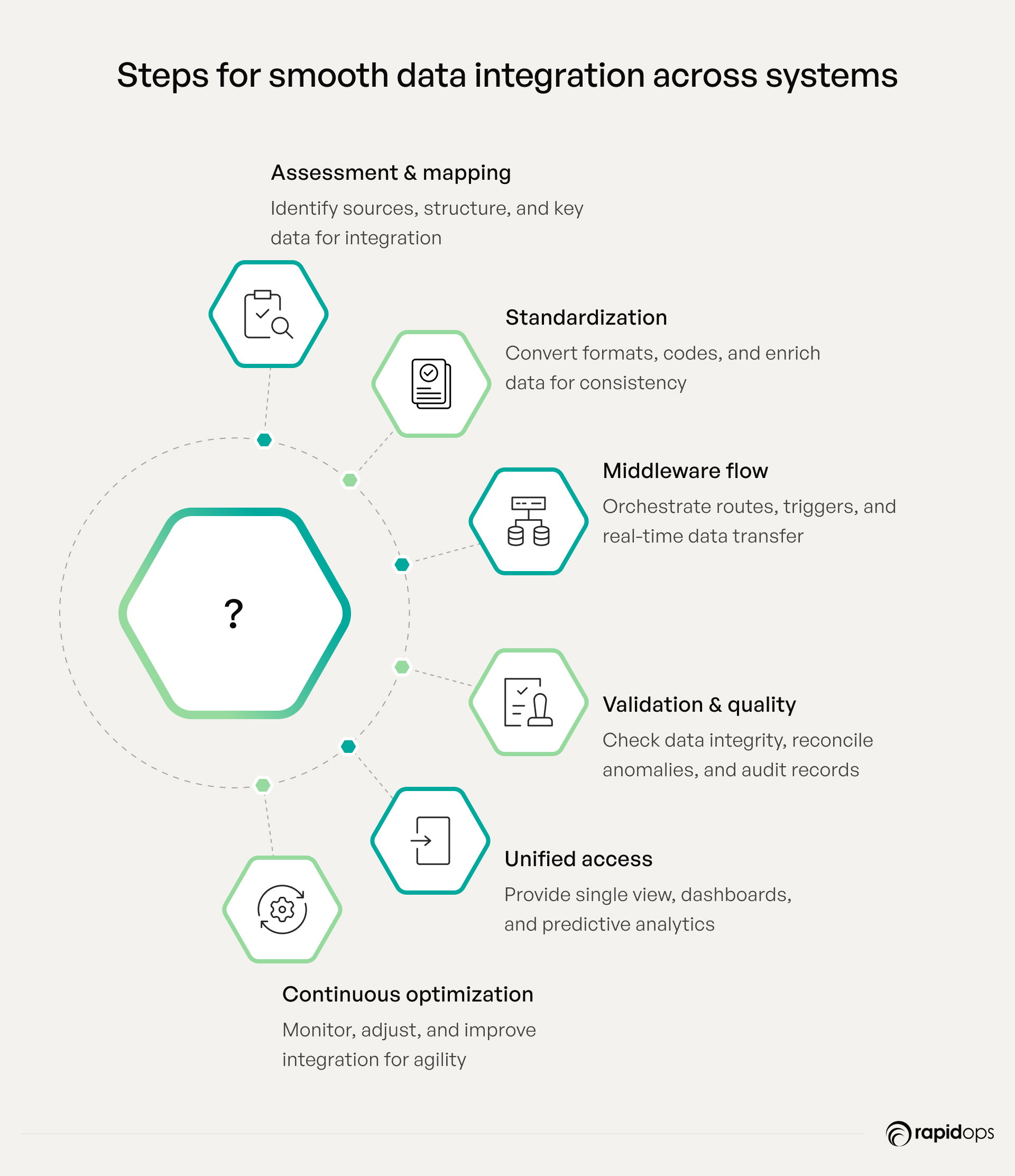
1. Assessment and data mapping: Know your landscape
Before any data integration work begins, it’s critical to understand the current data landscape. This involves:
- Identifying all data sources, including legacy ERP platforms, mainframes, CRMs, operational databases, cloud applications, and SaaS tools.
- Mapping the type, structure, and flow of data from different sources, including tables, APIs, batch processes, and dependencies.
- Highlighting critical data sets such as financial records, supply chain logs, and customer interactions.
Without a detailed assessment, integration can introduce data silos, duplicates, or errors. Proper mapping enables secure, reliable data replication and forms the foundation for high-quality data.
Expert tip: Use data virtualization and automated discovery tools to generate a complete map of all enterprise data sources.
2. Standardization and transformation: Make data speak the same language
Legacy and modern systems rarely share formats, units, or terminology. Standardization and transformation ensure data from multiple sources can be consolidated and interpreted consistently:
- Convert formats, currencies, timestamps, and data types.
- Harmonize codes, IDs, and naming conventions.
- Apply enrichment processes like deduplication or filling missing fields.
Standardized and transformed data eliminates conflicts and errors, enabling accurate data analysis, advanced analytics, and AI-driven insights.
Expert tip: Leverage ELT (Extract, Load, Transform) tools and data quality frameworks to automate processing data at scale.
3. Middleware-orchestrated data flow: Centralize control
Middleware orchestrates how data integration involves connecting systems seamlessly:
- Define routes, triggers, and schedules for data transfer across ERP, CRM, cloud data warehouses, and analytics platforms.
- Implement business rules to enforce compliance, security, and operational standards.
- Support real-time data integration or batch updates depending on data criticality.
Middleware enables scalable application integration, avoids bottlenecks, and ensures operational data is available to the right teams at the right time.
Expert tip: Choose middleware that handles structured and unstructured data, APIs, and hybrid environments for maximum flexibility.
4. Validation and quality checks: ensure data integrity
Data quality is central to actionable insights:
- Reconcile data across systems to detect anomalies, duplicates, or missing records.
- Implement alerts and error-handling workflows.
- Audit data replication and access for compliance.
Maintaining high-quality data builds trust across teams and ensures executives and operational staff can make confident decisions.
Expert tip: Use AI-powered anomaly detection and data governance tools to proactively prevent errors.
5. Unified access and analytics enablement: turn data into insights
Integration is incomplete until data is accessible and actionable:
- Provide a unified view across departments, breaking down data silos.
- Enable dashboards, KPI monitoring, predictive machine learning, and scenario modeling using data from different sources.
- Ensure role-based access to protect sensitive information.
Unified data accelerates decision-making, reduces operational friction, and enhances strategic alignment.
Expert tip: Incorporate data virtualization and self-service analytics to empower teams without heavy IT dependency.
6. Continuous monitoring and optimization: integration is an ongoing process
Modern data integration platforms require constant evolution:
- Monitor performance, latency, and error rates continuously.
- Adjust workflows, middleware, and business rules as new systems or applications are introduced.
- Conduct regular audits to ensure data quality, compliance, and alignment with business objectives.
Continuous optimization ensures scalability, resilience, and operational agility, supporting future technologies and ongoing digital transformation.
Expert tip: Establish a dedicated integration center of excellence (CoE) to oversee data integration processes, data governance, and best practices.
By following these steps, from assessment and data mapping to continuous optimization, organizations can transform fragmented legacy and modern systems into a connected, intelligent ecosystem. Data integration becomes a strategic enabler, not just a technical task. Enterprises gain high-quality data, a unified view, and real-time insights that fuel advanced analytics, machine learning, and operational efficiency. Executives and teams can act decisively, leveraging data from multiple sources and cloud data integration to unlock the full value of their operational data.
How to use data across systems: Unified access, analytics, and actionable insights
Connecting systems is only the first step. The true strategic value arises when integrated data is accessible, harmonized, and actionable across the organization. Unified data ensures executives and teams operate from a single source of truth, aligning decisions with accurate, up-to-date insights.
- Unified access across the enterprise: Middleware and integration platforms allow all stakeholders, sales, operations, finance, and strategy teams, to access consistent, authoritative data. Silos are eliminated, ensuring alignment in decision-making and operational execution.
- Advanced analytics and insights: Harmonized data powers predictive analytics, AI-driven insights, KPI dashboards, and scenario modeling, enabling leaders to anticipate market trends, optimize processes, and make data-driven strategic decisions rather than reactive guesses.
- Actionable intelligence: Integrated data flows directly to decision-makers in real time, enabling timely, confident action across operational, financial, and customer-facing functions. Leaders can implement strategies faster, reduce operational risks, and respond to market or customer demands proactively.
By transforming connected data into insights, organizations convert raw information into a high-value enterprise asset. Executives gain clarity, confidence, and agility, while teams across the enterprise execute with precision and alignment.
Middleware and integration platforms do not just connect systems; they enable organizations to harness data as a strategic asset, powering smarter, faster, and more confident decision-making at every level.
The modern data integration solution is a strategic enabler that connects legacy and modern systems, harmonizes enterprise data, and provides unified access to actionable insights. Middleware, APIs, and integration platforms ensure real-time, reliable, and accurate data flows, transforming fragmented workflows into an intelligent, connected ecosystem.
Practical examples of modern data integration with legacy systems
Modern data integration empowers organizations to transform fragmented legacy systems into strategic assets. By consolidating data from multiple sources and creating a unified view, businesses gain real-time insights, operational efficiency, and improved customer experiences. These examples demonstrate how organizations across retail, manufacturing, and distribution can modernize while preserving their legacy investments.
1. Large omni-channel retailer: Unified inventory across channels
A North American retailer faced chronic inventory discrepancies across stores, warehouses, and online channels due to legacy ERP and disconnected POS systems. Delayed updates and manual reconciliations caused stockouts, lost sales, and frustrated teams. By implementing middleware with real-time data integration into a centralized data store, inventory data now flows seamlessly across all channels. Sales, store, and supply chain teams access high-quality data in real time, enabling proactive replenishment, reducing stockouts by 40%, and improving decision-making speed by 90%. The integration also created a common operational dashboard, allowing executives to monitor inventory trends and plan promotions dynamically. This case illustrates how modern integration can bridge legacy systems with digital tools to drive operational excellence.
2. Lotus’s grocery retail: 370 systems, one coherent ecosystem
Lotus’s in Thailand managed over 370 legacy retail systems for pricing, promotions, and inventory, creating fragmented processes and slowing digital initiatives. Middleware acted as a connective layer, integrating all legacy systems with modern eCommerce, partner portals, and loyalty programs. Through cloud data integration, orders, stock levels, and promotions now flow automatically across all channels, creating a single source of truth for both operations and customers. Teams can launch digital campaigns faster, coordinate stock efficiently, and provide consistent customer experiences. Centralized reporting now highlights demand trends, inventory bottlenecks, and promotion performance in real time, showing how even highly complex legacy environments can be modernized without disrupting existing systems.
3. Oldcastle precast: Construction project visibility
Oldcastle Precast, a US manufacturer, struggled with fragmented project data spread across ERP, CRM, and cloud collaboration platforms. Sales and operations teams lacked visibility into quotes, production schedules, and delivery timelines, causing delays and errors. Middleware integrated these systems, consolidating data from multiple sources into a unified view, ensuring accurate, real-time project information. Teams can now track quotes, monitor production, and coordinate deliveries efficiently, reducing errors and accelerating project timelines. Access to high-quality data enables managers to make proactive decisions, forecast resource needs, and respond quickly to client requirements. This example highlights how manufacturing organizations can retain legacy ERP systems while leveraging modern tools for actionable insights.
4. ACORN East: consistent multi-channel ordering for distribution
ACORN East, a US food-service distributor, experienced inconsistencies between ERP, CRM, and eCommerce platforms, resulting in delayed order processing and manual reconciliation. Middleware integration enabled real-time data integration across all systems, ensuring synchronized inventory, pricing, and orders. Sales teams and customers now see the same information, improving accuracy and response times. The integration also automated workflows for repeat orders, reduced manual entry errors, and allowed operations to scale without additional staff. A unified view of customer interactions enables better forecasting, faster dispute resolution, and more personalized service. This demonstrates how distributors can modernize operations and customer experiences while preserving core legacy systems.
How technical partners help in modern data integration with legacy systems
Bringing modern systems together with legacy IT can be overwhelming, but technical partners act as navigators, turning complexity into clarity. They start by looking under the hood of your existing systems, understanding where data is trapped, processes are slow, or errors occur. This insight allows them to map out a smart, scalable integration plan that connects old and new systems without disrupting day-to-day operations.
During the integration, partners use tools and methods like APIs, ETL/ELT pipelines, event streaming, and change data capture (CDC) to ensure data moves quickly, accurately, and securely. They make sure data is clean, trustworthy, and compliant, so decision-makers can rely on it for planning, forecasting, and analytics.
Technical partners also fill gaps in skills and resources, giving your team the expertise needed without hiring full-time specialists. After implementation, they monitor, optimize, and support systems continuously, helping your integration adapt as your business grows and new technologies emerge.
Major challenges while integrating middleware with legacy systems for data integration
Integrating middleware with legacy systems is essential for modern data integration, but it comes with a unique set of challenges. These challenges arise because legacy platforms were not built for real-time data, multiple sources, or cloud-enabled operations. Middleware enables connectivity, but technical, operational, and organizational complexities must be addressed for seamless integration.
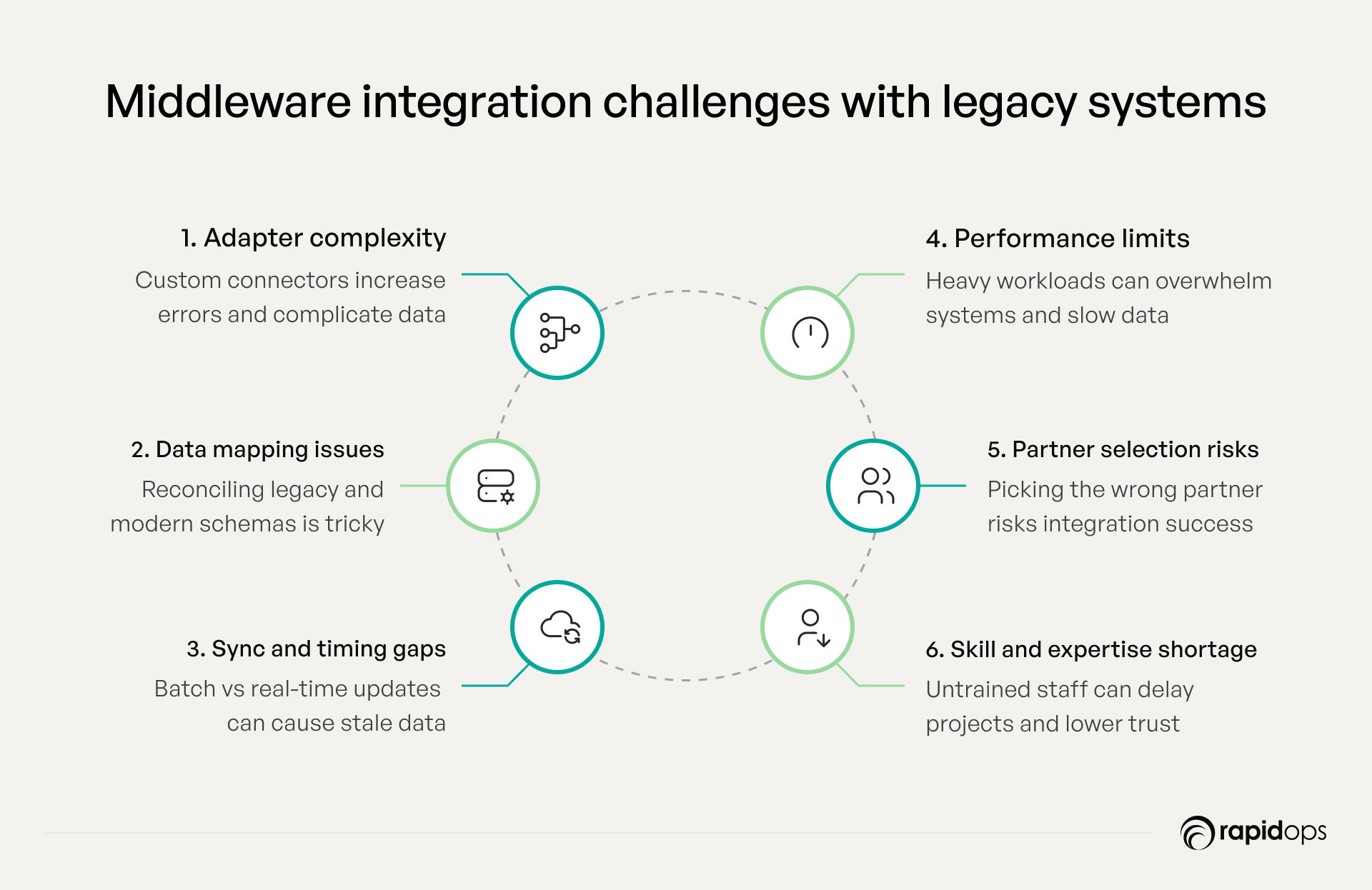
1. Adapter and connector complexity
Legacy systems often rely on proprietary protocols or outdated interfaces, requiring custom middleware adapters to integrate data across platforms. Designing, testing, and maintaining these connectors increases technical complexity and can introduce data replication or transformation errors if not carefully managed. Ensuring adapters support both batch and real-time data integration while preserving data quality is a persistent challenge.
2. Data mapping and transformation challenges
Middleware must reconcile differences between rigid legacy schemas and flexible modern data models. Mapping fields across systems, aligning business rules, and transforming operational, financial, or customer data is complex. Inaccurate transformations can compromise high-quality data and affect downstream analytics or advanced analytics initiatives. This challenge is amplified when integrating data from multiple sources like ERPs, CRMs, and data lakes.
3. Synchronization and timing issues
Legacy systems often process information in batch cycles, while modern platforms demand real-time data integration. Middleware must orchestrate workflows to handle asynchronous updates, avoid duplicate or stale records, and maintain a unified view across operational and analytics platforms. Misalignment can disrupt business processes and reduce the reliability of data from multiple sources.
4. Performance and scalability constraints
Middleware integration introduces new workloads that legacy systems weren’t designed to handle. High-frequency data ingestion, multiple simultaneous connections, and complex data integration processes can overwhelm system resources, leading to bottlenecks, latency, or errors during data transfer. Planning for scalable architectures is critical to maintain operational data integrity across the enterprise.
5. Error handling and monitoring limitations
Legacy systems often lack robust logging or error-reporting mechanisms. Middleware must detect, propagate, and resolve anomalies while ensuring compliance and traceability. Insufficient observability can impact data governance, hinder automated data replication, and make it difficult to maintain consistent data quality across integrated environments.
6. Skill gaps and organizational challenges
Successfully implementing middleware integration requires expertise in both legacy platforms and modern integration tools. Organizations often lack skilled data engineers or staff familiar with data virtualization, ETL/ELT processes, and modern data integration platforms. This skill gap can delay projects, introduce errors, and reduce confidence in integrated data for operational and strategic decision-making.
7. Partner selection and dependency risks
Choosing the right integration partner is critical. A partner without deep experience in legacy and modern systems may mismanage data mapping, fail to optimize middleware workflows, or compromise data integration efforts. Reliance on external expertise adds dependency risks and can affect the long-term maintainability of integrated systems.
While middleware provides the bridge to connect legacy and modern systems, organizations must navigate adapter complexity, data transformation challenges, synchronization mismatches, performance limits, error-handling gaps, and skill shortages. Addressing these challenges strategically ensures that modern data integration delivers high-quality data, unified access, and actionable insights from legacy systems to support advanced analytics, operational efficiency, and enterprise-wide decision-making.
Turning legacy data into actionable insights with modern integration
Your legacy systems hold years of valuable operational, customer, and financial data, but making them work together can feel overwhelming. Siloed applications, inconsistent formats, and manual data entry often slow decision-making and frustrate teams. Modern data integration transforms this complexity into clarity, consolidating data from multiple sources, standardizing it, and making it accessible in real time.
With the right approach, these once-fragmented systems can deliver actionable insights, support advanced analytics, and even fuel machine learning initiatives, turning your legacy systems from a roadblock into a strategic advantage.
At Rapidops, we bring decades of experience helping organizations bridge this exact gap. Our experts don’t just implement tools; they work closely with your operations, understand your workflows, and design integration architectures that unify systems without disrupting your business. From middleware implementation to real-time analytics and actionable dashboards, we ensure your data is accurate, accessible, and meaningful, giving your teams the confidence to act decisively every day.
Curious how your legacy systems can be integrated seamlessly? Book a no-cost call with our integration experts to assess your current setup and discover what it takes to fully integrate your systems.
Frequently Asked Questions

What’s Inside
- Why your organization can’t ignore modern data integration
- The role of legacy systems in modern data integration
- What is modern data integration
- How modern data integration transforms operations and strategy
- The modern data integration solution for unified systems and insights
- How middleware bridges legacy and modern systems seamlessly
- Steps to integrate data across systems
- How to use data across systems: Unified access, analytics, and actionable insights
- Practical examples of modern data integration with legacy systems
- How technical partners help in modern data integration with legacy systems
- Major challenges while integrating middleware with legacy systems for data integration
- Turning legacy data into actionable insights with modern integration

Let’s build the next big thing!
Share your ideas and vision with us to explore your digital opportunities
Similar Stories
- Transformation
- undefined Mins
- March 2022


- Transformation
- undefined Mins
- March 2020

Receive articles like this in your mailbox
Sign up to get weekly insights & inspiration in your inbox.