


Your business doesn’t slow down because of a lack of technology. It slows down when systems don’t move at the same speed, forcing manual data transfers, misaligned reports, and broken workflows that delay decisions. In fact, studies show that organizations without proper system integration spend up to 30% of employee time on manual reconciliation and suffer from data errors in over 25% of reports, directly impacting productivity and timely decision-making. This is the everyday reality for businesses running multiple systems without a reliable integration layer.
Middleware is the game-changing engine your business has been waiting for. It’s not just a technical layer hidden in the background, it’s the command center that connects the systems across your organization, transforming disconnected applications into a single, intelligent network. With middleware orchestrating seamless data flow, fragile point-to-point integrations and time-consuming manual workarounds become a thing of the past. Teams can focus on driving real business outcomes, while your systems operate in perfect harmony, fast, accurate, and reliable.
For executives, middleware is a strategic enabler that reduces operational risks, supports digital transformation, and allows your organization to scale without disruption. For operational leaders and growing businesses, it transforms complexity into clarity, accelerates decision-making, improves visibility, and drives consistent results across the enterprise.
By understanding what middleware truly is and how it works, your business can unlock the full potential of its technology landscape respond faster to customer needs, innovate more efficiently, and maintain a competitive edge in an increasingly digital world. In this guide, we’ll explore why middleware is no longer just a background tool, but the engine that powers modern business making it smarter, faster, and more reliable every day.
What is middleware
Middleware is the layer that enables applications, systems, and data to communicate and work together seamlessly across an organization. It acts as the connective backbone of enterprise technology, ensuring information flows reliably, processes stay coordinated, and operations run efficiently even in complex, hybrid IT environments.
Think of an enterprise as a sophisticated orchestra: legacy systems, cloud platforms, and databases are the instruments, and middleware is the conductor, keeping every element in harmony. It allows systems that were never designed to work together to exchange information accurately, maintain data integrity, and operate without disrupting day-to-day business activities.
For forward-thinking business leaders and C-suite executives, middleware is a strategic enabler. It transforms fragmented IT infrastructures into cohesive, scalable ecosystems, supporting faster, data-driven decision-making, operational efficiency, and enterprise-wide agility. Middleware eliminates silos, streamlines workflows, and accelerates digital initiatives, empowering organizations to respond confidently to market shifts and scale effectively.
By bridging legacy and modern systems, middleware ensures that technology investments deliver measurable business impact, enabling innovation, improved performance, and long-term organizational resilience.
Why do businesses need middleware in 2026
In 2026, businesses operate within highly distributed, cloud-native, and data-driven environments where applications, platforms, and partners must work together in real time. Middleware has become a critical enabler in this landscape, acting as the connective layer that integrates systems, governs data flow, and ensures reliability at scale.
For business leaders, understanding the role of middleware is essential to making informed technology decisions that support digital transformation, accelerate innovation, and strengthen long-term operational resilience. The following drivers explain why middleware is no longer optional, but foundational to modern enterprise architecture.
Disconnected IT and OT systems
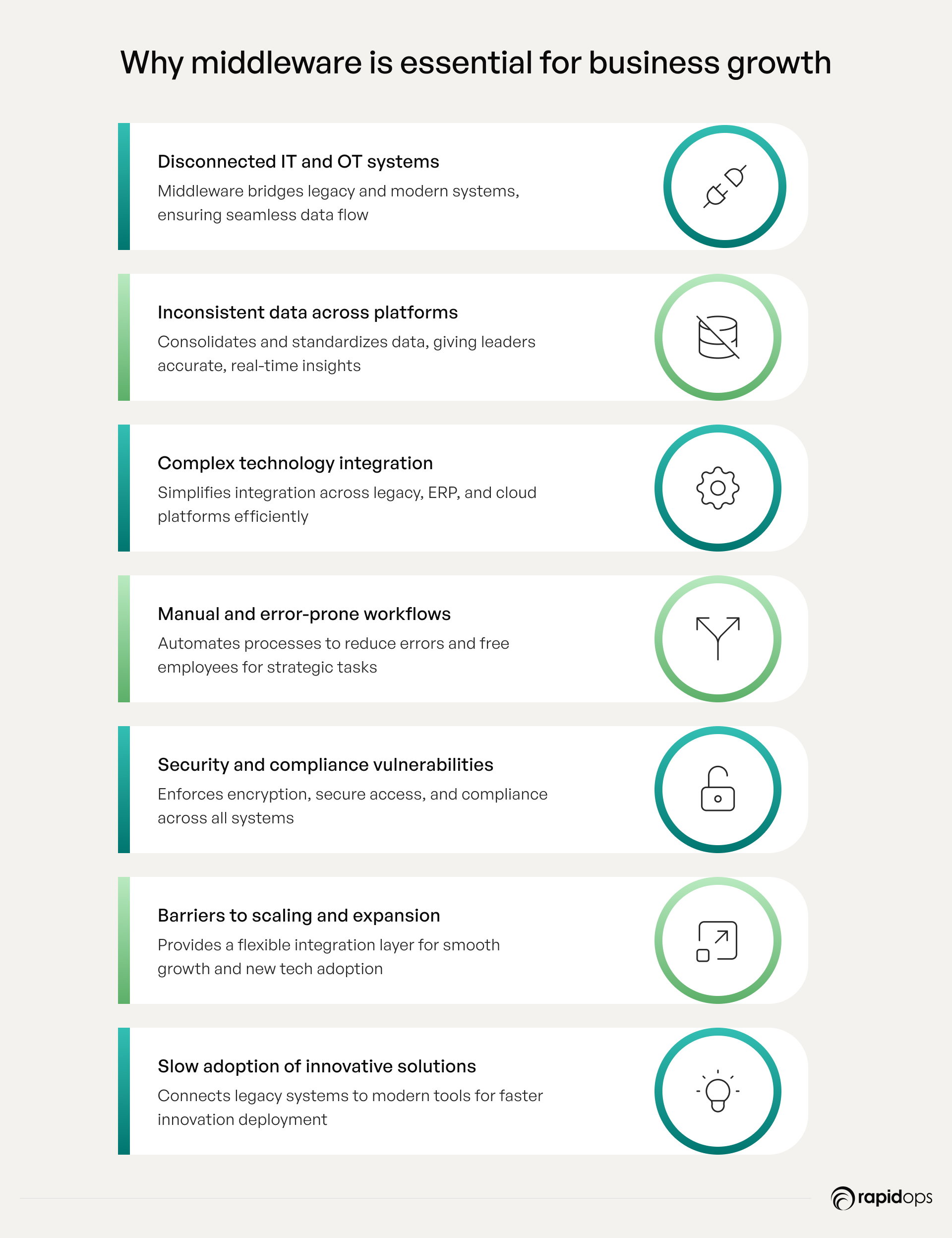
Many organizations still rely on a mix of legacy systems, traditional applications, and operational technology (OT) platforms that were not originally designed to communicate with each other. Disconnected systems can result in delayed workflows, redundant processes, and incomplete visibility into business operations. Middleware acts as a central hub, bridging legacy platforms with modern applications and cloud-based ERP solutions, enabling seamless communication, real-time synchronization, and efficient orchestration across multiple systems. By connecting IT and OT environments, businesses can ensure that information flows reliably across departments, reducing operational friction and supporting smarter, faster decisions.
Inconsistent data across platforms
Fragmented data across multiple ERP systems, databases, and cloud applications is a major obstacle for business leaders seeking accurate insights. Inconsistent data leads to poor decision-making, reporting errors, and lost opportunities. Middleware consolidates and standardizes information from legacy systems, cloud ERP solutions, and modern applications, ensuring real-time data exchange across platforms. By harmonizing data formats and providing secure access, middleware ensures that executives, analysts, and operational managers have consistent, up-to-date information to make data-driven decisions and improve overall business performance.
Complex technology integration challenges
Integrating legacy systems, traditional software, and cloud-based applications presents a significant challenge, particularly when organizations operate multiple ERP modules or specialized business tools. Custom point-to-point integrations are expensive, fragile, and difficult to maintain. Middleware simplifies this complexity by providing a reusable integration layer that connects every system to a central hub. This approach supports hybrid architectures, facilitates API management, and ensures secure, scalable communication across all platforms. As a result, organizations can reduce technical debt, streamline ERP modernization efforts, and accelerate the deployment of new tools without disrupting existing systems.
Manual and error-prone workflows
Reliance on disconnected systems often forces employees to perform manual data entry, cross-system updates, or repetitive tasks, which increases the risk of errors and slows down operations. Middleware automates these workflows by coordinating processes between legacy platforms, cloud-based ERP solutions, and modern applications. It transforms business processes from error-prone manual steps into efficient, automated operations. This not only improves data accuracy but also frees employees to focus on higher-value activities, enabling faster execution of business objectives and smoother operational performance.
Security and compliance vulnerabilities
Fragmented IT landscapes introduce vulnerabilities that can compromise sensitive ERP data, customer information, and business-critical assets. Legacy systems may lack modern security protocols, while multiple uncoordinated applications increase exposure risks. Middleware addresses these challenges by enforcing secure communication channels, data encryption, and role-based access controls across all connected systems. It also supports compliance with industry regulations by maintaining accurate data logs, audit trails, and real-time monitoring, ensuring organizations can safeguard data while meeting regulatory requirements efficiently.
Barriers to scaling and expansion
As businesses grow, adding new applications, cloud services, or ERP modules often results in complex integration challenges and disruption to existing workflows. Middleware enables organizations to scale operations without disruption by providing a flexible, modular, and reusable integration layer. Legacy systems, traditional applications, and modern cloud tools can coexist and operate efficiently, allowing businesses to expand capabilities, deploy new technology, and enter new markets while maintaining operational continuity.
Slow adoption of innovative solutions
The pace of innovation is accelerating, with AI, IoT, microservices, and cloud-based ERP tools becoming critical for competitiveness. Organizations often struggle to adopt these innovations due to legacy system constraints or integration difficulties. Middleware accelerates adoption by connecting legacy systems to modern tools, enabling real-time data exchange and seamless integration of emerging technologies. This ensures that businesses can leverage innovation without overhauling their existing infrastructure, making modernization more strategic, manageable, and cost-effective.
How does middleware work
Understanding middleware reveals how diverse systems operate as a unified, intelligent network. It orchestrates data flow, enforces business rules, and resolves conflicts in real time, transforming complex, fragmented processes into reliable, scalable, and actionable workflows that drive faster, smarter business decisions.
Core mechanism of middleware
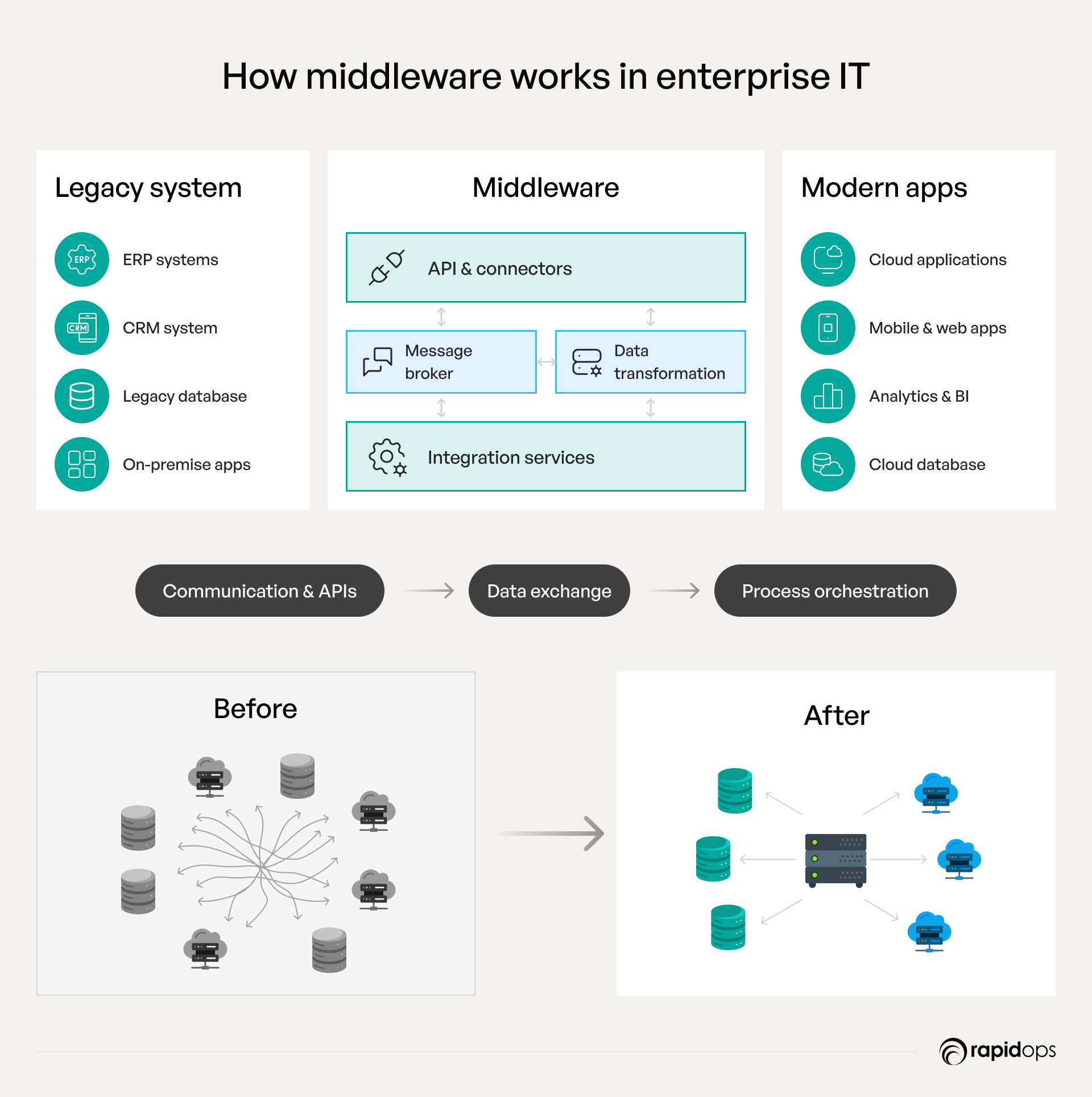
Middleware functions as a translator, coordinator, and orchestrator in complex IT environments. It standardizes communication using messaging frameworks such as:
- JavaScript Object Notation (JSON)
- Representational State Transfer (REST APIs)
- Extensible Markup Language (XML)
- Simple Object Access Protocol (SOAP)
- Web services
These frameworks provide a common interface across diverse platforms and programming languages like Java, Python, PHP, and C++. Middleware often follows a hub-and-spoke architecture, where each system connects once to a middleware hub, which manages request routing, rule enforcement, and secure data exchange. This approach prevents data silos, ensures data quality, and supports scalable, future-ready IT infrastructures.
Key tasks performed by middleware
Middleware actively manages data and workflows to maintain operational efficiency, security, and reliability:
- Information exchange: Transfers business data efficiently between applications, keeping business processes synchronized.
- Real-time information translation: Converts data into the format needed by the receiving system, enabling real-time decision-making.
- Data decoding and transformation: Validates and reformats data for accurate processing, maintaining data quality.
- API management: Provides standardized, reusable interfaces for consuming and exposing services, critical for ERP systems and cloud-based ERP solutions.
- Secure data access: Ensures sensitive information is transmitted safely, supporting compliance and protecting business operations.
- Traffic and workflow management: Optimizes request flow, automates responses, and prevents system overloads.
- Error handling and monitoring: Detects anomalies proactively, allowing IT teams to resolve issues before workflows are disrupted.
- Session management: Maintains user sessions for web and mobile applications, enabling seamless interactions.
Step-by-step middleware workflow
- An application sends a request to the middleware layer.
- Middleware validates the request and enforces security rules.
- If necessary, data is transformed into the correct format for the target system.
- Middleware routes the request to the intended application, database, or service.
- Responses are sent back through middleware, ensuring secure, reliable, and orderly data exchange.
Practical example
Consider a company modernizing its ERP systems while keeping multiple legacy applications. Middleware synchronizes inventory levels in real time, updates order statuses automatically, and integrates operational dashboards with financial reporting tools. Employees and systems interact without manual reconciliation, allowing faster decisions, improved accuracy, and more efficient business operations.
Middleware is essential for connecting disparate systems, reducing manual workload, and enabling data-driven decision-making, making it a foundational component in modern, multi-system IT environments.
Middleware vs. direct Integration
In complex IT environments, connecting multiple applications, databases, and systems is essential for seamless business operations. Organizations can either attempt direct integration, where every application communicates individually with others, or use middleware, a central software layer that manages communication between systems. Understanding the differences between these approaches clarifies why middleware is a preferred solution for ERP modernization, cloud adoption, and hybrid IT architectures.
Challenges of direct integration
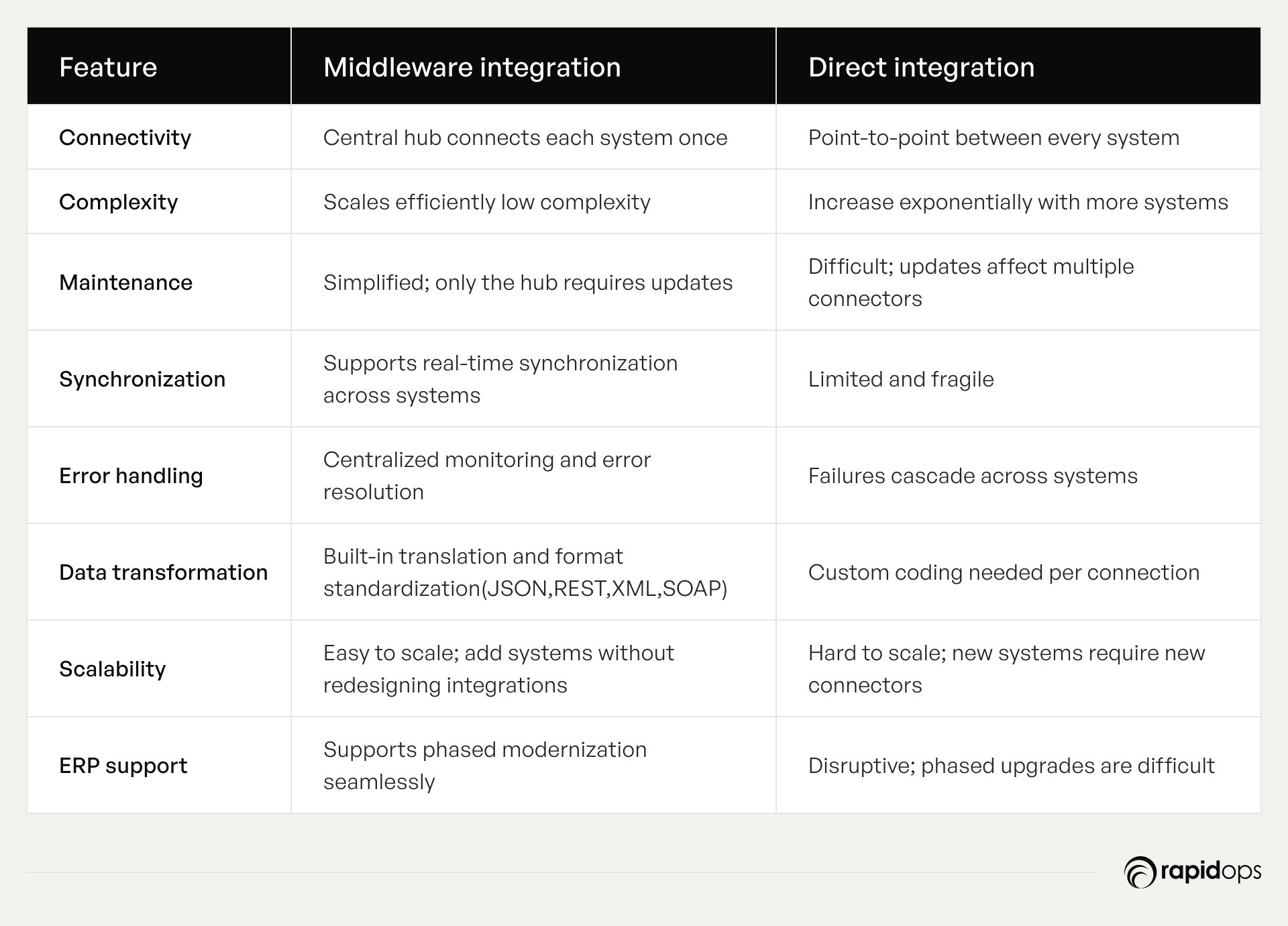
Direct integration requires custom point-to-point connectors between every pair of applications. In modern environments with legacy systems, multiple ERP systems, and cloud-based ERP solutions, this approach quickly becomes unmanageable.
Each additional system exponentially increases the number of connections needed, creating a complex web of interdependencies. Maintaining and updating these connectors becomes difficult, especially when applications are upgraded or replaced. This complexity can lead to data inconsistencies, errors, and integration failures.
Direct integration also struggles to support real-time data exchange, which is critical for maintaining ERP data accuracy, inventory synchronization, and operational workflows. Any disruption in one connection can cascade across systems, creating delays in business processes and affecting the reliability of decision-making data.
How middleware solves this
Middleware acts as a central hub, allowing each application to connect once to the middleware layer rather than building individual connectors for every other system. This hub manages messaging, API handling, data transformation, routing, and security, ensuring that information flows seamlessly across cloud-based ERP solutions, legacy ERP systems, and modern applications.
The middleware hub translates and transforms data formats between applications, enabling real-time communication even when systems use different protocols or programming languages. For example, it allows a legacy HR system to synchronize employee data instantly with a modern cloud-based payroll platform.
Middleware also standardizes communication through messaging frameworks such as JSON, REST, XML, SOAP, and web services, allowing ERP modules, financial systems, and operational tools to interact without creating custom integrations. This approach supports phased ERP modernization, where modules are updated or replaced gradually without disrupting existing operations.
By centralizing data flow, middleware reduces operational complexity, prevents system conflicts, and ensures consistent data quality across multiple platforms. It also allows organizations to scale IT systems efficiently, connecting additional applications or cloud services without redesigning the entire integration architecture.
Middleware components
Middleware is the central nervous system of modern IT environments, seamlessly connecting legacy systems, multiple ERP systems, and cloud-based ERP solutions to ensure real-time data flow, reliable communication, and smooth business processes. To understand how middleware operates, it helps to think of it like a corporate operations control center, where each component plays a critical role in keeping the organization running efficiently.
Management console: The command center
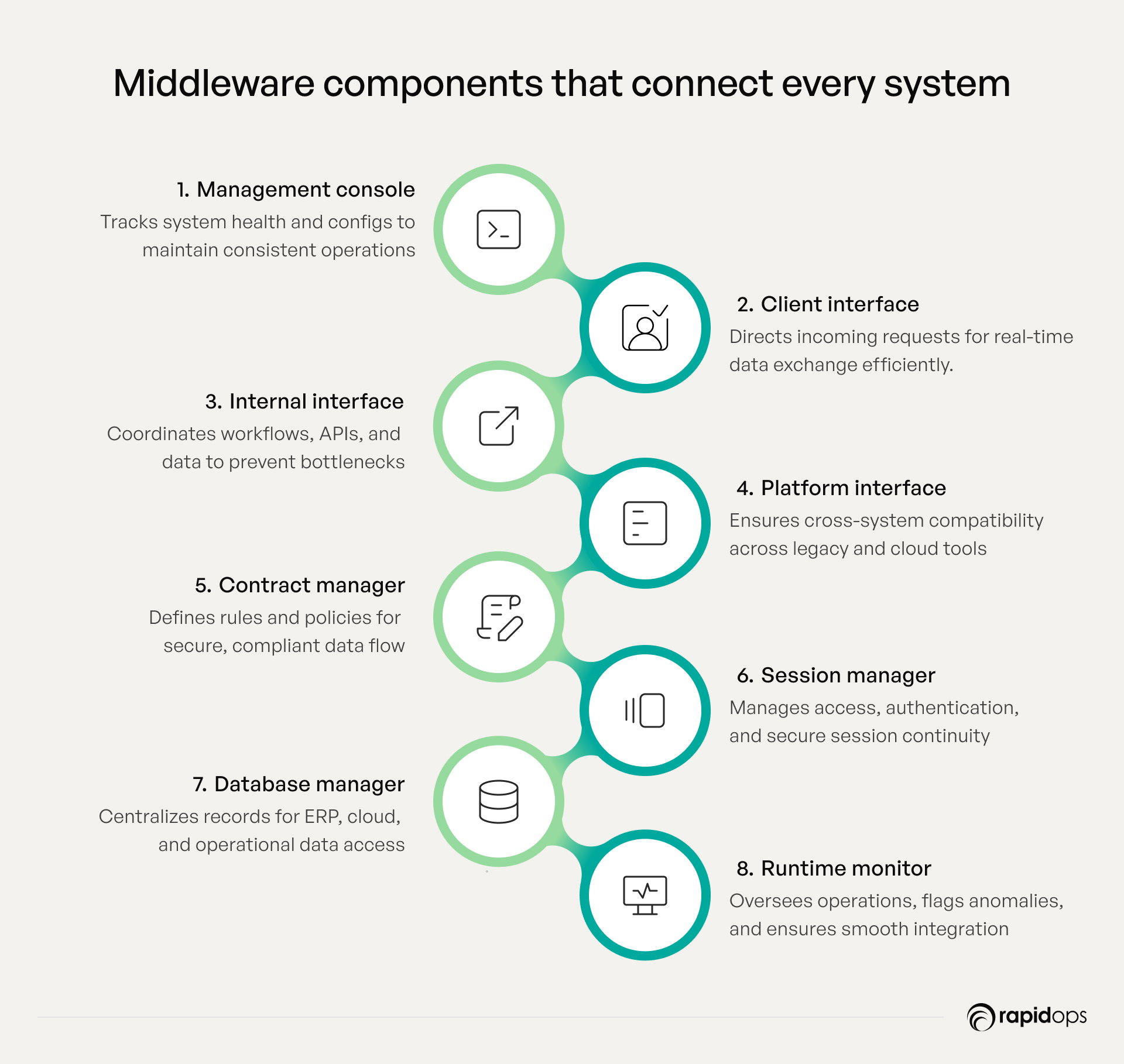
Think of the management console as the executive dashboard in a company’s operations room. Just as business leaders monitor KPIs, compliance, and operational alerts in real time, the management console provides an overview of events, rules, configurations, and system health within middleware. It ensures that every data exchange, from ERP modules to cloud-based applications, follows predefined rules and security protocols, maintaining operational consistency and governance across business processes.
Client interface: The reception desk
The client interface acts like a reception desk in a large corporate building. All requests from employees, mobile apps, or web portals pass through this interface. It translates incoming requests into a format the middleware can process, enabling real-time data exchange and immediate access to ERP data, financial systems, or operational dashboards. Just like a receptionist directs visitors efficiently to the right department, the client interface ensures data is routed correctly and efficiently across all systems.
Internal interface: The internal operations team
The internal interface is the operations team coordinating behind the scenes. It manages internal workflows, ensures smooth communication between middleware components, and guarantees that messaging, API management, and data transformation happen seamlessly. In large organizations with legacy ERP systems and modern cloud solutions, this internal coordination prevents bottlenecks and ensures business processes continue uninterrupted.
Platform interface: Cross-functional departments
The platform interface functions like cross-functional departments in a company, ensuring that employees from different divisions, using various tools and software can work together efficiently. It provides cross-platform compatibility, allowing legacy, on-premises, and cloud-based systems to communicate without disruption. This ensures that ERP modernization initiatives can proceed without compatibility issues, much like departments collaborating on a company-wide project.
Contract manager: The company policy office
The contract manager is analogous to the corporate policy office. It defines the rules and standards for data exchange, including formats, validation rules, and access permissions. By enforcing these “policies,” the middleware ensures that ERP data, inventory information, and financial records flow accurately and securely between multiple systems, maintaining data quality and regulatory compliance.
Session manager: The security and access team
The session manager acts like a security and access team, overseeing authentication, authorization, and session continuity for employees accessing various systems. This is crucial for ERP modules, cloud applications, and mobile apps, where multiple users may access the system simultaneously. It ensures that sensitive data and business processes remain secure while maintaining seamless access across platforms.
Database manager: The centralized records office
The database manager functions like a centralized records office. It integrates multiple database types, relational, NoSQL, and cloud repositories, ensuring consistency and accessibility. This component allows middleware to provide single-point access to ERP data, operational metrics, and financial records, reducing complexity and supporting real-time decision-making.
Runtime monitor: The operational oversight team
The runtime monitor is the oversight team that continuously tracks operations and flags anomalies. Just as executives monitor KPIs for unusual trends, the runtime monitor detects integration errors, workflow disruptions, and data anomalies, ensuring middleware processes run smoothly. This monitoring is particularly critical during ERP modernization projects, where multiple systems are being integrated simultaneously.
By understanding middleware through this corporate analogy, C-suite leaders, business decision-makers, and IT managers can see how each component functions like an integrated operations team, ensuring that legacy systems, multiple ERP systems, and cloud-based ERP solutions communicate effectively. Middleware coordinates, secures, and optimizes the flow of real-time data across complex environments, enabling organizations to maintain operational efficiency, data quality, and reliable business processes.
Middleware categories/types
Ever wondered why some enterprises run smoothly while others struggle with disconnected systems? The secret often lies in the type of middleware they deploy. Grasping the different middleware categories and knowing when to use each is essential for IT leaders and business decision-makers seeking seamless integration, efficient operations, and successful ERP modernization. Choosing the right type ensures systems, applications, and data work in harmony, solving specific challenges, maximizing efficiency, and turning technology into a powerful engine for measurable business impact.
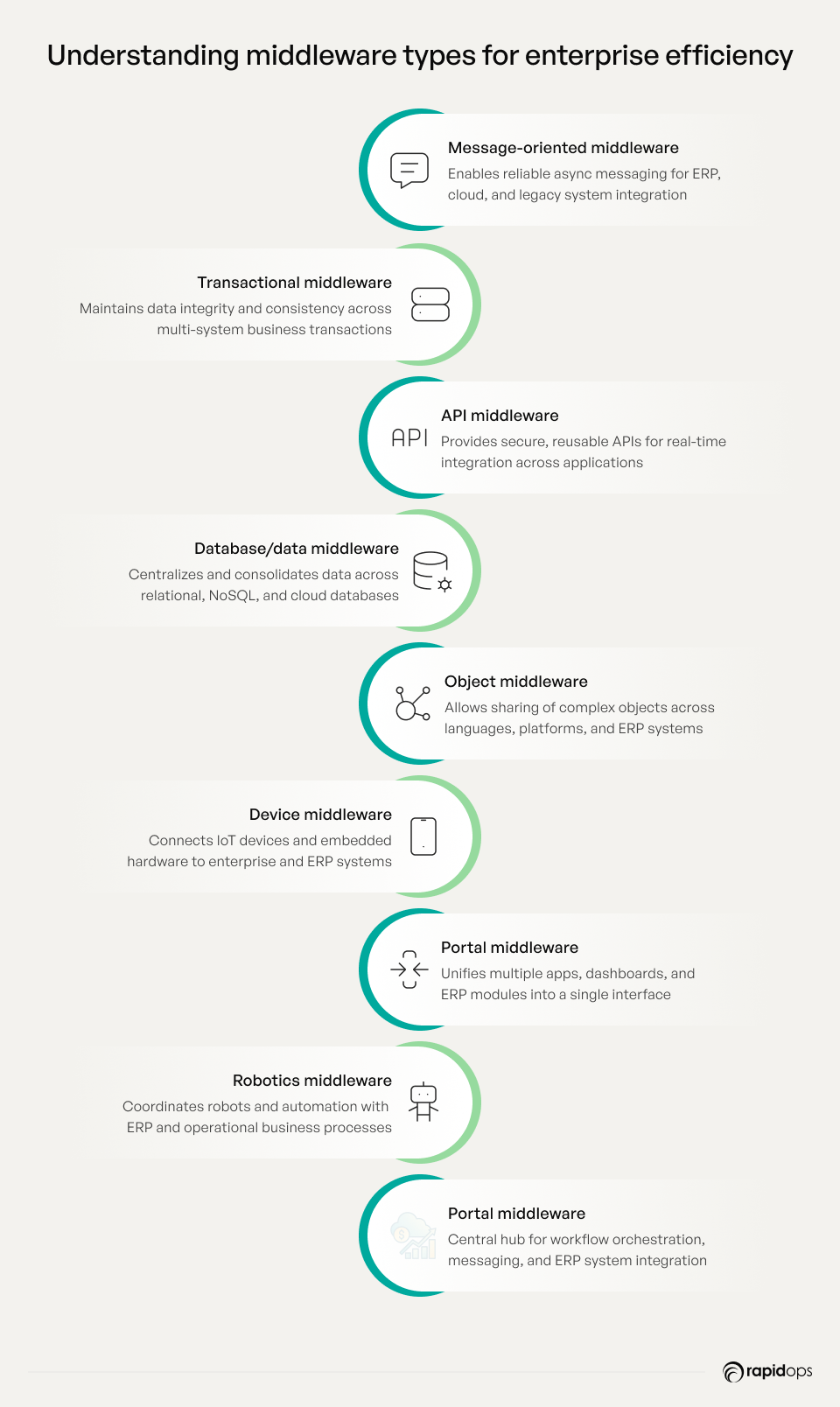
Message-oriented middleware
Message-oriented middleware serves as the messaging backbone for distributed applications. It enables asynchronous communication, message queuing, and guaranteed delivery, ensuring that ERP modules, cloud-based ERP solutions, and legacy systems remain synchronized even when some components are offline. MOM is vital for organizations aiming for real-time data visibility across business processes, such as inventory management, order tracking, or financial reporting. By facilitating reliable message delivery, Message-oriented middleware prevents data silos and supports ERP modernization initiatives without disrupting ongoing operations.
Message-oriented middleware is ideal for high-volume, distributed systems that require asynchronous communication, decoupling of applications, and reliable message delivery, especially when real-time processing is less critical than guaranteed data consistency.
Transactional middleware
Transactional middleware maintains data integrity and consistency across multiple applications and databases. It ensures that transactions, whether in ERP financial modules, HR systems, or supply chain platforms, are atomic, meaning all steps succeed or none do. This capability is crucial during ERP modernization projects, where data migration, integration of legacy systems, and cloud-based ERP solutions must maintain ERP data accuracy and compliance. Transactional middleware reduces the risk of errors, duplicate records, and inconsistent business data, ensuring reliable operations for enterprise decision-making.
Transactional middleware is best suited for critical business processes requiring strong data integrity, such as financial operations, multi-system transactions, or ERP migrations, where errors or inconsistencies could have significant operational or compliance consequences.
API middleware
API middleware provides a standardized interface for connecting applications, allowing modern apps, cloud platforms, and ERP systems to communicate without developing custom connectors. It enables reusable, secure, and real-time integration, accelerating ERP modernization timelines and facilitating data-driven decisions. By exposing APIs consistently, organizations can integrate multiple systems efficiently while maintaining data quality and system security.
API middleware is ideal when fast, reusable, and secure integration is required between modern applications, ERP systems, or cloud platforms, especially in environments emphasizing agility, scalability, and maintainability.
Database/data middleware
Database middleware bridges diverse database types, including relational, NoSQL, and cloud repositories, optimizing queries and ensuring data consistency. It enables consolidation of ERP data from multiple sources, legacy systems, new ERP modules, and cloud-based applications into a centralized access point. This middleware supports real-time reporting, analytics, and informed decision-making, while minimizing errors during data migration and ERP modernization projects.
Database middleware is essential when multiple heterogeneous databases must be accessed reliably, particularly for data consolidation, reporting, analytics, and ERP migrations where consistency and accuracy are crucial.
Object middleware
Object middleware enables applications to share complex objects and data structures across different programming languages and platforms. It manages object serialization, remote method invocation, and interoperability, allowing legacy systems, ERP modules, and new applications to communicate seamlessly. Object middleware is particularly valuable when modern ERP systems integrate with older enterprise applications while maintaining operational continuity.
Object middleware should be used when cross-language or complex object communication is required, especially in environments where legacy applications and modern ERP systems must interoperate without disrupting ongoing operations.
Device middleware
Device middleware provides the integration layer for IoT devices, embedded systems, and operational hardware, enabling real-time communication with enterprise systems. In logistics, manufacturing, and retail, device middleware ensures that ERP systems receive live updates on inventory, production, and shipment status, supporting real-time data flow and efficient business processes.
Device middleware is ideal for IoT-heavy operations, such as manufacturing, retail, where live data from devices and sensors needs to feed ERP or operational systems in real time.
Portal middleware
Portal middleware creates a single, unified interface for users to access multiple applications, dashboards, and tools. It aggregates ERP modules, cloud-based ERP solutions, and legacy systems into a single point of access, simplifying workflows and enhancing user experience. For business leaders and decision-makers, portal middleware ensures immediate visibility into operational metrics and ERP data, improving monitoring and strategic planning.
Portal middleware is best when organizations need a centralized user interface, enabling quick access to multiple systems, enhanced monitoring, and improved workflow efficiency across ERP and cloud applications.
Robotics middleware
Robotics middleware coordinates communication between robots, automated systems, and enterprise applications, integrating with ERP systems, inventory management, and operational workflows. This middleware enables automation, accuracy, and efficiency in manufacturing, logistics, and supply chain operations, supporting ERP modernization and digital transformation initiatives.
Robotics middleware should be implemented in automation-intensive environments, such as manufacturing or warehousing, where ERP and operational systems must interact with robots and automated machinery for accuracy, efficiency, and seamless workflow execution.
Enterprise application integration (EAI) middleware
EAI middleware serves as a central integration hub, connecting heterogeneous enterprise applications. It handles messaging, workflow orchestration, and data transformation across legacy systems, multiple ERP systems, and cloud-based ERP solutions, reducing complexity and enabling scalable, reliable, and consistent business processes. EAI middleware is essential for organizations seeking ERP modernization, consolidation of multiple systems, and real-time operational insights.
EAI middleware is ideal for organizations requiring a centralized integration approach to connect multiple ERP modules, legacy platforms, and cloud systems, ensuring scalable, consistent, and real-time business processes.
Each middleware type plays a specific role in creating a connected, agile, and scalable IT ecosystem. By understanding these categories, business leaders, C-suite executives, and IT managers can make informed decisions about ERP modernization, real-time data integration, and process optimization. Middleware ensures that legacy systems, cloud-based ERP solutions, and multiple ERP modules operate seamlessly together, supporting data-driven decisions, operational efficiency, and enterprise-wide visibility.
What benefits will your business gain from middleware
Middleware is no longer just a background tool; it has evolved into a strategic enabler that transforms enterprise operations. Acting as a centralized, intelligent integration layer, middleware allows businesses to unlock the full potential of their technology ecosystem, ensuring legacy systems, traditional applications, and modern tools work together seamlessly. It supports ERP modernization, real-time data exchange, and cloud adoption, providing operational visibility, scalability, and resilience. Below are the key benefits your business can realize in 2026 and beyond.
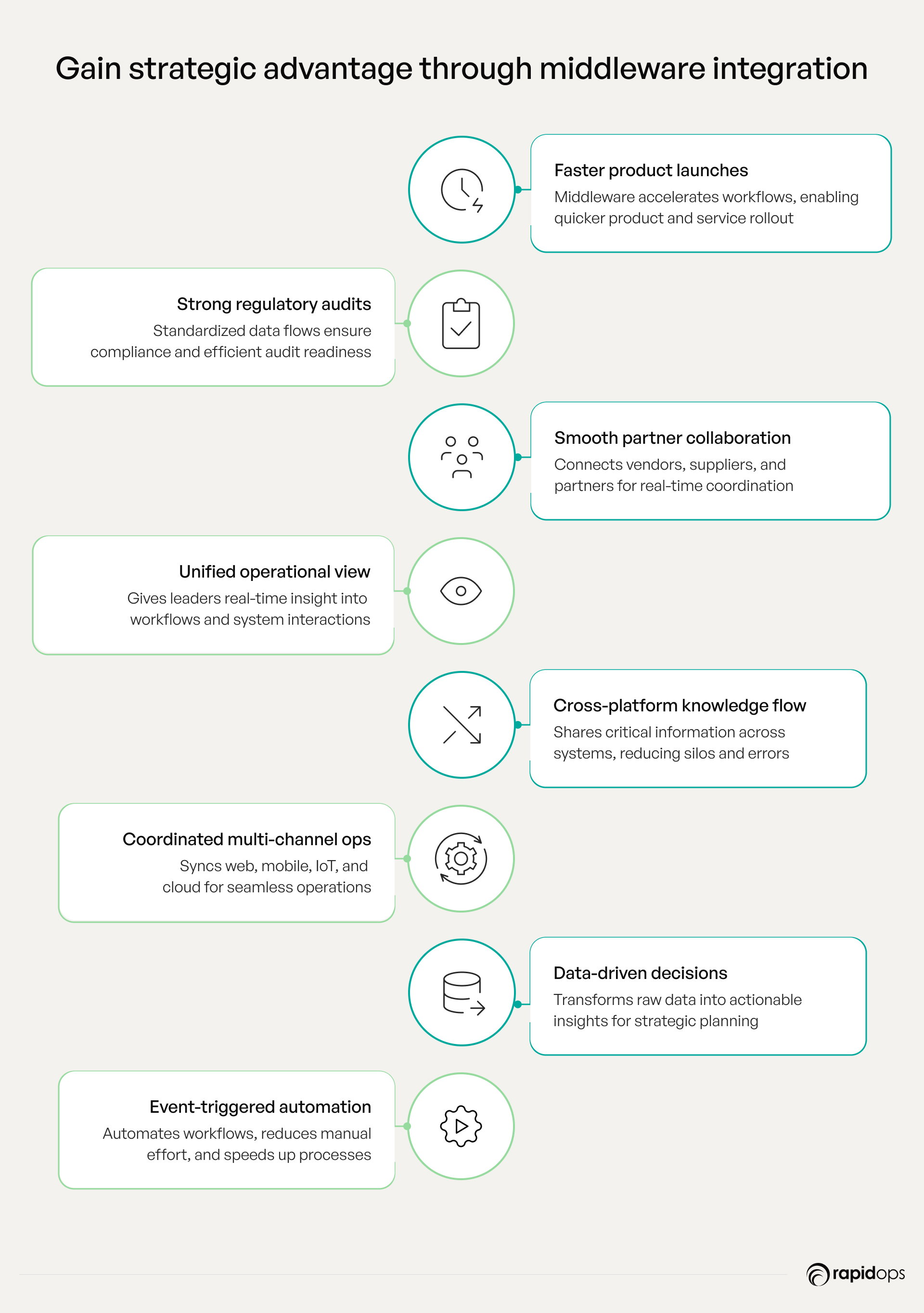
Accelerated product and service launch
By eliminating delays associated with point-to-point integrations and manual workflows, middleware enables seamless connectivity across ERP systems, cloud platforms, and multiple business applications. Teams can bring new products, features, and services to market faster, shortening innovation cycles and capturing revenue opportunities quickly. With real-time synchronization and automated business processes, middleware ensures that every system, from legacy platforms to modern ERP solutions, operates in harmony, providing a tangible competitive advantage.
Enhanced regulatory auditability
Middleware standardizes and traces data flows across all systems, simplifying compliance with industry regulations. Automated logging, consistent reporting, and controlled access to ERP data ensure audits are completed efficiently and accurately. This not only reduces operational risk but also demonstrates to stakeholders and regulators that your organization maintains rigorous operational and security standards, bridging the gap between older legacy systems and modern compliance requirements.
Seamless partner and supplier collaboration
Modern supply chains rely on timely, accurate data across multiple systems. Middleware centralizes communication protocols, enabling real-time data exchange with external partners, vendors, and suppliers. Businesses can share inventory updates, coordinate procurement, and synchronize operations across legacy systems, cloud-based ERP solutions, and modern applications. This ensures better alignment, fewer errors, and stronger operational partnerships, ultimately enhancing service delivery to customers.
Holistic operational visibility
Middleware provides a unified view of workflows, system interactions, and operational performance across multiple systems, cloud platforms, and traditional applications. Leaders can monitor activities in real time, identify bottlenecks, and make proactive, data-driven decisions. Consolidated visibility allows organizations to optimize business processes, reduce inefficiencies, and respond faster to changing market conditions, turning fragmented IT landscapes into cohesive, manageable environments.
Improved knowledge sharing across platforms
By integrating ERP systems, cloud applications, and legacy platforms, middleware ensures that critical information flows seamlessly across departments. Teams can collaborate effectively, leverage accurate insights, and eliminate data silos. This drives innovation by enabling knowledge to be applied where it delivers the most impact, improving operational alignment and maximizing the value of existing systems while supporting ERP modernization initiatives.
Streamlined multi-channel coordination
Middleware synchronizes information across web, mobile, IoT, and cloud-based applications, ensuring consistent operations and customer experiences across all channels. From marketing campaigns and order fulfillment to service interactions, middleware maintains real-time coordination, enhancing brand reliability, operational efficiency, and customer satisfaction.
Data-driven decision support
By consolidating data from multiple ERP systems, legacy platforms, and cloud solutions, middleware creates a single source of truth for analytics and reporting. Advanced insights enable businesses to forecast demand, optimize operations, and make informed strategic decisions. Middleware transforms raw data into actionable intelligence, providing executives with the clarity needed to guide enterprise-wide initiatives effectively.
Event-driven automation
Middleware automates workflows triggered by business events, such as inventory alerts, customer interactions, or supply chain updates. This reduces manual effort, minimizes errors, and accelerates operations. Handling repetitive business processes across legacy, modern, and cloud middleware allows teams to focus on strategic priorities and innovation rather than operational bottlenecks.
Extending the life of legacy systems
Instead of costly replacements, middleware integrates legacy platforms with modern tools and cloud-based ERP solutions, extending their usability and maximizing ROI. By acting as a bridge, middleware preserves investments in older systems while supporting enterprise-wide modernization, enabling organizations to modernize incrementally without disrupting ongoing operations.
Scalability without disruption
Middleware’s modular, flexible architecture allows organizations to scale operations, integrate new applications, or adopt additional cloud services without downtime. By connecting legacy systems, traditional applications, and modern tools, middleware ensures growth is seamless, reducing operational friction and enabling businesses to respond to evolving market demands efficiently.
Proactive monitoring and predictive maintenance
Middleware continuously monitors system performance, workflow execution, and data flows, detecting anomalies before they escalate into issues. Combined with predictive analytics, it supports preventive maintenance, reduces downtime, and improves operational reliability. Organizations gain real-time visibility into ERP data, business processes, and multi-system operations, safeguarding assets and ensuring continuity.
Middleware applications in real-world industries
1. Retail
In the fast-paced world of retail, staying competitive requires seamless coordination between online storefronts, backend inventory, order management, and payment systems. Middleware acts as the central nervous system that enables these systems to communicate effectively, ensuring that every transaction, inventory update, and customer interaction happens in real time.
1. eCommerce platform synchronization
Before middleware integration, retailers struggled with manual inventory updates, inconsistent pricing across channels, and delayed order processing, often leading to stockouts, overstock, and customer dissatisfaction. Middleware transformed this landscape by automating real-time synchronization between online and in-store inventories, orders, and customer data. Walmart and Target now maintain precise stock alignment across platforms, while Shopify-based retailers automatically sync orders and fulfillment details, minimizing errors. This integration ensures operational accuracy, faster order fulfillment, data-driven pricing adjustments, and an enhanced customer experience, turning fragmented systems into a seamless, reliable ecosystem.
2. Personalized customer experiences
Earlier, retailers lacked a unified view of customer behavior, with CRM, loyalty programs, and e-commerce platforms operating in silos. This made promotions and product recommendations generic, reducing engagement. Middleware now integrates these data sources in real time, enabling tailored offers, context-aware marketing, and personalized product suggestions. Retailers can respond instantly to customer preferences, enhancing relevance and satisfaction. By turning scattered data into actionable insights, middleware drives higher conversions, deeper engagement, and stronger customer loyalty, creating truly individualized shopping experiences.
3. POS integration with CRM and analytics
Previously, POS systems were disconnected from CRM and analytics platforms, limiting visibility into sales trends, customer journeys, and inventory performance. Middleware bridges these gaps, consolidating transactional and customer data in real time. Retailers gain a holistic, actionable view, allowing them to optimize inventory, refine marketing strategies, and deliver consistent omnichannel experiences. This integration transforms fragmented operations into data-driven, efficient workflows, enabling smarter decision-making, better customer targeting, and improved operational agility across all sales channels.
By bridging the gap between legacy systems, modern ERP solutions, and cloud-based applications, middleware empowers retailers to operate efficiently, scale seamlessly, and deliver a consistent, personalized experience to customers across all touchpoints.
2. Manufacturing
Middleware plays a pivotal role in modern manufacturing by connecting ERP systems, supply chain platforms, and production management tools, ensuring seamless operations across the factory floor and enterprise systems. It enables real-time communication, reduces manual interventions, and unifies data from diverse sources for actionable insights.
1. Linking ERP, supply chain, and production management systems
Manufacturers previously managed production planning, procurement, inventory, and order fulfillment across disconnected systems, causing misaligned schedules, stock discrepancies, and delays. Middleware now integrates these platforms into a seamless ecosystem, enabling accurate demand forecasts, optimized resource allocation, and real-time visibility across operations. By bridging legacy systems with cloud-based ERP solutions, manufacturers maintain continuity while modernizing processes, reducing errors, accelerating throughput, and gaining a comprehensive, data-driven overview that drives operational efficiency and informed decision-making.
2. Predictive maintenance using IoT sensor data
Before middleware, machinery performance data from IoT sensors remained siloed, making it difficult to anticipate equipment failures, often resulting in unplanned downtime and higher maintenance costs. Middleware now centralizes sensor data into dashboards, analytics tools, and ERP systems, allowing companies like Siemens and GE to identify potential issues before they escalate. This enables proactive maintenance, extended machinery life, and uninterrupted production, turning raw data into actionable insights that improve reliability, productivity, and cost efficiency across industrial operations.
3. Workflow automation across assembly lines and quality control
Production lines and quality control systems traditionally operated in isolation, requiring manual approvals, inspections, and work-in-progress tracking, which slowed throughput and increased errors. Middleware automates communication between machines and enterprise applications, as seen in SAP Manufacturing Cloud and Oracle Manufacturing Cloud implementations, centralizing approvals and quality checks. This integration accelerates production, ensures consistent standards, reduces operational errors, and streamlines workflows, transforming fragmented manual processes into a coordinated, automated system that enhances efficiency and product quality.
By acting as a bridge between legacy systems, modern ERP software, and cloud applications, middleware creates an integrated ecosystem that enhances visibility, reliability, and operational intelligence, allowing manufacturers to scale, automate, and innovate with confidence.
3. Distribution
Middleware serves as the backbone that connects inventory management systems, order processing platforms, and supplier networks, ensuring seamless coordination across the supply chain. By centralizing communication and automating workflows, middleware helps organizations maintain accurate stock levels, track orders in real time, and synchronize supplier information efficiently.
1. Connecting inventory systems, order management platforms, and supplier networks
Supply chain teams once struggled with disconnected inventory, order processing, and supplier platforms, leading to inaccurate stock data, delayed orders, and miscommunication with suppliers. Middleware now integrates these systems in real time, ensuring that stock levels, order statuses, and supplier information are synchronized across the enterprise. Cloud-based ERP solutions seamlessly connect legacy warehouse systems with modern order management tools, reducing discrepancies, accelerating workflows, and improving overall operational efficiency.
2. Efficient coordination across warehouses and suppliers
Previously, managing multiple warehouses, third-party logistics providers, and suppliers involved manual coordination, increasing the risk of delays, stockouts, and shipment errors. Middleware automates these interactions, enabling real-time replenishment, automated stock transfers, and accurate shipment tracking. In industries like FMCG, wholesale, and retail, this integration allows businesses to respond instantly to demand fluctuations, maintain service levels across regions, and reduce operational friction.
3. Reducing manual work, errors, and enabling scalability
Manual processes in disconnected systems often cause repetitive tasks, errors in order validation, and delayed supplier notifications, limiting scalability. Middleware automates these workflows, freeing teams from routine tasks while maintaining accuracy. Companies using SAP, Oracle, or Blue Yonder integrations demonstrate how middleware enables faster, reliable deliveries, error-free operations, and seamless expansion. By connecting legacy systems, ERP solutions, and cloud platforms, organizations transform supply chain operations into a connected, intelligent ecosystem with real-time visibility and scalable efficiency.
By integrating legacy systems, modern ERP solutions, and cloud platforms, middleware transforms supply chain operations into an intelligent, connected ecosystem, providing accurate, real-time insights into inventory, orders, and supplier activities while enabling efficient scalability.
Common misconceptions about middleware
Middleware is often misunderstood, leading to missed opportunities for businesses to streamline business processes, modernize ERP systems, and enable real-time data exchange. Here, we clarify these myths and demonstrate the modern relevance of middleware.
Middleware is only for legacy systems
Many believe middleware is relevant only for older platforms. In reality, modern middleware is designed to integrate cloud-based ERP solutions, AI-driven services, microservices architectures, and multiple ERP systems. Acting as a central hub, middleware connects legacy systems with modern applications, enabling real-time communication, orchestration, and scalability. This ensures businesses can adopt new technology stacks while maintaining interoperability with legacy platforms, supporting ERP modernization and data-driven decisions.
Middleware slows down systems
A common myth is that middleware increases latency. On the contrary, middleware optimizes data routing, standardizes communication, and reduces redundant processes, especially when managing ERP data across multiple systems. By centralizing integration logic, it prevents bottlenecks from numerous point-to-point connections, allowing businesses to operate faster, reliably, and at scale, even during complex multi-system operations.
Middleware is too complex for small or mid-sized businesses
Modern middleware solutions are modular, scalable, and cloud-ready, allowing small and mid-sized companies to integrate essential systems without large IT teams. Middleware can be implemented incrementally, connecting critical applications and ERP modules first. This approach simplifies integration, ensures real-time data access, and supports automation and efficiency without overwhelming resources or budgets.
Middleware is only technical
Middleware is not just a tool for IT teams; it is a strategic enabler for operational efficiency. By streamlining communication, automating workflows, and ensuring consistent ERP data exchange, middleware empowers executives and operational managers to make informed, real-time decisions, supporting digital transformation initiatives and innovation.
Middleware replaces IT teams
Middleware complements IT functions rather than replacing them. By handling repetitive tasks such as data transformation, system monitoring, and workflow automation, IT teams can focus on high-value initiatives like ERP modernization, process optimization, and new system implementation, while middleware ensures smooth, continuous operations across multiple systems.
Middleware is only for connecting applications
Middleware does more than link applications. It manages secure data transformations, enforces business rules, routes messages, and orchestrates workflows across complex IT landscapes. This ensures compliance, accuracy, and seamless integration across legacy systems, cloud-based ERP solutions, and modern SaaS applications, providing a reliable foundation for intelligent enterprise operations.
Middleware is only for developers
Middleware affects more than development teams. Its functions impact ERP data management, business processes, and decision-making. By enabling real-time data sharing, predictive analytics, and automation, middleware allows executives, analysts, and operational managers to respond faster, allocate resources efficiently, and scale operations without manual delays, generating tangible business value.
Middleware is inflexible
Contrary to belief, modern middleware is modular, configurable, and adaptable. It supports hybrid, on-premises, and cloud deployments and can integrate emerging technologies such as AI tools, IoT devices, and next-gen ERP systems. Organizations can dynamically adjust connections, workflows, and policies, ensuring agility, scalability, and innovation without disrupting existing business processes.
Middleware is expensive
Middleware adoption often reduces total integration costs. By consolidating multiple point-to-point connections, automating repetitive tasks, and preventing errors, middleware accelerates deployment, lowers operational overhead, and improves efficiency. Over time, the benefits, including real-time ERP data access, streamlined business processes, and scalable operations, outweigh initial costs.
Middleware is only for large enterprises
Middleware scales across all organization sizes. Small and mid-sized businesses can start by integrating critical ERP modules and legacy systems, gradually expanding to cloud-based ERP solutions and multiple systems. Even smaller organizations benefit from real-time data exchange, automated workflows, and consolidated operations, gaining enterprise-level capabilities and competitive advantages without massive infrastructure investments.
Unlock the full potential of your business with middleware
By now, you’ve learned what middleware is and why it’s essential for keeping your business systems connected. You understand how it helps data flow smoothly, keeps teams working efficiently, and prevents small tech issues from turning into bigger problems.
Many businesses struggle with disconnected tools, slow processes, or data trapped in silos. It can feel overwhelming, especially when you’re trying to grow, scale, or just get day-to-day operations running smoothly. The good news is that these challenges can be solved with the right approach and guidance.
At Rapidops, we’ve spent years helping businesses tackle these exact problems. Our team has hands-on experience developing purpose-built middleware solutions that seamlessly connect with all the legacy systems and latest technologies. We focus on understanding your systems and pain points to design practical, scalable solutions that make technology work for you, helping teams collaborate better and make faster, smarter decisions without disrupting daily operations.
If you’re curious how this could work for your business, schedule a free consultation call with one of our middleware experts today. Our expert can discuss your systems, your challenges, and how middleware can help your business work smarter and move faster.

What’s Inside
- What is middleware
- Why do businesses need middleware in 2026
- How does middleware work
- Middleware vs. direct Integration
- Middleware components
- Middleware categories/types
- What benefits will your business gain from middleware
- Middleware applications in real-world industries
- Common misconceptions about middleware
- Unlock the full potential of your business with middleware

Let’s build the next big thing!
Share your ideas and vision with us to explore your digital opportunities
Similar Stories
- Transformation
- undefined Mins
- March 2022


- Transformation
- undefined Mins
- March 2020

Receive articles like this in your mailbox
Sign up to get weekly insights & inspiration in your inbox.