


Every growing business eventually hits the same wall: operations slow down, teams lose alignment, data becomes unreliable, and decisions take longer than they should. Not because people are inefficient, but because the systems they rely on work in isolation. When your ERP can’t sync with your CRM, when cloud apps don’t connect to legacy platforms, and when departments operate on their own data islands, the entire organization feels the strain. These issues surface as delays, duplicated work, and blind spots that quietly erode performance and efficiency.
And while everyone already knows that integration is necessary, the real problem isn’t why to integrate; it’s where to start. With dozens of platforms, tools, and workflows running across the business, choosing the wrong system to integrate first can create more disruption, more complexity, and more cost than value. The challenge isn’t recognizing the need for connectivity; it’s identifying which systems are mission-critical, which dependencies matter most, and which integrations will create the fastest, most meaningful impact.
That’s why the focus of this guide isn’t to convince you of the importance of integration; you’re already aware of that. Instead, it’s to help you cut through the complexity and prioritize what actually matters. You’ll learn how to assess business impact, evaluate workflow bottlenecks, map system dependencies, and build a clear, strategic sequence for integration that strengthens your operations, accelerates decision-making, and unlocks the full potential of your digital ecosystem.
By the end, you’ll know exactly which systems to integrate first and how to build a high-performing, connected environment that supports your teams, scales with your business, and drives sustainable growth.
What is system integration, and why is it important
You already understand the value of system integration; that’s exactly why you’re here. Still, it helps to align on the essentials, so we’re on the same page. At its core, system integration connects disparate systems, your ERP systems, CRM tools, cloud applications, legacy systems, and departmental software into a unified system where data flows seamlessly, and workflows stay consistent. Instead of teams switching between different systems, reconciling inconsistencies, or relying on manual data entry, integration ensures your business processes, information pipelines, and operational activities function as one coordinated environment.
And while the importance is clear, what matters most now is not the concept of integration, it’s the ability to decide which systems need integration first. With increasing data volumes, more software applications entering the stack, and greater dependence on digital experiences, businesses can’t afford inefficient data flow, fragmented processes, or outdated integration methods. Prioritization has become a strategic decision, shaping operational efficiency, scalability, and long-term growth.
Why system integration matters now
Disconnected systems aren’t just an operational inconvenience anymore; they’re a structural risk. As digital demands accelerate, every delay caused by siloed platforms, inconsistent data formats, or broken connections directly impacts performance and customer experience. This is why modern system integration, whether through point-to-point integration, middleware solutions, enterprise application integration (EAI), data feed integration, or API-based integration, matters more than ever.
Strong integration today enables you to:
- Provide teams with real-time, accurate customer data and operational insights.
- Reduce friction caused by different systems using inconsistent data formats or workflows.
- Eliminate repetitive tasks and manual data entry, driving higher operational efficiency.
- Build scalable, resilient operations that support rapid growth across business functions.
Ensure critical business data moves reliably through your ecosystem using standardized data exchange and data transformation practices.
By acting now, you turn fragmented tools into a connected, high-performing environment, supported by robust integration platforms, pre-built connectors, and well-governed integration projects. This shift doesn’t just make your systems communicate effectively; it enables seamless data exchange, reduces operational costs, and strengthens decision-making across your organization.
When your systems flow as one, you gain a unified view of your operations, eliminate the risks of spaghetti integration, and build a digital foundation capable of supporting innovation, automation, and continuous business growth.
What are the main types of system integration
Before deciding which systems to integrate first, it’s crucial to understand the different approaches to system integration. Each method has distinct implications for effort, risk, scalability, and business impact. Understanding these approaches ensures your integration roadmap is strategic, outcome-driven, and aligned with your organizational goals. With this knowledge, you can make informed decisions about which projects deliver immediate operational wins and which support long-term growth and modernization.
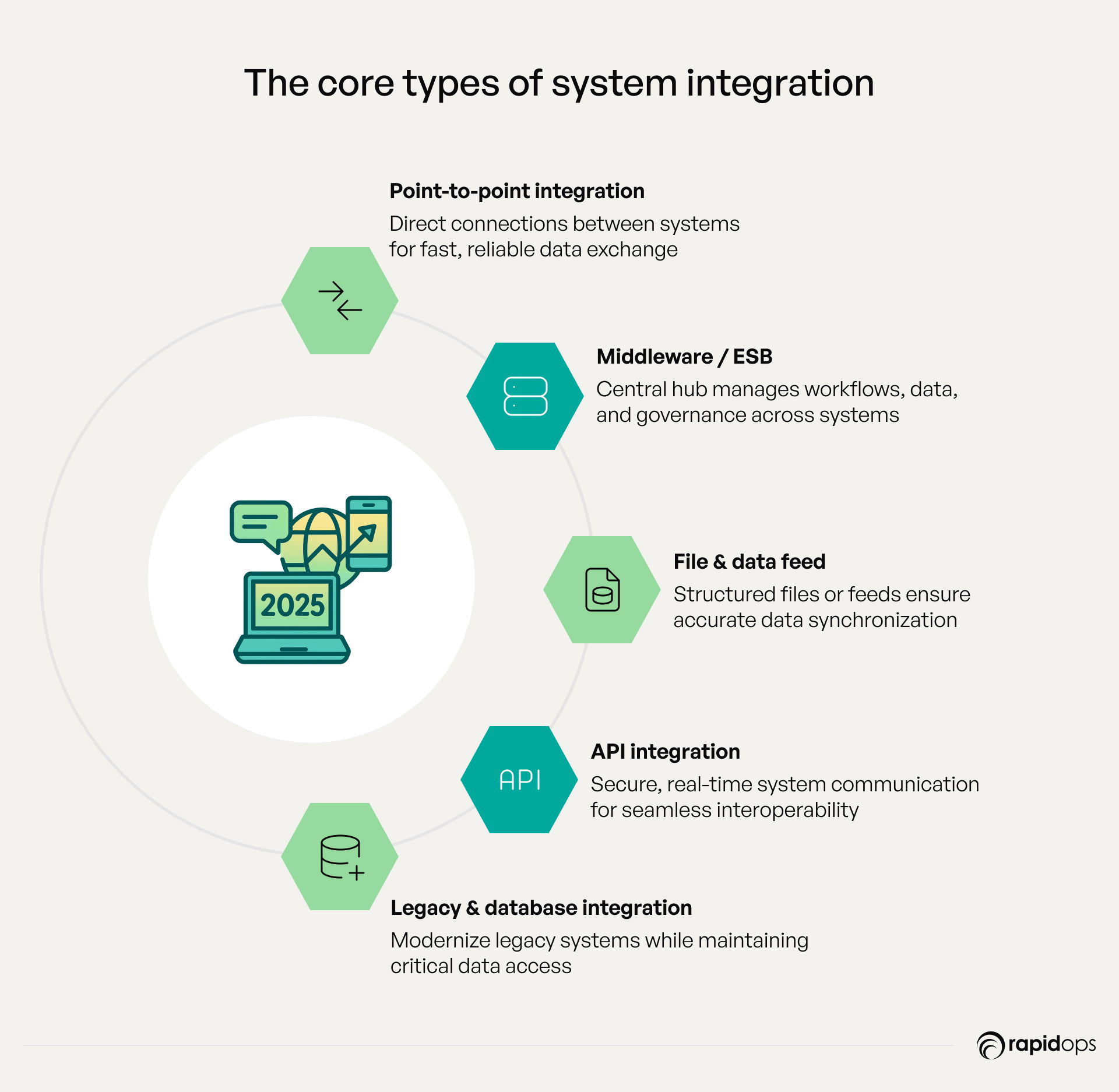
1. Point-to-point integration
Point-to-point integration creates direct connections between two systems, enabling fast and reliable data exchange and workflow synchronization. This approach is ideal for connecting systems with minimal dependencies or for urgent fixes in day-to-day operations.
It reduces manual data entry, eliminates duplicate work, and ensures data consistency across critical tools, such as linking a sales management system to an invoicing platform. While it offers speed and simplicity, point-to-point connections can become complex as the number of connected systems grows, potentially leading to spaghetti integration.
2. Middleware solutions / Enterprise service bus (ESB)
Middleware and ESB-based integration use a central hub to orchestrate communication among multiple systems, standardizing data formats, managing workflows, and ensuring governance. It’s particularly useful for ERP systems, software modules, and legacy systems that need to interoperate seamlessly.
Middleware enables scalable and maintainable integration systems, supporting operational efficiency across departments. It reduces the complexity of multiple point-to-point connections and ensures systems communicate effectively, which is critical for long-term digital transformation and hybrid environments.
3. File-based and data feed integration
File-based integration relies on structured files (CSV, XML, JSON) to transfer data between systems on a scheduled or batch basis, while data feed integration enables near real-time updates. Both ensure critical business data flows accurately across disparate systems.
These approaches are low-risk and cost-effective for synchronizing multiple systems, maintaining data consistency, and supporting business operations such as inventory management, customer data updates, and reporting. They are especially relevant when API connectivity is unavailable or when systems rely on common data format integration.
4. API integration
API (Application Programming Interface) integration allows secure, real-time communication between systems, automating enterprise workflows and enabling seamless interoperability. APIs connect cloud integration platforms, CRMs, ERP modules, and other software applications, creating a unified system view.
API integrations maximize scalability, automation, and operational agility, reducing reliance on manual processes and ensuring data flows seamlessly across your organization. They accelerate integration projects, simplify ongoing maintenance, and are essential for high-volume, dynamic operations.
5. Legacy Wrapper and Direct Database-Level Integration
Legacy wrapper integration creates interfaces around older systems to enable interaction with modern platforms, while direct database-level integration reads or writes data directly at the database layer. Both approaches preserve the reliability of legacy systems while unlocking modern capabilities like analytics, mobile access, and automation.
These integrations tackle system integration challenges posed by outdated platforms, reduce technical debt, and ensure access to critical business data without disrupting operations. They are strategic for businesses seeking to modernize ERP systems, improve data flow, and build a unified environment.
Why understanding integration types matters for prioritization
Each integration type carries unique implications for business impact, complexity, and strategic value. Point-to-point and API integrations often provide quick operational wins, middleware and data feed solutions protect revenue and customer experience, and legacy integrations enable long-term scalability, modernization, and compliance.
By understanding these methods, you gain the insight to prioritize integration projects confidently, balance short-term efficiency with long-term transformation, and create a connected, high-performing technology ecosystem. This foundation ensures that when you move to the next step, how to prioritize system integrations, your decisions are strategic, outcome-driven, and aligned with your organizational goals.
How to prioritize system integrations
Before diving into individual integrations, it’s essential to understand which systems will drive the most impact for your organization. Prioritizing system integrations isn’t just about technical importance; it requires evaluating business impact, workflow dependencies, data quality, risk, and long-term strategic value. A structured approach ensures that each integration strengthens operations, eliminates bottlenecks, and builds a cohesive, high-performing technology ecosystem that supports growth and efficiency from day one.
1. Assess business impact
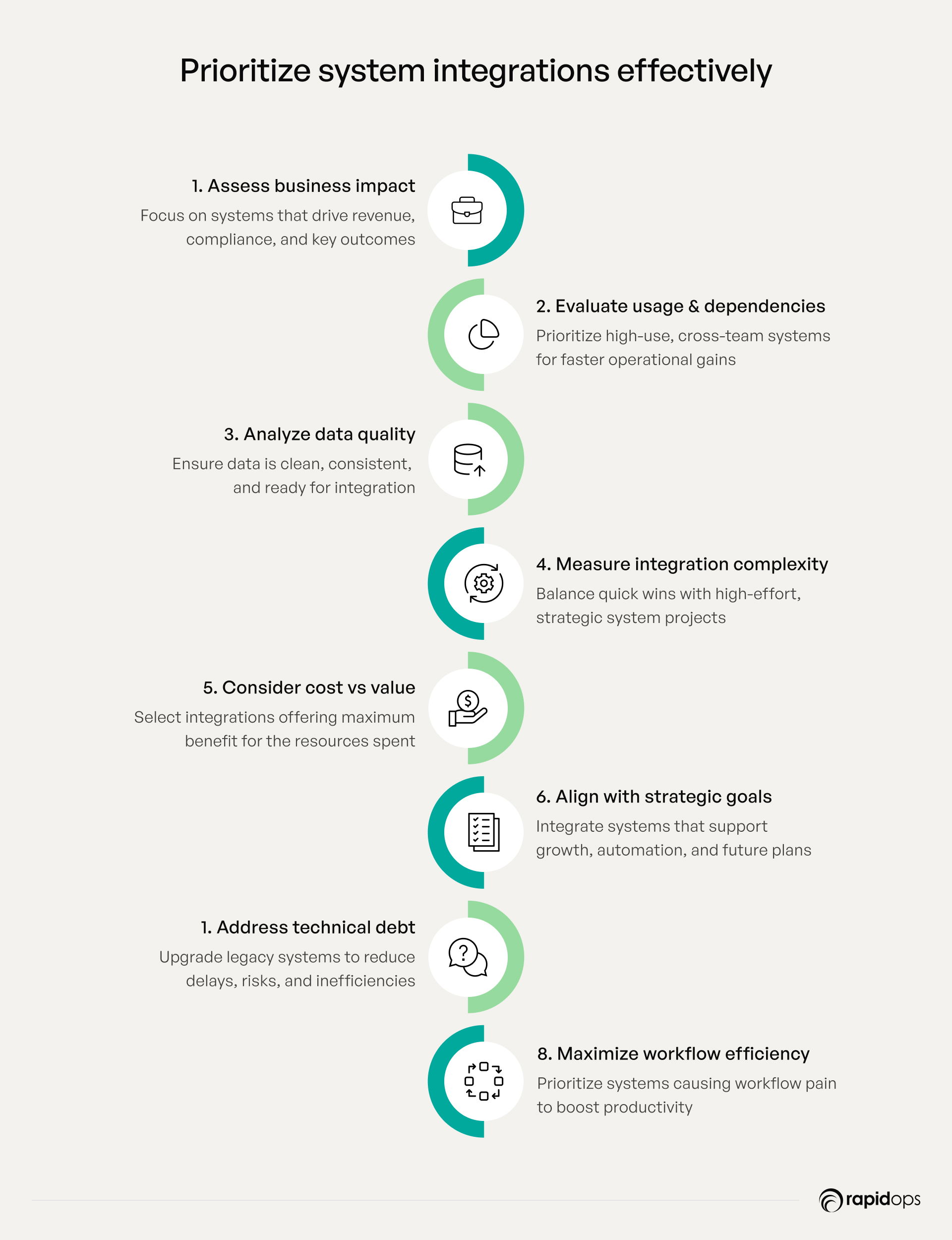
Start by examining which systems influence your revenue, customer experience, compliance, and mission-critical operations. These platforms often carry essential data, support high-frequency transactions, and directly affect outcomes your business cannot afford to interrupt. When you prioritize integrating high-impact systems, you eliminate bottlenecks that slow teams down, reduce operational risk, and enable faster, more informed decision-making. This ensures your integration roadmap supports the activities that matter most to your organization’s performance
2. Evaluate usage & cross-department dependencies
The systems your teams use most and those sitting at the center of cross-functional workflows deserve top priority. When you integrate platforms used by sales, finance, operations, support, or product teams, you immediately reduce friction, eliminate duplicate work, and maintain consistent data across your organization. Focusing on high-usage systems also maximizes ROI because the benefits reach more users. This ensures your integrations strengthen collaboration, enhance productivity, and simplify processes across departments.
3. Analyze data quality & integration readiness
Before you choose which system to integrate next, assess whether the data inside it is clean, consistent, and structured enough to support reliable integration. Evaluate API maturity, documentation quality, schema stability, and whether the system supports real-time or batch operations. Poor data quality can derail integrations, cause downstream errors, and delay go-live timelines. By evaluating readiness early, you reduce rework, prevent integration failures, and ensure that every system you connect enhances, not harms, your data ecosystem.
4. Evaluate integration complexity
Some systems require minimal configuration, while others demand architectural changes, middleware, or custom development. Prioritizing low-complexity systems gives you quick wins, builds stakeholder confidence, and accelerates momentum. High-complexity systems shouldn’t be ignored; you simply need to plan them carefully. Understanding the development effort, technical constraints, API limitations, and dependency chains helps you sequence integrations intelligently. This balance ensures your roadmap is both achievable and strategically aligned with your long-term technology goals.
5. Consider the cost-to-value ratio
Every integration has a cost for development, licensing, infrastructure, maintenance, and ongoing support. Evaluate whether the expected value justifies the investment. Sometimes a system offers massive long-term value but requires resources you can’t commit immediately. Other times, a modest integration produces immediate, measurable gains. When you prioritize based on cost-to-value alignment, you optimize budgets, accelerate ROI, and ensure every integration directly contributes to operational efficiency, business growth, or customer experience improvements.
6. Align with strategic goals & future growth
Integrations must support where your organization intends to go, not just where it is today. Prioritize systems that enable automation, AI initiatives, digital transformation, scalability, or market expansion. These integrations create a foundation your future systems, workflows, and innovations can build on. When your roadmap aligns with your long-term business objectives, you avoid technical debt, reduce rework, and ensure that every integration moves you closer to your vision for a fully connected, modern enterprise.
7. Understand technical debt & modernization needs
Legacy platforms with outdated architectures or limited APIs can slow your integration roadmap. Identify which systems require upgrades, middleware, or modernization before integration. Addressing technical debt early reduces surprises, prevents delays, and ensures your integrations are stable and scalable. When you evaluate hidden dependencies, codebase limitations, and required refactoring, you make smarter decisions about timing. This sets the stage for seamless connectivity and long-term architectural resilience.
8. Evaluate user impact & workflow efficiency
Some systems create daily friction for your teams' manual data entry, duplicate processes, inconsistent reports, or tedious switches between tools. Integrating these platforms eliminates inefficiency and improves employee productivity. When you prioritize the systems that cause the most workflow pain, you deliver immediate improvements to user experience. This builds internal trust, accelerates adoption, and ensures your technology ecosystem genuinely supports the people who rely on it every day.
9. Consider change management & adoption readiness
A successful integration isn’t just technical; it requires people to adapt. Evaluate stakeholder alignment, training needs, process changes, and potential resistance. Integrating systems whose teams are ready for change ensures you launch with confidence and reduce the risk of slow adoption. When you prioritize integrations with strong internal buy-in, you maximize the return on effort and ensure the benefits are realized across your organization quickly and smoothly.
10. Assess security & compliance requirements
Systems that handle sensitive customer data, financial information, employee records, or regulated workflows must be prioritized and managed carefully. Evaluate each system’s compliance obligations, authentication complexity, audit trail requirements, and role in your governance policies. Integrating these systems early ensures better control, reduces risk exposure, and improves your security posture. When you consider compliance from the start, you build integrations that protect your business, strengthen trust, and meet evolving regulatory standards.
11. Create a sequencing strategy to build a logical roadmap
After evaluating all systems, build a sequencing strategy that balances business value, technical feasibility, and risk. Start with high-impact, low-complexity systems to produce quick wins. Then move to mission-critical systems that drive revenue, compliance, or customer experience. Next, integrate data-heavy systems with the most dependencies to strengthen overall flow. Finally, address high-risk systems to reduce long-term exposure. This structured sequence ensures your roadmap is logical, efficient, and aligned with your strategic priorities.
Strategic framework for high-impact integrations
Integrating systems across an organization isn’t just a technical exercise; it’s a strategic opportunity to align technology with business outcomes. A high-impact integration framework ensures that every connection strengthens workflows, unlocks actionable insights, and supports long-term growth.
Start by mapping the interdependencies between applications, data sources, and operational processes. Understanding how systems interact reveals critical touchpoints where integration delivers the most efficiency and reduces operational risk. Evaluate the strategic value of each system by considering its influence on customer experience, revenue generation, regulatory compliance, and cross-functional collaboration.
Next, assess integration readiness and complexity. Some systems can be connected quickly for immediate gains, while others may require architectural changes or modernization. Balancing short-term wins with long-term priorities ensures resources are used effectively and adoption is smooth.
A robust framework also incorporates organizational alignment and governance. Engaging stakeholders across departments ensures integrations support real business objectives, secure compliance, and foster adoption. By sequencing initiatives strategically, starting with high-value, high-impact systems, organizations transform fragmented platforms into a connected, agile, and future-ready ecosystem that accelerates decision-making, enhances operational efficiency, and positions the business for sustainable growth.
How to handle urgency without compromising strategy
In high-pressure environments, the instinct is often to integrate every system immediately. However, reacting solely to urgency can fragment workflows, increase operational risk, and dilute strategic impact. Handling urgency effectively requires balancing short-term operational needs with long-term business objectives, ensuring that integration initiatives remain both timely and strategically aligned.
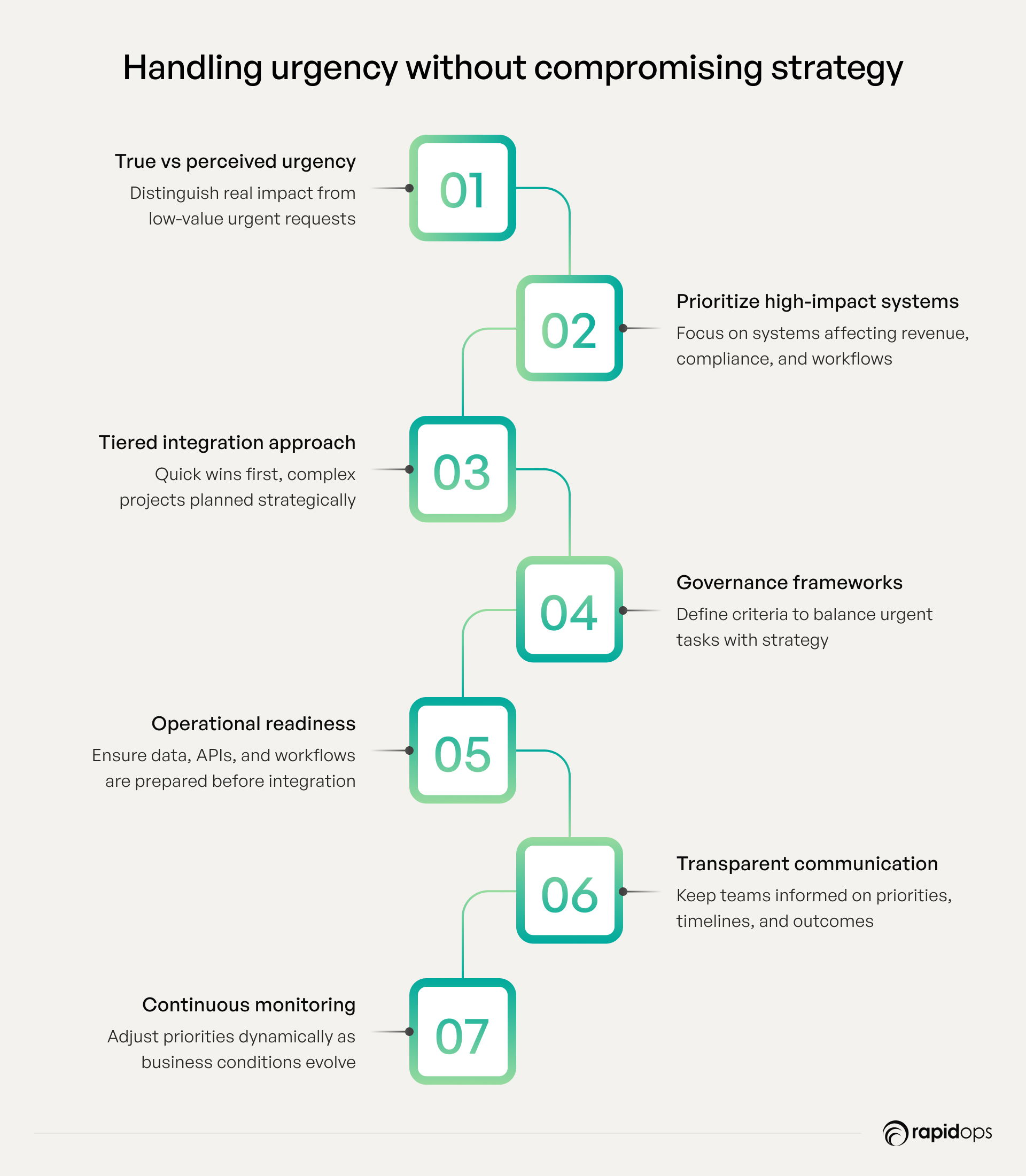
Evaluate true urgency versus perceived urgency
Not all urgent requests carry the same operational weight. A system may appear critical due to repeated complaints or visible workflow friction, but its actual impact on revenue, compliance, or strategic initiatives may be limited. By distinguishing true urgency from perceived urgency, you prevent resources from being diverted to low-value integrations while ensuring that high-impact systems receive the attention they require.
Prioritize high-impact systems first
Urgency should be addressed in the context of business impact. Systems that directly affect customer experience, revenue streams, regulatory compliance, or mission-critical workflows must be prioritized over less impactful systems, even if those other systems are generating more frequent requests. Integrating high-impact systems first ensures that urgent tasks do not compromise the organization’s strategic objectives.
Implement a tiered integration approach
A tiered approach allows organizations to handle urgent needs without undermining long-term strategy. Quick-win integrations can address immediate workflow bottlenecks or recurring operational pain points while remaining aligned with the broader integration roadmap. Simultaneously, complex or strategic integrations are planned, resourced, and executed systematically to safeguard architecture, data integrity, and operational stability.
Establish governance and decision-making frameworks
Strategic handling of urgency requires clear governance processes. Decision-making frameworks should define:
- Which systems qualify as urgent
- Criteria for aligning urgency with strategic objectives
- Protocols for balancing short-term fixes with long-term integration plans
Such frameworks ensure that urgent initiatives are evaluated consistently, resourced appropriately, and executed without jeopardizing broader digital transformation goals.
Align integration efforts with operational readiness
Even urgent integrations must consider data quality, system dependencies, and technical readiness. Rushing integration of systems with poor data hygiene, unstable APIs, or incomplete workflows can introduce errors, disrupt operations, and reduce adoption. Ensuring operational readiness mitigates risk while maintaining momentum on high-priority initiatives.
Maintain visibility and communication across teams
Transparent communication is critical to managing urgency strategically. Stakeholders across departments should have visibility into prioritization decisions, timelines, and expected outcomes. Keeping teams informed ensures alignment, reduces friction, and reinforces that urgency is being addressed in a structured, value-driven manner.
Continuously monitor and adjust priorities
Business conditions and system demands evolve. A dynamic approach to prioritization ensures that new urgent requirements are integrated into the roadmap without derailing ongoing projects. Continuous monitoring of impact, dependencies, and resource allocation enables organizations to respond to shifting urgency while maintaining strategic alignment.
Why handling urgency strategically drives success
Balancing urgency with strategy ensures that your integration initiatives:
- Deliver immediate operational relief without creating technical debt
- Maximize ROI by focusing on high-impact systems first
- Maintain workflow integrity, data consistency, and adoption momentum
- Strengthen long-term digital transformation goals and enterprise architecture
Which tools and methodologies support effective prioritization
Effectively prioritizing system integrations requires more than judgment alone; it relies on structured methodologies and digital tools that provide visibility, data-driven insights, and decision-making frameworks. Leveraging the right combination of approaches enables organizations to sequence integrations efficiently, mitigate risks, and maximize operational and strategic outcomes.
Weighted scoring models
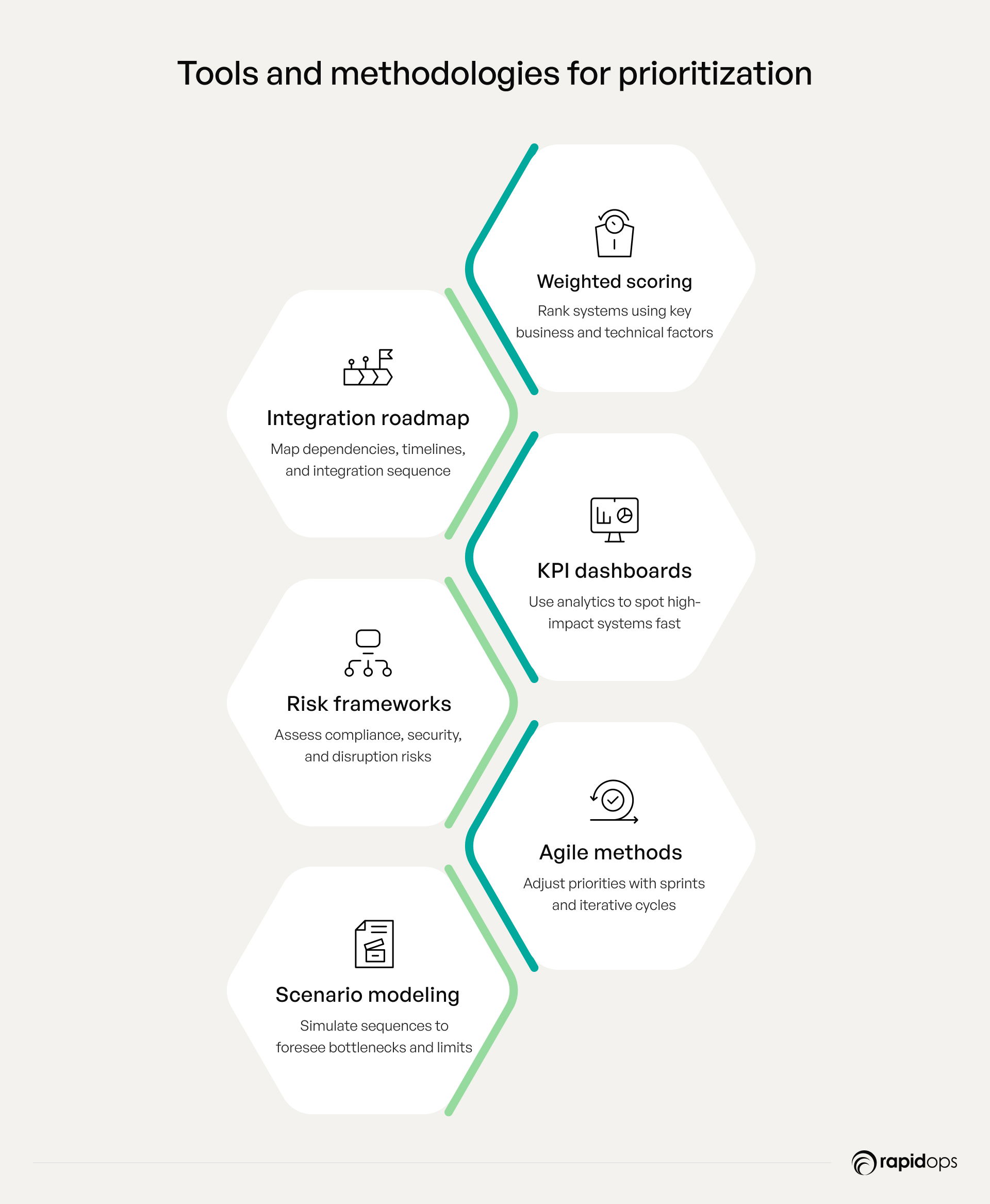
Weighted scoring models are a quantitative framework that assigns values to each system based on factors such as business impact, technical complexity, data readiness, risk, and user impact. Each factor is given a weight according to organizational priorities, and cumulative scores help rank systems objectively. This methodology reduces subjectivity, clarifies trade-offs, and aligns prioritization decisions with strategic goals.
Integration roadmaps and visual planning tools
Digital tools such as integration management platforms, workflow mapping software, and project visualization tools allow teams to create end-to-end integration roadmaps. These tools provide a centralized view of dependencies, sequencing, timelines, and resource allocation, enabling stakeholders to identify bottlenecks, simulate scenarios, and track progress in real time.
Data analytics and KPI dashboards
Data-driven prioritization relies on insights from analytics platforms, operational KPIs, and system performance metrics. Tools that aggregate usage statistics, error rates, workflow efficiency, and transaction volumes enable organizations to identify high-impact systems and recurring pain points, ensuring that prioritization decisions are supported by empirical evidence rather than intuition alone.
Risk assessment and governance frameworks
Structured governance frameworks and risk assessment methodologies help evaluate security, compliance, technical debt, and potential operational disruptions. These approaches ensure that urgent integrations do not compromise system stability, regulatory compliance, or data integrity, while providing a clear mechanism for stakeholder approvals and accountability
Agile and iterative methodologies
Agile methodologies, including sprints, Kanban boards, and iterative delivery cycles, support flexible and responsive prioritization. They allow organizations to address high-priority integrations quickly, incorporate feedback from stakeholders, and adapt to shifting business needs without derailing long-term strategic objectives. This approach ensures that urgency and strategic alignment coexist in a controlled, measurable manner.
Scenario modeling and simulation tools
Scenario modeling tools help organizations simulate different integration sequences and their potential impacts on workflows, dependencies, and data flows. By testing multiple prioritization strategies virtually, teams can anticipate bottlenecks, resource constraints, and risk exposures, ensuring that the final roadmap is both efficient and resilient.
Why leveraging tools and methodologies enhances prioritization
The combination of structured methodologies and digital tools enables organizations to:
- Make data-driven prioritization decisions aligned with business objectives
- Visualize dependencies, resource allocation, and workflow impact across systems
- Mitigate risk and technical debt proactively
- Maintain flexibility to respond to urgency while adhering to long-term strategy
- Drive measurable ROI and operational efficiency from integration initiatives
What are real-world examples of successful prioritization
Understanding the principles of system integration prioritization becomes clearer when applied to real-world scenarios across industries. The following examples demonstrate how strategic sequencing of integrations delivers measurable business value.
1. Retail: Streamlining omnichannel operations
A large retail chain faced challenges with fragmented sales, inventory, and customer management systems. Prioritization focused first on integrating the eCommerce platform with the ERP system, which managed inventory and fulfillment. By addressing the highest-impact system first, the retailer achieved real-time stock visibility, reduced stockouts, and improved order accuracy. Subsequent integrations connected the CRM and marketing automation platforms, enhancing personalized promotions and customer loyalty programs. Strategic prioritization ensured that high-value operational outcomes were realized quickly without overwhelming IT resources or disrupting ongoing sales operations.
2. Manufacturing: Optimizing production and supply chain efficiency
A global manufacturing company operated multiple production lines with disconnected MES (Manufacturing Execution Systems), ERP, and inventory management systems. The prioritization strategy targeted integrating production line MES systems with the central ERP first, ensuring accurate tracking of production output, raw material usage, and quality metrics. Once these high-impact integrations were completed, the focus shifted to linking supplier management systems and inventory analytics platforms. This sequenced approach enabled operational efficiency, reduced downtime, and strengthened supply chain coordination, demonstrating the value of prioritizing systems that directly affect production performance and business-critical metrics.
3. Distribution: Enhancing logistics and delivery operations
A distribution company managing multiple warehouses and transportation fleets faced inefficiencies due to siloed warehouse management, route planning, and customer order systems. Prioritization focused on integrating warehouse management systems with order processing platforms first, enabling accurate real-time inventory updates and improved fulfillment accuracy. Subsequent integrations connected fleet tracking and logistics analytics systems, optimizing delivery routes and reducing transit times. This structured sequencing of integration projects maximized ROI, improved operational transparency, and enhanced customer satisfaction across the distribution network.
What common mistakes should you avoid when prioritizing system integration
Successful system integration requires a strategic, business-aligned approach. Organizations often make mistakes that compromise efficiency, increase risk, and reduce the value of integration efforts. Avoiding these pitfalls ensures that your integration roadmap delivers tangible operational improvements, strategic alignment, and long-term scalability.
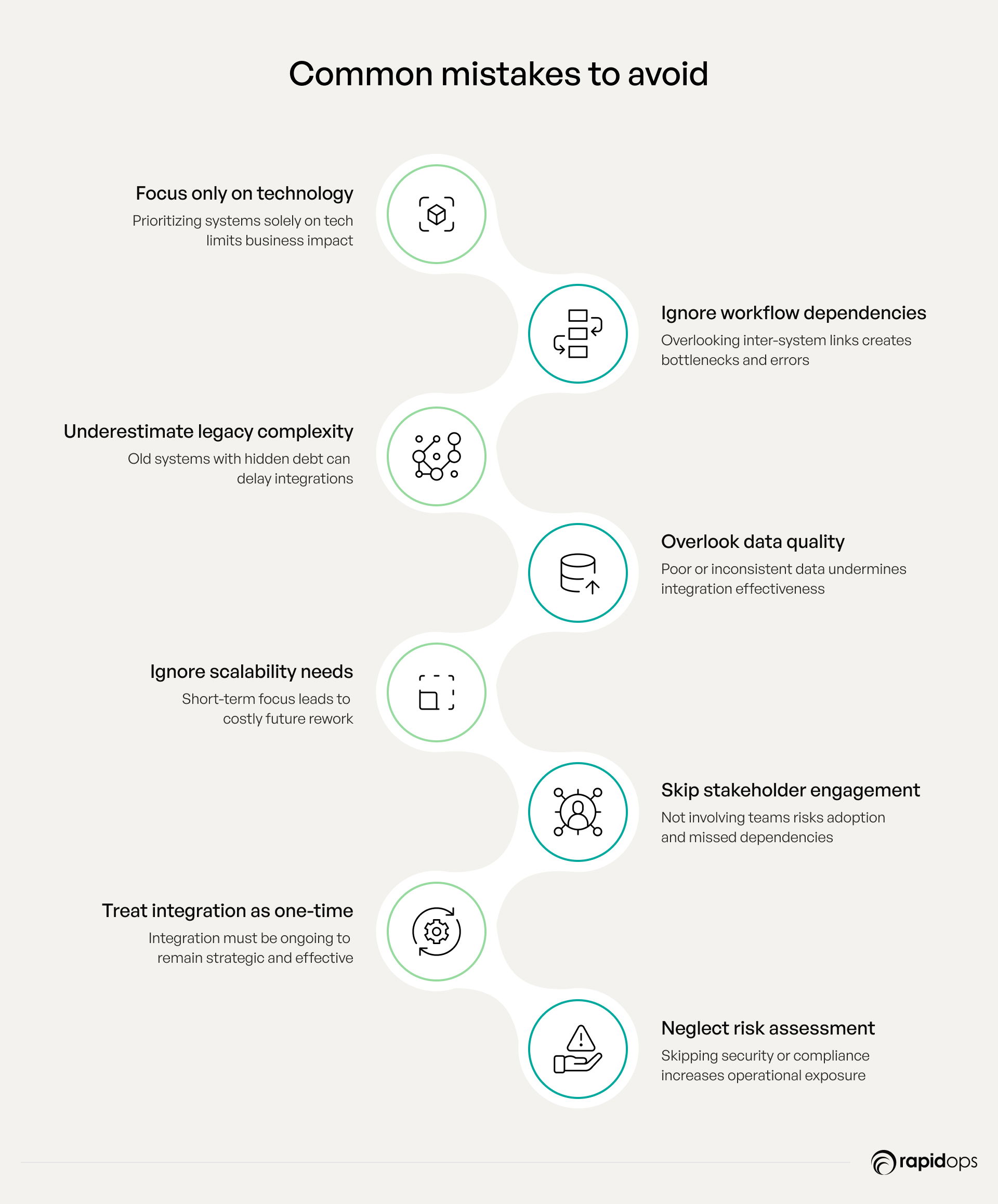
Focusing only on technology instead of business impact
Prioritizing systems solely based on technical complexity or platform capabilities can lead to investments that deliver limited operational or strategic value. Integration decisions should be driven by business outcomes, customer experience, compliance requirements, and revenue impact, ensuring that every connected system contributes meaningfully to organizational goals.
Neglecting workflow dependencies across systems
Failure to account for interdependencies between systems often results in bottlenecks, duplicated processes, and data inconsistencies. Comprehensive mapping of workflows, dependencies, and data flows ensures that integrations strengthen end-to-end processes rather than creating isolated improvements.
Underestimating the complexity of legacy systems
Legacy systems frequently contain hidden technical debt, outdated architectures, and limited API capabilities. Underestimating these factors can delay projects, increase costs, and introduce operational disruptions. Proper assessment of legacy system complexity is critical to avoid rework and ensure smooth sequencing of integration initiatives.
Ignoring data quality and governance requirements
Integrations built on inconsistent, incomplete, or poorly structured data can propagate errors across connected systems, undermining operational effectiveness and decision-making. Establishing data governance, validation, and quality checks at the outset safeguards data integrity and enhances the reliability of insights derived from integrated systems.
Overlooking scalability and future growth needs
Short-term integrations that fail to account for future business expansion, automation, or AI initiatives may require costly rework later. Prioritization must include long-term strategic considerations, ensuring that integrated systems support organizational growth and evolving digital transformation objectives.
Failing to involve key stakeholders in decision-making
Integration success depends on cross-functional alignment. Ignoring input from stakeholders in finance, operations, IT, sales, or compliance can result in missed dependencies, low adoption, and unanticipated risks. Early engagement fosters buy-in, smooth adoption, and a shared understanding of integration priorities.
Treating integration as a one-time project rather than a continuous strategy
System integration is not a one-off initiative. Business processes, technology landscapes, and customer expectations evolve continuously. Treating integration as a recurring strategic capability ensures ongoing efficiency, reduces technical debt, and allows the organization to adapt dynamically to new operational and technological requirements.
Neglecting risk assessment, including security and compliance
Prioritizing speed over due diligence can introduce vulnerabilities. Failing to assess security, regulatory compliance, or operational risk can compromise sensitive data, disrupt business continuity, and result in financial or reputational damage. A robust risk assessment framework must be incorporated into every prioritization decision to mitigate exposure effectively.
How to take action and prioritize effectively
When every system in your organization demands attention, it’s easy to feel overwhelmed. Urgency can cloud judgment, leaving teams unsure where to begin, worried about making the wrong choice, or struggling with disconnected workflows that slow growth. Prioritizing the right systems is the key to unlocking operational efficiency, accelerating decision-making, and creating measurable business impact. By focusing on integrations that matter most—whether they drive revenue, support compliance, or enhance customer experience, you can turn complexity into clarity and build a roadmap that delivers results from day one.
At Rapidops, we’ve been helping global brands for over a decade to seamlessly integrate their most critical core systems without disrupting daily operations. We guide businesses in adopting the latest tools and technologies to stay competitive, while preserving legacy systems. Every system and tool you use is fully connected, synchronized, and optimized to work together, unlocking efficiency, smarter decision-making, and long-term operational value.
If you’re ready to bring clarity to your integration strategy and understand which systems to prioritize first, book a session with our integration experts. Together, we’ll create a practical, actionable roadmap to streamline operations, improve data flow, and build a modern, integrated tech ecosystem that powers your growth, reduces risk, and maximizes ROI.

What’s Inside
- What is system integration, and why is it important
- What are the main types of system integration
- How to prioritize system integrations
- Strategic framework for high-impact integrations
- How to handle urgency without compromising strategy
- Which tools and methodologies support effective prioritization
- Why leveraging tools and methodologies enhances prioritization
- What are real-world examples of successful prioritization
- What common mistakes should you avoid when prioritizing system integration
- How to take action and prioritize effectively

Let’s build the next big thing!
Share your ideas and vision with us to explore your digital opportunities
Similar Stories
- Transformation
- undefined Mins
- March 2022


- Transformation
- undefined Mins
- March 2020

Receive articles like this in your mailbox
Sign up to get weekly insights & inspiration in your inbox.