


Roofing distributors have reached an inflection point. Over the last few years, many have started to clearly see the technology and capability gaps holding their businesses back - manual sales workflows, fragmented systems, limited visibility into operations, and digital experiences that no longer meet customer expectations. These gaps are no longer “nice to fix.” They directly impact margins, growth, and competitiveness.
Most distributors already know what needs to change. Systems must be modernized. Capabilities must be extended. Digital channels, integrations, and automation are no longer optional if consistent growth and operational resilience are the goal. The real challenge isn’t awareness, it’s risk. You can’t afford to modernize at the cost of disrupting daily operations. Replacing your ERP, stopping order flows, retraining teams overnight, or pausing the business even for a short period is simply not an option.
What many roofing distributors don’t realize is that modernization does not have to mean replacement. It doesn’t require ripping out core systems or reworking everything you’ve built over decades. There is a practical, low-risk way to modernize, one that works with your existing systems, extends their capabilities, and improves how your business operates without interrupting a single day of sales, fulfillment, or customer service.
This article is created to make that path clear. To show how roofing distributors like you can modernize incrementally, unlock digital and operational capabilities, protect margins, and gain a competitive edge, without disruption, without replacement, and without putting day-to-day operations at risk.
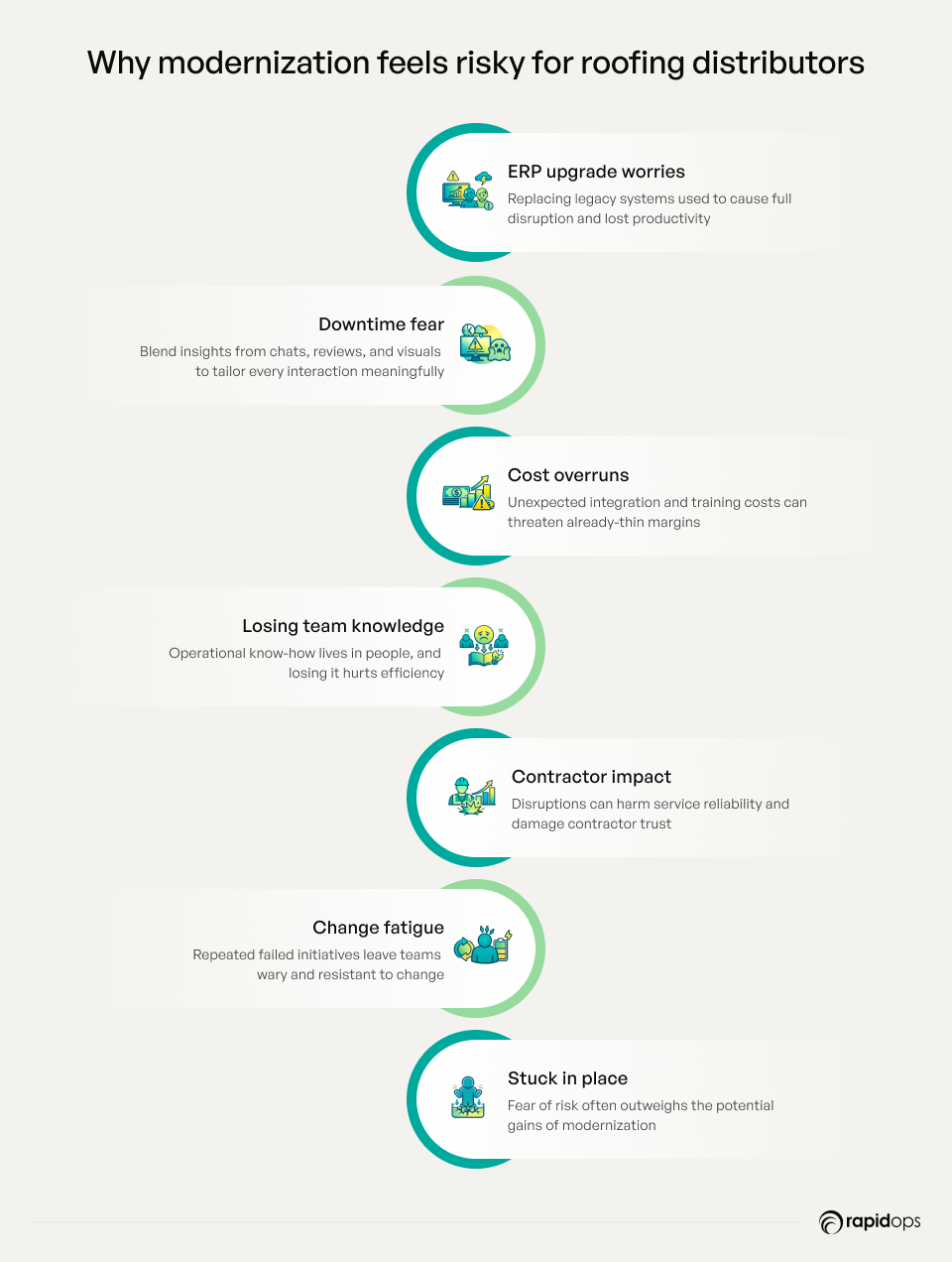
Why “modernization” feels risky for roofing distributors
Modernization carries a reputation that often precedes it: disruption, risk, and uncertainty. For many roofing distributors, the thought alone triggers concern: What if operations slow, teams resist, or margins are eaten away? The reality is different: modernization today doesn’t have to be a gamble. To take the first step confidently, you need to understand why it feels risky and why these fears are so deeply ingrained.
Why you may still equate modernization with ERP replacement
For decades, upgrading capabilities often meant tearing everything down and starting over. Legacy ERP systems were monolithic, so adding new functionality typically required a full replacement. Modular upgrades or phased improvements simply weren’t an option. It’s no surprise, then, that many distributors still associate modernization with disruption and risk.
The good news is that this assumption no longer has to hold. While not every platform is designed for seamless integration, there are a few technology partners who truly understand the operational challenges distributors face.
These partners provide solutions that connect your existing legacy systems with modern tools, digital channels, and automation platforms. With the right approach, you can extend capabilities, improve visibility, and enhance operational efficiency all without halting order flows, pausing fulfillment, or retraining teams overnight.
Modernization today, when guided by these select partners and solutions, is about evolution, not upheaval. It’s about building on the systems that already work, rather than replacing them, and turning technology gaps into opportunities for growth, resilience, and competitive advantage. Recognizing this shifts the perspective from risk to possibility and is the first step toward a modernization strategy that preserves your business while unlocking its next level of performance.
Fear of operational downtime that could halt daily business
Even a short system interruption can ripple across your operation: delayed shipments, mismanaged orders, frustrated branch teams, and contractors left waiting. For distributors operating multiple locations, one glitch can cascade into network-wide confusion.
No distributor wants modernization to ever feel like a threat to the business’s heartbeat. As one CIO in the industry said: “Even a half-day outage can cost more than a month of software licenses.”
The solution lies in zero-downtime strategies: staged rollouts, fail-safes, and carefully phased adoption. When executed correctly, modernization strengthens your operations without ever stopping your business.
Fear of cost overruns eating into already-thin margins
Large system upgrades and ERP replacements often exceed budgets and timelines. Hidden costs, such as extra integration work, extended training, or temporary workflow adjustments, can quickly eat into already-thin margins, creating stress for leadership and hesitation around modernization.
Research shows that over 60% of large system replacements exceed their initial budgets, largely due to integration and adoption challenges. This makes uncertainty one of the biggest barriers to taking the next step in modernization.
The encouraging news is that this risk can be mitigated. Certain modernization approaches work with your existing systems, enabling incremental improvements, measurable results, and operational continuity, all without disrupting workflows or compromising margins.
Later in this article, we’ll explore how these solutions function in practice, showing how you can modernize safely, protect margins, and progressively unlock new capabilities, turning modernization from a perceived risk into a clear path to efficiency and growth.
Fear of losing tribal knowledge embedded in your teams
Years of operational experience, workarounds, customer nuances, and branch-specific rules live in your teams, not in any manual or system. This knowledge has been built over decades and guides everything from fulfillment to customer service, decision-making, and day-to-day operations.
Replacing or modernizing systems carelessly can put this expertise at risk. Even small gaps in team knowledge can lead to confusion, delays, missed commitments, and frustrated customers. In some cases, a single disruption in a critical branch can slow operations for hours or trigger errors that ripple across teams and affect revenue.
It’s no surprise that leaders approach modernization with caution. When institutional knowledge is lost or fragmented, efficiency suffers, errors increase, and decision-making slows across the organization. Preserving this expertise is one of the most pressing concerns executives face when considering any system upgrade.
Fear of disrupting contractor commitments and service reliability
Contractors are on the front lines, and they notice issues long before internal teams do, such as missed ETAs, last-minute changes, or conflicting information from different branches. Even minor disruptions can quickly erode trust, frustrate contractors, and affect long-term loyalty.
For executives, this creates a significant concern: any misstep in modernization could ripple through operations, causing delays, miscommunications, or unfulfilled commitments. Maintaining consistent, reliable service is critical, and the fear of disrupting these relationships makes modernization feel risky.
Service reliability isn’t just operational; it’s a competitive advantage. Losing the confidence of contractors, even temporarily, can have consequences that extend beyond a single project, impacting revenue, reputation, and long-term partnerships.
Fear of change, fatigue, and resistance across teams
Many teams have endured multiple transformation initiatives that never fully delivered, leaving a legacy of frustration and skepticism. Constant shifts in processes, tools, and priorities can lead to burnout, disengagement, and reluctance to embrace even beneficial changes.
Employees often approach new initiatives with a cautious mindset, shaped by past experiences where promised improvements fell short, or disruptions outweighed gains. For executives, this human factor amplifies the perceived risk of modernization.
Resistance or fatigue can slow adoption, reduce productivity, and weaken morale, potentially undermining operational objectives. Even well-intentioned upgrades can falter if teams are not aligned or motivated. Understanding this dynamic is critical: modernization is as much about navigating human behavior as it is about implementing technology, making this fear a central consideration for leadership.
Why these fears often keep distributors stuck
The combined weight of operational risk, potential cost overruns, loss of team expertise, contractor impacts, and resistance from employees creates a natural barrier to action. Even when inefficiencies or gaps in processes and systems are clear, hesitation dominates, as the consequences of missteps delays, frustrated teams, disrupted contractors, or quietly eroded margins- feel immediate and tangible.
These fears are not abstract; they reflect the real-world stakes of maintaining smooth operations while considering any modernization initiative. It’s this pressure that keeps decision-makers cautious, making change feel riskier than staying with familiar systems.
The reality of existing systems in roofing distribution
Before you consider modernization, it’s essential to understand the systems keeping your business running today. Knowing both the strengths and the limits of your existing tech stack allows you to modernize confidently, protect operational stability, and improve contractor experiences without unnecessary risk.
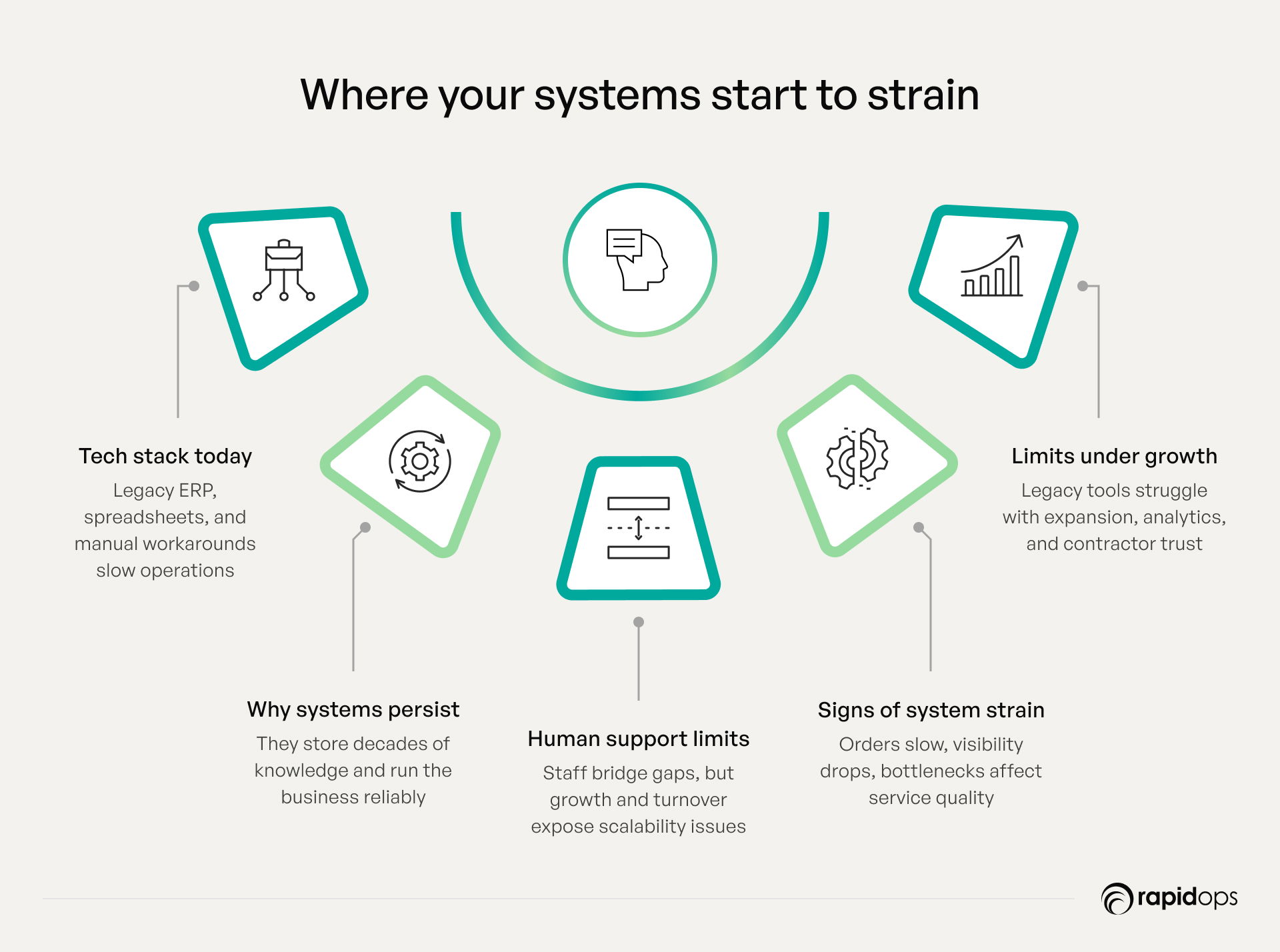
1. What does your tech stack look like today
Your technology foundation often combines legacy ERP systems, Epicor, and Eclipse, with spreadsheets, custom reports, and manual workarounds. Orders flow through email, phone calls, and counter transactions. While this patchwork keeps the business operational, it introduces hidden inefficiencies: inconsistent data, delayed updates, and reliance on human intervention. These systems are functional, but the way they interact with each other creates friction that silently slows decision-making, increases errors, and limits your visibility into day-to-day operations.
2. Why these systems are still here, and why that’s smart
You’ve maintained these systems for a reason: they encode decades of customer, pricing, and product knowledge, and they run your business reliably every day. They are the institutional memory of your organization, capturing complex branch-specific rules and exceptions that aren’t documented anywhere else. Replacing them recklessly risks erasing this knowledge, disrupting workflows, and alienating contractors who rely on your consistent service. Acknowledging these strengths reinforces why a modernization approach can build on what works instead of starting from scratch.
3. The human glue that keeps systems running, and why it can’t scale
Branch managers, planners, and sales teams act as the glue bridging gaps in your systems. Their expertise ensures continuity, but this human dependency has limits. Knowledge resides in people, not fully in your systems, which means scalability is constrained as volume grows, new branches are added, or turnover occurs. Without processes to codify this knowledge into systems, you risk inconsistent execution, slower onboarding, and uneven contractor experiences, making modernization necessary to scale efficiently without losing operational reliability.
4. Where your systems start to show strain
As your business grows, existing systems begin to show visible strain:
- Speed: Orders take longer to process, and reporting lags behind operational reality
- Visibility: Limited cross-branch insights create blind spots in inventory and shipments
- Scalability: Bottlenecks emerge during high-volume periods or post-acquisition integration
- Customer experience: Contractors notice delays, incorrect orders, or inconsistent service first
These are not theoretical concerns; they represent real-world operational frictions that affect your profitability and reputation. Recognizing where strain occurs helps you prioritize which areas to modernize safely.
5. Limits of current systems when growth or competitive advantage is at stake
Your legacy tech may handle daily operations, but strategic gaps emerge under pressure:
- Integrating new branches or acquisitions is slow and complex
- Analytics remain reactive, limiting proactive, data-driven decisions
- Delivering a consistent contractor experience across locations is difficult, putting your competitive position at risk
These limitations show why modernization is necessary, but also why it doesn’t need to mean replacing everything. A targeted approach preserves strengths while addressing strategic gaps, ensuring your business scales efficiently, retains contractor trust, and sustains competitive advantage.
What “modernizing without replacing” actually means
As we’ve seen before, the hesitation around modernization isn’t fear of change itself, it’s fear of losing control over operations that already function. “Modernizing without replacing” flips that concern on its head: it’s about building on existing systems, connecting processes, and enabling teams to work more efficiently, all without interrupting what already makes the business run.
The reality today is different: modernization doesn’t have to be disruptive. It’s not about tearing down systems or starting over; it’s about enhancing what already works, connecting workflows, and enabling teams to operate smarter, faster, and more reliably. Done right, it strengthens your business, protects margins, and ensures contractor satisfaction, all while preserving the institutional knowledge that makes your operations run smoothly.
Definition
Modernization begins with one principle: build on what already works instead of starting from scratch. Your ERP, spreadsheets, branch-specific tools, and manual workflows aren’t limitations; they’re the backbone of decades of operational knowledge.
By connecting these systems into an interoperable, intelligent workflow, you can:
- Eliminate repetitive manual work and reduce errors that quietly erode margins
- Provide real-time visibility into inventory, shipments, and orders across all branches
- Enable teams to focus on strategic work instead of firefighting exceptions
Consider a common scenario: A contractor calls your branch for a reorder. In a disconnected system, your staff double-checks inventory, confirms pricing, and reconciles exceptions, consuming hours of effort and risking mistakes. With connected systems, availability, pricing, and approvals are instantly visible, reducing delays, avoiding partial shipments, and improving contractor trust.
Modernization in this way ensures your daily operations remain stable, even as you introduce efficiencies and automation that deliver measurable ROI.
Core principle: Keep ERP as the system of record
The ERP remains the central source of truth, capturing core business data, workflows, and institutional knowledge. Modernization enhances ERP capabilities without replacing it, ensuring that business continuity is preserved while operational performance improves.
By integrating modern tools and analytics:
- Dashboards provide instant insights into inventory, orders, and branch performance
- Automated alerts prevent errors from becoming customer-impacting problems
- Data-driven decisions, from demand forecasting to margin optimization, become possible
This approach ensures that critical information remains centralized, trusted, and actionable, while day-to-day operations become faster, more accurate, and scalable. Leadership can confidently see, measure, and act, rather than firefight issues after they occur.
Shift from monolithic systems to an interoperable architecture
Monolithic systems often create silos, bottlenecks, and human dependency, which limit scalability and slow response times. Modernization moves organizations toward a modular, interoperable architecture where tools communicate seamlessly, reducing friction and operational risk.
The practical benefits are immediate and tangible:
- Faster operations: Orders, approvals, and inventory updates flow automatically across branches
- Consistent contractor experience: Every branch delivers the same reliable, on-time service
- Scalability: New branches, acquisitions, or increased volumes integrate smoothly without operational strain
ERP replacement is considered only when extensions or integrations no longer meet operational or strategic objectives. This ensures modernization delivers measurable value now, improving efficiency, reliability, and contractor satisfaction, while preserving institutional knowledge and minimizing risk.
How middleware enables modernization without replacing your ERP
When operational systems struggle to talk to each other, every delay, missed insight, or frustrated contractor represents a lost opportunity. Middleware acts as the ultimate bridge, linking your ERP, branch systems, and specialized applications into a single, intelligent operation. It doesn’t replace anything you already rely on; it orchestrates workflows, automates critical processes, and ensures real-time visibility across every branch and team. With middleware, modernization stops being a risky disruption and becomes a strategic lever, turning fragmented operations into efficiency, clarity, and actionable insights that directly impact margins and performance.
What middleware really is
At its core, middleware is the intelligent layer connecting all operational systems, transforming a collection of independent tools into a unified, cohesive platform. It enables systems to exchange data, trigger automated processes, and respond instantly to operational events, without replacing any of your existing infrastructure. Think of it as the central nervous system of your business: it monitors operations, coordinates multi-branch workflows, and provides a single source of truth for decision-making. By unifying disparate systems, middleware creates a resilient, scalable backbone, supports complex workflows, accelerates execution, and unlocks previously inaccessible growth opportunities, all while preserving the expertise, processes, and systems you’ve built over time.
How middleware works in your business
Middleware acts as the orchestration layer that ensures your ERP, branch applications, and specialized tools operate as a single, coordinated system. Here’s a detailed, step-by-step look at how it works:
- Data capture across systems: Middleware continuously monitors and collects data from every connected application, orders, inventory adjustments, production updates, or service events, without altering the core ERP or operational systems.
- Data translation and standardization: Each system often formats data differently. Middleware harmonizes these formats, ensuring that all tools understand and process information consistently, eliminating miscommunication or duplicate entries.
- Intelligent workflow automation: Middleware applies predefined triggers and rules across systems. For example, when an order is placed, it can automatically update inventory, generate picking tasks, notify fulfillment teams, and log delivery schedules, ensuring processes flow smoothly without manual handoffs.
- Real-time synchronization: All connected systems are updated simultaneously, keeping branch operations, reporting dashboards, and decision-making tools aligned. No system lags, and every team works with the same accurate information at the same time.
- Monitoring, orchestration, and exception handling: Middleware continuously tracks processes and flags anomalies, like missing data, conflicting updates, or delays. Teams receive alerts only when intervention is needed, reducing operational friction and allowing uninterrupted execution of routine tasks.
- Scalable integration layer: Middleware acts as a neutral hub, capable of integrating additional systems, tools, or automation solutions in the future. As operations grow or new technologies are adopted, middleware ensures every system communicates effectively without replacing or overhauling existing infrastructure.
By coordinating these steps, middleware transforms disconnected tools into an intelligent, resilient operational backbone, enabling accurate, efficient, and consistent workflows across every branch and team while keeping daily operations uninterrupted.
What middleware is used inside your business
Middleware delivers deep operational capabilities, forming the technical backbone of a modernized roofing distribution system:
- Centralized data orchestration: ERP, branch-level tools, and other applications operate on a consistent dataset, synchronized in real-time.
- Real-time inventory and order communication: Updates in one system immediately propagate across all relevant systems, eliminating delays and inconsistencies.
- Process automation: Repetitive tasks and exception management, such as pricing checks, reorder approvals, or inventory adjustments, are handled at the system level.
- Data transformation and translation: Converts data formats, units, and codes between incompatible systems so all platforms communicate seamlessly.
- Event logging and audit trails: Every transaction, exception, or workflow step is recorded, providing full traceability for operations and compliance.
- Scalable integration framework: Standardized APIs and protocols allow future systems, acquisitions, or branch modules to be added without architectural rework.
- Workflow management and sequencing: Complex operational sequences, multi-branch orders, approvals, and inventory reconciliation are coordinated automatically, respecting dependencies and conditional logic.
In short, middleware eliminates silos, harmonizes data, automates processes, and enables complex operational orchestration, forming the core foundation for safe, scalable modernization.
Where roofing distributors should begin: Low-risk modernization entry points
Many roofing distributors are just starting to explore modernization and may be unsure where to begin. A practical approach is to focus on small, low-risk initiatives that improve efficiency, reduce errors, and increase visibility, while keeping existing ERPs and workflows intact. These first steps help uncover inefficiencies, streamline operations, and create a foundation for sustainable growth, all without disrupting day-to-day business.
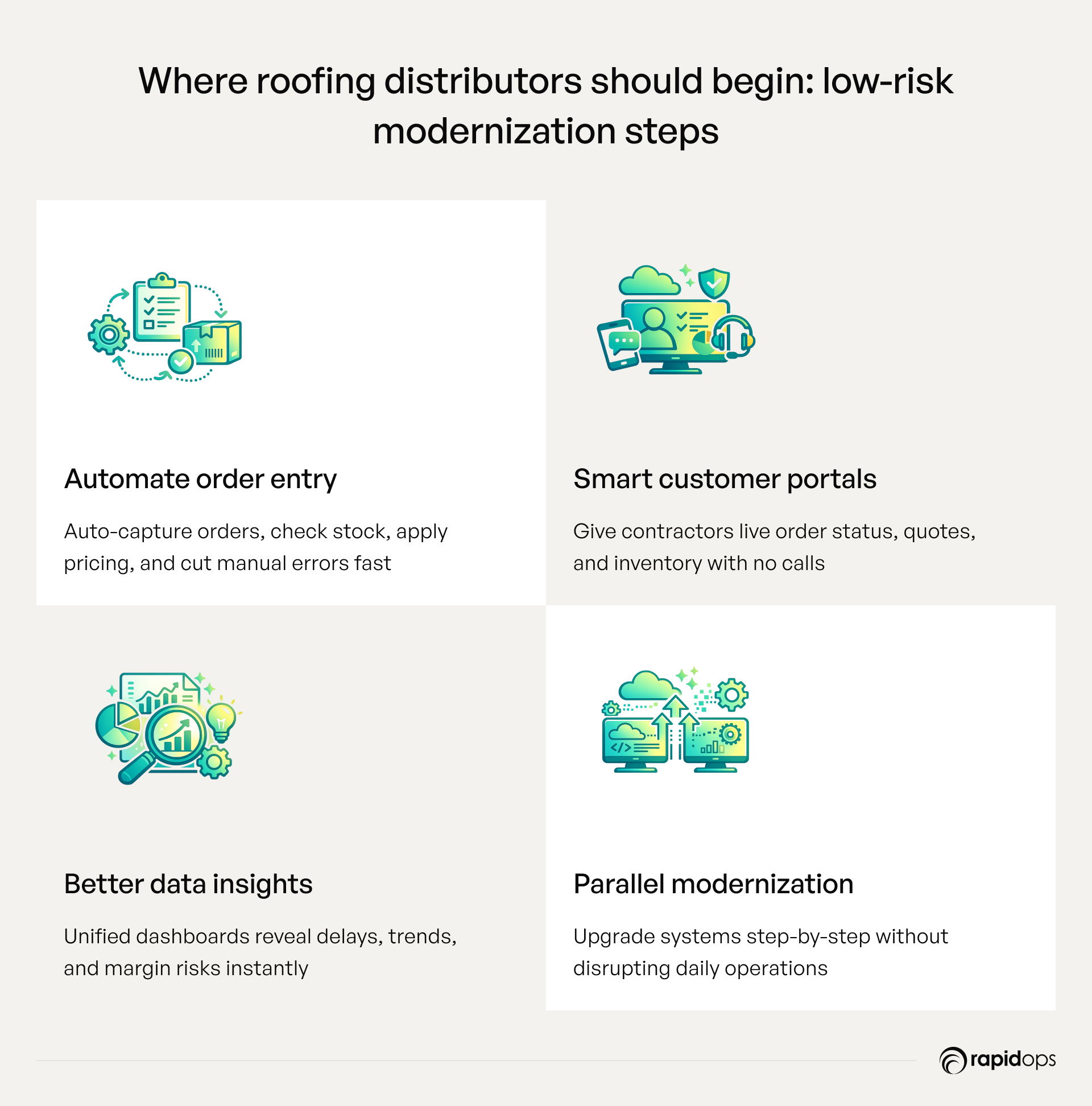
Automating order intake
Order intake is one of the most manual and error-prone areas in roofing distribution. Teams constantly reconcile orders from email, phone calls, and counter transactions against ERP records, risking delays, pricing errors, and partial shipments. Automation can transform this process by:
- Capturing and validating orders in real time across all channels
- Performing automated inventory checks to prevent stockouts or partial deliveries
- Applying branch-specific pricing, discount rules, and approval workflows automatically
For example, when a contractor sends a purchase order via email, the middleware automatically captures it, converts it into the ERP’s required format, and places the order without manual intervention. Regardless of the channel or formatting, the ERP receives the order correctly, reducing errors, freeing staff to focus on exceptions, and ensuring orders flow smoothly from entry to fulfillment. Over time, this connectivity eliminates hidden inefficiencies that quietly erode margins and slow operations.
Introducing customer portals
Contractors increasingly expect instant visibility into orders, quotes, and shipments. Customer portals provide a self-service interface while preserving your ERP as the system of record:
- Integrates in real-time with ERP and middleware to ensure accurate, up-to-date information
- Reduces reliance on staff for order entry, approvals, and status inquiries
- Improves transparency by giving contractors direct access to order progress, inventory, and delivery windows
A portal allows your contractors to place complex orders spanning multiple branches without back-and-forth calls. Inventory reconciliation, pricing validation, and approvals occur automatically behind the scenes, protecting margins and enhancing contractor trust. This approach modernizes the customer experience without replacing existing systems.
Enhancing reporting & analytics
Dispersed data across ERP systems, spreadsheets, and branch-specific tools creates blind spots that hinder decision-making. Consolidating and visualizing this data enables:
- Unified dashboards with near real-time KPIs for inventory, orders, margins, and contractor satisfaction
- Detection of exceptions, delays, or bottlenecks before they escalate
- Trend analysis for demand forecasting, branch performance, and labor allocation
For example, leadership can instantly see which branches are experiencing delayed shipments, which contractors are consistently affected, or which product lines are underperforming. This allows proactive operational adjustments without altering your existing ERP workflows, giving leaders actionable insight while preserving institutional knowledge.
Parallel modernization without disrupting daily operations
The ultimate modernization strategy is incremental and parallel, ensuring business continuity while building future readiness:
- Middleware and connected tools maintain data consistency across systems
- Incremental improvements deliver visible ROI, demonstrating value to staff and leadership
- Teams experience changes gradually, reducing change fatigue and resistance
By implementing modernization initiatives alongside daily operations, distributors can improve order accuracy, visibility, and scalability without ever risking downtime or contractor dissatisfaction. Modernization becomes a controlled, measurable, and strategically aligned process, enhancing efficiency, protecting margins, and positioning the business for sustainable growth.
Organizational impact: People and processes, not just technology
Modernization is more than technology; it transforms how teams work, how processes flow, and how contractors experience your business. When implemented thoughtfully, it strengthens daily operations, empowers staff, and elevates the entire organization.
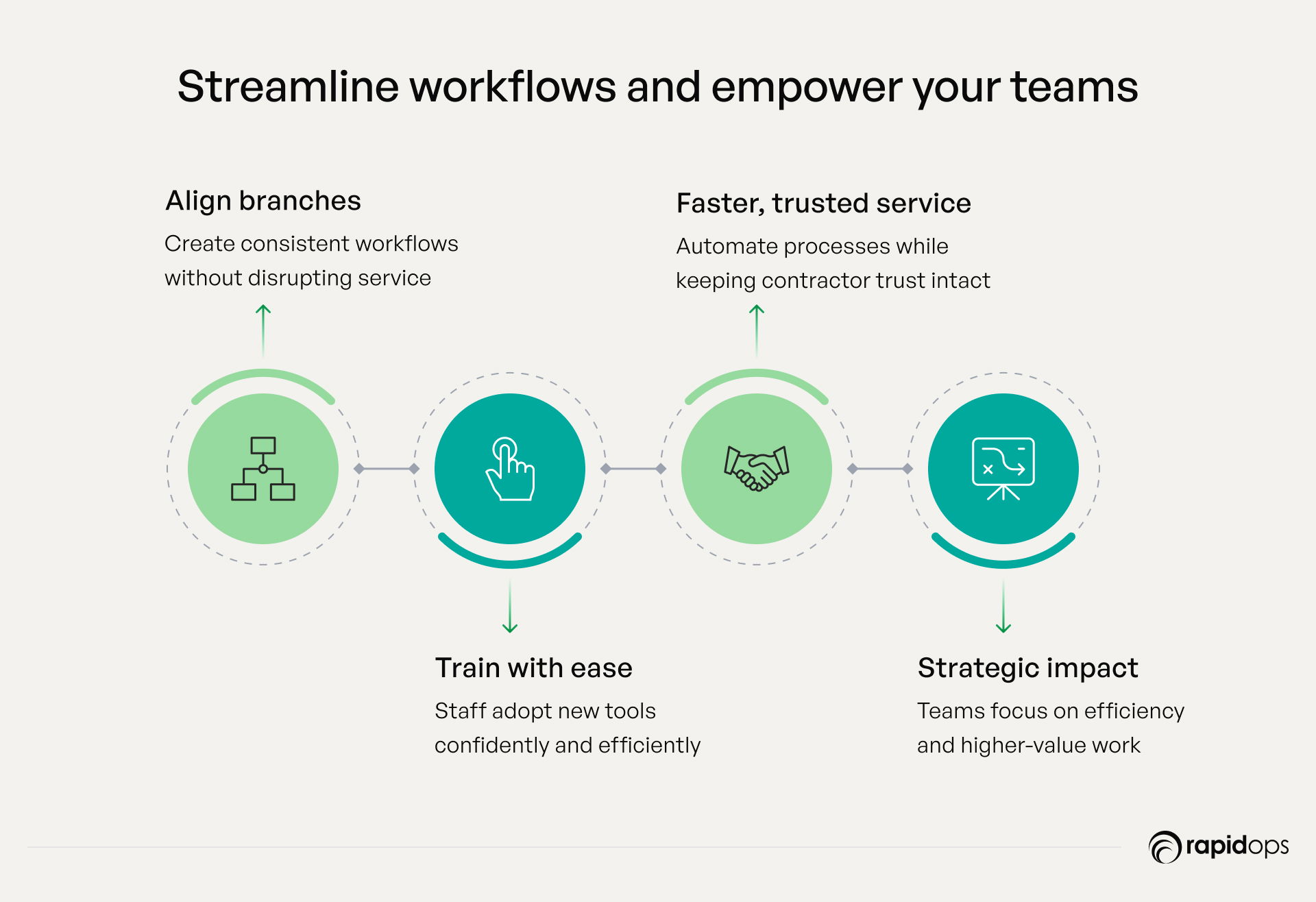
Managing change in branch-driven businesses
Branches often operate with unique workflows, informal practices, and deep institutional knowledge. Modernization aligns these operations, creating consistent and transparent processes while preserving the expertise that drives day-to-day success. Teams gain clarity, workflows become more predictable, and coordination across locations improves, without disrupting service or slowing execution.
Training and adoption without overwhelm
Staff transition smoothly from routine, manual tasks to strategic, value-added activities. Automation handles repetitive processes like order reconciliation or inventory updates, freeing employees to focus on problem-solving, planning, and contractor engagement. Employees become more confident, empowered, and capable, seeing modernization as an opportunity for growth rather than a disruption.
Preserving relationships while improving operational speed
Contractors experience faster, more reliable service as processes become automated, yet human oversight remains for personalized support. This balance ensures trust and satisfaction remain intact, even as operations accelerate, making modernization a driver of stronger external relationships.
Shifting teams from manual work to strategic impact
By removing routine operational burdens, modernization allows teams to operate at a higher level of strategic influence. Staff can focus on driving efficiency, optimizing branch operations, and enhancing contractor experience. The result is a workforce that leverages both technology and institutional knowledge to deliver measurable business impact.
Across branches, teams, and contractors, modernization transforms the organization into a more agile, capable, and intelligent operation. People feel empowered, processes are streamlined, and the business becomes more resilient, efficient, and ready to capitalize on growth opportunities, all while preserving the expertise and relationships that form the backbone of daily operations.
What a modernized roofing distributor looks like in practice
What changes when your business no longer relies on manual checks, branch-to-branch calls, or last-minute fixes to keep orders moving? When systems work together by design, execution becomes predictable, visibility improves across every branch, and contractors feel the difference without you having to explain it. This is what a modernized roofing distributor looks like in practice, an operation where growth no longer strains the system and reliability becomes a built-in advantage.
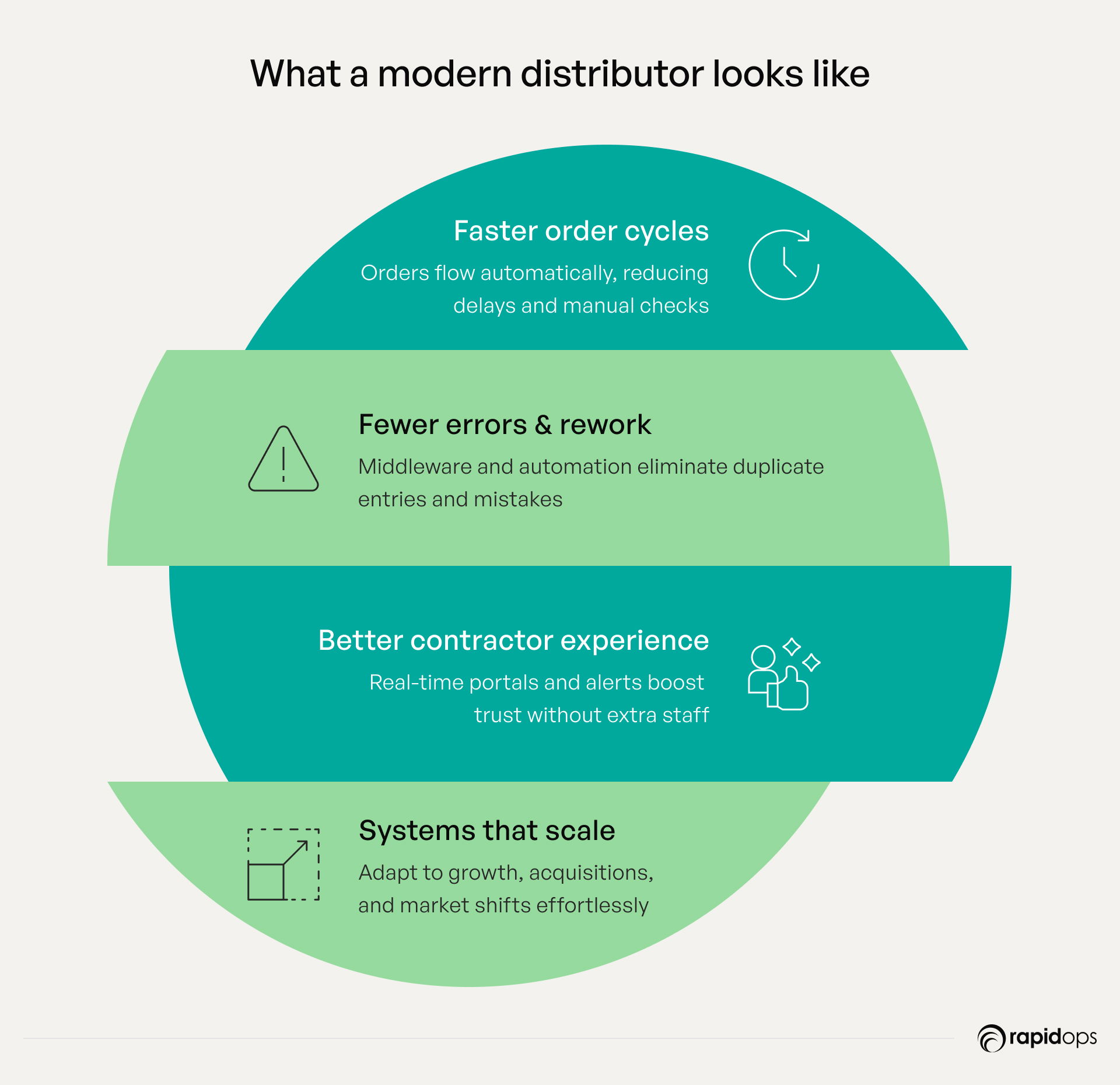
1. Faster order cycles
Orders move seamlessly from entry to fulfillment, eliminating traditional bottlenecks that slow your business:
- Automated validation ensures pricing, approvals, and inventory availability are checked instantly across branches, reducing the need for manual reconciliation or multiple system lookups.
- Real-time system communication allows ERP, branch-level tools, and spreadsheets to coordinate automatically, enabling multi-location orders to flow without delays.
- Exception handling flags irregularities immediately, allowing your team to focus on true exceptions rather than routine tasks.
Consider a complex multi-branch order: in a disconnected system, staff must manually check stock, confirm pricing, and coordinate approvals, often taking hours or even days. In a modernized system, these steps are automated, dramatically reducing cycle times, avoiding partial shipments, and improving contractor satisfaction.
2. Fewer errors and rework
Disconnected systems and manual workflows are the largest silent drain on margins:
- Middleware ensures data consistency, eliminating duplicate entries or conflicting records across ERP, spreadsheets, and branch tools.
- Automated exception resolution prevents small errors from cascading into operational bottlenecks or financial discrepancies.
- Staff spend less time correcting mistakes and more time on strategic, high-value activities, from planning to contractor support.
This reliability directly protects margins, enhances operational efficiency, and ensures contractors experience a dependable, professional service every time.
3. Better contractor experience without increasing headcount
Modernization elevates contractor relationships without adding staff overhead:
- Customer portals and self-service tools provide contractors with real-time access to quotes, orders, approvals, and delivery tracking.
- Automated notifications and alerts proactively communicate updates, reducing calls, follow-ups, and potential miscommunication.
- Teams can focus on value-added interactions such as personalized support, problem-solving, and consulting contractors on project timelines.
The combination of connected systems and automation ensures contractors experience consistent, reliable service, reinforcing trust and loyalty without increasing headcount or operational stress.
4. Systems that adapt to growth, M&A, and market volatility
A modernized architecture is scalable and resilient, allowing distributors to navigate growth and market changes effortlessly:
- Branch expansions or acquisitions are integrated seamlessly into existing workflows, preserving operational continuity and service consistency.
- Seasonal or unexpected demand spikes are managed in real-time through centralized visibility into inventory, orders, and shipments, reducing stockouts or service delays.
- Leadership gains access to consolidated dashboards, real-time KPIs, and actionable insights, enabling proactive, data-driven strategic decisions rather than reactive firefighting.
With modernization implemented this way, roofing distributors gain systems that scale with the business, support operational agility, and maintain contractor satisfaction, all while preserving the institutional knowledge that makes the business run efficiently.
Unlock growth and efficiency without overhauling your ERP
Modernizing roofing distribution isn’t about replacing systems; it’s about enhancing what already works and improving daily operations. Growth is often constrained not by demand but by fragmented execution: manual workarounds, disconnected workflows, and tribal knowledge slow operations and reduce visibility. The optimal solution is a technology layer that connects and extends existing systems, streamlining processes, reducing repetitive tasks, and delivering faster order cycles, fewer errors, and scalable operations.
At Rapidops, we’ve worked closely within roofing distribution to understand branch-level operations, field-driven sales, complex pricing logic, and the ERP systems that keep the business running smoothly. We see where teams add value, where systems can be extended, and how growth opportunities can be unlocked. That experience shapes our approach: modernize by connecting and enhancing what already works, delivering measurable efficiency, visibility, and scalability.
Want to modernize your systems but aren’t sure where to start? Schedule a free call with one of our experts to identify low-risk modernization opportunities and the most effective way to implement them.
Frequently Asked Questions

What’s Inside
- Why “modernization” feels risky for roofing distributors
- The reality of existing systems in roofing distribution
- What “modernizing without replacing” actually means
- How middleware enables modernization without replacing your ERP
- Where roofing distributors should begin: Low-risk modernization entry points
- Organizational impact: People and processes, not just technology
- What a modernized roofing distributor looks like in practice
- Unlock growth and efficiency without overhauling your ERP

Let’s build the next big thing!
Share your ideas and vision with us to explore your digital opportunities
Similar Stories
- Transformation
- undefined Mins
- March 2022


- Transformation
- undefined Mins
- March 2020

Receive articles like this in your mailbox
Sign up to get weekly insights & inspiration in your inbox.