

Technology keeps evolving rapidly, and so does the way your industry operates. If you’re working in a forward-thinking organization, you’ve already seen how digital systems have made work faster, easier, and more efficient over the years. Many businesses adopted these platforms early on, but because technology never stops advancing, the systems we once relied on have gradually become outdated and less effective for today’s needs.
And when systems get older, they often become incompatible with the modern technologies you now require to operate efficiently. You’ve probably experienced these bottlenecks firsthand slow processes, limited integrations, data silos, and tools that can’t support new workflows.
To maintain your industry’s ideal levels of efficiency and competitiveness, you need the ability to adopt new technologies and best practices. But that often seems to require replacing core legacy systems a major disruption that feels unrealistic for many organizations. Your daily operations depend on these systems. You can’t just switch them out overnight and expect your teams to adapt instantly to entirely new platforms they once learned over months or even years.
But what if adopting the latest technologies didn’t require ripping out or replacing your core systems? What if you could layer new capabilities on top of your existing infrastructure without disrupting processes or the way your teams work?
It might sound impossible, but it’s absolutely achievable. And the way to do it is through legacy system modernization the optimal option for businesses to upgrade the capabilities of their existing systems without replacing them entirely.
In this article, you’ll get a clear understanding of why modernization has become essential for enterprises, what typical challenges legacy systems create, and how businesses can modernize in practical, low-disruption ways. By the end, you’ll know exactly how modernization supports your digital transformation and what options exist for taking the next steps.
What is legacy systems modernization
Legacy systems modernization is the disciplined reinvention of an organization’s core technology landscape, rebuilding the systems that run the business so they can support new digital models, faster decision-making, and scalable growth. It is not a “technology upgrade.” It is a business transformation that aligns decades-old architectures with the speed, intelligence, and interoperability modern enterprises demand.
Most legacy environments were built for a world that valued stability over agility. They depend on tightly coupled architectures, mainframes, outdated programming languages, and fragmented data pipelines. Over time, these systems accumulate technical debt, increasing risk, slowing innovation, and consuming disproportionate IT budgets. Modernization addresses this constraint head-on by transforming these systems into cloud-native, API-driven, data-intelligent platforms.
A modernized system doesn’t just run faster; it fundamentally changes how an enterprise operates. It enables real-time data access instead of batch processing, scalable workloads instead of capacity limitations, and continuous deployment instead of multi-month release cycles. This shift allows businesses to integrate AI models, automate critical workflows, adopt microservices, improve security posture, and unlock previously inaccessible insights.
Enterprises typically modernize through one or more approaches, re-platforming core applications to cloud infrastructure, re-architecting monolithic systems into modular services, wrapping legacy systems with APIs for interoperability, or fully rewriting mission-critical applications. The right path depends on the system’s complexity, business criticality, and the value modernization can unlock.
Ultimately, legacy systems modernization equips organizations with a technology foundation built not for yesterday’s constraints but for tomorrow’s opportunities, supporting innovation, operational resilience, and sustainable competitive advantage.
How can you assess whether your legacy system needs modernization
From our previous discussion, you now understand what legacy system modernization is. But it’s equally important to know when modernizing your legacy systems is the right choice for you. Not every aging or outdated system needs a complete overhaul, and the wrong timing can be costly. Here, we highlight the key ways to assess whether your existing systems truly need modernization, helping you make informed, strategic decisions that align technology with your business goals, operational efficiency, and long-term growth.
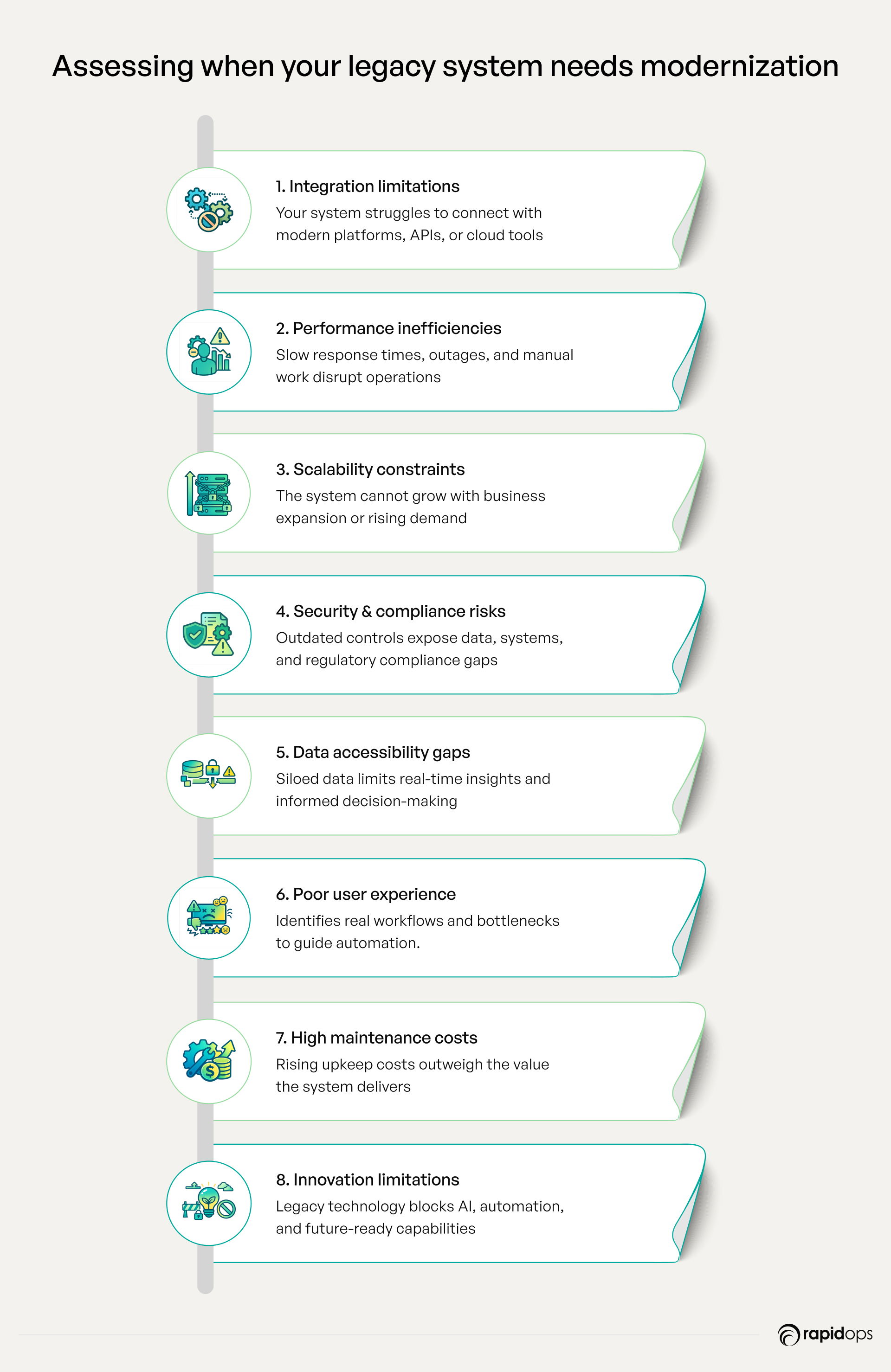
1. Infrastructure incompatibility and integration limitations
If your existing architecture cannot seamlessly connect with modern systems, cloud-native environments, or API-driven tools, you are likely facing hidden operational barriers. Such integration challenges create isolated data silos, slow decision-making, and prevent you from leveraging modern technologies like AI, machine learning, and IoT. When your technology resists integration, it is no longer enabling your critical business processes, it is constraining them. Recognizing this limitation is crucial for ensuring your systems can keep pace with the rapidly evolving digital transformation landscape.
2. Performance inefficiencies and operational instability
Slow response times, frequent outages, and overreliance on manual interventions directly erode productivity and increase operational risk. If your teams are spending more time managing exceptions than innovating, it signals that your legacy applications are failing to support core business operations. These inefficiencies not only impact your bottom line but also jeopardize customer satisfaction, making operational efficiency a strategic priority. Addressing these challenges is a critical step in any system modernization effort.
3. Limited scalability and organizational rigidity
Your business may be expanding, but can your legacy software grow with it? If adding new product lines, entering new markets, or handling increased transaction volumes requires complex workarounds, your older systems are bottlenecks. Modernized systems that cannot scale flexibly reduce agility, delay market entry, increase operational costs, and block your ability to seize new opportunities. Recognizing these constraints is vital for enabling business growth and ensuring your modernization journey delivers tangible results.
4. Security vulnerabilities and compliance exposure
Cybersecurity threats and regulatory compliance requirements are non-negotiable. Legacy applications that rely on outdated protocols, weak access controls, or incomplete audit trails put your organization at significant security risk. If your technology cannot proactively protect sensitive data and ensure compliance, it is exposing your business operations to vulnerabilities. Legacy system modernization is critical to provide enhanced security, safeguard critical systems, and future-proof your enterprise.
5. Restricted data accessibility and analytics limitations
Data is one of your most valuable strategic assets, but outdated systems often trap information in silos. When real-time insights and analytics are inaccessible, your decision-making is slowed, and opportunities for predictive or proactive action are lost. If your existing applications prevent you from transforming raw data into actionable intelligence, they are no longer enablers of growth; they are barriers to business value and innovation.
6. Inefficient user experience and collaboration barriers
Your employees interact with your systems every day, and poor usability directly impacts productivity, engagement, and decision-making speed. Legacy software modernization improves user interfaces, reduces cumbersome workflows, and unifies collaboration tools. When technology hinders your team instead of empowering them, it limits your ability to execute strategic processes efficiently. Modern solutions help ensure smoother adoption and improved performance across teams.
7. Misalignment with strategic objectives
Technology should accelerate innovation, support faster go-to-market initiatives, and enhance customer experiences. When your legacy systems do the opposite, slowing execution, restricting innovation, or misaligning with business goals, they become silent inhibitors of growth. Recognizing this misalignment is critical: your system modernization efforts must actively enable, not impede, your critical business processes and enterprise objectives.
8. High costs with diminishing returns
Maintaining legacy applications is expensive and resource-intensive. Beyond licensing and specialized skill requirements, operational inefficiencies and delayed innovation amplify the financial burden. If the cost of sustaining your older systems outweighs the business value they deliver, modernization projects become essential to unlock efficiency, achieve substantial cost savings, and generate measurable strategic benefit.
9. Talent dependency and obsolescence risk
Reliance on specialized personnel or limited vendor support exposes you to operational risk and slows adoption of new technologies. If critical expertise is scarce or systems become unsupported, your modernization journey is jeopardized. Legacy system modernization reduces this dependency, ensuring you can maintain agility, resilience, and access to modern technologies without risking disruption.
10. Missed opportunities for innovation and future readiness
Existing systems that maintain the status quo prevent you from leveraging modern technologies, application modernization, and next-generation capabilities, such as AI-driven insights, automation, and predictive analytics. If your legacy applications cannot enable innovation or deliver differentiated customer experiences, they risk leaving you behind competitors. Modernization strategies are not just about sustaining operations; they are about creating new possibilities, driving business growth, and ensuring your organization remains future-ready.
When your legacy systems exhibit any of these challenges, they are more than operational hurdles; they are strategic liabilities. They slow innovation, increase costs, and limit growth potential. By recognizing these warning signs and taking decisive action, you can turn constraints into a competitive advantage. Legacy system modernization enables your organization to unlock agility, drive innovation, and achieve measurable business value—transforming technology from a limitation into a true enabler of your business goals.
Key approaches to legacy system modernization
Legacy systems are often the backbone of enterprise operations, supporting critical workflows, data processes, and business logic. Over time, these systems can become rigid, costly, and misaligned with evolving technology and market demands.
Modernization ensures that your enterprise remains agile, competitive, and future-ready by strategically updating systems without disrupting core operations. Below are the four key approaches that enterprises can adopt to effectively modernize their legacy systems.
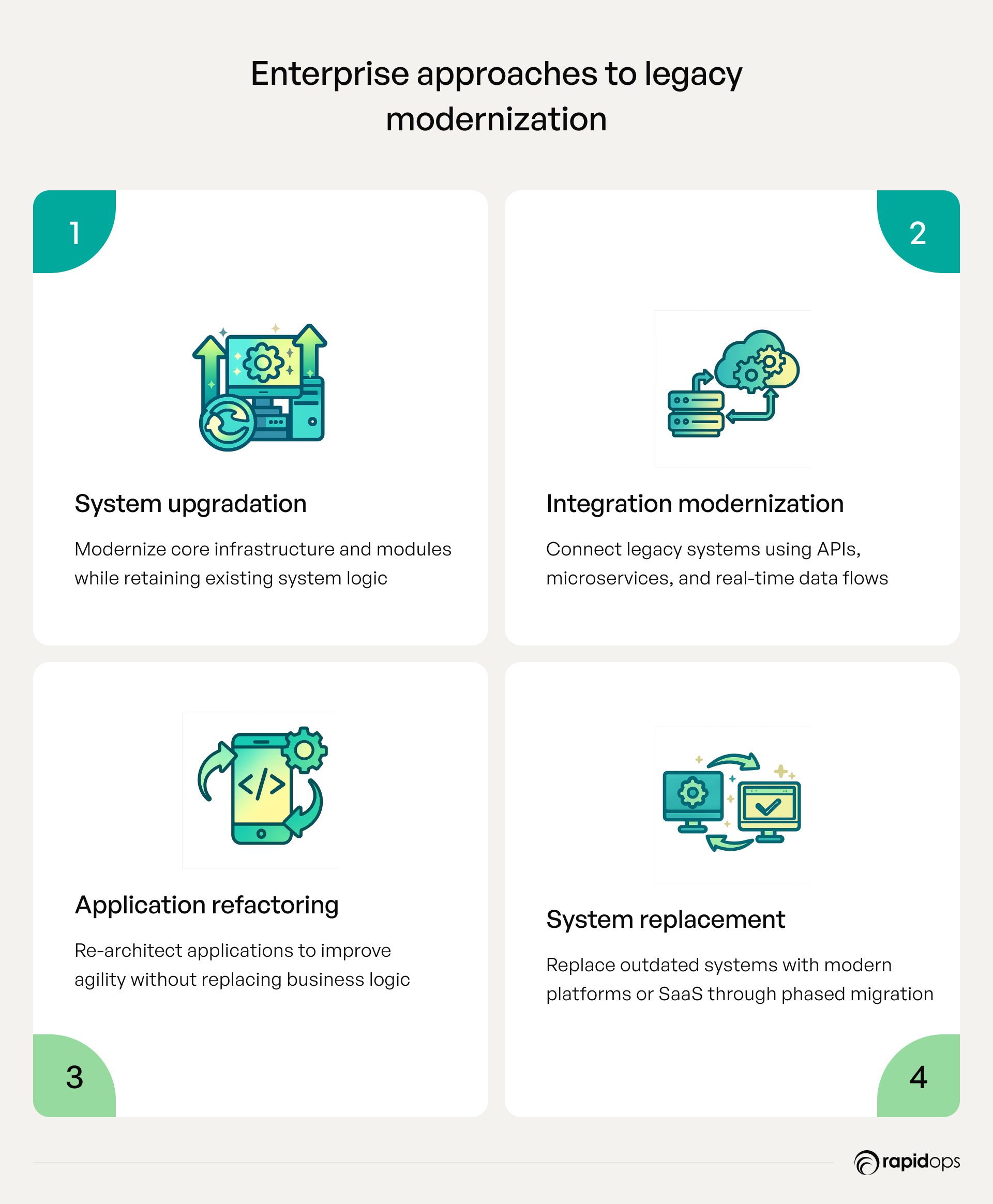
1. System upgradation: Reinventing the core
System upgradation involves improving and updating the core components of your legacy system while retaining its functional foundation. Unlike complete replacement, this approach focuses on modernizing infrastructure, databases, and critical modules to extend system lifespan, improve reliability, and support new business capabilities.
Problem it solves:
Legacy systems often suffer from outdated architectures, limited scalability, and poor performance. These limitations slow innovation, create operational inefficiencies, and increase maintenance costs. Upgradation resolves these issues without the high costs and risks of complete system replacement.
How it works:
- Upgrade servers, storage, and network infrastructure for improved scalability and performance.
- Transition databases to modern platforms such as cloud-native databases or hybrid environments.
- Refactor critical modules to improve efficiency and maintainability.
- Incorporate security patches, compliance updates, and performance optimization tools.
System upgradation preserves core functionalities while enabling your business to scale, secure, and innovate efficiently. It reduces operational bottlenecks, lowers technical debt, and ensures a future-ready foundation for further modernization initiatives.
2. Integration modernization: Connecting legacy systems to the enterprise ecosystem
Integration modernization ensures that your legacy systems are not isolated silos but active participants in a connected enterprise ecosystem. It enables seamless communication with modern applications, analytics platforms, and automation tools.
Problem it solves:
Disconnected systems lead to fragmented workflows, inaccessible data, and delayed decision-making. Without integration, even advanced solutions fail to deliver their full potential, limiting enterprise agility.
How it works:
- Implement API-led connectivity to expose legacy system functionalities to modern applications.
- Use microservices and modular interfaces for reusable and flexible system interactions.
- Adopt event-driven architecture to facilitate real-time communication between systems.
- Employ integration platforms (iPaaS/ESB) to orchestrate secure, reliable data exchange and workflows.
Integration modernization allows your enterprise to consolidate data, streamline workflows, enable automation, and make faster, data-driven decisions—turning legacy systems into strategic enablers.
3. Application refactoring: Evolving without replacing
Application refactoring involves re-architecting or rewriting parts of a legacy application to align with modern software paradigms, such as cloud-native or microservices architectures, without discarding existing business logic.
Problem it solves:
Monolithic legacy applications are often rigid, hard to maintain, and incompatible with modern technologies. Refactoring addresses technical debt, enhances maintainability, and unlocks the ability to innovate without a full system replacement.
How it works:
- Decompose monolithic applications into smaller, modular microservices.
- Update outdated code using modern programming languages and frameworks.
- Integrate automated testing and CI/CD pipelines for continuous improvement.
- Optimize performance and scalability while maintaining business functionality.
Refactoring improves system agility, reduces maintenance costs, and enables the deployment of modern features faster. Enterprises can innovate confidently while retaining critical functionality and minimizing operational risk.
4. System replacement (Selective Rip-and-replace / SaaS adoption)
Replacement is a strategic approach for deeply outdated legacy systems that cannot meet business requirements. It involves adopting modern platforms or SaaS solutions to fully replace legacy functionalities while delivering long-term operational and strategic benefits.
Problem it solves:
When legacy systems are unable to support critical business operations or integrate with modern technologies, continuing to maintain them becomes costly, inefficient, and risky. Replacement eliminates these limitations entirely.
How it works:
- Identify systems or modules that are too outdated or unsupported.
- Evaluate modern SaaS or platform solutions aligned with business objectives.
- Plan a phased migration strategy to minimize disruption.
- Ensure data migration, integration, and workflow continuity during transition.
Replacement reduces technical debt, improves scalability, enhances security, and enables the adoption of advanced technologies. Enterprises gain a modern, flexible, and sustainable system landscape that supports innovation and long-term growth.
Selecting the right modernization approach transforms your legacy systems into agile, efficient, and future-ready assets. Each method, whether upgrading infrastructure, refactoring, encapsulating, or adopting modern platforms, delivers measurable impact, enabling your enterprise to innovate, optimize operations, and stay competitive.
Benefits enterprises can expect from modernization
Your legacy systems may still support day-to-day operations, but they often hold your enterprise back in ways you don’t immediately see, delaying decisions, fragmenting data, and constraining growth. Modernization flips this scenario, transforming hidden limitations into strategic advantages. Ahead, you’ll discover the key benefits that can drive productivity, innovation, and business growth.
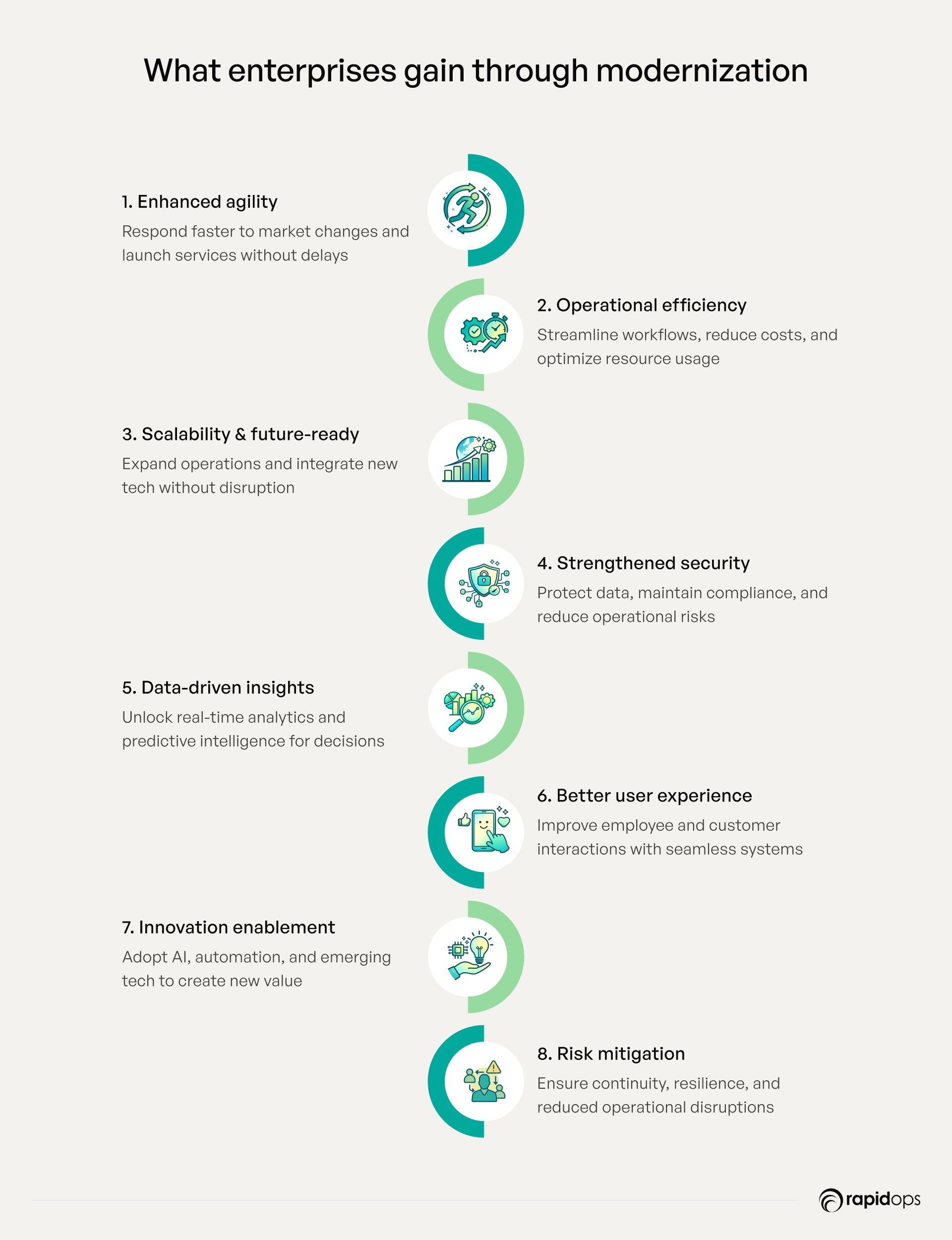
1. Enhanced agility and accelerated time-to-market
Modernization empowers your organization to respond to market shifts, customer expectations, and regulatory changes with speed and confidence. By adopting cloud-based platforms, modular architectures, and API-driven systems, you can launch new services, iterate on innovation, and scale rapidly without disruption. This agility ensures that you can seize emerging opportunities faster than competitors, turning strategic ideas into tangible business outcomes.
2. Operational efficiency and cost optimization
Modernization transforms how your enterprise operates, helping you maximize efficiency while reducing costs. Streamlined workflows, automated processes, and optimized infrastructure allow you to eliminate redundant operations, minimize downtime, and free your teams to focus on strategic initiatives. Beyond direct savings, modernization delivers predictable operational performance, improved resource utilization, and measurable ROI, allowing you to track the impact of every investment. By rethinking your processes holistically, you achieve leaner, faster, and more reliable operations that support both immediate results and long-term growth.
3. Scalability and future-readiness
Modern systems enable your enterprise to scale operations seamlessly and adapt to evolving business needs. Elastic infrastructure, modular designs, and microservices allow you to expand capacity, integrate emerging technologies, and support new business models without disruption. This ensures that your organization is prepared not only for today’s growth but also for the unpredictable demands of tomorrow, keeping you ahead of the curve.
4. Strengthened security and compliance
Legacy systems often carry hidden vulnerabilities that can threaten your data, reputation, and regulatory standing. Modernization equips you with advanced security protocols, real-time threat detection, and compliance management, protecting your enterprise against evolving risks. By embedding security and governance into your modern systems, you safeguard your data, maintain stakeholder trust, and ensure alignment with regulatory requirements, reducing both operational and reputational risks.
5. Data-driven decision-making
Your legacy systems hold a wealth of untapped data. Modernization allows you to unlock insights through real-time analytics, predictive modeling, and AI-driven intelligence. With access to accurate, actionable information, you can make informed decisions faster, anticipate market trends, optimize operations, and drive strategic initiatives. This empowers your enterprise to leverage data not just as a record of the past but as a driver of future business growth.
6. Enhanced user and customer experience
Modernization directly impacts the experience of your employees and customers. Streamlined interfaces, faster processing, and integrated platforms reduce friction, enabling your teams to focus on strategic, high-value work. At the same time, customers enjoy reliable, seamless, and personalized interactions, building loyalty and satisfaction. When your systems support people instead of holding them back, you create a culture of efficiency, responsiveness, and excellence.
7. Innovation enablement
By freeing your enterprise from the constraints of outdated systems, modernization unlocks the capacity to innovate continuously. You can integrate AI, IoT, machine learning, automation, and other emerging technologies, enabling new business models, services, and revenue streams. Modern systems transform your enterprise into a platform for experimentation and differentiation, giving you the agility to respond to market changes and technological advances proactively.
8. Risk mitigation and enterprise resilience
Modernized systems strengthen your enterprise’s resilience by reducing operational and technological risks. Redundant architectures, automated failover, and proactive monitoring ensure that critical operations continue uninterrupted, even during unforeseen events. By investing in modernization, you protect your enterprise from disruptions, safeguard essential functions, and maintain business continuity, creating a foundation for long-term stability.
9. Strategic alignment and sustainable competitive advantage
The ultimate benefit of modernization is that your technology becomes fully aligned with your strategic goals and market priorities. By transforming legacy systems into enablers of growth, you improve decision-making, operational agility, and innovation capacity. Every modernization initiative becomes a strategic investment that drives measurable outcomes, strengthens your market position, and ensures that your enterprise is prepared to thrive in an ever-evolving business landscape.
Misconceptions about legacy system modernization
Modernizing your legacy systems is often surrounded by myths, like it being too costly, too complex, or unnecessary. These misconceptions can hold enterprises back, delaying improvements that could enhance operational efficiency, unlock new capabilities, reduce technical debt, and strengthen your critical business processes.
By separating fact from fiction, organizations can make smarter, strategic decisions, turning legacy system modernization into a true driver of growth, innovation, and long-term success.
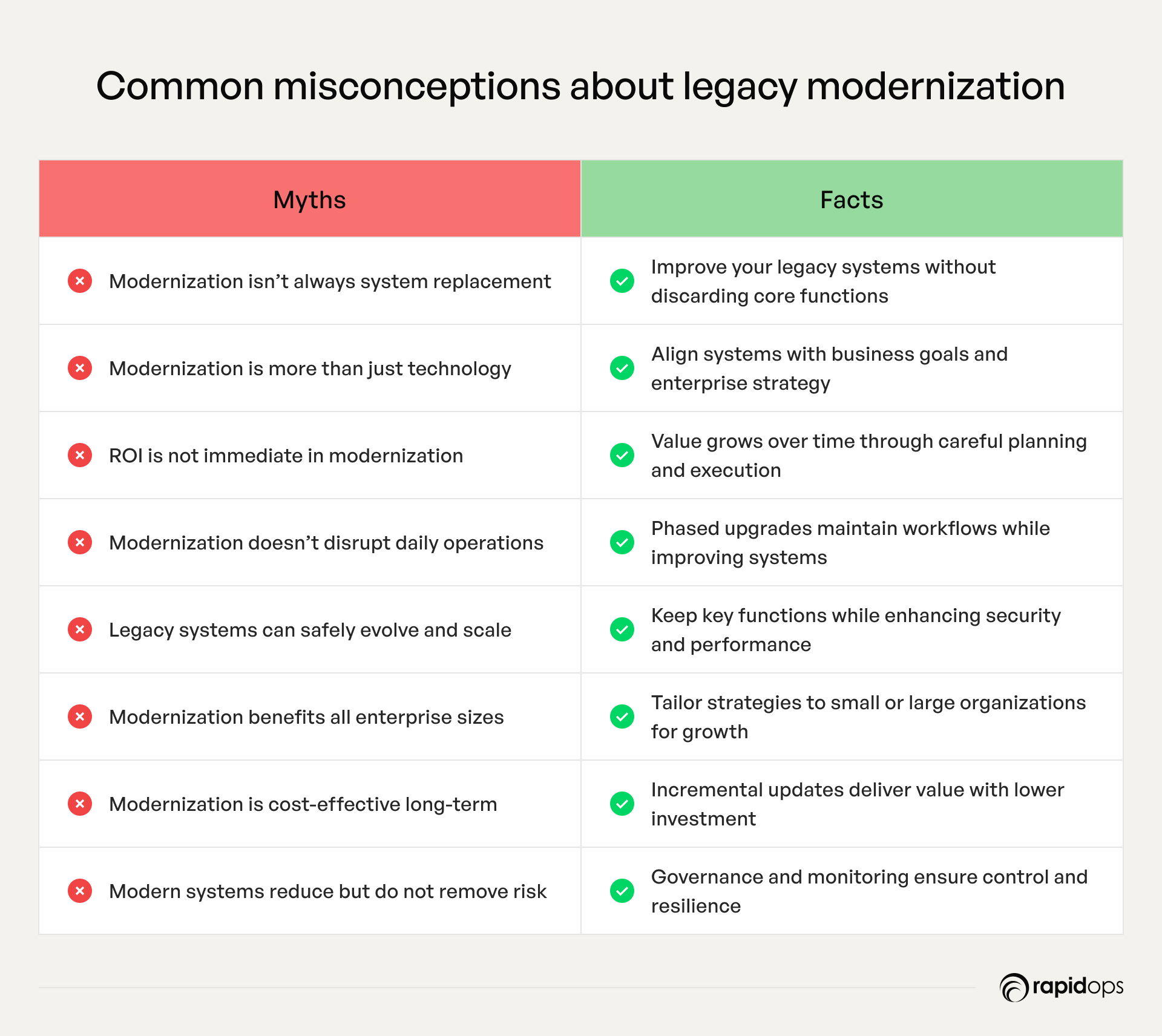
1. Modernization always means replacing systems
It’s a common misconception that modernizing your legacy applications requires a full replacement. In reality, legacy system modernization focuses on evolving and enhancing your existing systems rather than discarding them. Enterprises can achieve this through infrastructure upgrades, modularization, API integration, or workflow automation, retaining what works while improving performance, scalability, and efficiency. By modernizing strategically, organizations reduce risk, preserve critical functionality, and maximize the value of every investment. Modernization is about transformation and evolution, not unnecessary disruption.
2. Modernization is just about technology
Modernization is often mistaken for a purely technical exercise. The real value lies in aligning technology with business goals, critical business processes, and customer needs. Thoughtful legacy system modernization enables agility, operational excellence, and data-driven decision-making, ensuring that your systems act as enablers of enterprise strategy, not just IT infrastructure.
3. Modernization guarantees immediate ROI
While modernization offers significant long-term benefits, expecting instant returns is unrealistic. True value comes from strategic planning, staged execution, and linking modernization projects to measurable business outcomes. By prioritizing high-impact areas and tracking relevant KPIs, organizations ensure that each step contributes to operational efficiency, reduced technical debt, enhanced security, or innovation capacity, delivering tangible, measurable ROI over time.
4. Modernization disrupts operations
Fear of operational disruption can stall modernization efforts. However, incremental approaches like phased migration, hybrid modernization, and system encapsulation allow enterprises to transform systems while maintaining continuity. With careful planning, organizations can modernize critical systems without interrupting essential workflows, preserving productivity while enhancing agility and resilience.
5. Legacy systems are too valuable to touch
Some leaders worry that legacy systems are untouchable due to their role in core business operations. Ironically, avoiding modernization often increases operational risk and costs over time. Legacy system modernization allows enterprises to retain essential functionality while enhancing scalability, security posture, and innovation potential, turning systems from potential liabilities into strategic assets that support growth rather than constrain it.
6. Modernization is only for large enterprises
There’s a misconception that modernization benefits only large organizations with deep resources. Enterprises of all sizes can gain strategic and operational advantages. By tailoring modernization strategies to your context, organizations can reduce technical debt, optimize resources, strengthen critical business processes, and position themselves for growth and agility, regardless of scale.
7. Modernization is too expensive
Cost concerns often prevent leaders from acting. While modernization requires investment, the long-term benefits—improved operational efficiency, risk mitigation, and revenue opportunities far outweigh initial expenses. Legacy system modernization enables enterprises to adopt modern technologies incrementally, leveraging existing systems rather than replacing them entirely.
This approach delivers new capabilities with lower investment than full system replacement or upgrades, reduces technical debt, and improves operational efficiency. By targeting high-impact areas first, organizations can manage costs strategically, unlock measurable business value, enhance workflows, mitigate risks, and create a flexible foundation for future growth. Modernization transforms perceived financial burden into a powerful growth lever, enabling innovation and competitiveness without major upfront expense.
8. Modern systems eliminate all risk
Even after modernization, no system is risk-free. Transitioning, integrating, and managing modern infrastructure and modernized systems carries inherent challenges. By acknowledging this reality, enterprises can implement governance, monitoring, and risk management practices that protect operations and maximize outcomes. Legacy system modernization reduces risk while providing the tools to manage it proactively, ensuring your enterprise is resilient, secure, and prepared for the future.
What enterprises should consider before modernizing
Modernizing your legacy systems through legacy system modernization is a strategic move that can reshape how effectively your enterprise operates, grows, and competes. But the impact of modernization depends entirely on the clarity, preparation, and decisions you make before the process begins. To ensure every modernization effort delivers meaningful results, you need to evaluate not just the technology but everything modernization will influence across your critical business processes, people, and long-term business capabilities.
Below are the critical considerations that help you make confident, informed, and high-value modernization decisions.
Alignment with business priorities and measurable outcomes
Before modernizing, identify the exact business outcomes you want to unlock, whether it’s improving system performance, enabling automation, strengthening customer experience, enhancing data accessibility, or supporting faster innovation. Legacy system modernization should directly elevate your operational efficiency and your ability to respond to market demands. When you clearly define these priorities, you can ensure your modernization efforts solve the right problems and create tangible business value across your organization.
Process dependencies and cross-system impact
Legacy systems often sit at the center of interconnected workflows, meaning any change can influence multiple departments and processes. Understanding how data flows, where bottlenecks occur, and which touchpoints rely on your existing systems helps you modernize without creating disruption. By mapping these dependencies, you can determine where modular upgrades, integration improvements, or modernization strategies are needed, ensuring your modernization projects strengthen operations instead of complicating them.
Technical limitations, performance gaps, and future scalability
Not all legacy applications fail because they are old; they fail because they restrict what you can accomplish. Before modernizing, assess where your current systems limit scalability, performance, integration, or security. This gives you clarity on which components require restructuring, optimizing existing code, or architectural changes. When you modernize with a deep understanding of these constraints, you create a platform that supports new technologies, simplifies maintenance, and scales with your enterprise.
Investment efficiencies and long-term financial impact
Modernization delivers its strongest benefits when approached with a clear financial strategy. Instead of treating it as a cost, evaluate the measurable value you gain, reduced maintenance overhead, improved uptime, automation opportunities, faster deployments, or better customer engagement. Prioritizing modernization efforts based on ROI ensures every initiative supports your long-term objectives and avoids unnecessary spending. This approach maximizes impact while minimizing operational costs and financial risk.
Security posture, compliance needs, and operational risk
Legacy systems often carry outdated security frameworks and higher vulnerability exposure. Before modernizing, evaluate your current risk surface, authentication gaps, compliance demands, outdated protocols, and data protection challenges. Incorporating enhanced security and modern standards into your planning ensures your upgraded environment is more resilient, compliant, and capable of protecting critical systems. This proactive preparation allows you to modernize confidently without compromising enterprise security.
Data readiness, integration capabilities, and analytics potential
Your ability to use data effectively often depends on how modern your systems are. Assess whether your current environment supports seamless integration, real-time data access, advanced analytics, or modern API frameworks. Legacy system modernization should help you unlock consolidated data flows, improve accuracy, and gain better insights across teams. When your systems are prepared for high-quality data exchange, you’re better equipped to support decision-making, automation, AI initiatives, and enterprise-wide intelligence.
People readiness, skill alignment, and change adoption
Modernization succeeds only when your teams can adopt and operate the modernized systems confidently. Evaluate your staff’s skills, readiness for workflow changes, and ability to adapt to new tools and processes. A structured change-management approach communication, training, and user readiness, ensures smoother transitions and faster value realization. When employees understand how legacy system modernization benefits their work, adoption becomes easier and outcomes become stronger.
Technology choices that ensure long-term flexibility
With technology evolving rapidly, your modernization decisions should future-proof your systems rather than create new constraints. Select platforms, architectures, and integration models that support flexibility, whether introducing automation, integrating cloud-native systems, adding new digital channels, or adopting emerging modern technologies. Adaptable and scalable technology choices make modernization a foundation for future innovation, not just a short-term fix.
Partner expertise and implementation support
The complexity of modernizing enterprise systems requires expertise that goes beyond implementation. Choose partners who understand legacy application modernization, integration challenges, and proven modernization strategies. The right partner helps you evaluate options, mitigate risks, and implement modernization in a phased, predictable, and low-disruption manner. This ensures you benefit from industry best practices while avoiding delays, rework, or misalignment.
Legacy system modernization is most impactful when rooted in clarity, clarity about what your business needs today, what capabilities you want to unlock tomorrow, and how your systems must evolve to support both. By evaluating these considerations upfront, you create a modernization strategy that enhances performance, strengthens resilience, reduces technical debt, and positions your enterprise for long-term business growth and success.
Transform your legacy systems into engines of growth and efficiency
Now you have explored the critical aspects of legacy system modernization, from analyzing system dependencies and performance constraints to aligning initiatives with business objectives, ensuring compliance, optimizing data integration, and preparing your organization for change.
Your legacy systems hold immense potential; when thoughtfully modernized, they can become agile, resilient, and value-driving assets that empower your teams, streamline operations, and unlock new growth opportunities. By taking a deliberate, strategic approach, you can transform operational challenges into a platform for innovation, efficiency, and long-term success.
At Rapidops, we bring decades of experience helping enterprises like yours navigate complex modernization journeys. We have seen firsthand how modernizing legacy systems can relieve operational strain, empower teams, and open the door to innovation that truly impacts business outcomes. Our hands-on experience across industries ensures that your modernization initiatives are strategically aligned, practical, and designed to deliver tangible results, giving you the confidence to act decisively and shape the future of your organization.
Curious how your legacy systems could fuel growth and efficiency? Book a free consultation with our modernization experts to uncover high-impact opportunities, understand potential outcomes, and get actionable strategies tailored to your organization.
Frequently Asked Questions

What’s Inside
- What is legacy systems modernization
- How can you assess whether your legacy system needs modernization
- Key approaches to legacy system modernization
- Benefits enterprises can expect from modernization
- Misconceptions about legacy system modernization
- What enterprises should consider before modernizing
- Transform your legacy systems into engines of growth and efficiency

Let’s build the next big thing!
Share your ideas and vision with us to explore your digital opportunities
Similar Stories
- Transformation
- undefined Mins
- March 2022


- Transformation
- undefined Mins
- March 2020

Receive articles like this in your mailbox
Sign up to get weekly insights & inspiration in your inbox.