


Every day, your teams rely on systems that once felt like a strategic advantage, but lately, they feel like those same systems are holding you back. They’ve powered your growth, kept operations running smoothly, and allowed your organization to scale for years. Yet as markets accelerate, customer expectations rise, and workflows become more interconnected, the limitations of these systems are becoming impossible to ignore. Even a small delay in one process can ripple across departments, partnerships, and customer experiences, turning yesterday’s efficiency into today’s bottleneck.
It’s not just perception; 80% of organizations agree that outdated technology is holding back innovation, and 94% of C‑suite executives say legacy infrastructure slows business agility. Your systems aren’t failing; they did exactly what they were built to do. Most legacy platforms were designed for stability, incremental growth, and predictable operations. They weren’t built for the speed, complexity, or flexibility that modern business demands. That’s why even minor changes can feel risky, expensive, or disruptive, leaving leadership blind to hidden fragility and creating frustration for teams who are simply trying to get work done.
Replacing everything entirely might seem like the obvious answer, but the cost, time, and operational risk of a full rip-and-replace are daunting. The smarter approach is to scale and evolve your existing systems, extending their capabilities, improving flexibility, and strengthening the workflows they already support, without breaking the operations your teams depend on every day.
Through this article, we aim to help leaders like you navigate growth without unnecessary disruption. Our goal is to provide practical strategies and proven solutions for strengthening critical systems, so you can make informed decisions, reduce operational risks, and scale your organization with confidence rather than reacting to challenges as they arise.

What are the imperatives of scalable systems in 2026
In 2026, scalable systems are no longer about handling growth alone; they are about sustaining reliability, adaptability, and control under constant change. Organizations must support rising user expectations, AI-driven workloads, distributed teams, hybrid and multi-cloud environments, and real-time decision-making without compromising stability. Scaling has become a systemic discipline, not a reactive fix.
To scale safely and predictably, systems must be intentionally designed around a set of non-negotiable imperatives. These imperatives define how modern systems should be built, operated, and evolved to remain resilient, efficient, and future-ready in an increasingly complex technology landscape.
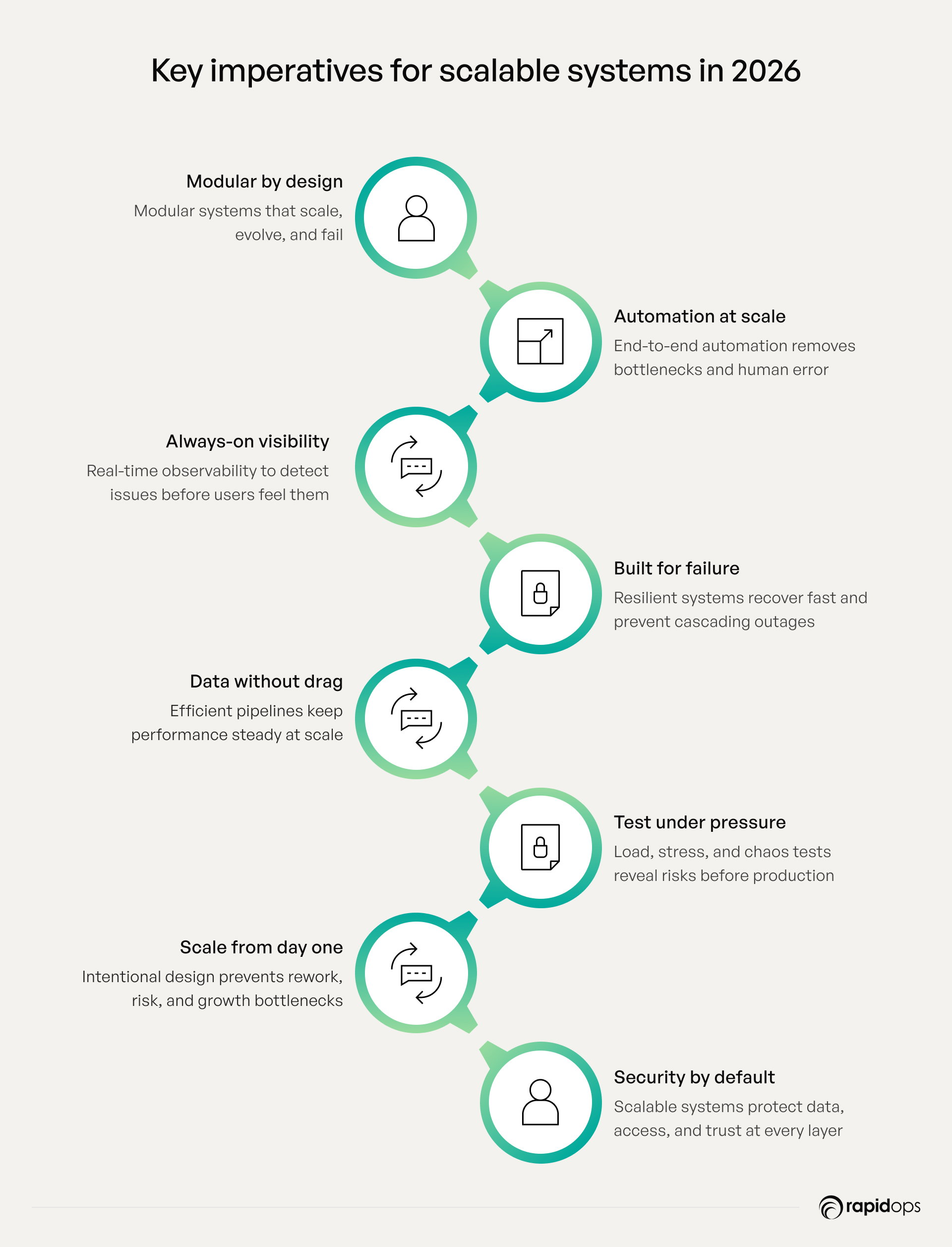
Design modular architectures that scale without risk
In 2026, scalability starts with modular system architecture. Systems must be composed of loosely coupled, independently deployable components that can scale, evolve, or fail without impacting the entire platform. This modularity enables teams to introduce changes, deploy new capabilities, or scale specific services without triggering system-wide instability.
With hybrid and multi-cloud environments becoming the norm, modular design ensures consistency across infrastructure while reducing dependency risks. Clear service boundaries, well-defined interfaces, and ownership models allow organizations to scale functionality safely while maintaining operational control. Without modularity, scale amplifies fragility instead of performance.
Automate every critical scaling and operational workflow
Manual operations do not scale in 2026. Systems must rely on end-to-end automation to handle provisioning, deployments, scaling triggers, recovery actions, and routine maintenance. Automation eliminates human bottlenecks, reduces error rates, and ensures consistency across environments as system complexity increases.
AI-enhanced automation now plays a critical role in anticipating load patterns, adjusting resources dynamically, and resolving issues before they impact users. Scalable systems must be capable of responding autonomously to change, ensuring stability during traffic spikes, infrastructure shifts, or demand surges, without requiring constant human intervention.
Automate every critical scaling and operational workflow
Manual operations do not scale in 2026. Systems must rely on end-to-end automation to handle provisioning, deployments, scaling triggers, recovery actions, and routine maintenance. Automation eliminates human bottlenecks, reduces error rates, and ensures consistency across environments as system complexity increases.
AI now plays a critical role in anticipating load patterns, adjusting resources dynamically, and resolving issues before they impact users. Leveraging AI in software development enables systems to respond autonomously to change, ensuring stability during traffic spikes, infrastructure shifts, or demand surges without requiring constant human intervention.
Embed continuous monitoring and observability at the core
Scalable systems in 2026 cannot rely on reactive monitoring. They require continuous observability across infrastructure, applications, and data pipelines. Real-time insights into performance, latency, error rates, and resource utilization are essential to understand how systems behave as they scale.
Advanced observability platforms now leverage AI and predictive analytics to detect anomalies, forecast failures, and surface root causes before disruptions occur. By embedding monitoring directly into system design, organizations gain the visibility needed to scale confidently while maintaining performance, reliability, and operational awareness at every stage of growth.
Engineer resilience and fault tolerance by default
Scaling inherently increases failure probability. In 2026, resilient systems are designed with failure as an expected condition, not an exception. Fault tolerance must be built into every layer through redundancy, automated failover, geographic distribution, and traffic isolation.
Cloud-native architectures enable systems to reroute traffic, replicate services across regions, and recover rapidly from incidents without manual intervention. Scalable systems that lack resilience turn minor disruptions into cascading failures. By engineering for fault tolerance from the start, organizations protect continuity, maintain trust, and ensure growth does not compromise reliability.
Optimize data architecture to sustain performance at scale
Data becomes the primary constraint as systems scale. In 2026, scalable systems must manage increasing data volumes from AI models, real-time analytics, IoT streams, and transactional workloads without degrading performance. Efficient data partitioning, caching strategies, and streaming pipelines are essential to maintain responsiveness under load.
Modern systems must process, move, and store data intelligently, ensuring insights remain accurate and available in real time. Poor data architecture creates bottlenecks that no amount of infrastructure scaling can fix. Organizations that prioritize data efficiency enable consistent performance, faster decision-making, and sustainable system growth.
Continuously test systems under real scaling conditions
Scalability cannot be assumed; it must be continuously validated. In 2026, scalable systems are tested under real-world conditions through load testing, stress testing, and chaos engineering. These practices expose weaknesses that only emerge under pressure, long before they impact production users.
AI-driven simulations now allow teams to model extreme scenarios, predict failure patterns, and refine system behavior proactively. Continuous testing transforms scaling from a risky leap into a controlled process, ensuring that system evolution does not introduce instability as complexity increases.
Plan for scale as a foundational design principle
In 2026, scalability must be designed from day one, not retrofitted later. Systems built without scalability in mind accumulate technical debt that restricts growth and increases operational risk. Cloud-native frameworks, containerization, automated scaling policies, and observability must be foundational, not optional enhancements.
By planning for scale early, organizations avoid reactive firefighting and costly re-architecture. Proactive scalability, as outlined in this digital transformation guide, enables predictable expansion, efficient resource utilization, and long-term system health. Systems designed to scale intentionally can evolve alongside business objectives without disruption or compromise.
What today’s market expects from your systems
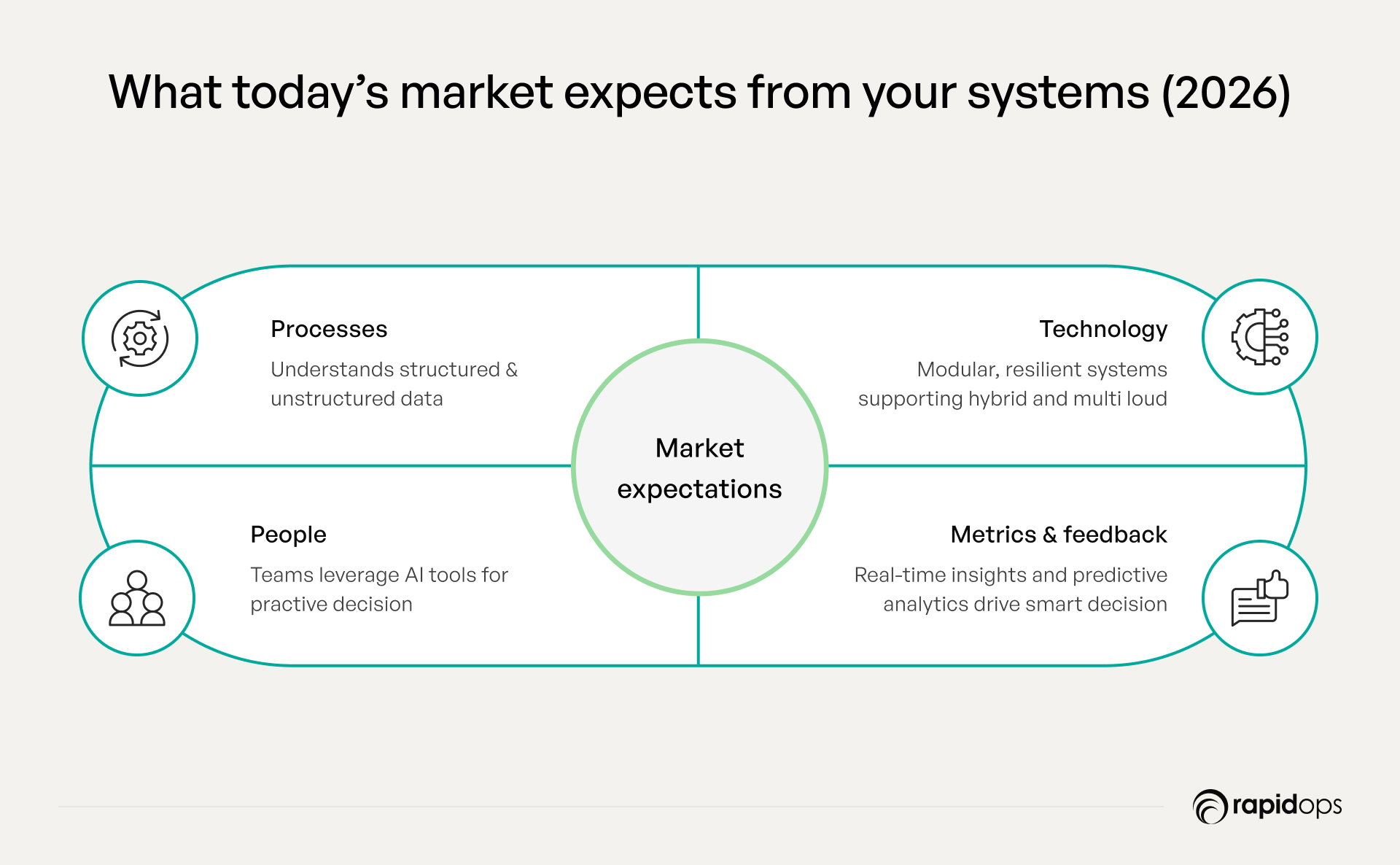
In 2026, systems are judged by their ability to deliver uninterrupted performance, anticipate operational pressure points, and provide actionable intelligence in real time. Market leaders no longer tolerate latency, hidden bottlenecks, or reactive fixes; every delay or failure carries measurable business cost. Understanding these expectations empowers decision-makers to prioritize scaling strategies, optimize resources, and design systems that sustain growth while maintaining reliability, turning operational excellence into a tangible competitive advantage.
People
Teams remain the most critical factor in meeting market expectations. Organizations must invest in skilled professionals who understand complex systems, can respond to unexpected challenges, and drive continuous innovation. Clear roles, strong collaboration practices, and ongoing upskilling ensure operational resilience while supporting growth. In 2026, businesses increasingly expect teams to leverage AI-assisted tools and predictive insights, enabling proactive decision-making rather than reactive problem-solving, which directly impacts uptime, user experience, and competitive advantage.
Processes
Standardized, automated, and transparent processes are no longer optional, they are essential. Efficient processes reduce human error, accelerate deployment, and allow organizations to adapt rapidly to changing market conditions. Workflows must be flexible enough to accommodate new technologies, evolving customer demands, and unpredictable spikes in load. In practice, organizations that implement process automation and enforce best practices can scale safely, maintaining consistency and operational predictability while freeing teams to focus on innovation and value creation.
Technology
Modern systems are expected to be modular, interoperable, and resilient. Market expectations demand systems that integrate effortlessly across cloud, edge, and enterprise platforms, support AI-driven automation, and process vast data volumes in real time. In 2026, hybrid and multi-cloud deployments are common, and systems must maintain performance and security across these complex environments. Organizations that prioritize scalable architecture and future-ready technology stacks can handle growth smoothly, deliver consistent customer experiences, and respond to emerging market opportunities quickly.
Governance
Strong governance is vital to meet regulatory, compliance, and strategic expectations. Organizations are evaluated not only on operational reliability but also on how responsibly and efficiently scaling initiatives are managed. Governance frameworks provide accountability, ensure risk mitigation, and enable informed decision-making at every level. In an era of increasing cyber threats and global data regulations, companies that embed governance into system operations can scale confidently without exposing themselves to operational or reputational risk.
Metrics & feedback loops
Real-time metrics, structured feedback loops, and predictive analytics enable proactive system management. Organizations can identify performance bottlenecks, anticipate demand surges, and optimize resource allocation before issues escalate. By continuously monitoring outcomes, analyzing trends, and adjusting operations, companies ensure that scaling is measurable, sustainable, and aligned with business objectives. In 2026, the expectation is for systems to provide actionable insights to both technical teams and business leaders, enabling faster, smarter, and more strategic decision-making.
In essence, today’s market expects systems that are fast, reliable, adaptive, and intelligently managed across all dimensions: people, processes, technology, governance, and feedback.
Organizations that meet these expectations gain a distinct competitive advantage, ensuring operational continuity, exceptional customer experience, and scalable growth in an increasingly complex and digital-first economy.
The most common failure modes when companies scale
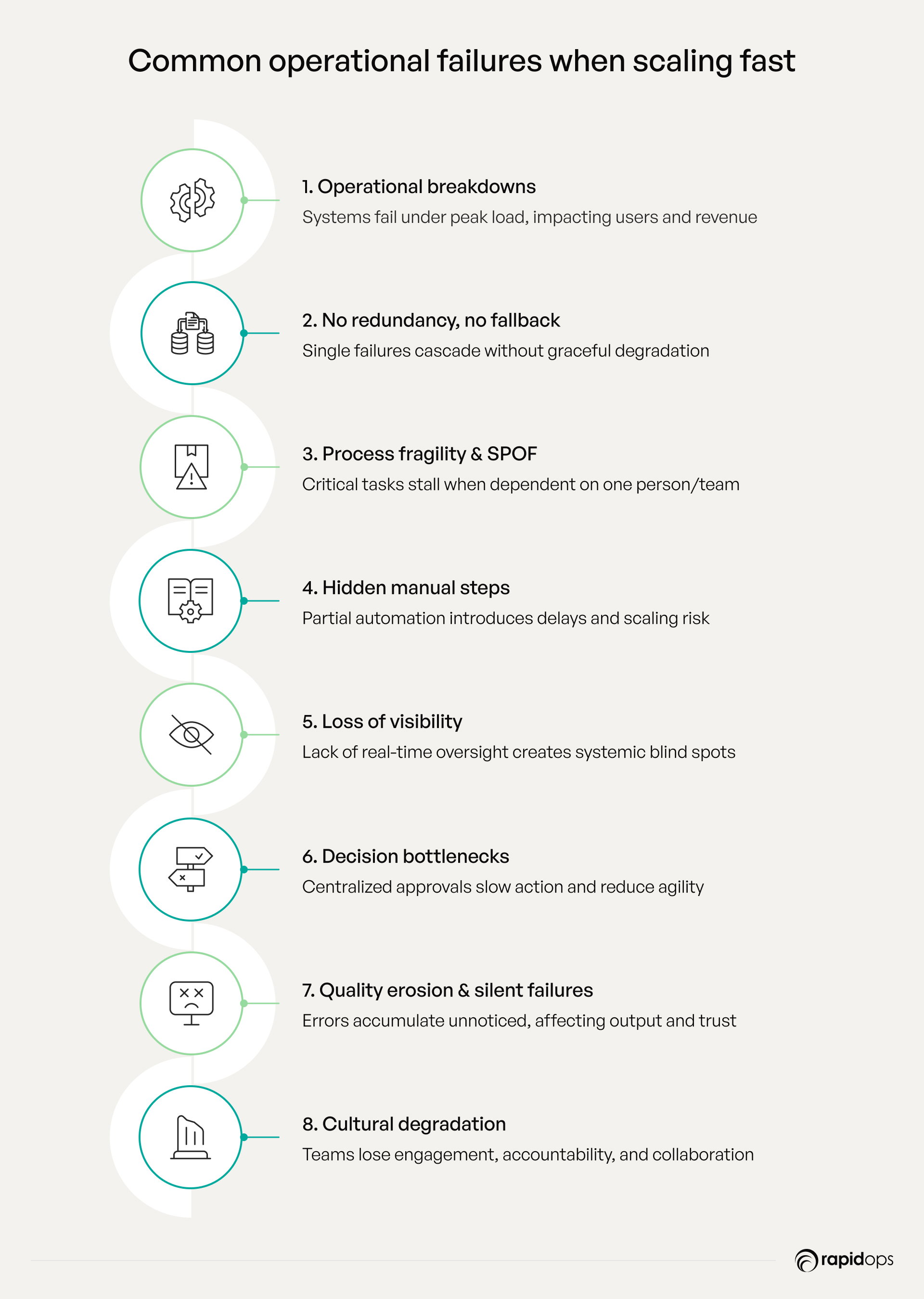
Scaling exposes weaknesses in systems, processes, and culture that were tolerable at smaller sizes. Leaders often recognize recurring patterns of operational bottlenecks, process fragility, and decision overload that predict failures long before they surface externally. Understanding these common failure modes enables organizations to redesign systems proactively, avoid costly downtime, maintain service quality, and preserve both operational control and team morale as they grow.
Operational breakdowns under peak load
Systems designed for average or routine demand often collapse during extreme peaks. Infrastructure bottlenecks, database contention, and application latency multiply, impacting customers directly. Organizations may underestimate traffic surges or stress scenarios, leading to outages that damage trust and revenue. Leaders familiar with these patterns know that load testing, capacity planning, and resilient design are critical to maintain uninterrupted service, even when usage spikes beyond historical norms.
No redundancy, no graceful degradation
When redundancy is absent, single failures cascade into larger outages, halting operations. Systems must be able to degrade gracefully, maintaining partial functionality instead of collapsing entirely. Leaders often witness downtime during high-demand periods because failover mechanisms were not implemented. Incorporating redundancy, modular services, and fault-tolerant design ensures resilience, allowing operations to continue even when individual components fail and maintaining business continuity at scale.
Process fragility and single points of failure
Processes that depend on one individual, one team, or undocumented workarounds create critical vulnerabilities. If that link is unavailable, operational tasks stall and errors escalate. Leaders frequently see this pattern during audits or crises, recognizing that knowledge concentration can halt progress. Standardizing procedures, documenting workflows, and implementing shared responsibilities reduce fragility, ensuring continuity and reliability as organizations expand and complexity increases.
Manual steps hidden inside “automated” flows
Processes that appear automated but contain hidden manual steps introduce unpredictability and delay. Leaders notice tasks that lag, fail silently, or require intervention, revealing hidden dependencies. Such gaps create bottlenecks and scaling risk. To prevent failures, organizations must fully automate end-to-end workflows, monitor for exceptions, and eliminate manual handoffs, ensuring that systems remain reliable, predictable, and capable of handling increased operational volume without hidden friction points.
Loss of visibility and control
As organizations scale, leaders lose real-time oversight if they rely on anecdotal information or outdated reporting. Small issues that were manageable become systemic risks before detection. Lack of observability can lead to degraded performance, compliance failures, or missed opportunities. Implementing real-time monitoring, dashboards, and predictive analytics restores control, allowing proactive intervention, faster decision-making, and maintaining operational excellence under high growth pressures.
Decision bottlenecks at the top
Centralized decision-making slows scaling, as all approvals and escalations funnel to a limited group of leaders. Bottlenecks delay action, reduce responsiveness, and stifle innovation. Teams become dependent, and risk management slows. Recognizing this pattern, leaders can delegate authority, define clear escalation paths, and empower mid-level decision-making, ensuring organizations retain agility and responsiveness while scaling, without sacrificing strategic oversight or operational control.
Quality erosion and silent control failures
Errors accumulate silently, often before leadership notices, impacting product quality, compliance, and customer satisfaction. Minor process deviations compound under scale, creating systemic risk. Leaders recognize this pattern when audits, customer complaints, or security incidents surface. To counteract it, organizations must implement continuous testing, automated quality checks, and structured feedback mechanisms, ensuring early detection, consistent output, and sustained operational reliability during rapid growth.
Cultural degradation
Scaling challenges extend beyond technology; culture often suffers first. Teams may shift from ownership to blame, pride to burnout, and collaboration to siloed behavior. Leaders notice declining morale, higher attrition, and decreased accountability. To maintain culture at scale, organizations must reinforce values, clarify roles, promote shared responsibility, and celebrate achievements, ensuring engagement, resilience, and performance remain strong as operational complexity increases.
The underlying truth
These failures are not random; they are the predictable result of systems, processes, and cultures that were never designed for scale. Recognizing and addressing these patterns proactively allows organizations to avoid costly breakdowns, maintain quality, preserve team morale, and grow sustainably, turning scaling from a risk-laden challenge into a controlled, strategic advantage that supports both operational and business objectives.
Middleware: The key to scaling legacy and core systems
As your business grows, the pressure on legacy and core systems increases. These systems were originally built to operate at a defined scale, supporting a predictable level of work, time, and operational complexity. Over the year, as customer expectations evolve and new products and digital initiatives emerge, these systems often become the limiting factor that restricts your ability to scale systems safely.
You may begin to notice slower response time, fragmented data, increased dependency on manual support, and reduced ability to adapt. For many organizations across every industry, this challenge is not about replacing systems, but about enabling them to scale without disruption. Middleware addresses this exact need by creating a controlled layer that allows systems to evolve while remaining stable.
How middleware enables scalable systems in 2026
Middleware plays a foundational role in modern scale systems by ensuring that legacy platforms, modern software, operational tools, and digital products function as a single, coordinated system. It establishes structured communication, consistent data exchange, and predictable control mechanisms that allow systems to scale in alignment with business growth.
In 2026, scalable systems must support increasing operational demands across customers, clients, and regions without introducing instability. Middleware provides this stability by managing how systems interact, how data is processed, and how changes are introduced, ensuring growth remains controlled rather than reactive.
Enabling structured integration across systems
Scalable systems require integration that is deliberate, governed, and resilient. Middleware enables structured integration by connecting systems through defined interfaces rather than fragile point-to-point dependencies. This is especially critical when managing industrial scales, equipment, and operational scale systems that generate continuous data streams.
Modern industrial scales increasingly integrate with software to automatically log measurements and measure performance, accuracy, and throughput. Middleware ensures this data flows reliably across systems, supporting consistency, compliance, and operational visibility without compromising core stability.
Supporting modular and phased system growth
In 2026, effective scaling is incremental rather than disruptive. Middleware supports modular system growth by allowing capabilities to be introduced in phases, tested, and refined before broader adoption. This approach aligns with how advanced scale systems evolve, adding capacity while maintaining accuracy and reliability.
By enabling phased expansion, middleware allows your organization to find system constraints early, adjust architecture deliberately, and scale operations month by month without forcing abrupt change. This reduces risk, protects operational continuity, and ensures long-term system health.
Maintaining resilience and operational continuity
As systems scale, resilience becomes a defining requirement. Middleware strengthens resilience by isolating failures, managing dependencies, and controlling data flow between systems. This prevents localized issues from cascading across the organization and impacting customers or internal teams.
This capability is essential in environments where precision and reliability are critical, including food production and healthcare, where system failures can affect quality, safety, and compliance. Middleware ensures systems continue to work under pressure, preserving trust and operational stability as scale increases.
Enabling continuous monitoring and measurement
Scalable systems must be observable at all times. Middleware provides centralized visibility into system behavior, enabling teams to continuously measure performance, monitor data flow, and log operational events. This mirrors the principles used in modern digital scale systems, where accuracy and consistency are continuously validated.
By embedding monitoring into system operations, middleware allows organizations to maintain control as scale increases, identify issues proactively, and optimize performance without interrupting ongoing operations.
Extending scalability beyond core operations
Scalable systems in 2026 extend beyond internal platforms. Middleware enables integration with customer-facing and growth-oriented systems, including social media and social media sales systems, without creating operational silos.
By coordinating data across internal systems and external channels, middleware helps your organization reach audiences more effectively, meet demand without additional operational burden, and offer consistent experiences across touchpoints. This integration ensures that growth initiatives remain aligned with system capacity and operational readiness.
Preparing systems for long-term scalability
Middleware is a strategic solution for long-term scalability. By decoupling systems and introducing a flexible integration layer, you create an architecture that can evolve as your business, industry, and markets change across every country you operate in.
This approach ensures your systems can support future innovation, adapt to new operational models, and scale sustainably over time. Middleware enables you to protect existing investments while building a foundation that supports growth, stability, and continuous improvement.
Middleware creates the technical foundation for scalable systems, but sustainable growth also depends on how change is executed. To fully realize the value of scalable architecture, organizations must implement change in deliberate phases that protect workflows, minimize disruption, and maintain system integrity.
Scaling your systems safely in phases using middleware
Scaling systems in modern organizations is rarely straightforward. Legacy platforms, siloed applications, and growing operational complexity create invisible friction points until they disrupt workflows. Middleware provides a strategic layer that connects your existing systems to new technologies, enabling you to scale intelligently, orchestrate processes, and manage interdependencies, without tearing out infrastructure that already works. By leveraging middleware, you gain a structured path to scale in phases, reduce risk, and maintain control over every critical workflow.
Step 1: Map critical systems and dependencies
Before scaling, clarity on your operational landscape is essential. Middleware allows you to visualize workflows and dependencies across business systems, connecting legacy ERPs, databases, and departmental tools with modern applications. By identifying where data flows, bottlenecks occur, and handoffs happen, you can find potential points of fragility that could be exposed under higher operational loads. This foundational step ensures you understand not just what needs to scale, but how your systems interact, creating a deliberate, controlled approach to expansion.
Step 2: Layer orchestration on existing processes
Middleware provides a central orchestration layer that coordinates complex workflows across all connected systems. Processes no longer operate in isolation tasks, approvals, and data move automatically in the correct sequence. By prioritizing critical operations, middleware ensures predictable system behavior as demand grows, reducing disruptions to your business operations and support teams. This orchestration is especially valuable when scaling industrial scales, digital scale systems, and integrated software solutions that rely on precise timing and measurement.
Step 3: Introduce controlled feature exposure
Scaling does not require rolling out all changes at once. Middleware supports phased scaling by enabling feature flags and selective rollouts, giving specific teams or business units access to new capabilities first. This allows you to measure system performance, monitor operational stress, and adjust incrementally. By controlling exposure, you ensure that each system change is validated in real-world conditions, keeping core operations stable while your business grows.
Step 4: Monitor performance and manage stress
Middleware provides real-time visibility into system load, queues, error rates, and resource utilization, giving leaders actionable insights into operational stress points. Unlike traditional monitoring, which signals failures after they occur, middleware lets you proactively identify bottlenecks, near-misses, and areas at risk. This proactive approach ensures scaling is controlled, measured, and responsive, protecting your customers, clients, and critical workflows from disruption. The ability to log and track performance continuously reinforces reliability across scale systems and industrial scales alike.
Step 5: Incrementally expand integrations
Middleware enables phased integration of new applications, cloud platforms, SaaS tools, or internal systems without disrupting existing infrastructure. Each integration can be tested, optimized, and monitored independently, preserving operational continuity while enabling expansion. This phased approach reduces cost, risk, and the need for disruptive full-system replacements, letting your business build capabilities steadily while maintaining operational efficiency and compliance.
Step 6: Continuously refine and reinforce
As systems scale, some workflows perform reliably while others may show stress under higher demand. Middleware provides ongoing orchestration, monitoring, and management, allowing you to reinforce workflows that work and adjust those that bend before they break. By continuously refining your system layer, you maintain resilience, stability, and operational predictability, ensuring your infrastructure can support future growth, products, and expansions without compromising performance.
Step 7: Enable leadership to operate strategically
Middleware doesn’t just optimize systems; it empowers leadership to focus on strategy rather than firefighting. By automating orchestration, connecting workflows, and managing system stress, middleware allows your executives to meet growth objectives, oversee operations, and make informed decisions. Teams remain productive, processes stay connected, and leadership gains real-time insight into system health, making scaling both safe and strategically aligned with business goals.
Why middleware is the modern solution for scaling
Middleware is not simply a technical convenience; it’s a strategic enabler for organizations aiming to grow intelligently and sustainably. Its advantages include:
- Integrates legacy and modern systems: Connects existing ERPs, CRMs, departmental tools, and industrial scales with new cloud or SaaS platforms, ensuring continuity without risky rip-and-replace approaches.
- Orchestrates complex workflows: Automates dependencies, routing, and task coordination, reducing errors, bottlenecks, and operational strain.
- Manages operational stress: Provides real-time monitoring of queues, load, and near-misses, allowing proactive intervention before disruption reaches customers or core processes.
- Supports phased, controlled scaling: Enables selective rollout of new features, incremental integrations, and parallel processes while maintaining operational stability.
- Enables real-time visibility: Delivers dashboards and insights for leaders to monitor, adjust, and optimize scaling in progress.
- Reduces cost, risk, and complexity: Extends the life of existing infrastructure, avoiding full system replacement while evolving capabilities.
- Empowers strategic decision-making: Frees executives to focus on growth, innovation, and long-term planning rather than firefighting daily operational issues.
Middleware transforms your infrastructure into a scalable, resilient, and manageable system layer, allowing your business to grow intelligently, safely, and sustainably while maintaining continuity, efficiency, and high-quality service for clients and customers.
Scaling is a choice, not a risk
Scaling is not about doing more; it’s about redesigning systems so more can flow safely. Organizations that succeed treat scaling as a deliberate strategy, designing systems, processes, and teams to handle growth without compromising reliability, performance, or customer experience.
What disciplined leaders do differently is clear: they invest before pain forces them, design for resilience rather than optimism, and scale deliberately, not reactively. They understand that hope is no substitute for deliberate architecture, modular processes, and accountable teams. By addressing constraints proactively, they turn potential failures into predictable growth opportunities.
At Rapidops, we bring 17 years of hands-on experience helping organizations scale complex systems safely and efficiently. With end-to-end expertise in digital product development, technology, process design, and people systems, we deliver solutions that are measurable, resilient, and fully aligned with business goals. Our proven frameworks have helped companies streamline operations, reduce operational risk, and unlock growth, turning complex challenges into opportunities for innovation and performance.
Are your systems struggling to keep up with growth? Speak with our system modernization experts in a complimentary consultation call to identify what’s holding you back and explore the best path to modernize them.
Frequently Asked Questions

What’s Inside

Let’s build the next big thing!
Share your ideas and vision with us to explore your digital opportunities
Similar Stories
- Transformation
- undefined Mins
- March 2022


- Transformation
- undefined Mins
- March 2020

Receive articles like this in your mailbox
Sign up to get weekly insights & inspiration in your inbox.