


You know the promises of digital transformation: faster, data-driven execution, seamless operations, and measurable growth. Yet in 2026, delivering on that promise is more complex than ever. Customer expectations evolve overnight, markets shift unpredictably, and boards demand results immediately. Despite $3.4 trillion in global digital investments, only 16–35% of initiatives achieve lasting impact, while the majority fall short of their objectives.
Look at your teams today. Are workflows fully aligned, or do small bottlenecks silently slow performance? Are tools being adopted consistently, or do some fall into underutilization? These are strategic risks. Even sophisticated systems underperform without guidance from a partner who can align technology with business priorities, orchestrate adoption, and ensure initiatives drive measurable results. The right partner transforms technology from a tool into a driver of real business impact.
A capable digital transformation partner turns these challenges into opportunities. They define the success metrics that matter, embed technology seamlessly into operations, and empower teams to embrace change confidently. High-risk initiatives become engines for growth, improving efficiency, resilience, and competitive advantage. With expert guidance, stalled projects turn into actionable plans, and technology investments translate into tangible results.
That’s why we wrote this article: to help you understand what makes a digital transformation partner truly effective, what to look for when choosing one, and how the right partner can turn your initiatives into measurable growth. By reading this guide, you’ll gain actionable insights to make confident, informed decisions that accelerate results, improve adoption, and ensure your technology investments deliver real business impact.

Define clear transformation goals before engaging partners
Digital transformation is a strategic opportunity to enhance business operations, elevate customer experience, and create measurable growth. The foundation of any successful transformation is clarity, clarity on what your organization wants to achieve, why it matters, and how progress will be measured.
When goals are clearly defined, your organization can identify and engage partners with the right capabilities, rather than reaching out to any random provider. This clarity not only ensures your partner’s solutions are precise, scalable, and aligned with your objectives but also naturally filters out unsuitable partners, increasing the likelihood of a successful transformation.
Connect your transformation with your business objectives
Every transformation initiative should be explicitly tied to the challenges your organization is facing today and the opportunities it can unlock through technology. This means going beyond general aspirations like “improve efficiency” or “modernize technology.” For example, your business may be struggling with slow process cycle times, inconsistent customer experiences, or delays in data-driven decision-making, these are the problems to fix. At the same time, technology may allow opportunities such as automating repetitive tasks, providing personalized customer experiences, or enabling faster, smarter decision-making.
By framing objectives around these real-world problems and opportunities, your digital transformation partner can recommend technologies and solutions that directly address your needs. This ensures that every initiative creates tangible, measurable impact, rather than simply adding tools to your technology stack, and helps your organization capture opportunities that drive growth and efficiency.
Define success with meaningful metrics
Clear goals become actionable only when tied to measures that reflect the challenges your organization is trying to solve and the opportunities it wants to capture. Metrics transform abstract ambitions into tangible targets and provide a lens to track progress against real business problems.
For instance, if your business struggles with slow operational processes, efficiency KPIs such as reduction in manual tasks, faster order fulfillment, or streamlined workflows directly measure improvement. If customer experience is a pain point, metrics like engagement rates, service response times, or customer satisfaction scores show whether initiatives are closing those gaps.
By defining these success metrics upfront, your digital transformation partner can tailor solutions to directly address your challenges and exploit opportunities, continuously optimizing processes. This approach ensures that every investment delivers quantifiable impact, drives better decision-making, and aligns technology initiatives with both business priorities and measurable outcomes.
Assess current capabilities to unlock potential
Before partnering, it’s essential to conduct a detailed assessment of existing capabilities. This includes your internal teams, current systems, workflows, and business processes. Understanding strengths and gaps allows your partner to identify where emerging technologies like artificial intelligence or cloud computing can create the most impact.
For instance, an AI-powered recommendation engine could transform your customer interactions, while cloud migration might provide scalable infrastructure that supports future growth. By evaluating current capabilities thoroughly, the digital transformation partner can design solutions that amplify what is already working while creating new opportunities for innovation and efficiency.
Focus on high-impact initiatives
Not every transformation initiative delivers the same value. Start by identifying the critical challenges your organization faces today for example, slow operational processes, gaps in customer experience, or underutilized data, and the opportunities technology can unlock, such as automation, predictive analytics, or personalized customer engagement.
By focusing on initiatives that address these real problems and opportunities, you ensure resources are concentrated where they will create the greatest measurable impact. A digital transformation partner can help prioritize these high-value areas, design solutions tailored to your business needs, and ensure early wins that build momentum, demonstrate value to stakeholders, and accelerate adoption.
Targeting high-impact initiatives in this way creates a structured, outcome-driven roadmap, balancing ambitious goals with achievable, measurable results, while turning your technology investments into tangible improvements that directly advance your organization’s strategic objectives.
Prepare your organization for a culture of transformation
Transformation is as much about culture as it is about technology. By clearly defining goals, you give teams a purpose for the changes, helping them understand how initiatives will improve their work and the company culture as a whole. Partners with expertise in effective change management guide teams through adopting new systems, embracing new workflows, and developing capabilities that support sustained success.
When goals are clearly communicated and tied to outcomes that employees value, the organization naturally cultivates a culture that supports innovation, agility, and continuous improvement.
Validate goals with industry benchmarks and insights
Ensuring your goals are ambitious yet realistic is critical. Leverage industry insights and benchmarks to align your objectives with proven practices. For example, 88% of businesses engage external partners for at least one component of digital transformation, demonstrating the value of collaboration and expertise. Evaluating your digital transformation partner’s proven track record and referencing sector-specific success stories ensures your objectives are grounded in reality while remaining forward-looking.
Validation also builds confidence among leadership and teams that the transformation plan will deliver measurable growth, operational improvements, and enhanced customer experience.
When transformation goals are clearly defined, your organization moves with purpose. Teams know where to focus, initiatives deliver real impact, and your digital transformation partner can create solutions that improve efficiency, elevate customer experiences, and open new opportunities, helping your business thrive and stay ahead in 2026.
Understanding digital transformation partner types and their capabilities
Your digital transformation journey can only reach its full potential when you understand the partners who will guide it. Each type of partner brings distinct expertise, tools, and insights that can directly shape how your organization operates, innovates, and delivers value. By knowing which partner fits your strategic priorities, you can make confident decisions, accelerate critical initiatives, and unlock measurable outcomes that strengthen your competitive edge.
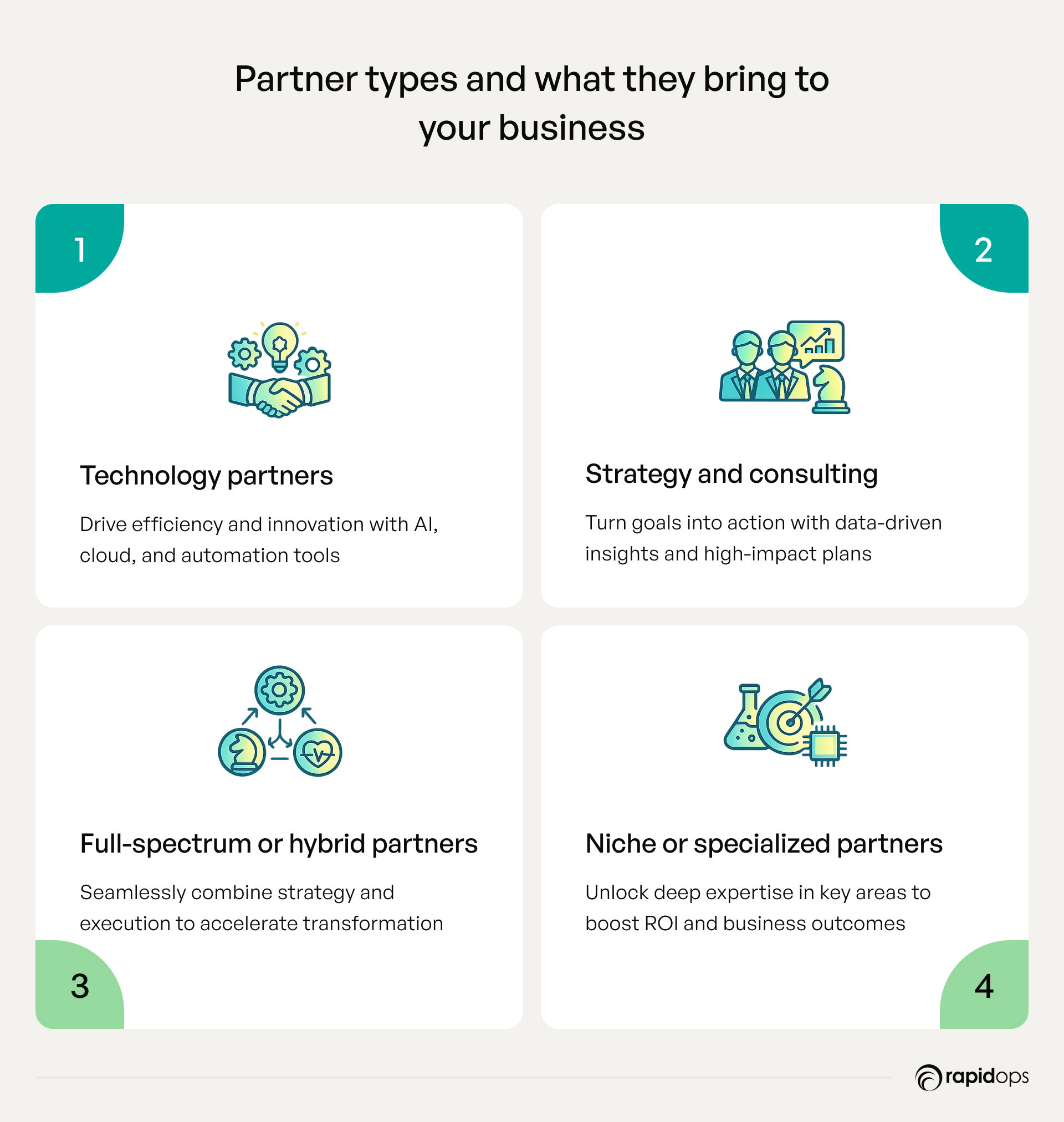
1. Technology partners: Boost your efficiency and innovation
Technology-focused partners bring deep expertise in digital technologies, emerging technologies, and your technology stack, enabling you to optimize business operations and streamline processes. They focus on implementing scalable and flexible solutions that enhance efficiency, reduce manual tasks, and support data-driven decisions across your organization.
By working with technology experts, you gain access to AI, cloud computing, and automation tools that are carefully integrated to enhance your workflows without disrupting existing operations. According to industry research, organizations that engage technology-focused partners report up to 30% faster adoption of digital tools and measurable improvements in operational KPIs.
With this type of partner, you can ensure that every technology investment directly supports your business objectives, drives measurable impact, and positions your organization for sustainable growth.
2. Strategy and consulting partners: Align initiatives with your goals
Strategy-focused partners help you translate your organizational goals into actionable digital transformation initiatives. They provide guidance on assessing your current capabilities, internal team readiness, and operational priorities, ensuring your efforts are strategically aligned with your business objectives.
By collaborating with a strategy partner, you can prioritize high-impact initiatives, link transformation goals to measurable outcomes, and implement effective change management practices that ensure cultural adoption and team engagement. Research shows that 88% of leading enterprises rely on strategy-focused partners for at least one component of their digital transformation, highlighting the value of strategic alignment.
This partnership ensures that your initiatives are not only technically sound but also deliver tangible business results, improve decision-making through data-driven insights, and accelerate the overall transformation journey.
3. Full-spectrum or hybrid partners: Combine strategy and execution seamlessly
Full-spectrum or hybrid partners combine strategic advisory with hands-on execution, providing a seamless approach to transformation. They guide you from goal-setting and roadmap development to solution implementation and process optimization for long-term impact.
With a hybrid partner, you can be confident that initiatives integrate with your existing operations and business processes, ensuring continuity while driving transformation. They monitor progress, assess outcomes, and continuously refine strategies, giving your leadership team visibility, accountability, and confidence in achieving measurable objectives.
Organizations that leverage full-spectrum partners often report 20–25% faster realization of benefits from digital initiatives, because strategy and execution are coordinated under a single framework. For your business, this means a clear pathway to scalable growth and operational efficiency, with reduced complexity and risk.
4. Niche or specialized partners: Access expertise where you need it
Specialized partners focus on specific technologies, domains, or industry challenges, delivering deep expertise where you need it most. Whether your priority is AI, cybersecurity, or sector-specific digital transformation services, these partners provide capabilities that complement broader initiatives and ensure critical objectives are fully addressed.
By engaging niche partners, you access expert insights that strengthen operational efficiency, enhance customer experience, and optimize high-value functions. This focused expertise allows you to maximize ROI in specialized areas while maintaining alignment with broader transformation goals.
Market research indicates that companies engaging specialized partners in high-priority domains achieve measurable improvements in productivity and customer satisfaction, reinforcing the value of leveraging targeted expertise for strategic initiatives.
When you clearly understand partner types and their capabilities, you can align your choices with your business goals and transformation objectives.
Technology partners streamline your operations and embed innovation, strategy partners connect initiatives to measurable outcomes, hybrid partners ensure seamless execution, and specialized partners bring targeted expertise to critical areas. With the right combination supporting your journey, you empower your teams, maximize efficiency, and drive growth that lasts well into 2026 and beyond.
Key criteria to evaluate a digital transformation partner
Not every digital transformation partner is equipped to operate in your reality, your constraints, timelines, risk tolerance, and internal dynamics. Some partners excel at technology but struggle to connect it to business outcomes. Others speak fluently about strategy, yet fall short when it’s time to execute at scale. The criteria you use to evaluate a partner determine whether they become a force that drives momentum or a source of friction that slows decisions, stretches budgets, and dilutes impact.
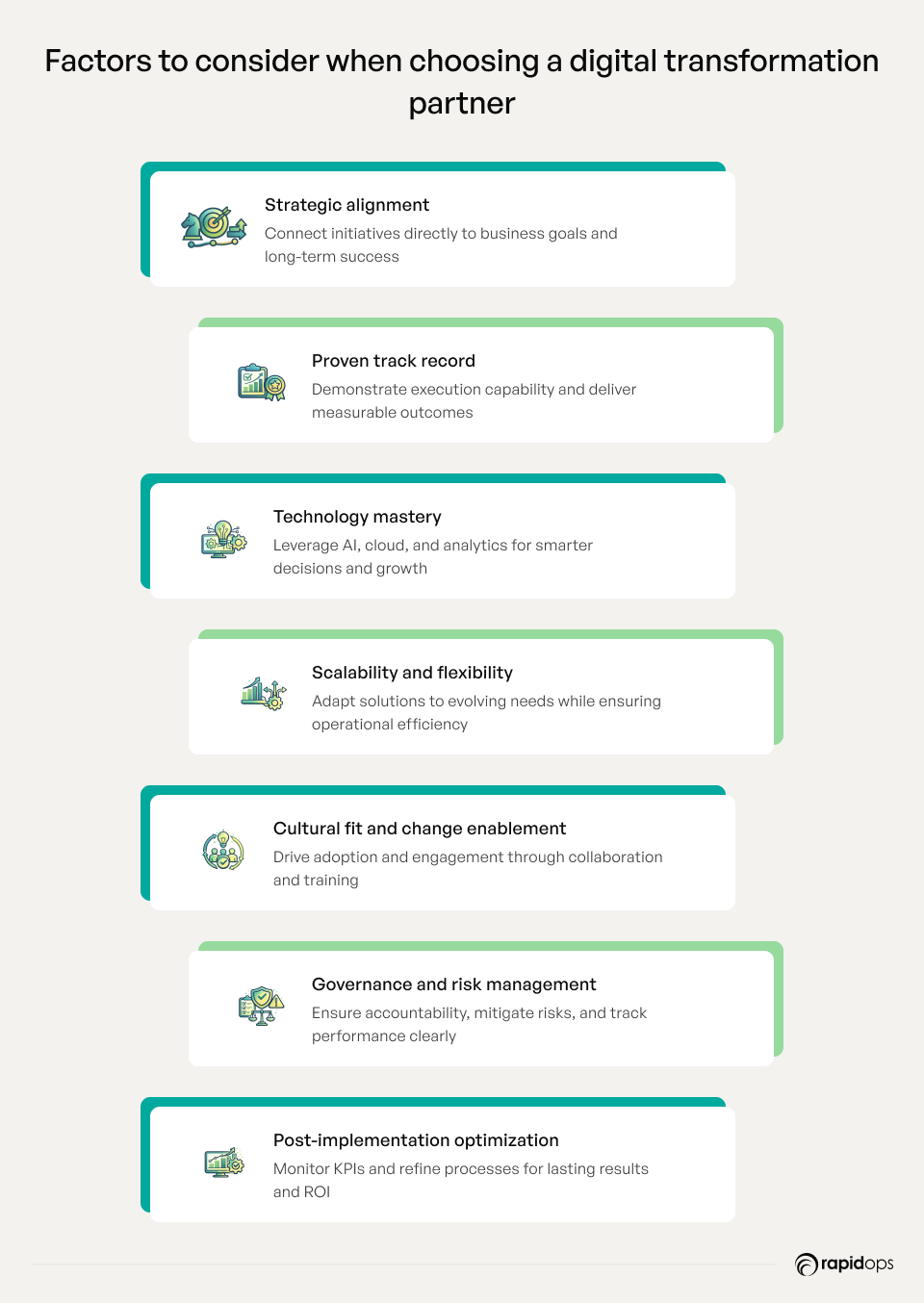
Strategic alignment with your business objectives
A partner’s effectiveness starts with their ability to understand and embrace your organizational priorities. Every recommendation, technology implementation, or workflow redesign should connect directly to your strategic goals—whether that’s enhancing customer experience, optimizing operational efficiency, or unlocking new revenue streams.
When your partner’s approach is rooted in your business objectives, they don’t just deploy tools, they create solutions that scale with your operations, integrate seamlessly with existing processes, and position your organization for long-term success. By focusing on strategic alignment, you prevent wasted effort, misdirected investments, and initiatives that fail to deliver measurable value.
Proven track record and execution capability
Execution is where strategy meets reality. Studies indicate that up to 70% of digital transformations fail to meet ROI expectations, primarily due to execution gaps. A high-performing partner demonstrates a proven history of delivering complex projects successfully, with evidence of operational efficiency gains, productivity improvements, and measurable business outcomes.
You should evaluate their ability to navigate emerging technologies, operational challenges, and cross-functional coordination, ensuring that your initiatives progress from vision to tangible results with predictable timelines and high-quality delivery.
Mastery of emerging technologies and data-driven insights
In 2026, transformation is inseparable from technology and data intelligence. Your partner must provide deep expertise in AI, cloud computing, automation, and analytics, while integrating these technologies in a way that complements your current systems and workflows.
By leveraging real-time data insights, your partner enables you to make informed decisions, anticipate market shifts, and optimize business processes. This combination of technological mastery and analytical rigor ensures every digital initiative directly contributes to operational excellence and strategic growth.
Scalability, flexibility, and future readiness
A forward-looking partner designs solutions that adapt to evolving business needs and market demands. Scalability allows you to expand capabilities, integrate new services, and implement AI-driven processes without disrupting operations. Flexibility ensures your technology architecture can evolve with your growth trajectory.
Ongoing monitoring, iterative optimization, and post-implementation support guarantee your transformation remains efficient, cost-effective, and aligned with shifting objectives, allowing your organization to maintain a competitive edge in a rapidly changing market.
Cultural fit and change enablement
Even the most technically proficient partner will underperform without cultural alignment and change enablement. The right partner collaborates with your teams, understands company culture, and actively drives employee adoption through training, engagement, and communication strategies.
By embedding change management into every initiative, your organization reduces resistance, accelerates adoption, and maximizes ROI. This ensures that new systems, processes, and workflows are fully utilized and optimized, transforming your workforce into active contributors to digital success.
Governance, accountability, and risk management
Strong governance is a cornerstone of successful transformation. Partners should establish clear accountability structures, reporting mechanisms, and performance indicators across all project stages. They proactively identify and mitigate risks, from vendor dependencies to change management challenges, ensuring your initiatives remain on track.
With transparent executive dashboards and monitoring frameworks, your leadership team gains real-time visibility and control. This disciplined approach ensures initiatives are measurable, defensible, and aligned with your long-term objectives, safeguarding both time and investment.
Post-implementation optimization and measurable outcomes
Digital transformation is an ongoing journey, not a one-time project. Top partners establish continuous monitoring and feedback mechanisms to track KPIs, ROI, and operational performance. They proactively identify inefficiencies, optimize workflows, and ensure systems remain scalable, compliant, and aligned with evolving objectives.
By maintaining accountability and a focus on measurable results, your partner ensures your transformation delivers long-term operational excellence, improved customer experience, and sustainable business growth, solidifying your position as a future-ready, resilient organization.
Identify red flags early to prevent costly mistakes
In any digital transformation journey, even the most carefully planned initiatives can face unexpected obstacles. Identifying red flags early allows your organization to respond quickly, minimize risk, and prevent costly mistakes that could derail timelines, inflate budgets, or compromise business outcomes. For business leaders, this proactive approach is critical not just to safeguard investments but to ensure your transformation delivers measurable value and positions your organization for a competitive future.
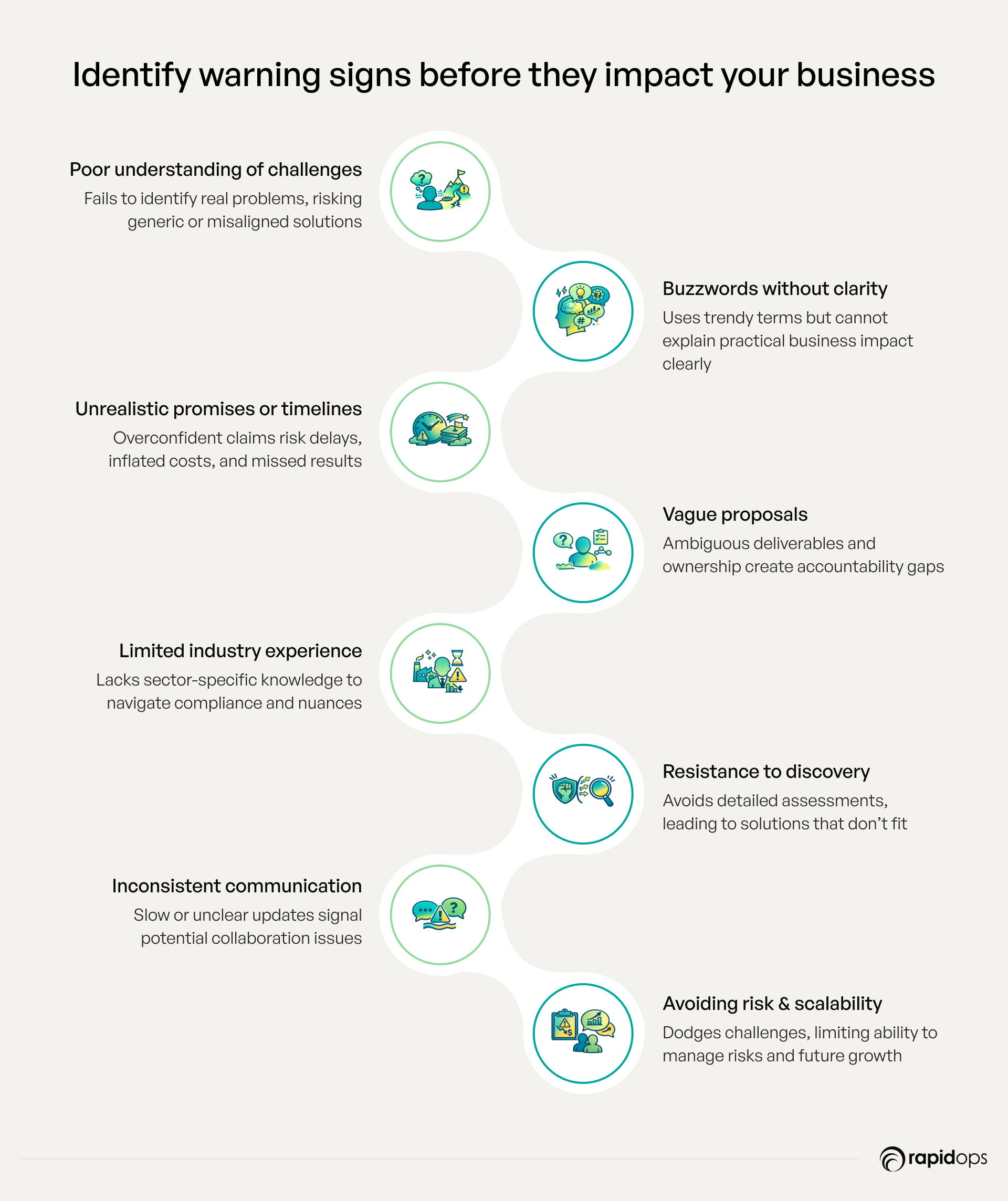
1. Poor understanding of your current challenges
A partner who cannot clearly articulate the real problems your organization faces, from operational bottlenecks and underutilized data to customer pain points, may deliver generic solutions that fail to address your needs. Early recognition of this gap helps you avoid partners who cannot tailor their approach to your unique business context, ensuring you engage only those who can solve the issues that matter most.
2. Overreliance on buzzwords without practical clarity
Terms like “AI-powered,” “cloud-native,” or “hyper-automation” are often used liberally. However, if a partner cannot explain how these technologies will directly address your current problems or opportunities, it signals a lack of practical execution capability. Detecting this early allows you to focus on partners who translate technology into meaningful business outcomes.
3. Unrealistic promises or aggressive timelines
Claims of immediate ROI or overnight transformation are red flags. Partners overconfident in their execution often underestimate complexities, which can result in missed expectations, inflated costs, and delayed benefits. By identifying this early, you can prioritize partners who provide transparent, phased approaches with measurable milestones.
4. Vague proposals or unclear responsibilities
A partner who provides ambiguous deliverables, undefined phases, or uncertain ownership risks poor execution and accountability gaps. Early awareness of this allows you to select partners with structured plans, clearly defined responsibilities, and a commitment to transparency throughout the transformation journey.
5. Limited industry-specific experience
Partners without demonstrated success in your sector may struggle to navigate regulatory, compliance, or operational nuances. Early detection of this gap ensures your organization works with partners who bring real-world, sector-specific expertise, reducing risk and accelerating adoption of best practices.
6. Resistance to discovery or detailed assessment
If a partner avoids in-depth analysis of your workflows, systems, or existing processes, they may deliver solutions that are ill-fitted to your reality. Identifying this early ensures you select partners who prioritize understanding your current capabilities and constraints, enabling precise, scalable solutions.
7. Inconsistent or opaque communication
Slow responses, unclear updates, or evasive answers during initial discussions often foreshadow collaboration challenges. Recognizing this early allows you to choose partners who maintain transparent, real-time communication, ensuring alignment and timely decision-making.
8. Avoiding discussions about risks, limitations, or scalability
Partners who dodge questions regarding potential obstacles, compliance requirements, or future scalability may not be equipped to handle real-world implementation challenges. Spotting this early ensures you select partners prepared to address contingencies proactively, safeguarding timelines, budgets, and outcomes.
Cultural fit matters more than most companies realize
Every misaligned partner silently costs your business time, money, and market advantage. Leaders who overlook cultural fit risk stalled initiatives, frustrated teams, and wasted investments. By partnering with experts who understand your organization’s DNA, decision-making rhythms, and team dynamics, you accelerate adoption, empower employees, and turn every new tool or strategy into measurable, lasting impact, ensuring your business stays ahead in the digital future.
Why cultural fit is critical for transformation success
Digital transformation is not just a technology upgrade; it fundamentally reshapes workflows, roles, and ways of working. Partners who understand your organization’s culture can anticipate resistance, communicate effectively with teams, and embed solutions that align with your employees’ motivations and values.
A partner lacking this insight may deploy the best tools and strategies, but adoption will be slow, errors may multiply, and your organization risks losing the intended benefits of the transformation.
How to evaluate cultural compatibility
- Engagement style: Does the partner’s approach foster collaboration and transparency across your leadership and internal teams? Partners that encourage co-creation and open dialogue help employees feel invested in change rather than imposed upon.
- Change enablement: Assess the partner’s track record in managing digital skills development, stakeholder communication, and process adoption. Effective change management strategies accelerate learning curves and minimize disruptions.
- Shared values: Look for alignment in priorities such as agility, innovation, and responsiveness. Partners that resonate with your company culture are more likely to anticipate challenges, respond quickly, and champion solutions tailored to your organization’s unique challenges.
The impact on business leaders and clients
For business leaders, a culturally aligned partner provides confidence and clarity, ensuring that transformation efforts translate into measurable business outcomes rather than friction or frustration.
Employees experience smoother transitions, reduced resistance, and higher engagement, ultimately reflecting in enhanced customer experience and satisfaction. Clients benefit when your teams can deliver consistent, efficient, and digitally enabled services, reinforcing trust and positioning your organization to stay competitive in a rapidly evolving digital future.
Embedding cultural alignment into partner selection
To integrate cultural fit into your decision-making:
- Include internal stakeholders in evaluating potential partners to assess communication and collaboration effectiveness.
- Review prior engagement examples that demonstrate how the partner has successfully navigated company cultures similar to yours.
- Evaluate the partner’s commitment to training your internal teams and building digital skills that persist beyond deployment.
Cultural fit is often underestimated, but it is a critical determinant of transformation success. A partner who aligns with your company culture accelerates adoption, mitigates common pitfalls, and ensures that your transformation initiatives deliver measurable impact.
By emphasizing cultural compatibility alongside technical capability and strategic alignment, your organization positions itself to achieve sustainable business transformation, fully leverage new technologies, and thrive in the digital future.
The engagement models that work best for digital transformation
Selecting the right engagement model is critical to ensuring your digital transformation initiatives deliver measurable outcomes, minimize risk, and accelerate adoption. Different organizations require different models depending on size, complexity, industry, and strategic goals. The most effective engagement models balance flexibility, accountability, and clear alignment with your business objectives.
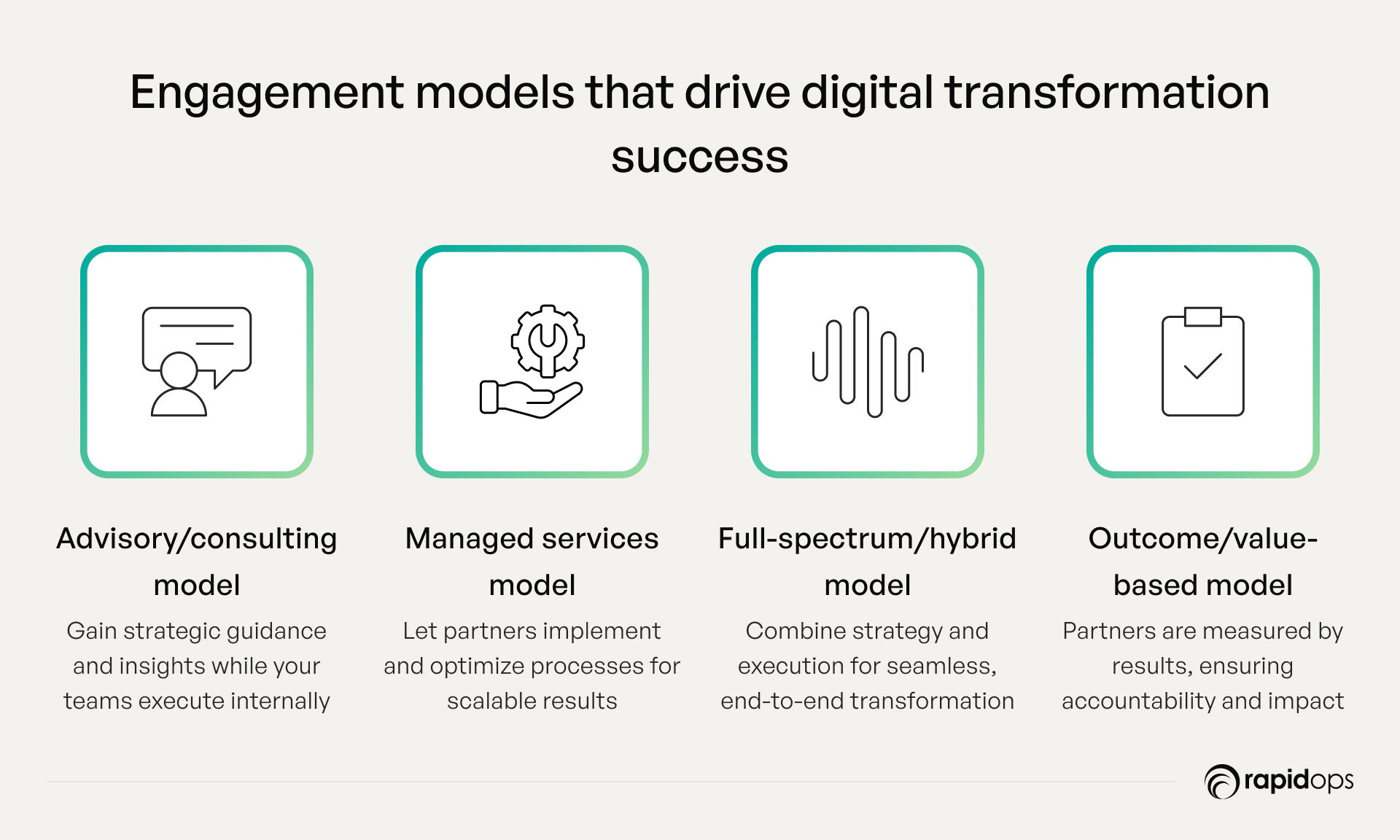
1. Advisory/Consulting model
In this model, the partner provides strategic guidance, assessment frameworks, and roadmap planning while your internal teams retain execution responsibility. Advisory partners are ideal when your organization seeks expertise to define transformation priorities, identify gaps, and optimize existing processes. By leveraging an advisory engagement, you gain access to data-driven insights and industry benchmarks without immediate operational disruption, enabling informed decision-making and precise planning for subsequent execution phases.
2. Managed services model
Managed services partners assume responsibility for implementing, operating, and optimizing specific technologies or processes on your behalf. This model is effective when you require specialized skills, scalable execution, or rapid deployment of digital tools without overburdening internal teams. Managed services allow your organization to respond quickly to market shifts, maintain continuity across operations, and focus internal resources on strategic initiatives, all while ensuring consistent performance, compliance, and efficiency.
3. Full-spectrum/Hybrid model
Hybrid partners combine strategic advisory with hands-on execution, offering end-to-end transformation support. They guide you from goal definition to roadmap creation, solution implementation, and continuous optimization. This model reduces complexity, shortens time-to-value, and ensures alignment across technology, people, and processes. For organizations pursuing large-scale transformation, hybrid engagements integrate cultural fit, process adoption, and emerging technologies seamlessly, delivering measurable outcomes while future-proofing operations.
4. Outcome-based/Value-based model
In outcome-focused models, partners are compensated based on agreed-upon business results such as efficiency gains, customer experience improvement, or revenue impact. This approach creates strong alignment between the partner’s incentives and your transformation goals, encouraging rigorous execution and measurable success. Outcome-based engagements are particularly effective for risk-conscious organizations, ensuring accountability, transparency, and continuous improvement throughout the transformation journey.
Choosing the right model for your organization
The engagement model you select should reflect your transformation goals, internal capabilities, risk appetite, and desired speed of adoption. Advisory models work well when defining strategy, managed services when execution support is critical, hybrid models when end-to-end guidance is needed, and outcome-based models when measurable accountability is paramount. In all cases, selecting a partner that aligns with your company culture, understands your industry, and possesses deep expertise in emerging technologies maximizes the probability of sustainable success.
Your strategic partner for AI-driven, results-oriented transformation
Throughout this journey, we’ve seen why even the most ambitious digital initiatives can stall, and how the right partner can turn challenges into opportunities. From solving operational bottlenecks and adoption gaps to harnessing AI, cloud computing, automation, and custom LLMs, the difference between initiatives that succeed and those that fall short often comes down to having a partner who can translate strategy into measurable outcomes across your organization.
At Rapidops, we’ve been a trusted, full-spectrum digital transformation partner for numerous renowned global brands, guiding leaders through complex challenges and delivering measurable impact. We help organizations integrate intelligent systems, streamline workflows, and leverage emerging technologies to drive tangible results, whether it’s automating repetitive processes or creating personalized experiences with AI and custom LLMs. Our approach ensures technology works for your business, not the other way around, turning digital initiatives into real growth, efficiency, and resilience.
Unsure if your transformation strategy is on the right path? Connect with our experts in a no-cost session and leave with a clear, actionable plan you can confidently execute.

What’s Inside
- Define clear transformation goals before engaging partners
- Understanding digital transformation partner types and their capabilities
- Key criteria to evaluate a digital transformation partner
- Identify red flags early to prevent costly mistakes
- Cultural fit matters more than most companies realize
- The engagement models that work best for digital transformation
- Your strategic partner for AI-driven, results-oriented transformation

Let’s build the next big thing!
Share your ideas and vision with us to explore your digital opportunities
Similar Stories
- Transformation
- undefined Mins
- March 2022


- Transformation
- undefined Mins
- March 2020

Receive articles like this in your mailbox
Sign up to get weekly insights & inspiration in your inbox.