


As a leader of a growing business, you already understand the role your ERP system plays. It is the operational backbone supporting finance, supply chain, operations, and reporting. For years, it has helped the organization run reliably. Yet as the business environment has evolved, what once worked well can start to feel increasingly limiting.
Technology cycles have accelerated, customer expectations have risen, and data now drives how businesses compete and scale. Decisions that once relied on periodic reports demand timely, accurate insight, while organizations are expected to integrate automation, advanced analytics, AI, and customer-facing systems. Traditional ERP systems often continue to function, but these pressures surface gradually, through delayed reporting, rigid integrations, spreadsheet dependencies, and growing complexity when scaling, expanding into new markets, or integrating acquisitions. Over time, the ERP still runs the business, but it begins to define its constraints.
When this friction becomes visible, many leaders instinctively consider a full ERP upgrade or replacement. However, such initiatives are widely known to be costly, disruptive, and slow to deliver value. For organizations that cannot afford operational disruption, this approach is often impractical.
This is where ERP modernization provides a more deliberate alternative. Rather than replacing your core system, modernization focuses on extending and enhancing what already works, strengthening integrations, improving data accessibility, and enabling modern capabilities without disrupting daily operations.
This guide is designed to help you move from recognizing ERP limitations to understanding how modernization works in practice when it should be introduced, where it delivers the most impact, and how it restores agility, improves decision-making, and supports sustainable growth through targeted, incremental upgrades that preserve what already works.
What is ERP modernization
ERP modernization is the intentional evolution of an organization’s enterprise resource planning (ERP) environment to ensure it can effectively support modern business operations, interconnected systems, and data-driven business processes. It is not limited to upgrading ERP software or replacing an existing system; instead, it focuses on transforming how the ERP operates, how it is structured, and how it integrates across the organization.
The scope of ERP modernization centers on four tightly connected dimensions:
- System capabilities: Expanding what the ERP can support, including handling growing volumes of data, enabling consistent execution of core functionality, and supporting access to real-time data across business functions
- Architecture: Moving away from rigid designs built on older or legacy systems toward modern ERP systems, commonly leveraging cloud-based ERP systems or hybrid cloud systems
- Operating model: Redefining how teams use ERP to perform tasks across departments, locations, and many systems, while maintaining consistency in workflows and information
- Integrations: Strengthening integration between ERP and other systems to reduce fragmentation, eliminate data silos, and ensure a reliable flow of business data
Because ERP serves as the system of record for finance, human resources, inventory management, and other core areas, modernization focuses on improving how ERP connects with surrounding systems. By integrating data across applications, organizations gain a unified, real-time view without consolidating platforms, improving data quality, simplifying processes, and ensuring ERP data remains accurate and usable as the business scales.
ERP modernization initiatives are focused and targeted, enabling organizations to enhance key ERP capabilities quickly. Most projects are completed within two to twelve months, depending on system complexity and scale, delivering rapid value while minimizing disruption compared with a full ERP replacement.
Purpose & strategic role
The strategic purpose of ERP modernization is to reposition ERP as a central platform that actively supports business performance, rather than functioning solely as a transactional system. A modernized ERP environment enables organizations to operate with connected, consistent, and timely information, improving how decisions are made and executed across the enterprise.
At a strategic level, ERP modernization:
- Enables faster, more accurate decisions by providing unified, real-time access to ERP and business data
- Improves operational alignment by standardizing workflows and processes across teams
- Enhances visibility and consistency across systems, supporting informed, data-driven decisions
- Supports scalability and growth by ensuring ERP adapts to changing business objectives
- Strengthens ERP as a reliable foundation for connected, enterprise-wide decision-making
Modern cloud-based ERP solutions reinforce this role by enabling secure access from any location, supporting mobile access, and delivering automatic updates that keep systems current. Many modern ERP platforms also embed analytics, artificial intelligence, and automation capabilities that transform raw ERP data into actionable insights, supporting deeper understanding and faster responses to operational changes.
In essence, successful ERP modernization ensures that ERP remains a relevant, scalable, and intelligent system, one that aligns technology with how the business operates today while supporting long-term performance, adaptability, and strategic clarity.
Core components (Pillars) of ERP modernization
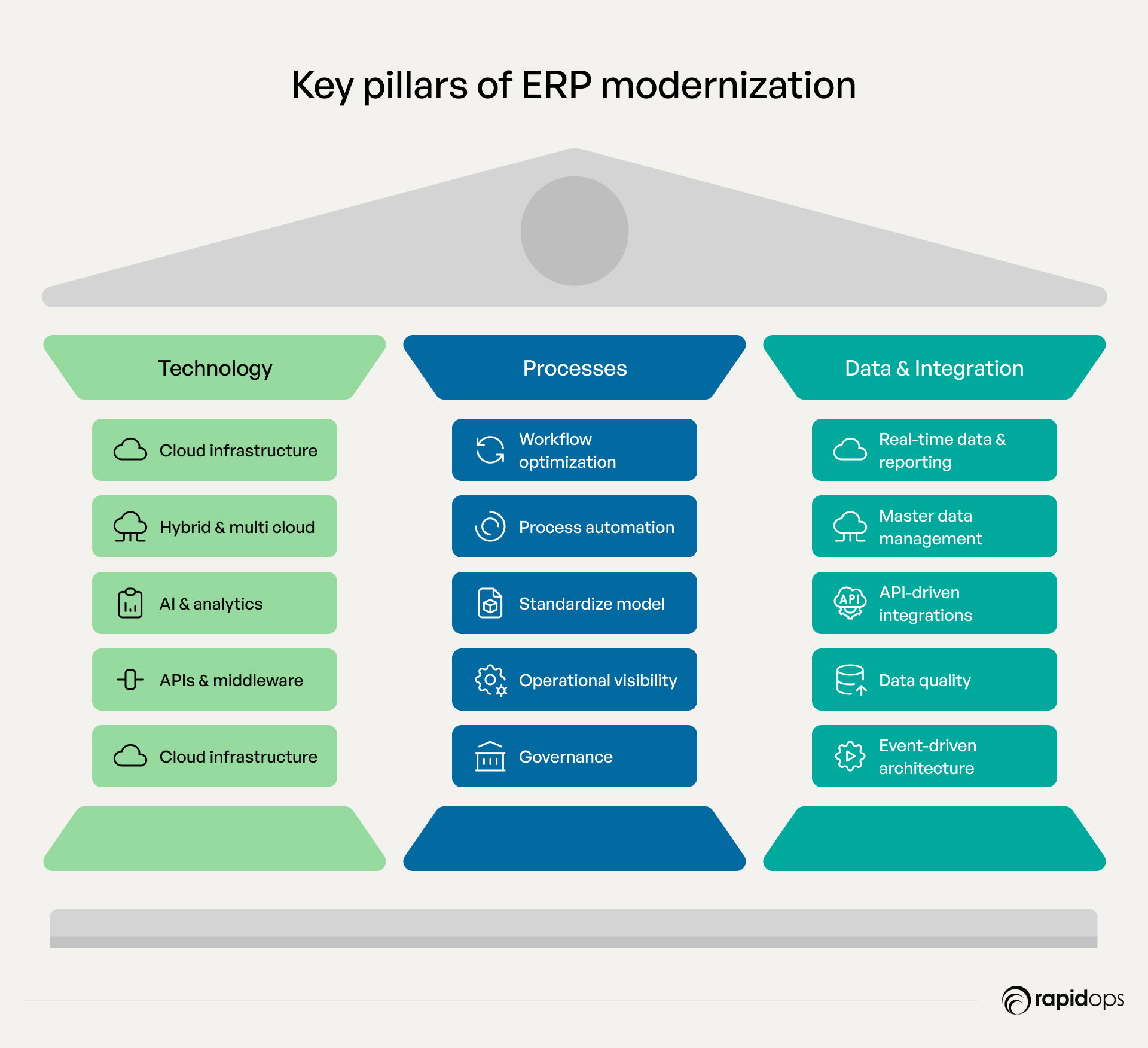
A robust, future-ready ERP modernization strategy depends on three interconnected pillars: Technology, Processes, and Data & Integrations. Each plays a distinct role in enabling a modern ERP ecosystem, but the true transformative impact emerges only when all three pillars evolve together. Organizations that focus on just one risk underutilize their ERP, creating inefficiencies or leaving critical business data untapped. Understanding these pillars deeply is key to building a resilient, intelligent, and scalable ERP foundation.
1. Technology
The Technology pillar is the backbone of ERP modernization. It defines how scalable, intelligent, and resilient your systems are and establishes the foundation for modern ERP systems to drive business performance. The right technology stack ensures that ERP can evolve alongside business objectives without constant re-engineering.
Key technological components include:
Cloud infrastructure (Public, Private, Hybrid)
Deploying cloud-based ERP systems allows organizations to scale resources dynamically, reduce upfront capital expenditure, and deploy ERP solutions faster. Public clouds enable rapid innovation, private clouds offer strict compliance and control, and hybrid approaches balance flexibility with risk management.
Hybrid and multi-cloud architectures
These architectures provide redundancy, compliance flexibility, and the ability to manage legacy systems alongside cloud solutions. They allow organizations to implement phased ERP modernization while maintaining business continuity.
AI and advanced analytics
Incorporating artificial intelligence and predictive analytics transforms raw ERP data into actionable insights. Leaders can forecast demand, optimize inventory, and make data-driven decisions faster, enhancing operational efficiency and strategic planning.
Microservices architecture
Modular microservices enable independent scaling of applications, easier system upgrades, and simplified integration with other systems. This approach ensures a smooth transition from older systems to modern ERP systems without disrupting operations.
APIs and middleware platforms
APIs and middleware facilitate seamless communication between ERP, CRM, legacy systems, and modern SaaS tools. These integrations eliminate data silos, ensure consistent ERP data, and allow teams to access real-time information across the enterprise.
Cybersecurity and identity management
With ERP systems storing sensitive business data, robust security frameworks, end-to-end encryption, and identity management are essential. Modern ERPs adopt Zero Trust architectures, protecting data while supporting cloud systems and hybrid deployments.
DevOps and CI/CD pipelines
Adopting DevOps practices and continuous integration/deployment pipelines accelerates software delivery, allows for automatic updates, and ensures ERP upgrades are deployed efficiently with minimal business disruption.
Together, these technologies create a resilient and adaptable foundation, allowing organizations to innovate, scale, and respond to evolving business processes without constant system overhauls.
2. Processes
Even the most advanced technology is ineffective without well-designed processes. The Processes pillar ensures that ERP technology translates into measurable business performance, operational clarity, and efficiency.
Key aspects include:
Workflow optimization
Streamlining workflows reduces bottlenecks, minimizes manual handoffs, and ensures teams can leverage real-time data effectively. Optimized processes create the foundation for faster decision making and improved productivity.
Process automation
Leveraging RPA, low-code/no-code platforms, and event-driven systems automates repetitive tasks, reduces errors, and allows employees to focus on strategic initiatives. This ensures that ERP investments drive operational efficiency rather than administrative overhead.
Standardized operating models
Standardization across teams, departments, and geographies ensures consistent ERP usage, enhances user adoption, and reduces training needs. Standardized processes also simplify reporting, SLA management, and governance.
Operational visibility
Clear process structures enable monitoring of performance, outcomes, and compliance in real-time, providing leaders with immediate visibility into operational efficiency and supporting data-driven decisions.
By establishing strong processes, organizations ensure that technological investments are fully leveraged and ERP systems deliver consistent, measurable results across all business functions.
3. Data & integrations
The Data & Integrations pillar ensures that information is accurate, consistent, and accessible across systems, forming the intelligence layer of ERP modernization. Properly managed data and integrations are essential for informed business decisions and efficient operations.
Key components include:
Real-time data pipelines and reporting
Fast, accurate data pipelines enable instant access to insights, supporting strategic decisions and operational agility. Leaders can track KPIs, inventory, finance, and human resources in real time.
Master data management (MDM)
Centralized management of critical data ensures consistency across platforms and reduces errors during data migration or ERP upgrades, supporting trustworthy business data for decision-making.
System integrations
ERP modernization often involves connecting multiple systems, including legacy systems, CRM platforms, and modern SaaS tools. API-driven and event-based integrations prevent data silos and provide a seamless flow of information across the enterprise.
Data governance and quality frameworks
Establishing rules and standards ensures data accuracy, compliance, and security. High-quality data is foundational for predictive insights, reporting, and operational efficiency.
Event-driven and API-led integrations
These enable real-time updates, automated workflows, and better collaboration across teams. A strong integration layer ensures that ERP modernization delivers connected operations and reliable business performance.
When technology, processes, and data & integrations are aligned, ERP modernization creates a platform that is agile, intelligent, and scalable. Organizations gain operational clarity, faster decision-making, and the ability to adapt and grow without disruption. Neglecting even one pillar compromises the foundation, reducing ROI and hindering business performance.
By investing in all three pillars, businesses create a future-ready ERP ecosystem that is secure, connected, and capable of driving measurable, strategic results across the enterprise. This alignment ensures that ERP modernization is not just an IT project, but a strategic enabler of business growth, innovation, and operational excellence.
Why you need to modernize your ERP in 2026
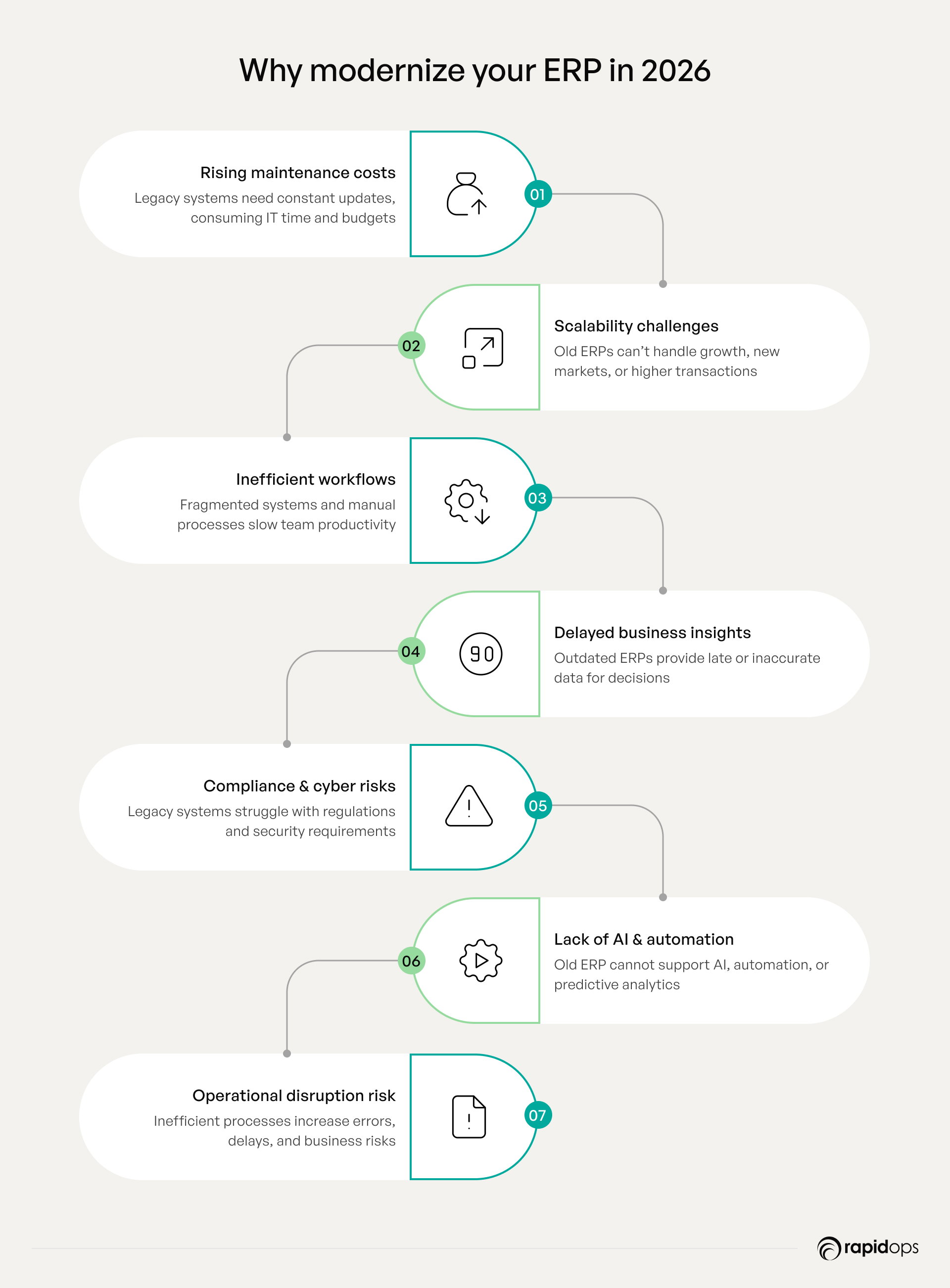
Your ERP was built for yesterday’s business, but today’s markets move faster, data is more complex, and expectations are higher. Recognizing the need to modernize sets the foundation for smarter, more agile operations.
1. Escalating maintenance costs
Legacy ERP systems demand constant maintenance, updates, and workarounds to keep operations running. These ongoing requirements consume significant IT resources and budgets, leaving little room for strategic initiatives. Over time, managing patches, fixing errors, and addressing system issues becomes increasingly expensive, creating financial pressure and operational friction. Organizations relying on outdated systems risk escalating costs that divert attention from higher-priority business objectives. As costs rise, the pressure to maintain efficiency shifts attention to other operational challenges.
2. Limited scalability to meet market demand
Outdated ERP systems often struggle to handle increased transaction volumes, new product lines, or expansion into new markets. This limitation constrains organizational agility, slows response times, and restricts the ability to adjust to evolving customer demands. As business complexity grows, rigid systems create bottlenecks that prevent teams from scaling operations efficiently, leaving organizations vulnerable to missed opportunities and challenges in meeting both current and future market requirements.. These scalability challenges highlight how operational constraints can impact broader business objectives.
3. Operational inefficiencies from fragmented systems
Organizations relying on disconnected tools, manual processes, and repetitive reconciliations face significant productivity challenges. Fragmented systems create bottlenecks, increase the risk of errors, and consume employee time that could be spent on strategic activities. Inconsistent workflows across departments further slow collaboration and reduce operational efficiency. Over time, these inefficiencies compound, creating friction between teams, delaying critical processes, and limiting the organization’s ability to respond quickly to evolving business needs. When processes are inefficient, the organization struggles to make decisions and execute initiatives effectively.
4. Delayed or inaccurate business insights
Legacy ERP systems often cannot provide real-time, reliable data, leaving decision-makers dependent on outdated or incomplete information. This limits the organization’s ability to forecast accurately, plan strategically, and respond promptly to emerging trends. Inaccurate or delayed reporting affects both daily operations and long-term strategy, creating uncertainty for leadership. Without timely insight into critical business data, organizations risk making decisions that are reactive rather than proactive, undermining growth potential. Limited insights increase uncertainty, affecting not only current operations but also future strategic planning.
5. Rising regulatory, compliance, and cybersecurity pressures
Evolving regulations, increasing compliance requirements, and growing cybersecurity threats place added stress on outdated ERP systems. Many legacy platforms lack sufficient controls, audit trails, and security measures to meet current standards. Organizations relying on these systems face a higher risk of data breaches, non-compliance penalties, and operational disruptions. Without addressing these gaps, businesses are exposed to financial, legal, and reputational risks that can escalate quickly in a highly regulated and digitally connected environment. Regulatory and security pressures further compound operational risks, making it harder to maintain stability.
6. Inadequate readiness for AI, automation, and advanced analytics
Legacy ERP systems often lack the architecture, integration capabilities, and APIs necessary to support emerging technologies such as AI, automation, and predictive analytics. This limits the organization’s ability to leverage data for intelligent decision-making, optimize workflows, and anticipate trends. Businesses relying on outdated systems struggle to adopt digital transformation initiatives, leaving them less competitive and less responsive to innovation-driven market demands, ultimately slowing growth and the ability to capitalize on emerging opportunities. Without readiness for emerging technologies, the organization risks falling behind competitors and missing growth opportunities.
7. High risk of disruption from outdated processes
Inefficient workflows, manual tasks, and fragmented systems increase the likelihood of errors, delays, and operational interruptions. These disruptions can affect customer experience, employee productivity, and overall business performance. Organizations relying on outdated processes face higher operational risk, slower response times, and challenges in maintaining consistency across teams and locations. Over time, the cumulative effect of these inefficiencies can hinder scalability, strategic execution, and the organization’s ability to adapt to evolving business requirements. These disruptions make it clear that addressing ERP limitations is essential to maintaining operational reliability and resilience.
What ERP modernization brings to your organization
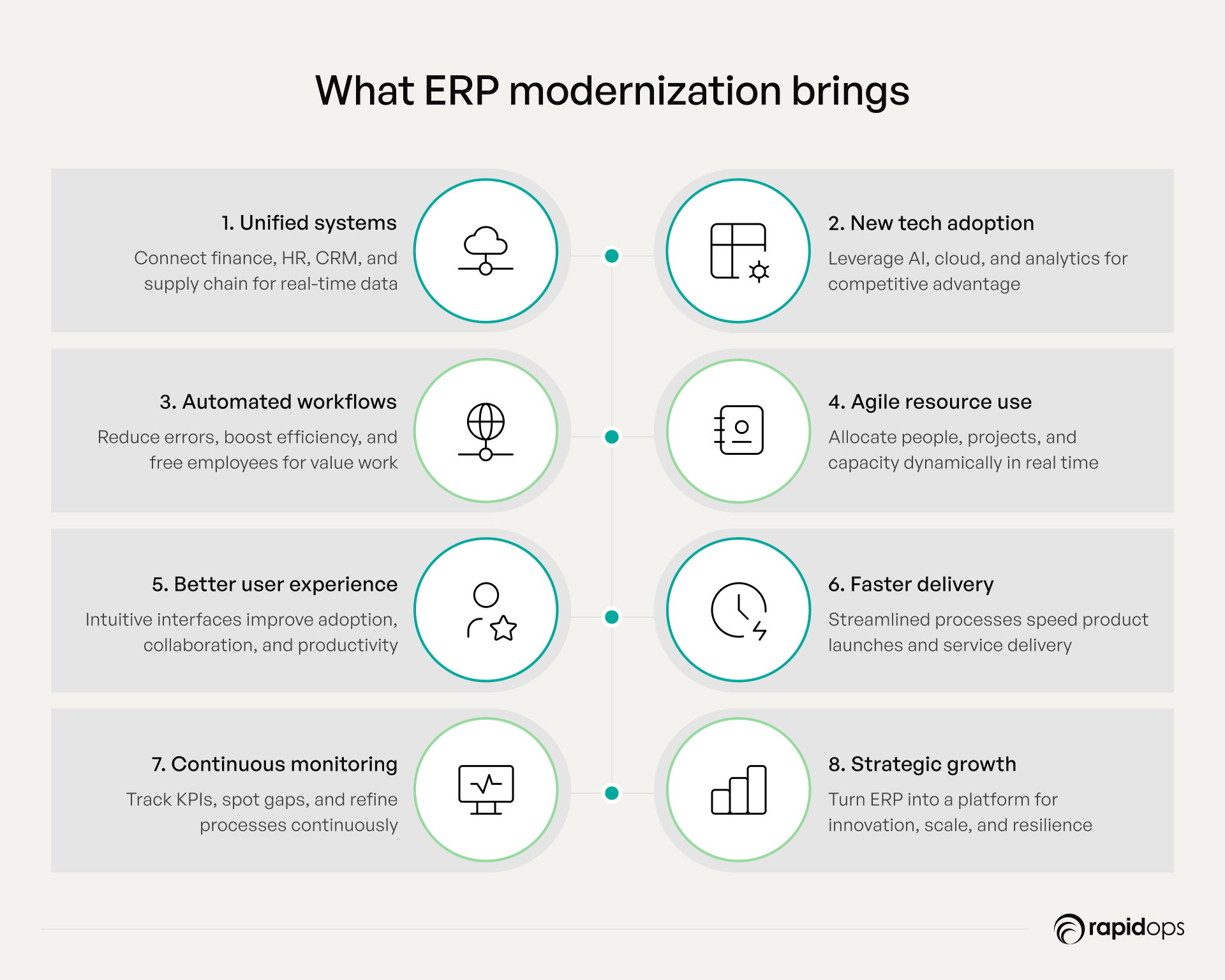
Every process, decision, and piece of data in your organization depends on ERP, yet legacy systems can quietly constrain performance and limit adaptability. Modernizing ERP is more than an upgrade; it’s an opportunity to reframe how your system supports evolving business priorities, laying the foundation for operational resilience, strategic growth, and future-ready decision-making.
1. Unified core systems
Modern ERP systems connect finance, human resources, CRM, supply chain, inventory management, and production into a single, integrated platform. This connection breaks down data silos, reduces manual reconciliations, and ensures consistent, reliable ERP data across departments. By linking multiple systems, business leaders gain a unified view and real-time visibility into operations, allowing teams to focus on strategic initiatives rather than firefighting inefficiencies, ultimately enhancing agility, resilience, and overall business performance.
2. Seamless adoption of new technologies
ERP modernization prepares your organization to leverage cloud-based ERP systems, artificial intelligence, predictive analytics, and integration with other business systems. These modern ERP systems provide deep insights for forecasting, demand planning, and inventory optimization, while automation and robotic process automation (RPA) reduce repetitive tasks. The open architecture and developer-friendly APIs allow smooth incorporation of modern ERP systems capabilities, ensuring businesses stay ahead of technological trends and gain a measurable competitive advantage.
3. Automated workflows
Modern ERP automates business processes that are repetitive or rule-based, reducing human errors and operational bottlenecks. Automation ensures tasks execute consistently, boosting efficiency, accuracy, and compliance. This capability not only improves operational reliability but also lowers costs, minimizes risk, and frees employees to focus on high-value work, enhancing overall boost productivity and business performance.
4. Agile resource management
With modern ERP, organizations can dynamically allocate people, projects, and production capacity in real time. This agility allows businesses to respond to market shifts, optimize resource utilization, and maintain service levels without overburdening teams. The system supports phased rollouts for gradual deployment, minimizing disruption and ensuring a smooth transition from legacy systems.
5. Enhanced user experience
Modern ERP systems deliver intuitive, role-based interfaces that improve user adoption and engagement. Employees can access ERP data quickly, collaborate across functions, and navigate tasks efficiently. A positive user experience reduces training time, accelerates ROI, and ensures the system supports business objectives rather than becoming a barrier to productivity.
6. Faster product and service delivery
By streamlining business processes and enhancing connectivity between multiple systems, modern ERP enables faster product launches, quicker service delivery, and responsive operations. Organizations can scale efficiently, maintain quality standards, and meet customer needs with reduced time-to-market, directly supporting competitive advantage and cost savings.
7. Continuous monitoring and improvement
Modern ERP platforms offer built-in dashboards, KPIs, and analytics for real-time monitoring of systems, ERP data, and business operations. Leaders can track progress, identify gaps, and refine processes continuously. This data-driven approach ensures sustained operational excellence, better compliance, and proactive decision-making, reinforcing the organization’s ability to achieve successful ERP modernization.
8. Strategic enablement for growth
Beyond operational efficiency, ERP modernization transforms the system into a strategic enabler. By integrating cloud-based ERP solutions, advanced analytics, and AI-driven automation, organizations can innovate confidently, scale operations seamlessly, and convert legacy constraints into opportunities for growth. ERP becomes a catalyst for digital transformation, resilience, and long-term competitive advantage, ensuring the system supports both current needs and future business objectives.
ERP modernization versus replacement versus hybrid
When it comes to transforming your ERP, the first question isn’t just what technology to adopt, it’s how to align that choice with your business strategy. Should you modernize your existing system, replace it entirely, or take a hybrid path? Each approach comes with its own trade-offs in cost, risk, and operational impact. Understanding these differences upfront empowers leaders to make decisions that not only solve today’s challenges but also position the organization for growth, agility, and long-term efficiency.
Definition of each approach
ERP modernization
Upgrading the existing ERP system by enhancing architecture, integrating cloud-based capabilities, improving workflows, and embedding advanced technologies like AI and predictive analytics without discarding the current system.
ERP replacement
Retiring the legacy system entirely and implementing a new ERP system that meets current and future business needs, often cloud-native with built-in analytics, automation, and integration capabilities.
Hybrid approach
Combining modernization and replacement strategies, retaining certain legacy modules while implementing modern ERP functionalities incrementally, enabling a phased rollout and minimizing disruption.
When to choose each approach
Modernization is ideal when the current ERP system supports core business processes, and upgrades can improve real-time data, automation, and cloud integration. This path suits organizations aiming to reduce technical debt while maintaining operational continuity.
Replacement is suitable for organizations with legacy systems that cannot support modern ERP systems, advanced analytics, or cloud-based ERP solutions, requiring a complete reset to achieve operational efficiency.
Hybrid works for businesses that need gradual transformation due to cost, ongoing operations, or legacy dependencies. It allows a smooth transition and strategic integration without full system replacement.
Pros and cons of each approach
| Approach | Advantages | Disadvantages |
| Modernization | Leverages existing systems, faster deployment, lower disruption, supports automation and integration | May require ongoing updates and careful management to fully realize potential |
| Replacement | Clean slate, full access to modern features, cloud-ready, supports ERP data analytics, and AI | High cost, longer implementation, potential user adoption challenges |
| Hybrid | Flexible, phased implementation reduces disruption, balances investment | Requires careful integration, can create complexity, and requires ongoing change management |
Time-to-value and ROI implications
- Modernization delivers incremental value quickly through enhanced workflows, data-driven decisions, and automation improvements.
- Replacement takes longer but provides maximum long-term ROI, enabling full adoption of cloud-based ERP systems, predictive insights, and advanced analytics.
- Hybrid balances immediate operational improvements with long-term transformation benefits, allowing phased ERP upgrades without halting business operations.
Risk and disruption level
- Modernization: Low-to-moderate disruption; main focus is employee engagement and change management.
- Replacement: High disruption; requires comprehensive training, data migration, and operational alignment.
- Hybrid: Moderate disruption; careful integration of legacy and modern systems is key to preventing data silos and ensuring continuity.
Customization and technical debt considerations
- Modernization allows organizations to optimize existing customizations, refactor workflows, and reduce technical debt.
- Replacement eliminates technical debt and delivers modern ERP systems with standardized processes and minimal legacy constraints.
- Hybrid requires deliberate assessment of which legacy customizations to retain, modernize, or replace to ensure efficiency and integration consistency.
Decision framework for executives
When evaluating the right approach, business leaders should consider:
- Limitations of current ERP systems and older systems.
- Quality and consistency of ERP data and business processes.
- Impact on business operations, disruption, and employee adoption.
- Cost, total cost of ownership (TCO), and expected ROI.
- Need for cloud-based ERP solutions, AI, and automation.
- Scalability, flexibility, and alignment with business objectives.
- Integration requirements with multiple systems and external tools.
Selecting modernization, replacement, or a hybrid path directly impacts your organization’s efficiency, scalability, and ability to innovate. By aligning the ERP strategy with business priorities, operational realities, and technology readiness, leaders can unlock measurable ROI, streamline processes, and build a resilient foundation for future growth.
Middleware: The optimum solution for ERP modernization
Once you recognize that ERP modernization is the right choice for your organization, the next question is how to implement it efficiently without disrupting ongoing operations. In today’s complex business environment, middleware provides a practical and strategic solution. It connects legacy systems, modern ERP platforms, and other enterprise applications, enabling organizations to modernize their ERP environment while maintaining continuity, reducing risk, and preparing systems for evolving business needs.
What middleware is
Middleware is a specialized software layer that connects your ERP systems with other enterprise tools, applications, and business data sources. Acting as a bridge, it allows seamless integration between legacy and modern platforms, including cloud-based ERP solutions, AI-driven tools, analytics platforms, automation engines, and multiple systems. By providing standardized interfaces, middleware ensures reliable ERP data flow and interoperability, supporting digital transformation without requiring a complete ERP overhaul.
How middleware works
Middleware enables real-time data exchange, process automation, and system interoperability. It standardizes communication between older legacy systems and newer ERP software, eliminating data silos and enabling consistent, accurate ERP data across the organization. Through automatic updates, event-driven workflows, and API-based integrations, middleware allows organizations to adopt advanced analytics, artificial intelligence, and cloud-based ERP systems while continuing to run current business operations smoothly.
Why middleware is the optimum solution
- Minimizes disruption: Teams can continue using familiar ERP interfaces, reducing employee resistance and supporting user adoption, while modernization occurs in the background.
- Reduces cost and risk: Avoids the high expense, complexity, and operational risk of a full ERP reimplementation or replacement.
- Accelerates innovation: Supports integration with AI, predictive analytics, and automation tools, enabling faster decision-making and data-driven decisions.
- Improves agility and scalability: Middleware connects multiple systems, allowing organizations to respond quickly to changing business needs and scale resources without major ERP modifications.
- Enhances data reliability: Ensures consistent, high-quality ERP data, improves reporting, and enables more accurate forecasting, operational visibility, and strategic planning.
By leveraging middleware, organizations can unlock the full potential of their ERP modernization initiatives. It enables seamless adoption of cloud systems and modern ERP capabilities, supports phased rollouts, reduces technical debt, and allows businesses to modernize workflows without halting operations. This approach enhances business performance, strengthens security, and ensures that ERP systems remain future-ready, delivering measurable ROI and sustainable operational excellence.
How middleware enables ERP modernization
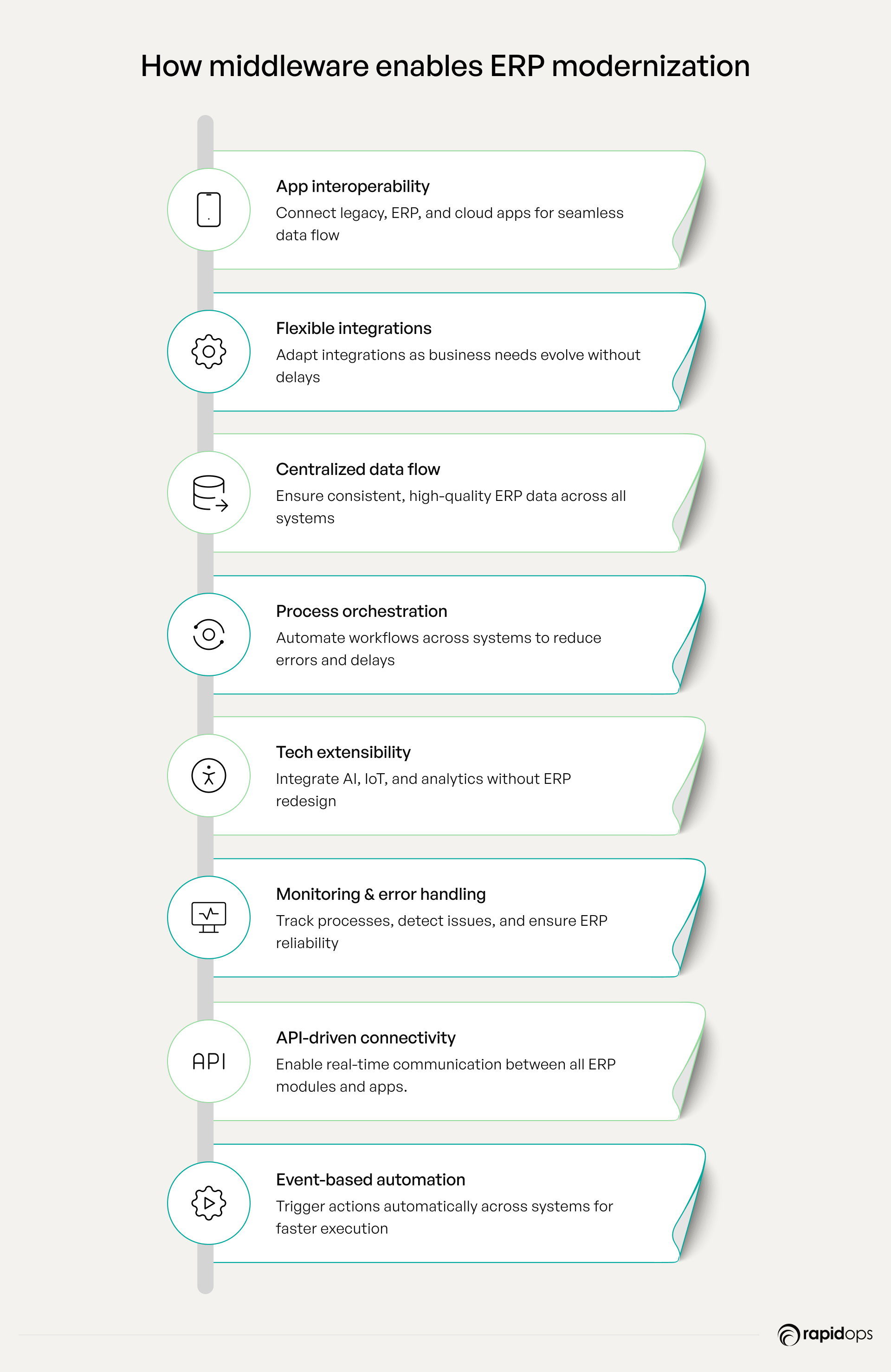
ERP systems rarely fail all at once; they struggle quietly at the seams where systems, data, and processes should connect. As organizations push for speed, scale, and smarter decision-making, these gaps become impossible to ignore. Middleware addresses this tension by enabling progress without upheaval, allowing modernization to happen where it matters most across integrations, workflows, and data flows, while the ERP core continues to run the business.
1. Application interoperability
Middleware ensures that disparate applications, whether legacy systems, modern ERP systems, or cloud-based ERP solutions, communicate effortlessly. It automates data exchange and business processes across systems, eliminating manual reconciliations and data silos. This enables organizations to maintain real-time data accuracy and supports more informed decision-making.
2. Flexible integration architecture
Middleware provides robust API-led and event-driven integration patterns, connecting on-premise, cloud, and hybrid systems. This flexible architecture allows organizations to adapt integrations as business requirements evolve, supporting rapid deployment of new applications or modules. By reducing dependence on ERP core modifications, middleware accelerates time-to-value for modernization initiatives.
3. Centralized data orchestration
Middleware acts as the control center for data flow, ensuring consistent, high-quality ERP data across all modules and external systems. It reconciles inconsistencies automatically, maintains a single source of truth, and enhances data quality. This orchestration enables accurate reporting, predictive analytics, and strategic planning without disrupting ongoing operations.
4. Process orchestration across systems
Complex business processes often span multiple systems. Middleware coordinates these multi-step workflows, ensuring tasks execute in the correct sequence and automatically triggering downstream actions. By automating repetitive tasks, middleware reduces operational errors, boosts business performance, and frees teams to focus on strategic priorities.
5. Extensibility for emerging technologies
Modern ERP modernization requires readiness for AI, machine learning, IoT, and advanced analytics. Middleware provides a scalable framework to integrate these emerging technologies without extensive ERP reimplementation. Organizations can leverage predictive insights, automation, and intelligent analytics, positioning their ERP systems as a foundation for continuous innovation.
6. Rapid adaptation to business changes
Middleware allows businesses to onboard new geographies, departments, or applications quickly, minimizing disruption. It reduces reliance on ERP core modifications, enabling faster ERP upgrades, improved process efficiency, and quicker realization of business value. This agility supports scalable operations and ensures organizations can respond promptly to evolving business needs.
7. Monitoring, logging, and error handling
Middleware provides comprehensive visibility into all integrations and automated workflows. With robust logging and proactive error detection, it ensures system reliability, minimizes downtime, and safeguards ERP data integrity. Leaders gain real-time insights into operational health, enabling faster resolution of issues and maintaining uninterrupted business performance.
9 common myths about ERP modernization
ERP modernization is often surrounded by misconceptions that can create hesitation, misaligned expectations, and missed opportunities. Understanding the realities behind these myths is crucial for leaders seeking to leverage ERP as a strategic enabler. Here, we debunk the most common misunderstandings and highlight what truly matters.
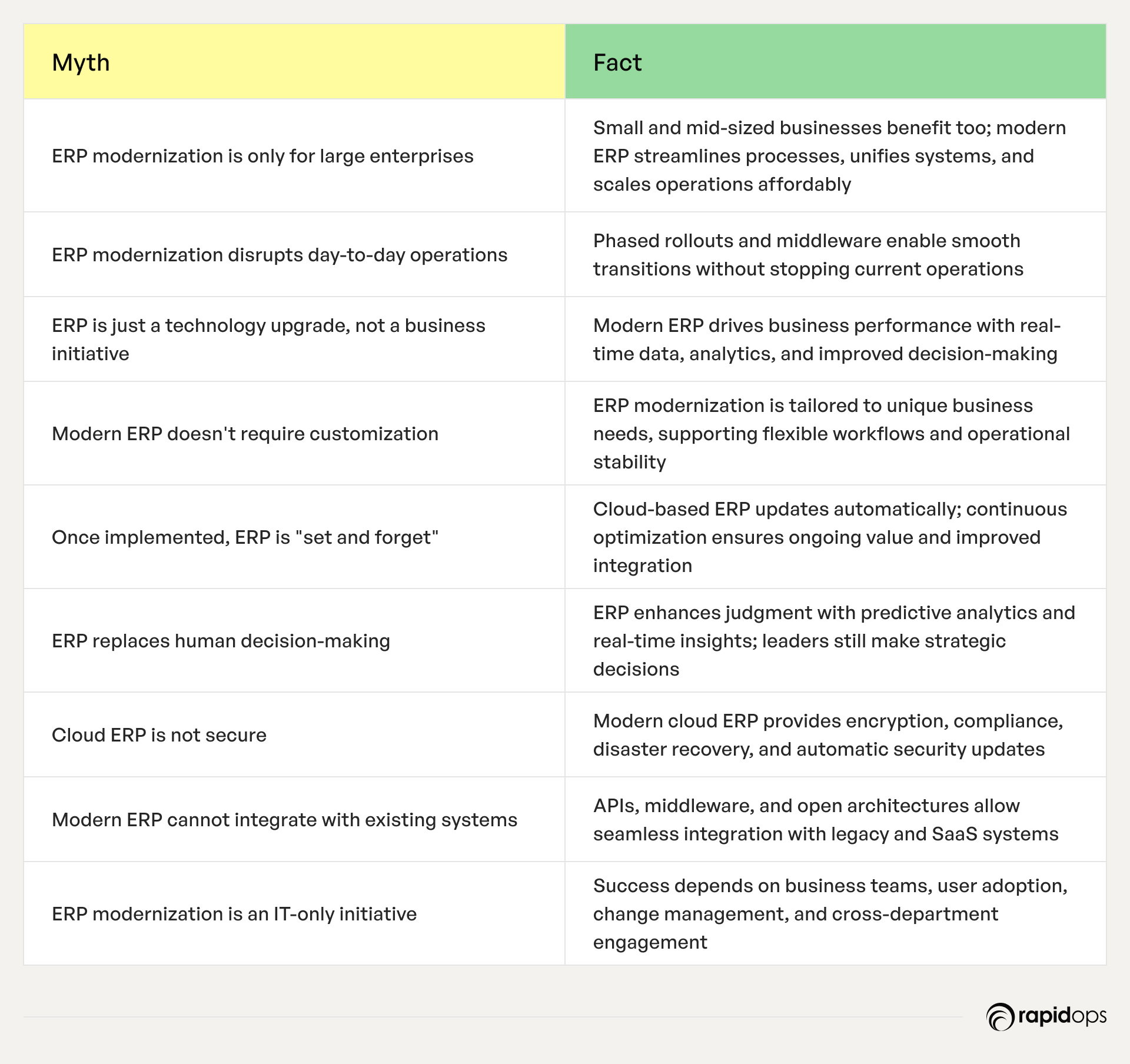
1. ERP modernization is only for large enterprises
A common belief is that ERP modernization applies only to global enterprises with complex operations. In reality, small businesses and mid-sized organizations often benefit the most. Modern ERP systems help streamline business processes, eliminate data silos, and unify multiple systems into a single platform. Cloud-based ERP systems enable organizations of all sizes to scale business operations without the cost or effort required by traditional ERP software.
2. ERP modernization disrupts day-to-day operations
This myth is rooted in past experiences with large-scale ERP replacements. Today, ERP modernization often follows a phased approach or phased rollout, allowing organizations to modernize gradually. Middleware and integration platforms enable a smooth transition, letting teams continue to perform tasks in the current ERP while modernization progresses behind the scenes.
3. ERP is just a technology upgrade, not a business initiative
ERP modernization is not about systems alone; it directly impacts business performance. Modern ERP supports more informed decision-making through real-time data, immediate visibility into business data, and advanced analytics. When aligned to business needs, ERP modernization drives digital transformation across finance, human resources, inventory management, and supply chain operations.
4. Modern ERP doesn’t require customization
Every business has unique processes, and ERP systems must adapt. Modernization is inherently a custom process, designed around the organization’s specific needs. Unlike rigid legacy systems, it enables workflows to evolve efficiently while maintaining system stability, reducing technical debt, and supporting long-term operational flexibility.
5. Once implemented, ERP is “set and forget”
ERP systems are not static. Automatic updates, new features, and continuous optimization are fundamental to cloud-based ERP. Organizations that treat ERP as a living platform consistently realize full benefits, including improved data quality, better integration with other systems, and sustained business value over time.
6. ERP replaces human decision-making
ERP does not replace judgment; it strengthens it. Modern ERP provides deep insights, predictive analytics, and AI-driven recommendations that support data-driven decisions. Business leaders remain accountable for strategy, while ERP enhances decision-making with accurate ERP data and real-time context.
7. Cloud ERP is not secure
Security concerns often arise during data migration from legacy systems. However, modern cloud systems typically deliver stronger protections than on-premise ERP. Cloud-based ERP systems include encryption, compliance controls, disaster recovery, and automatic security updates, significantly reducing risk exposure related to older systems.
8. Modern ERP cannot integrate with existing systems
This myth ignores how modern ERP systems are built. Open architectures, APIs, and middleware enable seamless integration with various systems, SaaS platforms, and legacy applications. This interoperability allows organizations to modernize without replacing every system at once, supporting both hybrid and incremental ERP upgrade strategies.
9. ERP modernization is an IT-only initiative
ERP modernization succeeds only when business teams are involved. Employees across finance, operations, HR, and supply chain rely on ERP daily. Strong user adoption depends on change management, internal champions, and role-based training. Engaging many teams early reduces employee resistance and ensures ERP supports real business objectives.
Turning ERP modernization into business value
Across ERP modernization journeys, one insight is clear: the biggest obstacles are rarely about the ERP software itself but about how it has evolved. Legacy customizations, fragmented integrations, and inconsistent data often create friction that slows business processes and limits informed decision-making. ERP modernization is not merely a technical upgrade; it is a strategic opportunity to realign your ERP with how your business truly operates, turning it into a platform that drives efficiency, agility, and growth.
At Rapidops, we have guided hundreds of organizations across industries through complex ERP modernization initiatives. Our experience helps businesses untangle legacy complexity, integrate multiple systems, and enhance cloud-based and modern ERP environments efficiently. By combining technology, processes, and people, we deliver modernization strategies that minimize disruption, leverage middleware for seamless integration, and enable AI-driven insights.
Curious how you can modernize your ERP system? Connect with one of our modernization experts to explore your ERP opportunities, uncover hidden inefficiencies, and discover the best ways to enhance the capabilities of your systems without disrupting ongoing operations.
Frequently Asked Questions

What’s Inside
- What is ERP modernization
- Core components (Pillars) of ERP modernization
- Why you need to modernize your ERP in 2026
- What ERP modernization brings to your organization
- ERP modernization versus replacement versus hybrid
- Middleware: The optimum solution for ERP modernization
- How middleware enables ERP modernization
- 9 common myths about ERP modernization
- Turning ERP modernization into business value

Let’s build the next big thing!
Share your ideas and vision with us to explore your digital opportunities
Similar Stories
- Transformation
- undefined Mins
- March 2022


- Transformation
- undefined Mins
- March 2020

Receive articles like this in your mailbox
Sign up to get weekly insights & inspiration in your inbox.