


In 2026, your organization is expected to operate in an environment where every second counts, every interaction matters, and every misstep can ripple through revenue, compliance, and productivity. Your frontline teams are constantly on the move, operations span multiple locations, and your customers expect seamless, instant service. Yet, despite the advanced technologies at your disposal, fragmented devices, disconnected applications, and inconsistent workflows continue to create blind spots, delays, inefficiencies, and security gaps that quietly erode your operational performance and strategic advantage.
You’ve likely felt it firsthand: approvals take longer than they should, tasks are executed inconsistently, and sensitive data can slip through cracks. Each gap doesn’t just cost time it amplifies risk, slows decision-making, and makes it harder for you to drive measurable business outcomes with confidence.
This is where enterprise mobility solutions come into play. EMS is not just a technology; it is a strategic enabler that connects people, processes, and systems across your organization. EMS provides real-time visibility into workflows, ensures teams operate seamlessly across locations, and enables leaders to make faster, more informed decisions. By enhancing collaboration and optimizing operational processes, EMS turns routine activities into measurable business outcomes and creates a foundation for sustained efficiency, agility, and growth.
As operations grow more dynamic and decisions become increasingly time-sensitive, this article guides leaders on how enterprise mobility solutions can drive real business impact. You’ll discover how EMS streamlines workflows, amplifies efficiency, and unifies teams, processes, and technology, equipping you with actionable insights to make faster, smarter decisions, strengthen execution, and confidently lead your organization in 2026 and beyond.
What enterprise mobility solutions really mean
Enterprise mobility solutions (EMS) in 2026 are no longer just tools to manage devices; they are strategic enablers that orchestrate how your organization operates, collaborates, and delivers value. With teams increasingly mobile, operations spanning multiple locations, and real-time customer expectations, EMS ensures your workforce, applications, and data are connected seamlessly. It transforms mobile interactions into actionable insights, enabling faster decisions, smoother workflows, and stronger alignment between IT and business goals.
EMS acts as the backbone of modern enterprise operations, integrating technology, people, and processes into a cohesive, secure ecosystem. It provides you with real-time visibility into device health, application usage, and workflow efficiency, allowing proactive management rather than reactive problem-solving. By centralizing control and automating governance, EMS ensures that every endpoint, whether a smartphone, tablet, laptop, or IoT device, becomes a productive, compliant, and insightful part of your operations.
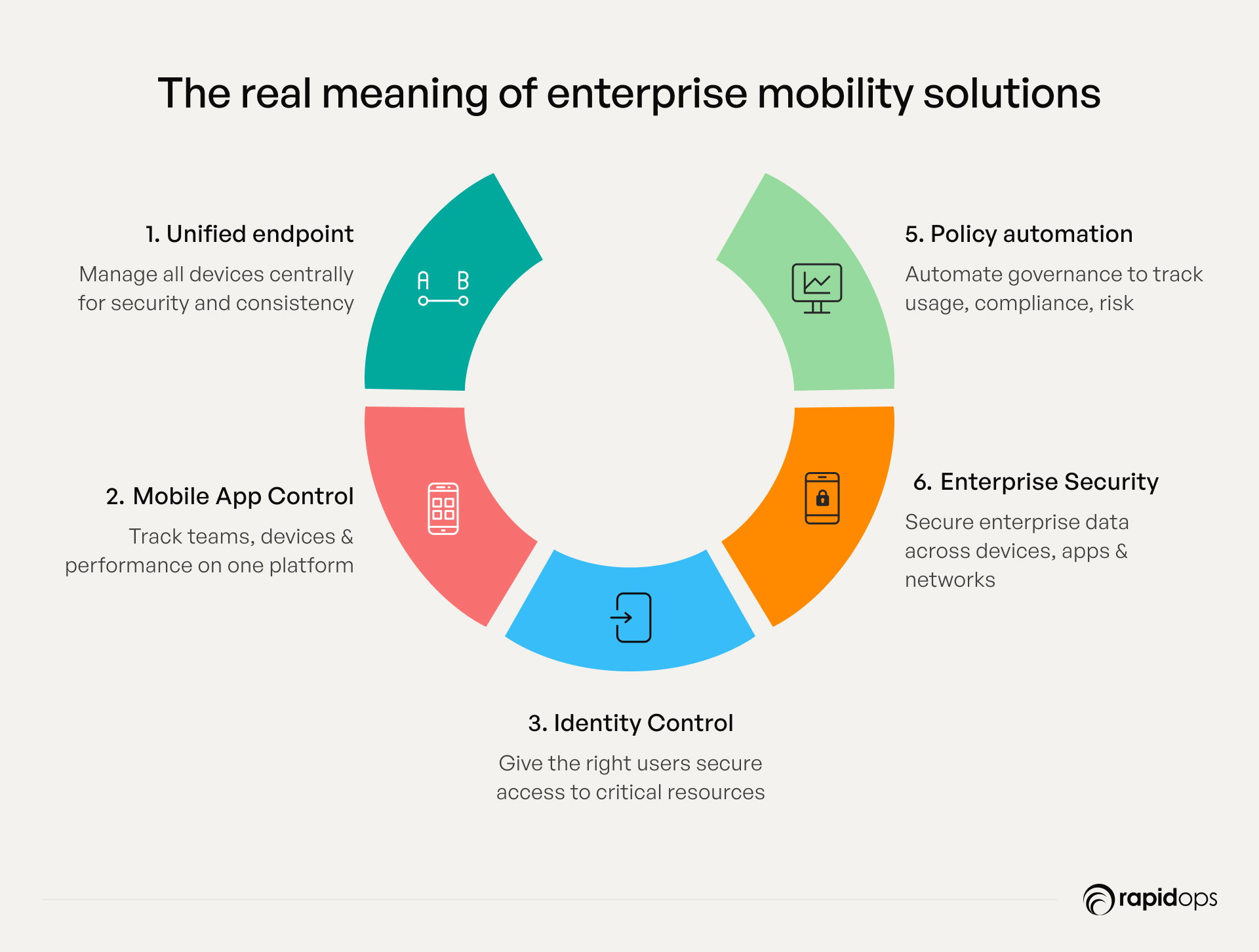
At its core, EMS consists of four critical components that make this possible:
- Unified endpoint management (UEM): Centralized oversight of all devices and endpoints for consistency, security, and efficiency.
- Mobile application management (MAM): Streamlined deployment, updating, and protection of business applications to keep teams productive anywhere.
- Identity and conditional access: Ensures the right people access the right resources securely, safeguarding sensitive data.
- Policy automation and analytics: Automates governance and provides actionable insights on usage, compliance, and operational performance.
By connecting devices, applications, identities, and policies, EMS transforms mobile operations into a measurable strategic advantage, empowering your teams, optimizing IT, and enabling executives to make confident, data-driven decisions.
Key drivers pushing enterprises toward enterprise mobility solutions
When your teams operate across multiple locations and devices, operational blind spots become inevitable. Identifying the core drivers of EMS adoption helps you act decisively, secure data, and maintain seamless performance.
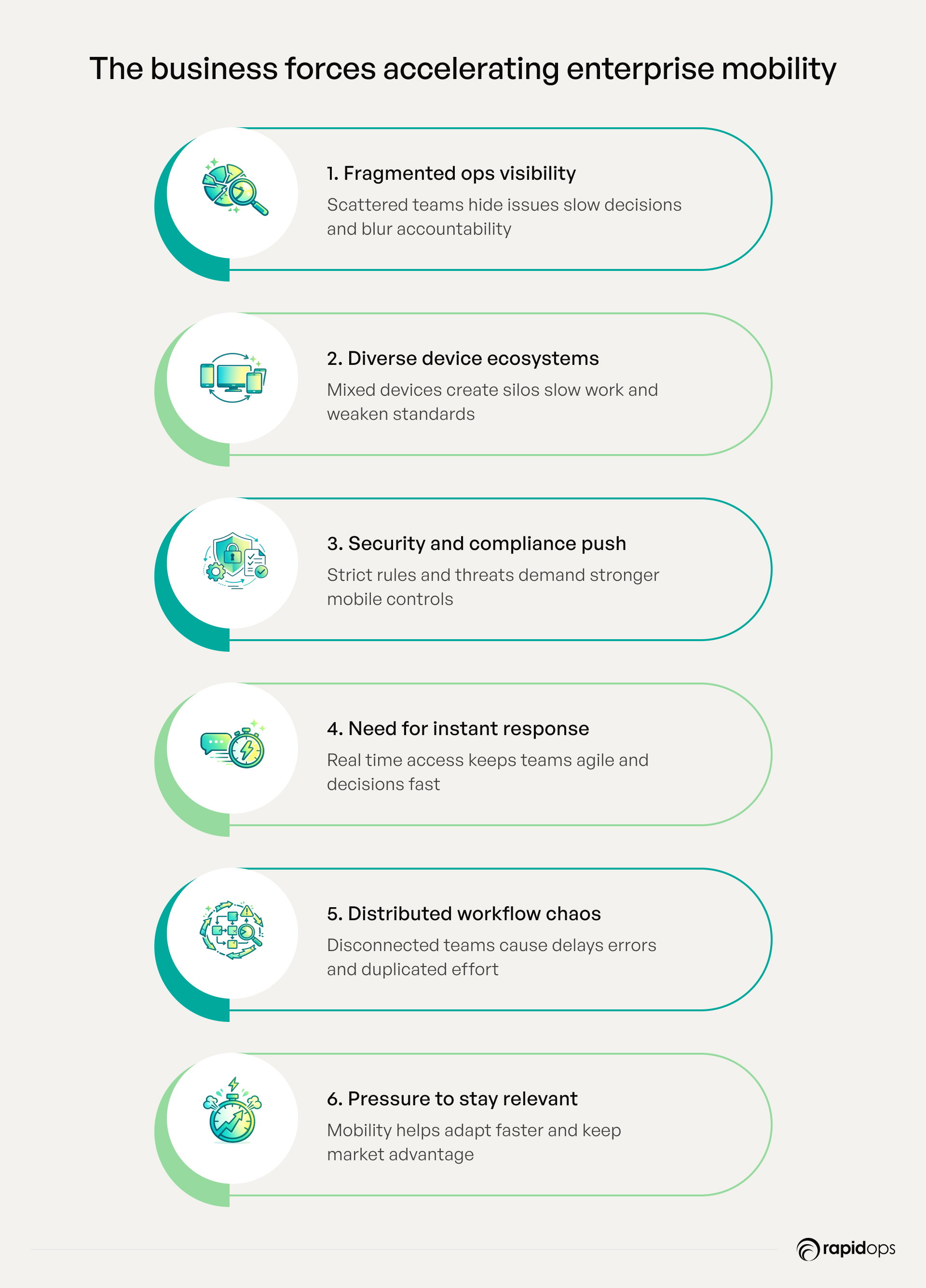
1. Fragmented operational oversight
When your teams are spread across multiple locations and devices, keeping track of tasks and performance can feel like navigating in the dark. These operational blind spots slow down your decision-making, let critical issues slip through the cracks, and make accountability a constant challenge. Without clarity, your organization risks inefficiency and inconsistent outcomes. Enterprise mobility solutions give you a single lens to monitor progress, identify bottlenecks instantly, and keep your operations running smoothly, so you’re always in control, even across the most complex networks.
2. Diverse device and platform usage
If your employees are juggling a mix of corporate laptops, personal smartphones, and IoT devices, you know how quickly workflows can become fragmented. Data silos form, collaboration slows, and enforcing consistent standards becomes a daily struggle. This fragmented environment doesn’t just delay tasks; it affects your team’s ability to act decisively. EMS unifies all your devices under a single, secure ecosystem, giving your people seamless access to the tools and information they need—so your operations stay connected, efficient, and reliable.
3. Regulatory and security pressures
In today’s world, your organization’s sensitive data is under constant scrutiny from regulators, customers, and cyber threats. Any inconsistency in device management or mobile policies could put you at risk of breaches, compliance failures, or costly penalties. The stakes are high, and the margin for error is low. With EMS, you can enforce security policies and governance across your entire mobile landscape, giving you the confidence that your data and your reputation remain protected.
4. Demand for immediate responsiveness
Your customers and markets expect rapid responses. When approvals are delayed or updates don’t reach the right people, opportunities slip away, and your competitors move faster. EMS ensures that you and your teams have real-time access to the information you need, wherever you are. With instant connectivity and actionable insights at your fingertips, you can respond faster, make smarter decisions, and turn agility into a competitive advantage.
5. Complexity of distributed workflows
When your operations span multiple teams, locations, and tools, inconsistencies are inevitable. Duplicate efforts, misaligned processes, and errors become everyday obstacles, slowing down your results and creating frustration for your people. EMS standardizes workflows and automates routine tasks, giving you a streamlined, cohesive system that keeps everyone aligned so your teams can focus on delivering results, not firefighting inefficiencies.
6. Pressure to stay market-relevant
Your customers’ expectations evolve every day, and competitors are quicker to adapt. If your operations aren’t agile, you risk falling behind, losing market share, credibility, and growth opportunities. EMS equips you to stay ahead by enabling faster adoption of new technologies, scaling your operations seamlessly, and responding to market shifts with confidence. When you’re empowered by mobility, your organization is not just keeping up, it’s setting the pace.
Why enterprise mobility solutions are essential for businesses
Some businesses always seem to be one step ahead; execution is faster, teams stay aligned, and nothing slips through the cracks. What they’re doing differently becomes clear as you explore how enterprise mobility solutions reshape control, visibility, and execution.
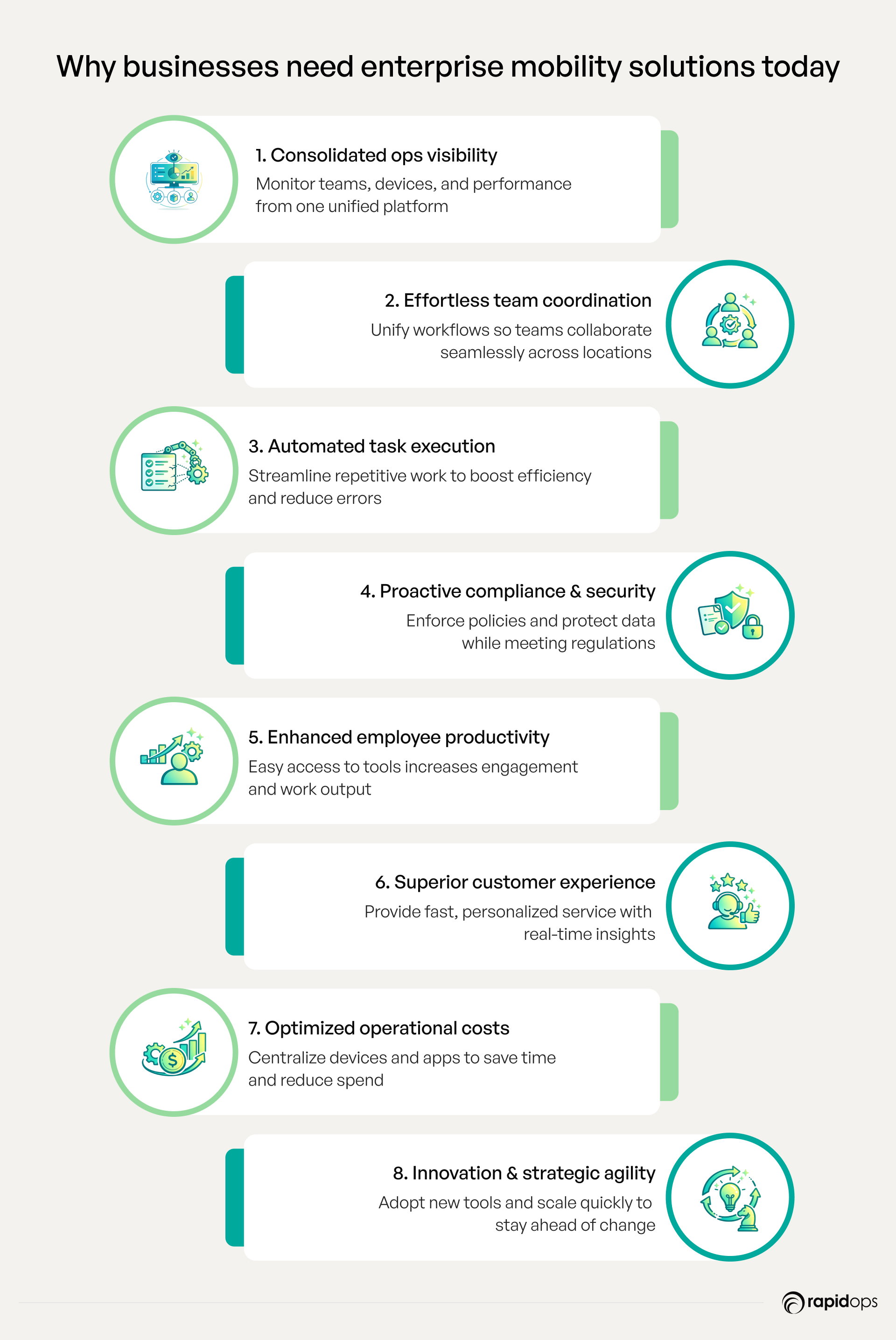
1. Consolidated operational visibility
When your teams, devices, and applications are scattered, gaining a clear view of operations can feel impossible. With EMS, you can monitor progress, resource allocation, and performance metrics in real time, all from a single platform. This visibility allows you to identify bottlenecks quickly, understand workload distribution, and make data-driven decisions. By having a complete picture at your fingertips, you can anticipate challenges before they escalate and keep your operations running with precision and control.
2. Effortless cross-team coordination
Your teams may be spread across multiple locations, time zones, or departments, making coordination a constant challenge. EMS unifies workflows and communication channels so your people can collaborate seamlessly, share updates instantly, and make aligned decisions. By breaking down silos, you ensure that every team member is on the same page, reducing miscommunication and accelerating project execution. This alignment empowers you to act faster and with confidence, no matter how complex your operations.
3. Automated, efficient task execution
Repetitive manual tasks can slow down your teams and increase the risk of errors. EMS leverages mobile workflow automation to streamline these activities, from approvals and inventory updates to routine reporting. By automating these processes, your teams spend less time on low-value tasks and more time on strategic work that drives results. This efficiency not only accelerates execution but also frees your people to focus on innovation and problem-solving, enhancing overall organizational performance.
4. Proactive compliance and data protection
In today’s regulatory landscape, every device and application is a potential compliance or security risk. EMS continuously monitors your endpoints, enforces policies, and protects sensitive information, ensuring you meet regulatory requirements without constant manual oversight. By proactively safeguarding your data, you reduce the risk of breaches, maintain customer trust, and protect your organization’s reputation, allowing you to operate confidently in a highly regulated environment.
5. Enhanced employee productivity and engagement
When your teams can access applications, data, and resources easily from any device or location, their productivity naturally increases. EMS simplifies access and eliminates the friction of switching between tools or waiting for approvals. This ease of work empowers employees to focus on high-value tasks, reduces frustration, and improves engagement. When your people feel equipped and supported, retention improves, and your organization benefits from a more motivated, high-performing workforce.
6. Superior customer experience
Your customers expect fast, personalized, and accurate interactions. EMS equips your service teams with real-time insights into customer history, preferences, and operational data. By anticipating needs and responding promptly, your teams can deliver tailored experiences that enhance satisfaction and loyalty. This not only strengthens your relationships but also positions your organization as responsive, reliable, and ahead of competitors.
7. Optimized operational costs
Managing devices, applications, and resources across multiple platforms can be expensive and inefficient. EMS centralizes these operations, reducing IT overhead, minimizing manual management, and improving resource allocation. Automated updates, remote troubleshooting, and consolidated device management allow you to redirect time and budget toward strategic initiatives, making your operations leaner, smarter, and more cost-effective.
8. Innovation enablement and strategic agility
In a fast-moving market, your ability to adopt new tools and respond to change determines your competitive edge. EMS provides a unified, flexible technology environment that supports rapid adoption of emerging solutions, seamless scaling of operations, and proactive responses to market shifts. By empowering your teams with agility, you can innovate confidently, experiment safely, and position your organization as a market leader ready for whatever comes next.
How EMS enables end-to-end business management
Enterprise mobility solutions have evolved far beyond basic device management. In 2026, they act as a strategic orchestration layer, connecting your devices, applications, data, identity, and policies to deliver a seamless, secure, and measurable business ecosystem. By enabling end-to-end management, EMS transforms how organizations operate, empowering leaders to make informed decisions, streamline operations, and maintain consistent performance across every function.
Unified device and endpoint management
EMS centralizes the management of all endpoints, corporate devices, BYOD smartphones, tablets, laptops, and IoT devices through unified endpoint management (UEM). This consolidation allows IT teams to provision, monitor, and update devices in real time, ensuring operational consistency while reducing administrative burden. With every device secured and standardized, organizations gain full visibility across their technology landscape, minimizing blind spots that could otherwise compromise efficiency or compliance.
Integrated mobile application management
Mobile application management (MAM) ensures that all enterprise apps are secured, updated, and optimized for performance across all devices. Employees can access critical tools and information instantly, while IT can enforce application policies and prevent unauthorized access. This integration enhances workforce agility, enabling employees to collaborate, share insights, and execute tasks effectively, regardless of location.
Policy automation and compliance oversight
EMS enables automated enforcement of security policies, conditional access controls, and role-based permissions. Real-time monitoring and reporting ensure adherence to regulatory standards such as GDPR, HIPAA, or industry-specific compliance frameworks. By embedding compliance into daily operations, organizations reduce risk exposure and protect sensitive business and customer data without slowing down productivity.
Data visibility and analytics for strategic decisions
EMS provides executives and managers with real-time dashboards and actionable insights. From device health to application usage and operational performance, these analytics empower leaders to identify inefficiencies, forecast needs, and make informed strategic decisions. Access to accurate, timely data across all endpoints ensures organizations can respond quickly to market changes and customer demands.
Operational consistency across teams and locations
For enterprises with distributed and hybrid workforces, EMS ensures that workflows, communication channels, and process standards are uniform across branches, teams, and geographies. By eliminating fragmentation, organizations can scale operations efficiently, maintain consistent service quality, and align employee productivity with overarching business objectives.
Enhanced security and risk management
Security is embedded at every layer within EMS. From device encryption and secure access controls to threat detection and remote wipe capabilities, EMS mitigates the risk of breaches, data loss, and unauthorized access. A proactive security posture not only safeguards operations but also instills confidence among employees, customers, and stakeholders.
Streamlined IT and operational efficiency
By automating device provisioning, updates, and incident management, EMS reduces administrative overhead, allowing IT and operations teams to focus on strategic initiatives rather than routine maintenance. This efficiency translates into faster onboarding, quicker troubleshooting, and reduced downtime, driving productivity across the organization.
In summary, EMS enables true end-to-end business management by unifying devices, applications, policies, and data under a single, secure framework. It empowers your teams to perform at their best, enhances operational visibility, strengthens security, and provides executives with the insights they need to steer the business strategically. For organizations in 2026, EMS is not just a technology investment; it’s a strategic lever that drives agility, resilience, and competitive advantage across every facet of your enterprise.
Real-world applications of enterprise mobility solutions
Enterprise mobility solutions (EMS) are no longer optional; they are a cornerstone of modern business management, connecting people, processes, and data in real time. By providing instant visibility, analytics-driven insights, and seamless communication, EMS allows organizations to operate with speed, precision, and consistency. Below are the most critical applications, explained in depth to help you understand how mobility can transform operations, decision-making, and business outcomes.
1. Operational visibility and field execution
Organizations often struggle to maintain consistency across dispersed teams and locations, with delays in task completion, missed updates, and fragmented information causing inefficiencies. EMS transforms field operations by providing a real-time window into every ongoing activity, from task execution to progress tracking. Teams can log updates, flag exceptions, and document observations instantly, creating a centralized operational record. This visibility allows managers to identify bottlenecks, allocate resources dynamically, and standardize workflows, ensuring that every location aligns with organizational priorities. Over time, this not only improves operational discipline but also enables predictive management, where potential disruptions can be addressed before they escalate.
2. Mobile-enabled sales and customer interaction
Customer engagement is increasingly defined by speed, accuracy, and responsiveness, yet teams often operate without real-time information, leading to missed opportunities. EMS provides staff with instant access to product catalogs, pricing, inventory status, and customer histories directly on mobile devices. This empowers teams to respond to inquiries immediately, confirm orders accurately, and capture critical feedback in real time. Beyond immediate transactions, EMS also enables analytics-driven insights, highlighting trends in customer behavior, preferences, and buying patterns. By combining immediacy with intelligence, organizations can enhance the customer experience, improve loyalty, and shorten sales cycles, creating measurable business impact.
3. Real-time decision-making through mobile intelligence
Decision-making often suffers from reliance on static reports and delayed data, resulting in reactive strategies and missed opportunities. EMS consolidates operational, workforce, and performance data into interactive dashboards and mobile analytics, providing decision-makers with a live overview of key metrics. Managers can detect anomalies, monitor trends, and act proactively, whether it’s reallocating resources, adjusting workflows, or responding to performance deviations. This approach fosters data-driven leadership, where decisions are grounded in current realities rather than outdated assumptions. Over time, it also enables predictive insights, helping organizations anticipate challenges, optimize efficiency, and align operations with strategic goals.
4. Workforce productivity and organizational agility
Managing distributed teams, dynamic schedules, and multiple tasks can create operational friction, reducing productivity and accountability. EMS simplifies this through mobile task assignment, real-time updates, performance tracking, and automated reporting, giving leaders a clear view of workforce activities. Teams receive instant updates on priorities, deadlines, and progress, ensuring alignment and responsiveness. Additionally, EMS captures performance data that can be analyzed to identify skill gaps, optimize workloads, and improve efficiency. By reducing manual coordination and administrative overhead, organizations not only improve productivity but also create a workforce that is adaptable, accountable, and capable of scaling operations seamlessly in a rapidly changing environment.
Measurable business outcomes enabled by enterprise mobility solutions
Enterprise Mobility Solutions (EMS) do more than streamline devices and workflows; they deliver tangible results that executives care about. By connecting devices, applications, data, and policies under a secure, unified framework, EMS directly translates operational efficiency into measurable business outcomes:
Faster onboarding of employees, partners, and contractors
EMS accelerates the setup and provisioning of devices, applications, and access rights, allowing new hires and external collaborators to start contributing immediately. Streamlined onboarding reduces downtime, drives early productivity, and ensures consistent access to corporate resources across teams and locations.
Reduced operational errors and rework
With standardized mobile processes, automated workflows, and real-time monitoring, EMS minimizes errors caused by inconsistent execution. Teams can complete tasks correctly the first time, reducing rework, improving quality, and maintaining operational accuracy across branches and departments.
Lower support ticket volumes and faster resolution
Centralized device and application management empower IT teams to proactively detect issues, remotely troubleshoot, and resolve incidents before they escalate. This reduces the number of support tickets and enables faster resolutions, freeing IT resources to focus on strategic initiatives.
Improved SLA adherence and execution consistency
EMS ensures uniform application of policies, workflows, and approvals across distributed teams. By enforcing standards and real-time monitoring, organizations can consistently meet service-level agreements, maintain predictable operations, and deliver reliable service to customers and partners.
Reduced security incidents and compliance violations
By integrating conditional access, encryption, automated policy enforcement, and audit trails, EMS significantly lowers the risk of data breaches, unauthorized access, and regulatory non-compliance. Executives can track compliance performance, mitigate threats, and maintain a strong security posture.
Predictable operational costs and scalable operations
EMS allows organizations to standardize device lifecycles, automate IT tasks, and optimize resource allocation. This reduces unforeseen operational costs and ensures scalability, enabling businesses to expand or adapt without compromising performance or budgets.
By linking EMS capabilities to these measurable outcomes, executives gain a clear view of how enterprise mobility drives productivity, risk reduction, efficiency, and financial predictability. These results make EMS not just a technology investment, but a strategic lever for operational excellence and sustained business growth.
Best practices for implementing enterprise mobility solutions
Implementing enterprise mobility solutions (EMS) effectively requires a strategic approach that balances technology, security, and business objectives. Organizations that follow structured best practices not only maximize the ROI of their mobility initiatives but also ensure operational efficiency, regulatory compliance, and workforce productivity. Below is a comprehensive guide to the most critical best practices for enterprise mobility solutions (EMS) implementation in 2026.
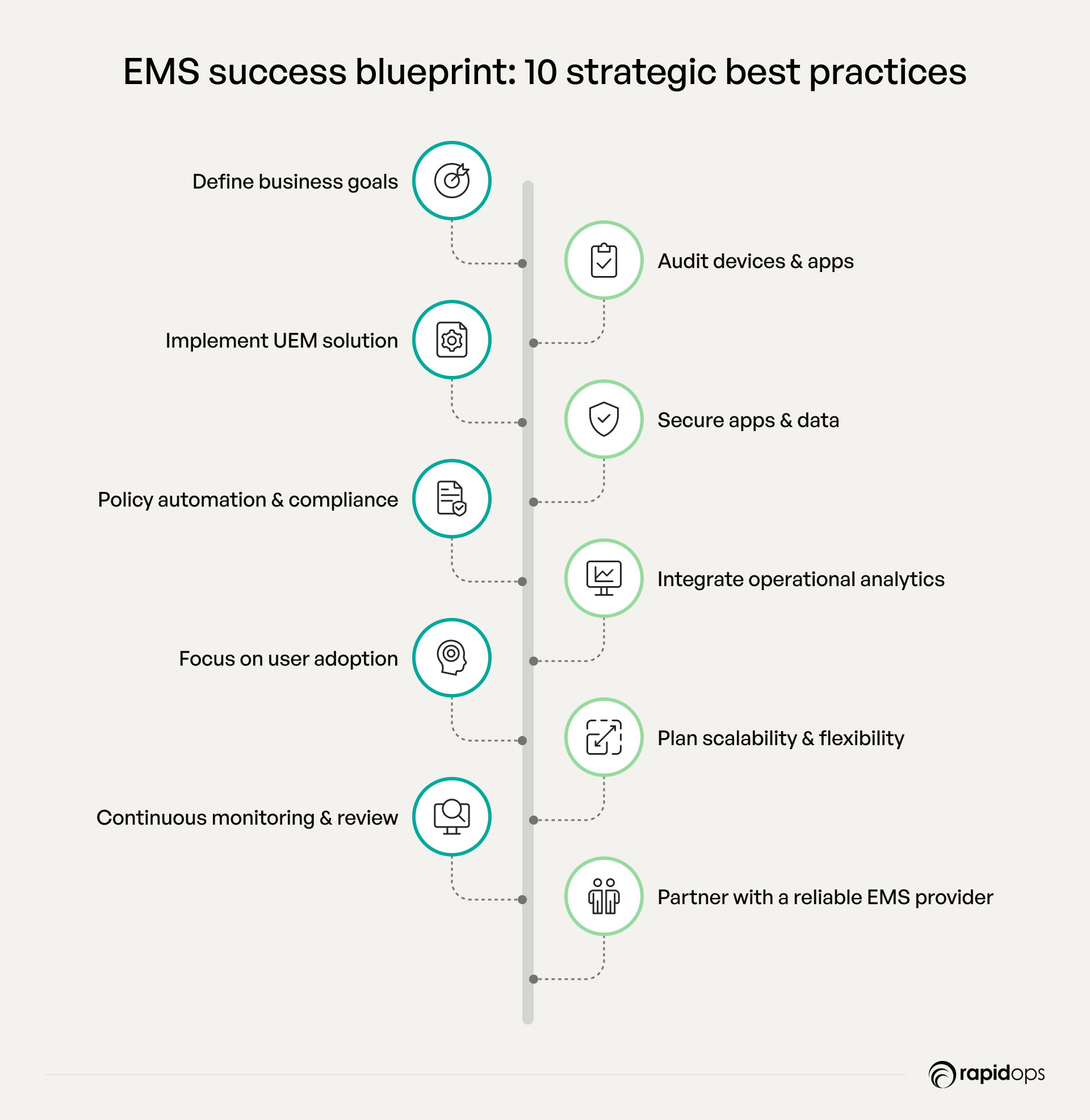
1. Define clear business objectives
Before implementing Enterprise Mobility Solutions (EMS), identify the precise goals the solution should achieve. Are you aiming to improve workforce productivity, streamline device management, enhance security, or enable real-time operational insights? Clear objectives ensure that your EMS deployment aligns with organizational priorities, avoids unnecessary complexity, and delivers measurable business outcomes.
2. Conduct a comprehensive device and application audit
Understanding your existing ecosystem is crucial. Inventory all mobile devices, applications, and IoT endpoints in use across your organization. Assess the diversity of operating systems, app versions, and hardware configurations. A complete audit highlights potential fragmentation, identifies security gaps, and informs the design of policies for device provisioning, management, and application deployment within enterprise mobility solutions (EMS).
3. Implement unified endpoint management
A central principle of enterprise mobility solutions (EMS) is consolidating device management through Unified Endpoint Management (UEM). UEM enables organizations to manage corporate and BYOD devices, laptops, tablets, and IoT devices from a single console. This approach ensures standardized policies, real-time monitoring, and streamlined updates, reducing blind spots and operational inefficiencies.
4. Secure applications and data with mobile application management
Mobile application management (MAM) ensures enterprise applications are protected, up-to-date, and optimized across all devices. By integrating MAM within enterprise mobility solutions (EMS), organizations can enforce app-level policies, control access to sensitive data, and prevent unauthorized use. This practice is particularly vital for hybrid and remote teams where mobile applications form the backbone of daily operations.
5. Establish policy automation and compliance governance
Automation reduces manual errors and ensures continuous compliance. Set up automated security policies, conditional access controls, and role-based permissions through enterprise mobility solutions (EMS). Ensure your EMS enforces industry-specific compliance standards such as GDPR, HIPAA, or other regulatory frameworks. Real-time monitoring and reporting allow IT teams to identify anomalies and enforce consistent adherence across the enterprise.
6. Integrate analytics for operational insights
Enterprise mobility solutions (EMS) provide actionable insights from device usage, application performance, and user behavior. Analytics help identify inefficiencies, forecast resource requirements, and enable strategic decision-making. Leaders gain visibility into mobile operations, allowing them to proactively manage risks, optimize workflows, and respond quickly to market or operational changes.
7. Prioritize user experience and workforce adoption
Even the most advanced Enterprise mobility solutions (EMS) can fail if employees find them cumbersome or restrictive. Conduct training sessions, provide clear guidance, and ensure intuitive interfaces. Prioritize seamless integration with employees’ workflows, balancing security with usability. Encouraging adoption reduces friction, accelerates productivity, and maximizes the value of your EMS investment.
8. Plan for scalability and flexibility
Businesses grow and evolve, and your Enterprise Mobility Solutions (EMS) should scale accordingly. Design your solution to accommodate increasing numbers of devices, new applications, and emerging technologies like IoT or AI-driven automation. Flexibility ensures your EMS continues to deliver operational efficiency, visibility, and security even as organizational needs change.
9. Conduct continuous monitoring and improvement
EMS deployment is not a one-time project. Continuously monitor device health, application performance, and policy compliance through Enterprise Mobility Solutions (EMS). Regularly review analytics, security alerts, and operational metrics. Use these insights to optimize configurations, refine policies, and implement new capabilities, ensuring the solution remains aligned with evolving business objectives.
10. Partner with a trusted EMS provider
Selecting a reliable Enterprise Mobility Solutions (EMS) partner can significantly influence the success of your deployment. Look for providers with proven expertise in device management, security, IoT integration, and real-time analytics. A strong partner ensures smooth implementation, timely support, and the ability to evolve your mobility strategy as your organization grows.
Challenges of implementing enterprise mobility solutions
Implementing enterprise mobility solutions (EMS) is a strategic priority for organizations in 2026, but the process comes with several challenges that must be understood and addressed to ensure success. These challenges are not merely technical; they span organizational, operational, and cultural dimensions and directly affect the adoption, effectiveness, and ROI of EMS initiatives.
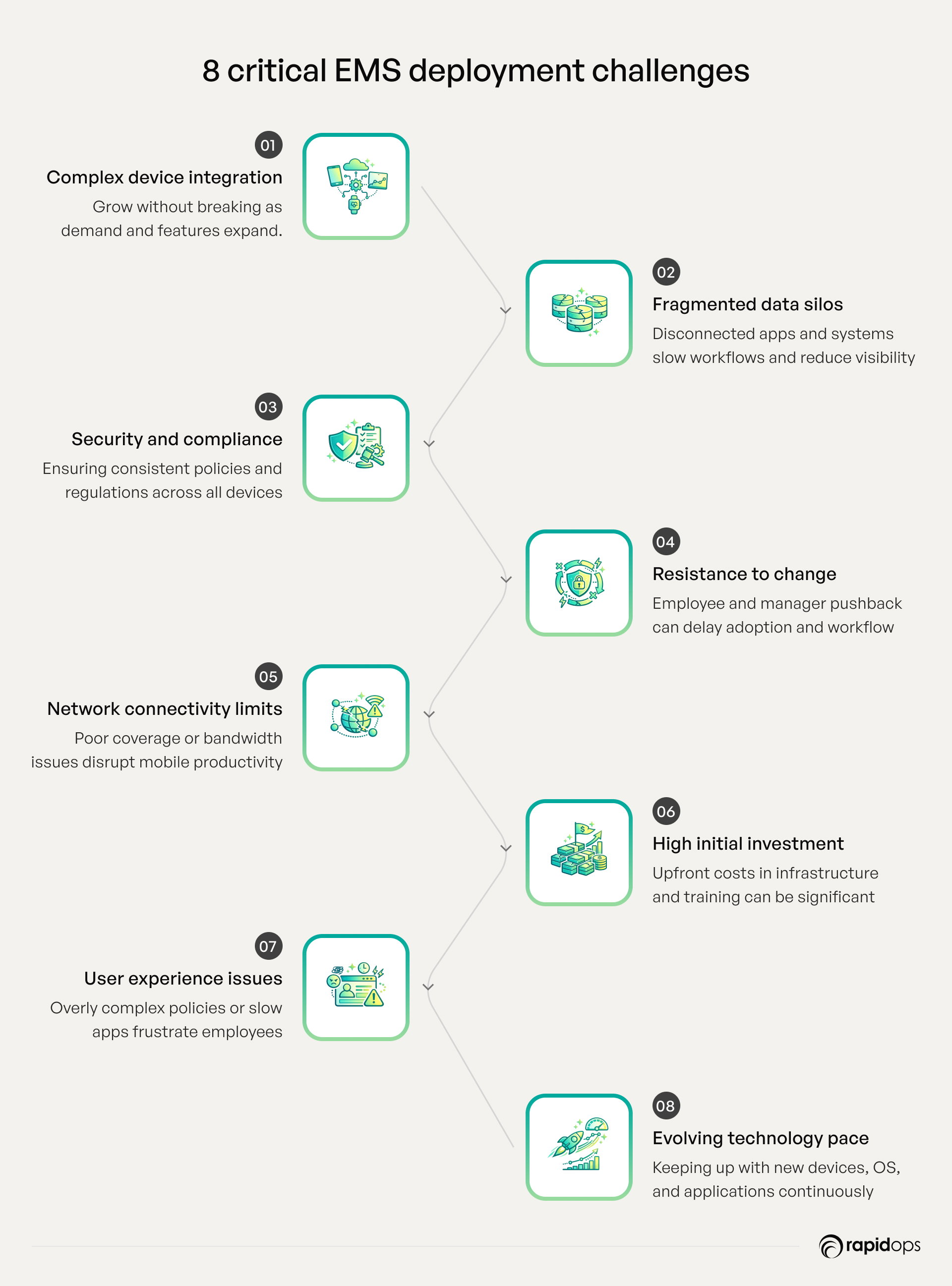
1. Complexity of integrating multiple devices and platforms
Modern enterprises operate with a diverse mix of devices, corporate laptops, BYOD smartphones, tablets, and IoT devices, across various operating systems. Ensuring seamless integration across all these endpoints is inherently complex. Differences in platforms, device capabilities, and compatibility issues can slow deployment and create inconsistencies in performance and security if not properly managed.
2. Fragmented applications and data silos
Organizations often rely on multiple applications, cloud systems, and enterprise software. Without a cohesive mobility strategy, these applications can remain disconnected, leading to fragmented data, inefficient workflows, and operational blind spots. Consolidating applications while maintaining uninterrupted access and usability presents a significant challenge during EMS implementation.
3. Security and compliance concerns
Mobile devices introduce new vectors for potential data breaches, unauthorized access, and compliance violations. Enforcing consistent security policies, encryption standards, and conditional access controls across all devices is challenging, especially in hybrid work environments. Ensuring adherence to industry regulations like GDPR, HIPAA, or sector-specific frameworks adds another layer of complexity.
4. Organizational resistance and change management
Implementing EMS requires a shift in how teams work, access data, and manage workflows. Resistance from employees, managers, or IT teams can slow adoption. Without proper communication, training, and alignment, employees may bypass new protocols, reducing the effectiveness of the mobility solution and creating potential security or operational risks.
5. Network and connectivity limitations
Seamless mobility relies on reliable network access across multiple locations. Connectivity issues, bandwidth constraints, or inconsistent mobile coverage can disrupt access to applications, data, and communication tools. These disruptions can hinder productivity and create frustration among mobile teams.
6. High initial costs and resource allocation
While EMS drives efficiency over time, initial investments in infrastructure, licensing, integration, and training can be substantial. Allocating budget and resources without impacting ongoing operations can be a significant hurdle, particularly for large, distributed organizations with diverse IT environments.
7. Monitoring, maintenance, and scalability challenges
Once deployed, EMS requires ongoing monitoring, updates, and maintenance to ensure devices, applications, and policies remain secure and optimized. Scaling EMS across multiple locations, departments, or global teams can strain IT resources and require advanced planning to maintain consistency and performance.
8. Ensuring user experience and adoption
A critical challenge is balancing security and control with usability. Overly restrictive policies, complex authentication, or slow application performance can frustrate users, leading to reduced adoption or workarounds. Ensuring a smooth, intuitive experience is essential to maximizing the benefits of EMS.
9. Managing BYOD and personal device policies
Employees increasingly use personal devices for work. Integrating these devices into the EMS framework while respecting privacy, ensuring security, and maintaining compliance adds another layer of complexity. Clear policies and careful configuration are essential to manage these endpoints effectively.
10. Keeping pace with evolving technologies
The mobility landscape evolves rapidly, with new devices, operating systems, and applications emerging continuously. Staying current, ensuring compatibility, and updating security protocols in line with these changes requires ongoing attention and strategic foresight.
Unlock seamless operations and real-time insights with EMS
Now that you understand how enterprise mobility solutions unify devices, applications, and workflows to drive end-to-end business management, operational inefficiencies, fragmented processes, and security gaps are no longer challenges you must accept. Organizations struggling with delayed approvals, inconsistent execution, or limited visibility into mobile operations can transform these pain points into strengths with a strategic EMS deployment.
At Rapidops, we draw on years of experience helping organizations navigate complex mobility challenges. Our expertise lies in unifying devices, applications, and workflows to create seamless operations. By working closely with teams, understanding real-world pain points, and tailoring solutions to actual business needs, we help leaders gain visibility, employees work efficiently, and enterprises achieve measurable outcomes, turning EMS from a technology tool into a strategic advantage.
Ready to unlock seamless operations, stronger security, and real-time business insights? Schedule a free call with one of our EMS experts today to discover how your organization can turn mobile management into a strategic advantage.

What’s Inside
- What enterprise mobility solutions really mean
- Key drivers pushing enterprises toward enterprise mobility solutions
- Why enterprise mobility solutions are essential for businesses
- How EMS enables end-to-end business management
- Real-world applications of enterprise mobility solutions
- Measurable business outcomes enabled by enterprise mobility solutions
- Best practices for implementing enterprise mobility solutions
- Challenges of implementing enterprise mobility solutions
- Unlock seamless operations and real-time insights with EMS

Let’s build the next big thing!
Share your ideas and vision with us to explore your digital opportunities
Similar Stories
- Transformation
- undefined Mins
- March 2022


- Transformation
- undefined Mins
- March 2020

Receive articles like this in your mailbox
Sign up to get weekly insights & inspiration in your inbox.