


When you evaluate your product portfolio today, which products are fueling growth, and which are simply keeping the lights on? In 2026, you’re realizing that bold ideas alone no longer guarantee success; it’s strategy that turns innovation into measurable impact. Companies with clearly aligned product strategies achieve 30–40% higher revenue growth, 20% faster time-to-market, and up to 25% higher user retention than their peers.
Yet, fewer than half of organizations report having a strategy that fully connects vision, customer needs, and outcomes, leaving promising products underperforming and market opportunities untapped. The most successful products evolve continuously. Modular architectures scale to handle 3–5x user growth, hyper-personalized experiences increase engagement and retention 20–25%, frictionless UX drives adoption 2–3x faster than industry averages, and intelligent automation converts efficiency into measurable growth. Every iteration is guided by real-time data, experimentation, and direct market feedback, making innovation repeatable and scalable.
Early adopters of AI and automation report 15–30% productivity gains in the first year, giving them advantages that competitors struggle to match.
This blog exists to help you make sense of the challenges and opportunities of 2026, from navigating AI adoption to scaling products efficiently and creating experiences that resonate with your customers. By reading this, you’ll gain actionable insights to refine your product strategy, maximize growth, drive adoption, and establish a competitive advantage that endures even as markets evolve. It’s designed to give you clarity, perspective, and confidence to make strategic decisions that truly move the needle.
What is a digital product strategy
A digital product strategy is the blueprint that guides a product from concept to market and beyond, ensuring that every decision from design to deployment aligns with the company’s business goals and delivers measurable value. Unlike ad-hoc product initiatives, a robust digital product strategy provides clarity on target users, competitive positioning, and the desired outcomes, forming the foundation for successful digital product development.
At its core, a digital product strategy defines three essential dimensions: vision, differentiation, and execution. The product vision articulates what the product intends to achieve, why it matters to users, and how it fits within the broader business strategy. Differentiation identifies the product’s competitive advantage in the market, highlighting how it meets unmet needs and addresses user pain points better than alternatives. Execution establishes a structured approach to the entire product development lifecycle, including design, prototyping, testing, and iteration, ensuring that the roadmap aligns with strategic objectives.
A well-crafted digital product strategy goes beyond mere planning; it’s a framework for achieving product success. It encompasses market research, competitive analysis, and user research, enabling teams to make informed, data-driven decisions. For example, leveraging qualitative and quantitative metrics allows product teams to measure adoption, retention, and conversion, providing actionable insights to refine both the product roadmap and strategic priorities.
In today’s digital age, enterprises cannot rely on static plans. Digital product strategies must be dynamic, adapting to evolving customer behaviors, emerging technologies, and market shifts. Tools like the Business Model Canvas and Strategic Intent Canvas help align cross-functional team members, ensuring that product initiatives contribute to achieving business objectives while maintaining a clear focus on user needs.
Ultimately, a digital product strategy is the bridge between innovation and execution. It transforms ideas into a structured, actionable plan, turning digital products into scalable solutions that deliver real value, strengthen market positioning, and enable business growth. Without it, even the most promising products risk misalignment, inefficiency, and failure to capture their potential.
Why you need a digital product strategy in 2026
In 2026, the digital landscape is more complex and fast-moving than ever. Customers expect personalized, seamless experiences, while competitors innovate at unprecedented speed. In this environment, simply “going digital” is not enough.
A well-crafted digital product strategy acts as a guiding framework that aligns your business objectives, resources, and market opportunities. It ensures every decision, from design to launch, drives measurable impact. Without it, organizations risk creating fragmented products, wasting resources, and falling behind in a highly competitive marketplace.
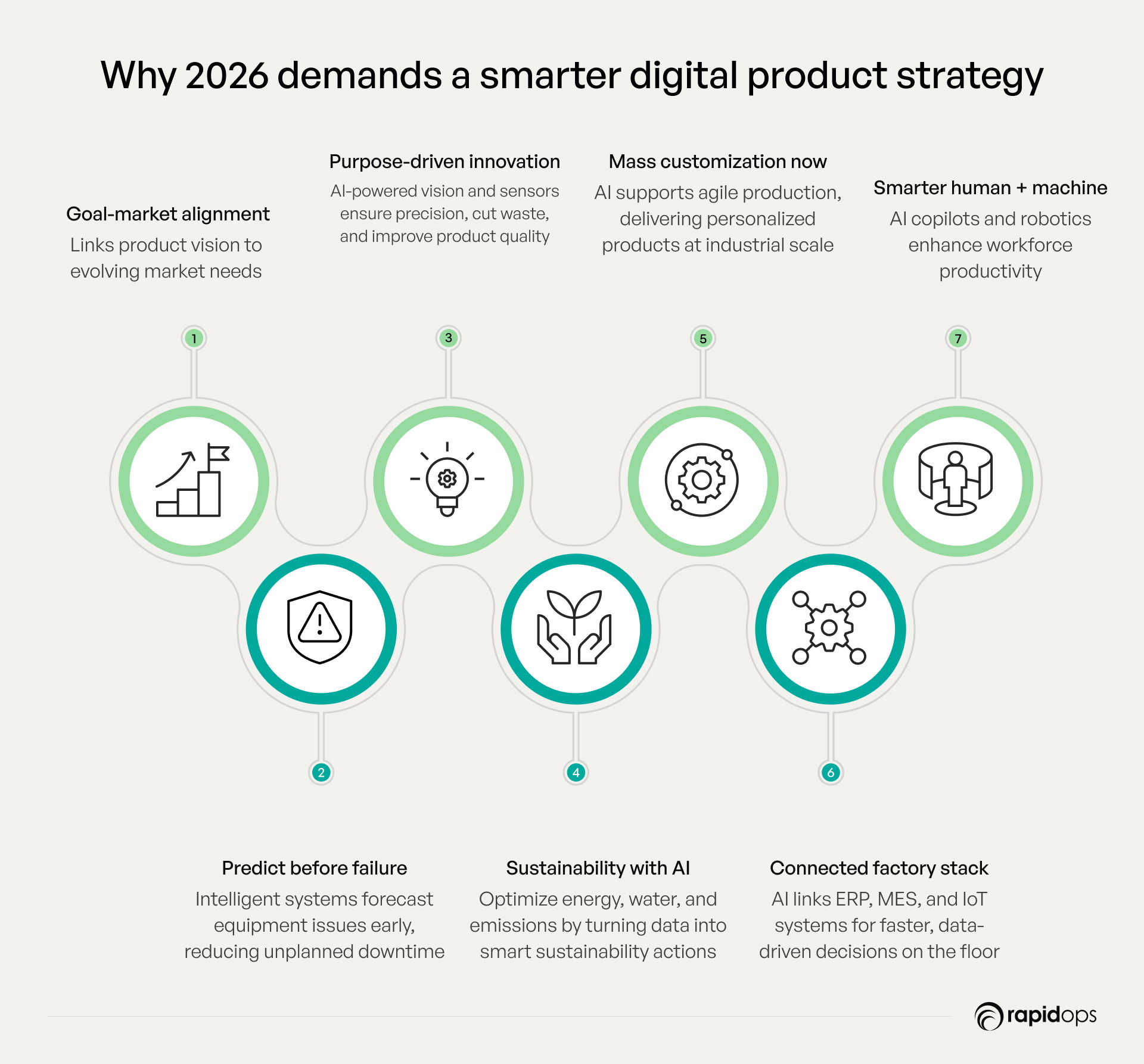
1. Align business goals with market demands
A digital product strategy bridges the gap between your strategic vision and real-world market dynamics. In a landscape where consumer behavior evolves rapidly, businesses must identify gaps, monitor market trends, and define the product roadmap to prioritize initiatives that drive growth. Aligning your strategy with business objectives ensures that every product feature, development sprint, and go-to-market plan contributes to measurable outcomes, reduces inefficiencies, and clarifies the value proposition for your target users.
2. Drive innovation with purpose
Innovation in 2026 is not experimentation for its own sake; it’s about creating tangible value. A successful digital product strategy ensures investments in emerging technologies generate product growth, enhance user experience, and deliver a competitive edge. For example, AI-embedded workflows can increase productivity and decision-making speed by 20–30%, while modular digital product development enables faster iteration and scalable solutions. Without a clear strategy, organizations risk costly distractions and diluted focus.
3. Enhance customer experience and loyalty
Customers expect digital products to anticipate their needs across platforms, from mobile and web to IoT and immersive experiences. A well-defined strategy integrates user research, user feedback, and qualitative and quantitative metrics to craft experiences that resonate. By continuously analyzing behavior and iterating the product roadmap, businesses can improve adoption, retention, and lifetime value, positioning digital products as a strategic foundation for sustainable growth.
4. Enable data-driven decision-making
Data alone isn’t enough; it must be guided by a digital product strategy framework. By defining key performance indicators (KPIs) and tracking product success metrics, leaders can make informed business decisions, optimize features, and predict emerging needs. Predictive analytics and AI-powered insights help anticipate customer behavior, refine product positioning, and accelerate time-to-market, transforming data into actionable intelligence rather than overwhelming noise.
5. Streamline cross-functional collaboration
Building a successful digital product requires alignment across product teams, engineering, design, marketing, and leadership. A clearly articulated strategy ensures everyone shares the strategic intent, understands the compelling product vision, and works toward the same business objectives. In 2026, where agility and speed are critical, cross-functional cohesion reduces bottlenecks, mitigates conflicts, and accelerates product development outcomes.
6. Mitigate risk and increase ROI
Launching digital products without a strategy exposes organizations to financial, operational, and reputational risks. A structured strategy identifies high-value initiatives, avoids feature bloat, and ensures key features align with the target audience’s needs. Companies that follow a digital product strategy framework can achieve product-market fit faster, optimize resource allocation, and generate measurable business growth while maintaining flexibility to adapt to changing conditions.
7. Stay ahead of competition
The 2026 digital marketplace is highly dynamic, with evolving customer preferences, new entrants, and emerging technologies reshaping industries. A digital product strategy equips businesses to anticipate trends, monitor competitors, and innovate proactively. Organizations without a clear roadmap risk being outpaced, whereas those with a robust digital product strategy can turn disruption into opportunity, delivering successful new initiatives and maintaining a competitive edge.
In 2026, an effective digital product strategy is not optional; it’s the foundation of sustainable success. By aligning business strategy, target market insights, and digital product development, organizations can create products that deliver measurable ROI, scale efficiently, and innovate continuously.
Companies that invest in a robust digital product strategy framework position themselves to meet evolving customer expectations, achieve product success, and maintain a long-term competitive advantage. Those without a strategy risk falling behind in a rapidly evolving digital age.
Core components of a digital product strategy
In 2026, having a great idea isn’t enough to win in the digital marketplace. The difference between products that soar and those that stall often comes down to one thing: a clear, actionable digital product strategy. Think of it as the playbook that guides every decision, from the spark of an idea to the moment your product reaches customers, and beyond.
A strong strategy doesn’t just map features or timelines; it ensures your product solves real problems, delights users, and drives measurable business outcomes. We’ll dive into the five core elements that make a digital product strategy not just theoretical, but actionable, defensible, and capable of turning innovation into lasting success.
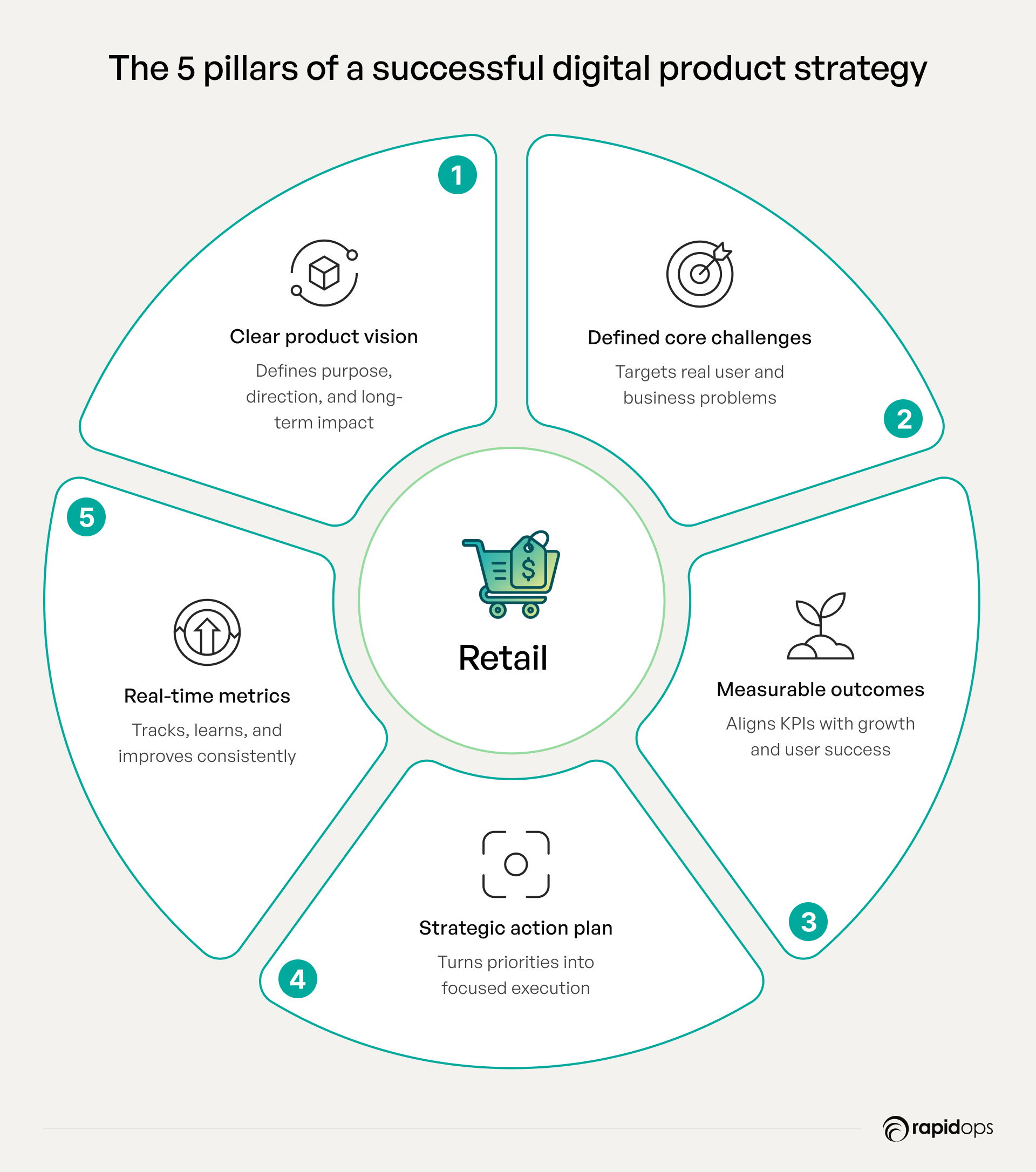
1. Vision
A clear and compelling product vision defines the “why” and “what” of your digital product, guiding every action from ideation to execution.
- Long-term purpose and strategic intent: Your vision articulates how the product contributes to broader business objectives, ensures alignment with your business model, and frames precise objectives for cross-functional teams. In practice, companies with a clearly defined vision achieve 30–40% faster time-to-market for new digital products.
- Aligning teams and stakeholders: Vision alignment ensures all product teams design, engineering, marketing, and leadership share a common understanding of priorities. A strategic foundation reduces ambiguity, accelerates decision-making, and empowers teams to execute with confidence.
Industry examples: Microsoft’s AI-first platform strategy and Amazon’s focus on customer-obsessed experiences demonstrate how a compelling product vision drives measurable business impact, including adoption, retention, and revenue growth.
Ask your team: “If this product succeeds, what specific business outcomes will it achieve in 12 months?” This ensures vision clarity and connects day-to-day work with long-term strategy.
2. Challenge
A strategy without clearly defined challenges is like a roadmap without coordinates. Identifying the right problems ensures your product delivers value where it matters most.
- Identifying key problems: Conduct market research to uncover gaps and unmet needs. In 2026, data shows 78% of successful digital products result from problem-driven innovation rather than technology-first experiments.
- Understanding customer pain points: Leverage user research, personas, and journey mapping to quantify and prioritize pain points. For example, predictive analytics can highlight workflow bottlenecks that, when resolved, can boost productivity by 20–30%.
- Root cause vs symptom: Focus on underlying business or user issues, not superficial features. A well-scoped challenge phase prevents wasted investment in low-impact solutions.
Map out the top three challenges your product addresses and validate them with both internal stakeholders and real target users.
3. Outcomes
Defining measurable outcomes turns abstract goals into actionable metrics.
- Business and user results: Identify KPIs that balance business growth (e.g., revenue, retention) with user success (e.g., adoption rate, task completion efficiency).
- Short-term wins vs long-term objectives: Establish a roadmap that allows early successes to fund and validate long-term initiatives. Research shows companies that track short-term wins alongside long-term KPIs see 25% higher stakeholder alignment.
- KPIs and success metrics: Use qualitative and quantitative metrics across the entire product development lifecycle to ensure iterative improvement and strategic intent alignment.
Define three core KPIs for your product and share them with all product teams. This ensures everyone knows what success looks like.
4. Actions
A strategy only matters if it translates into concrete execution steps.
- Key steps to address challenges: Outline initiatives that solve prioritized problems. This may include digital product development, AI-powered personalization, or modular architecture improvements.
- Coordinating cross-functional work streams: Align team members across engineering, design, marketing, and leadership to prevent silos and ensure coordinated delivery.
- Prioritizing strategically: Focus on initiatives that deliver maximum ROI, improve product-market fit, and strengthen your competitive advantage. A McKinsey study shows that organizations with disciplined prioritization outperform peers by 20% in time-to-market efficiency.
Create a simple priority matrix of all ongoing initiatives by impact vs. effort to help teams focus on what drives value.
5. Measures
Continuous measurement ensures your product evolves with market needs and customer expectations.
- Tracking beyond deliverables: Measure progress against business objectives, target market success, and user-centric outcomes, not just completed tasks.
- Qualitative and quantitative metrics: Include KPIs like adoption rate, churn, retention, and engagement, combined with user feedback and sentiment analysis.
- Continuous improvement loops: Adopt agile methodologies with iterative sprints. Combine analytics, user feedback, and cross-functional retrospectives to adapt strategy in real-time. Products that iterate continuously report up to 35% higher retention over static release models.
Set up a quarterly strategy review where teams evaluate KPIs, analyze feedback, and adjust initiatives, turning the strategy into a living, evolving system.
A successful digital product strategy in 2026 is far more than a document; it’s a living framework that aligns vision, challenges, outcomes, actions, and measures. By embedding user research, measurable KPIs, competitive insights, and cross-functional alignment, companies can deliver digital products that scale, innovate, and drive sustainable business growth. A well-executed strategy ensures teams remain on the same page, products meet target audience needs, and organizations maintain a competitive edge in an increasingly complex digital age.
Craft a future-ready digital product strategy in actionable steps
You might think your digital product strategy is solid, but in 2026, most companies are missing the hidden levers that drive real growth, retention, and market dominance. Standard playbooks can leave you trailing competitors who are already exploiting these moves. In this content, you’ll uncover advanced strategies few businesses even consider, from AI-powered product intelligence and trust-driven design to ecosystem-centric growth and predictive insights. Mastering these approaches gives you the edge to build, scale, and future-proof your products, turning what seems impossible for others into your competitive advantage.
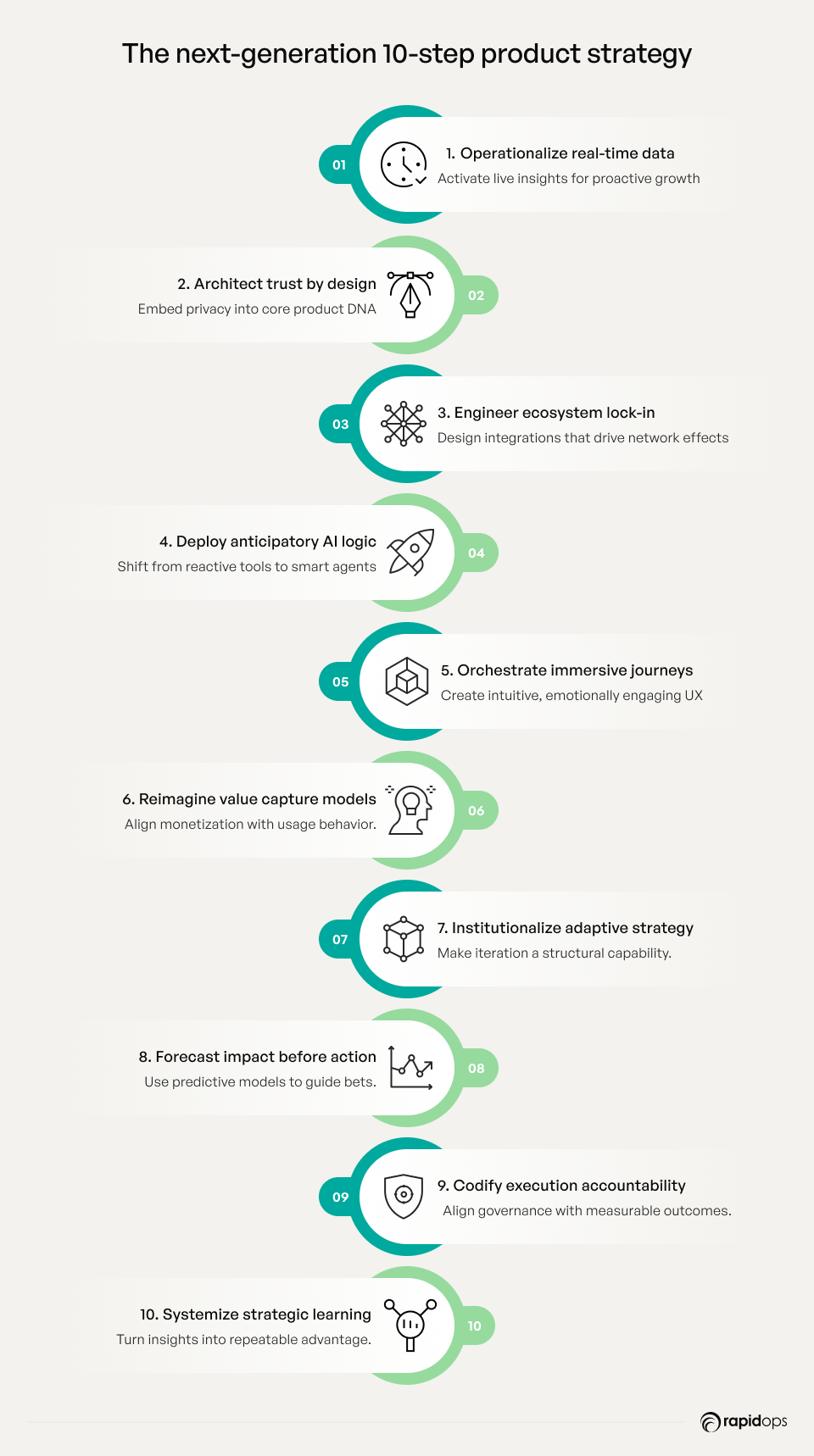
1. Elevate your data into a strategic engine
Your data is your most valuable asset when it drives action, not just reporting. By unifying real-time data from user interactions, product usage, and operational metrics into a single ecosystem, you can anticipate user behavior, identify friction points, and prioritize initiatives that create measurable impact. Predictive analytics and AI-powered insights allow you to make decisions before problems emerge, turning data into a proactive tool. Treating your data as a strategic engine ensures your product adapts quickly to market changes, optimizes user flows, and drives adoption, giving your business a tangible competitive advantage in 2026.
2. Embed privacy and trust as core design principles
Trust and privacy are no longer optional; they are essential to adoption and retention. Incorporating self-sovereign identity (SSI), zero-trust access, and privacy-first workflows from day one positions your product as secure, ethical, and user-focused. When users feel confident that their data is protected and controlled, engagement, loyalty, and advocacy naturally increase. Embedding trust and privacy as visible design principles differentiates your product from competitors who treat security as an afterthought. In today’s market, a product that safeguards sensitive information not only meets regulatory requirements but also establishes credibility, strengthens your brand, and drives sustainable adoption.
3. Map ecosystem opportunities for strategic lock-in
Your product will achieve lasting success when it integrates into broader ecosystems. By identifying partner platforms, APIs, marketplaces, and complementary products, you can design your product to generate network effects that increase adoption and retention. Ecosystem thinking goes beyond user acquisition; it creates multi-layered engagement that makes your product indispensable. When your product interacts seamlessly with other tools and platforms, it delivers amplified value for your users and strengthens your market position. Strategic ecosystem integration reduces churn, increases stickiness, and positions your product as a core solution in a competitive landscape where single-product adoption is often insufficient.
4. Integrate AI strategically to anticipate user needs
AI can transform your product from a passive tool into a proactive assistant. Embedding AI-driven agents that learn user behavior, recommend actions, and adapt dynamically enables personalization at scale. These agents reduce friction, optimize workflows, and deliver continuous value, making users more engaged and reliant on your product. By incorporating AI thoughtfully and ethically, you can anticipate user needs before they arise, offering guidance and automation that enhance experiences. In 2026, integrating AI into your product logic is a high-level lever for differentiation, retention, and competitive advantage, turning your product into an intelligent partner for every user.
5. Design immersive and human-centric experiences
User experience is now a strategic differentiator. Leveraging AR, VR, 3D interactivity, and predictive personalization where it matters allows your product to engage users in ways that feel natural, intuitive, and meaningful. Accessibility, inclusivity, and ethical design ensure your product resonates with a broad audience, deepening engagement and loyalty. Exceptional experiences go beyond usability—they create emotional connections that encourage advocacy and retention. By focusing on human-centric design, you make your product not just functional but compelling, memorable, and indispensable, positioning it as a product that users choose, engage with repeatedly, and recommend in today’s competitive digital marketplace.
6. Innovate revenue and engagement models
Revenue strategy must evolve alongside your product. Moving beyond one-time purchases to subscriptions, platform models, microtransactions, or tokenized incentives aligns user engagement with long-term value creation. Innovative monetization ensures predictable revenue, funds continuous improvement, and strengthens the link between usage and business outcomes. By experimenting with multiple models and iterating based on user behavior, you can discover what maximizes adoption and lifetime value. In 2026, revenue innovation is not just about profitability—it is a strategic lever to increase engagement, strengthen ecosystems, and ensure your product scales sustainably while delivering ongoing value to both your business and your users.
7. Shift strategy from static planning to continuous adaptation
Annual or quarterly plans are insufficient in fast-moving markets. Embedding strategy into daily operations ensures your product adapts dynamically to market shifts, user behavior, and emerging technologies. Cross-functional teams should monitor data and insights continuously, pivot quickly, and test new ideas iteratively. By making your strategy a living, evolving system, you reduce risk, avoid wasted effort, and ensure every initiative drives impact. Continuous adaptation allows your product to remain relevant and competitive, positioning your business to capitalize on emerging opportunities while responding proactively to changes in user expectations, technology, and competitive landscapes in 2026.
8. Build predictive intelligence into decision-making
Knowing what happened yesterday is not enough. Predictive intelligence enables you to forecast adoption, churn, feature engagement, and revenue outcomes before decisions are made. Combining quantitative models with qualitative insights allows you to prioritize initiatives effectively, allocate resources smartly, and optimize the roadmap for measurable results. Predictive insights also reduce uncertainty and enable proactive planning, ensuring that every product decision contributes to growth and competitive advantage. In today’s data-rich environment, predictive intelligence is an advanced lever that ensures your product strategy is forward-looking, actionable, and designed to maximize both user satisfaction and business outcomes.
9. Align organizational capabilities and governance for execution
Even the most sophisticated strategy fails without aligned execution. Clearly define roles, responsibilities, decision rights, and incentive structures that connect every team member to outcomes. Cross-functional squads across product, engineering, design, and marketing must collaborate seamlessly, understanding how their contributions affect adoption, retention, and revenue. Alignment fosters accountability, accelerates delivery, and ensures strategy translates into tangible results. In 2026, organizational alignment is critical to turning vision into action, enabling your teams to execute high-impact initiatives efficiently and consistently while maintaining strategic focus across your product portfolio.
10. Communicate, iterate, and institutionalize learnings
Your strategy is only as effective as your ability to share, learn, and adapt. Openly communicate roadmaps, KPIs, and insights across teams, creating feedback loops that drive continuous improvement. Evaluate features, processes, and decisions regularly, and document learnings to strengthen future strategies. Iteration ensures your product evolves with user needs, market trends, and emerging technologies. Institutionalizing learning allows your organization to scale knowledge, make data-informed decisions, and maintain a competitive edge. In 2026, a strategy that evolves continuously ensures your product remains relevant, scalable, and successful in fast-changing digital markets.
By following these ten steps, you can create a digital product strategy that aligns your business goals, anticipates user needs, leverages emerging technologies, and drives measurable results. In today’s 2026 market, this approach ensures your products scale, innovate, and stay ahead of competitors, providing long-term growth and strategic differentiation.
Five rules of a successful digital product strategy
Crafting a successful digital product strategy is not about checking boxes; it’s about creating a roadmap that guides your digital products from concept to product-market fit, ensures alignment with business goals, and delivers measurable business growth.
Research shows that enterprises with structured digital product strategies achieve 30–40% higher adoption rates and 20% faster time-to-market than competitors without a clear framework. Here’s how to implement these five rules effectively.
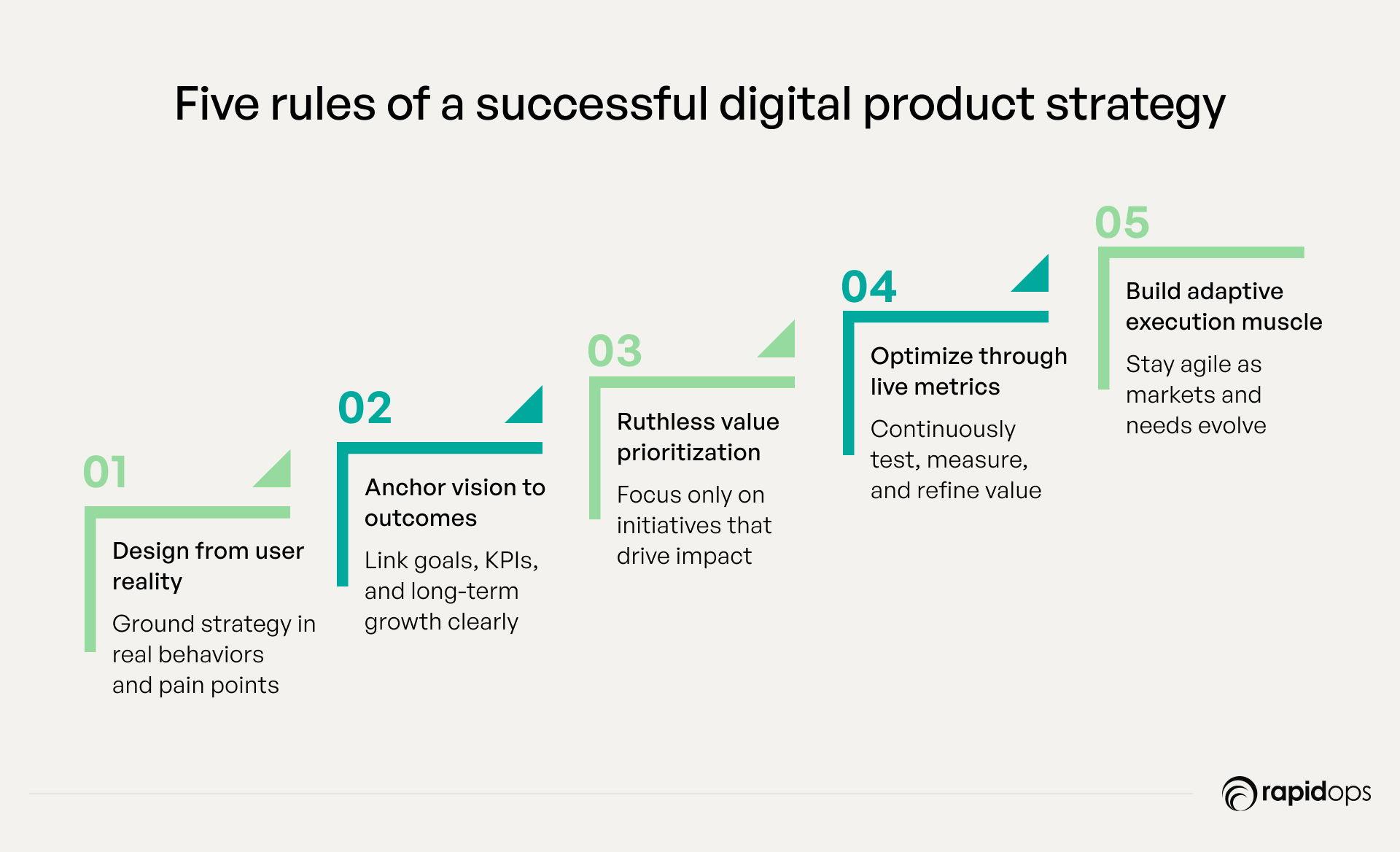
1. Start with the customer in mind
Your target users and target audience define the success of your digital product. Use user research, personas, and journey mapping to gain a deep understanding of their needs, pain points, and behaviors. For example, real-time behavioral analytics can reveal which features drive engagement and which create friction. Companies prioritizing user-centric design see up to 50% higher retention. By embedding customer feedback early, your digital product development remains aligned with actual user needs, not assumptions, reducing the risk of launching products that fail to resonate.
2. Define a clear vision and goals
A compelling product vision is your strategic foundation. It connects business priorities, user needs, and market trends, ensuring every team member and stakeholder understands the product roadmap. Set precise objectives, identify key performance indicators (KPIs), and map short-term wins against long-term goals. Organizations that articulate a clear digital product strategy framework are 2x more likely to achieve competitive advantage and see measurable business growth. A winning strategy clearly communicates the value proposition and the desired outcomes for both the business and the user.
3. Prioritize ruthlessly
In a world where resources are finite, focus on high-impact initiatives that drive measurable outcomes. Use frameworks like business model canvas or strategic intent canvas to evaluate initiatives against business objectives, product success metrics, and market opportunity. Avoid feature bloat; every addition should strengthen the product's competitive advantage. Studies indicate that products with well-prioritized roadmaps launch 20–30% faster while achieving higher adoption and ROI.
4. Measure and optimize continuously
A solid digital strategy is grounded in data-driven experimentation. Track qualitative and quantitative metrics, collect ongoing user feedback, and analyze market trends to inform iteration. This allows teams to pivot effectively, optimize key features, and improve user experience. Organizations that leverage predictive analytics and real-time monitoring achieve up to 3x higher innovation velocity and reduce risks associated with product launches. Continuous measurement ensures that your digital products not only meet market demands but also exceed expectations.
5. Maintain flexibility
The digital age is dynamic, and rigid plans quickly become outdated. Embrace agile development and adaptability to respond to changing market research, emerging technologies, and evolving user needs. Cross-functional product teams working in iterative sprints can test assumptions, adjust features, and refine go-to-market plans. Companies adopting flexible, iterative strategies outperform peers in both speed to market and product adoption, ensuring the product's future success and sustaining a competitive edge in rapidly evolving industries.
By applying these five rules, your organization can create a robust digital product strategy that aligns with business strategy, addresses user needs, and drives measurable outcomes. Starting with the customer, defining vision, prioritizing ruthlessly, measuring continuously, and staying agile ensures that your digital products not only succeed today but remain adaptable, scalable, and innovative in 2026 and beyond.
Shifting from strategy to execution
In 2026, even the most visionary digital product strategy can falter if it isn’t translated into precise, actionable execution. A strategy remains theoretical until it is embedded into your product roadmap, aligned with business objectives, and operationalized across cross-functional product teams. Execution is where your strategic intent canvas meets reality, where vision becomes measurable product success and competitive advantage.
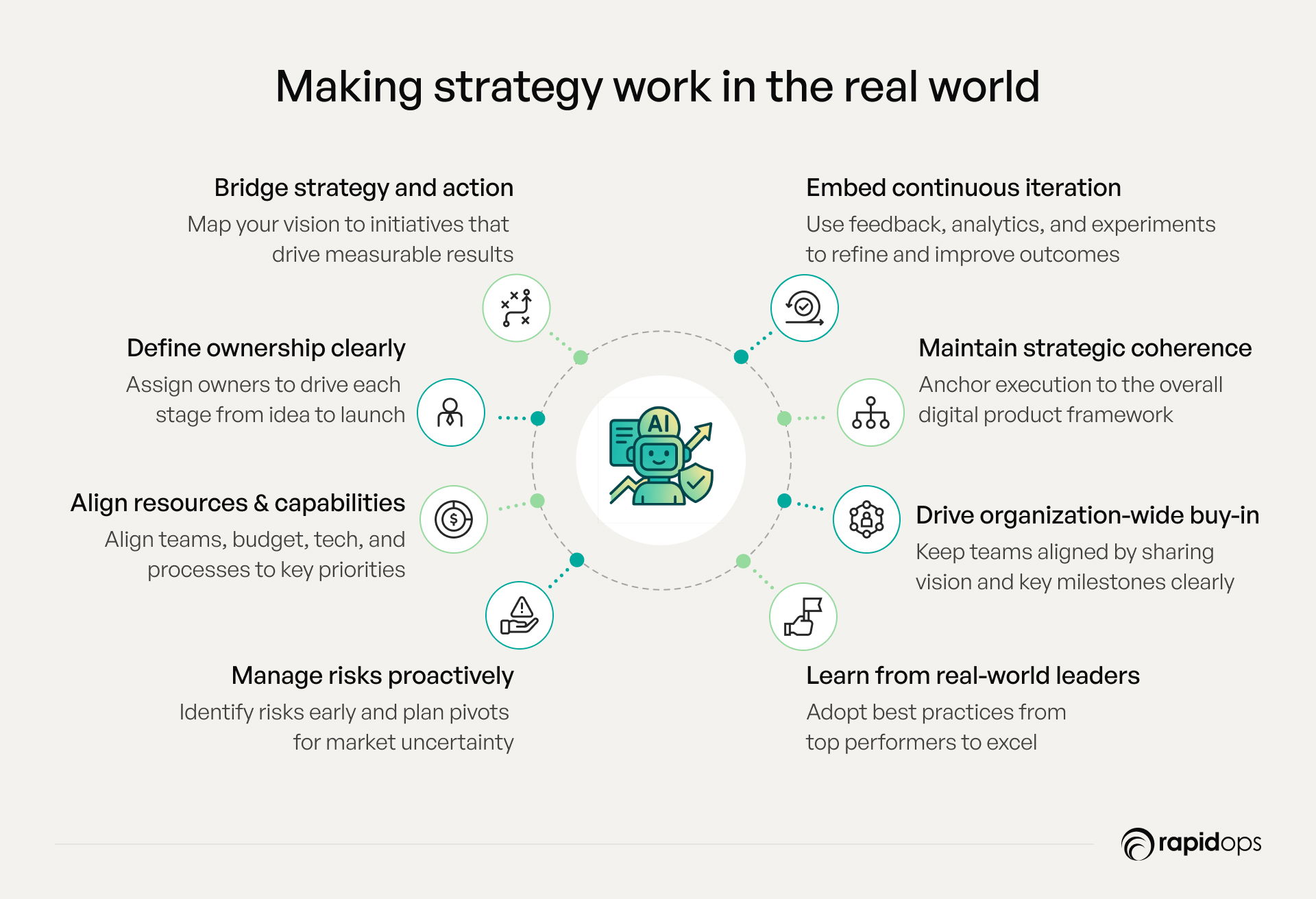
Bridging the strategy-execution gap
Many organizations struggle with strategic drift, where ambitious goals fail to manifest as tangible outcomes. Bridging this gap starts by mapping your product vision and desired outcomes directly onto actionable initiatives. This requires understanding the target market, evaluating market trends, and aligning initiatives with both business goals and the digital age expectations of your customers. Data shows that organizations with clearly mapped strategies to execution are 35% more likely to achieve product-market fit within planned timelines.
Establishing ownership and accountability
Execution thrives on clarity of responsibility. Assigning ownership across team members, digital product leaders, and product managers ensures that every stage, from ideation to launch has accountable champions. Without this, teams operate in silos, slowing progress and risking product line misalignment. Clear ownership also embeds strategic awareness, ensuring that every decision reinforces the product’s competitive advantage and contributes to achieving business goals.
Resource and capability alignment
A strategy is only as strong as the resources supporting it. Aligning people, budgets, technology, and operational processes with execution priorities is essential. For example, leveraging a business model canvas to allocate resources effectively, or using analytics platforms to track key performance indicators ensures initiatives are data-driven and impactful. Aligning capabilities also includes defining development processes, ensuring digital product development is agile, scalable, and responsive to target users’ needs.
Navigating risks and uncertainty
Execution carries inherent risk. Effective strategies proactively identify threats, including technology constraints, evolving market trends, regulatory shifts, or operational bottlenecks. Incorporating risk management practices and scenario planning allows your teams to pivot quickly while protecting business growth and minimizing wasted effort. Companies that embed risk assessments in execution are 40% more likely to maintain successful new initiatives under dynamic conditions.
Embedding continuous learning and iteration
Execution is a dynamic process. Using user feedback, qualitative and quantitative metrics, and real-time insights allows your teams to iterate rapidly. Agile sprints, MVP testing, and data-driven experiments ensure that each product iteration optimizes product success and enhances the value proposition. This continuous feedback loop aligns strategy with actual market responses, improving both adoption and long-term engagement.
Maintaining strategic coherence
Flexibility is critical, but execution must remain anchored to the digital product strategy framework. Regularly reviewing the product roadmap against business objectives ensures initiatives support the overarching digital-first business strategy. This coherence prevents teams from deviating into non-strategic activities and ensures existing products and new initiatives reinforce your strategic vision.
Driving organizational buy-in and change
Strategy only succeeds when the organization moves as one. Communicating the strategic vision, milestones, and measurable desired outcomes fosters collaboration across departments. Engaging business stakeholders and ensuring all team members understand their role creates shared ownership, accelerates execution, and maximizes product growth. Organizations with strong buy-in report 50% higher adoption rates of digital products.
Lessons from real-world execution
Leading companies like Salesforce and Adobe demonstrate how strategy translates to results. They integrate digital transformation principles, align product teams with clear responsibilities, and embed continuous learning in every stage of the product development lifecycle. The outcome: products that deliver measurable business growth, retain users, and maintain a competitive edge in rapidly evolving markets.
Common pitfalls to avoid in digital product strategy
Building a digital product strategy is as much about avoiding failure as it is about driving success. In 2026, executive surveys indicate that nearly 70% of digital transformation initiatives fail to meet expectations due to strategic missteps, misalignment, or poorly defined objectives.
These failures rarely stem from poor ideas; instead, they emerge when organizations fall into predictable strategic pitfalls. Recognizing these traps early ensures your digital products are positioned for product success, business growth, and sustainable competitive advantage.
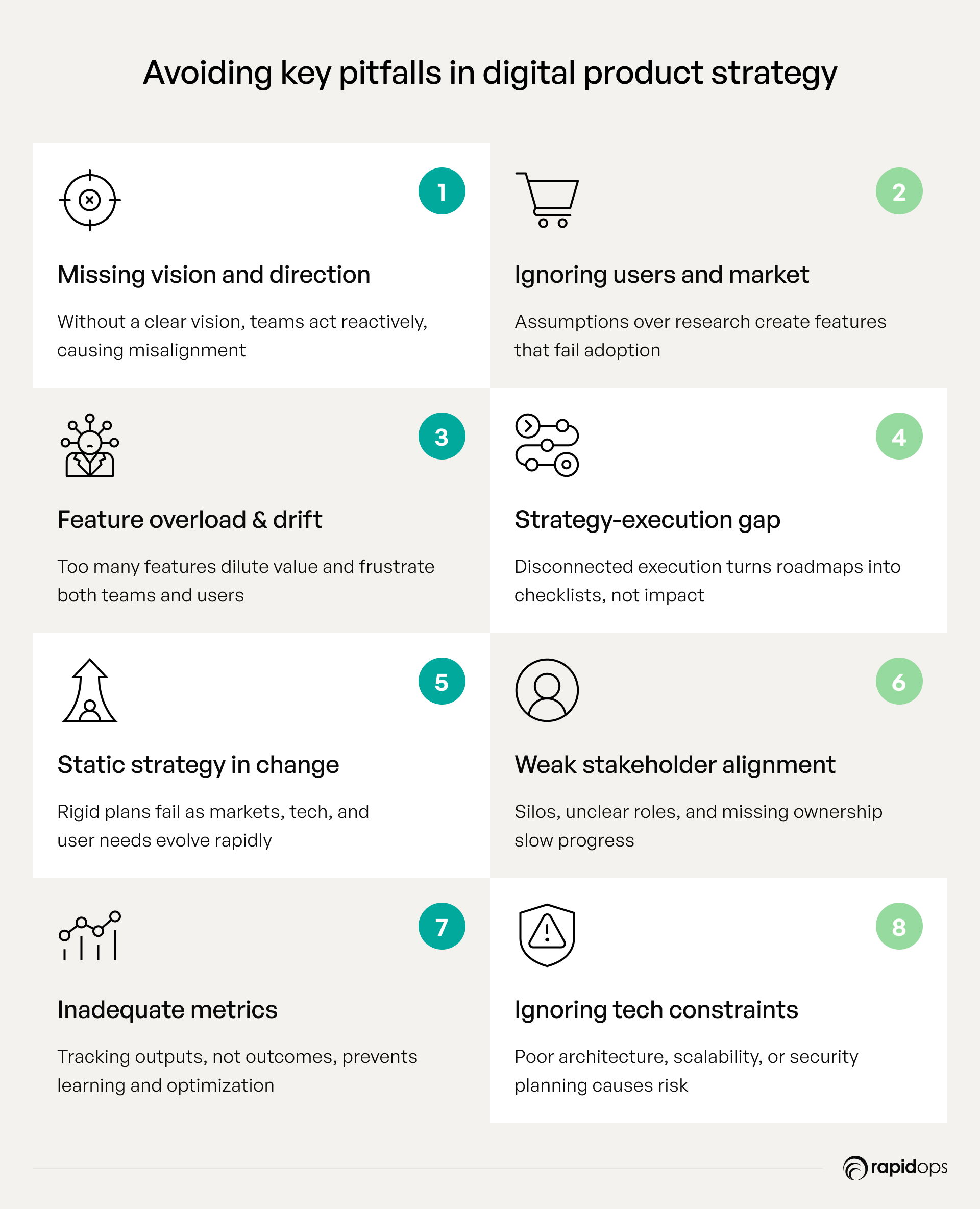
1. Lack of clear vision and strategic direction
Launching without a compelling product vision or strategic intent is one of the most damaging errors. Without this foundation, your product teams make reactive decisions, leading to a fragmented product roadmap and misaligned business objectives. Pitfalls here include vague goals, shifting priorities, and disconnects between product managers and business stakeholders. In 2026, organizations with unclear digital product strategies see up to 40% lower adoption rates and wasted investment.
2. Ignoring real user needs and market evidence
A digital product strategy built on assumptions rather than user research and market trends is almost destined to fail. Skipping structured market research or neglecting target audience insights leads to features that don’t solve core user needs, creating low adoption and costly pivots. Pitfalls include designing for internal preferences, ignoring competitor benchmarks, and failing to analyze target market gaps.
3. Feature overload and strategic drift
Adding too many features, commonly called feature creep, dilutes product value and frustrates users. Pitfalls include overcomplicating the development process, spreading team members too thin, and losing sight of precise objectives. Without discipline, even strong digital product strategies fail to achieve product-market fit, and your product’s competitive advantage erodes.
4. Disconnect between strategy and execution
A strategy is only as effective as its execution. Pitfalls arise when digital strategy and digital product development operate in silos. This causes roadmaps to become checklists rather than actionable plans, and feedback loops from execution fail to inform strategy refinement. Teams may deliver outputs that don’t align with business goals, undermining desired outcomes and wasting resources.
5. Static strategy in a dynamic environment
Treating your digital product strategy framework as fixed is risky. Markets, technologies, and user behavior evolve rapidly. Pitfalls include ignoring emerging technologies like AI, failing to adjust for market trends, and neglecting iterative learning. Without continuous updates, your digital products risk obsolescence, and your competitive edge diminishes.
6. Poor stakeholder alignment and ownership
Misalignment among business stakeholders, product teams, and leadership slows progress and causes internal friction. Pitfalls include unclear roles, siloed decision-making, and a lack of ownership by digital product leaders. This leads to inconsistent messaging, conflicting priorities, and delayed product launches, weakening both product vision and strategic intent.
7. Inadequate metrics and measurement systems
Failing to track meaningful key performance indicators (KPIs) undermines your digital strategy. Common pitfalls include focusing on outputs (features shipped, sprints completed) rather than outcomes (adoption, user feedback, business growth). Without qualitative and quantitative metrics, organizations cannot refine their product roadmap or ensure the product’s future success.
8. Underestimating technical and operational constraints
Even a brilliant digital product strategy fails if technical realities are ignored. Pitfalls include choosing an incompatible tech stack, neglecting scalability, or ignoring security. Poor architecture, outdated frameworks, and lack of technical governance create risk management challenges and require expensive post-launch fixes. Forward-looking strategies integrate development process planning and entire product development lifecycle considerations from day one.
Crafting digital success through strategy and execution
In 2026, the pressure on digital products has never been greater. Rapid technological evolution, emerging AI capabilities, and ever-changing market trends mean businesses can no longer rely on incremental updates or ad-hoc solutions. Teams without a robust digital product strategy risk misalignment, wasted resources, and lost competitive advantage, while customers increasingly expect seamless, personalized, and innovative experiences.
A truly effective digital product strategy unites your business objectives, target audience insights, and emerging technologies into a coherent, actionable framework. It ensures your product roadmap drives measurable outcomes, aligns team members and stakeholders, and adapts dynamically to market shifts. By embedding continuous learning, agile execution, and strategic awareness, your organization can transform uncertainty into opportunity, delivering digital products that scale, delight users, and secure sustainable growth.
At Rapidops, we help you turn vision into action. From building robust business strategies to bringing them to life as market-ready products, we guide you every step of the way. By combining strategic intent frameworks, deep market insights, and end-to-end product expertise, we help you unlock high-impact opportunities, align initiatives, and accelerate success with clarity, confidence, and precision.
Have a product idea but aren’t sure where to start? Schedule a free consultation with one of our experts to shape a strategy, build your product, and implement it successfully, turning your vision into measurable results.

What’s Inside
- What is a digital product strategy
- Why you need a digital product strategy in 2026
- Core components of a digital product strategy
- Craft a future-ready digital product strategy in actionable steps
- Five rules of a successful digital product strategy
- Shifting from strategy to execution
- Common pitfalls to avoid in digital product strategy
- Crafting digital success through strategy and execution

Let’s build the next big thing!
Share your ideas and vision with us to explore your digital opportunities
Similar Stories
- Strategy
- undefined Mins
- February 2017


- Strategy
- 19 Mins
- August 2023

Receive articles like this in your mailbox
Sign up to get weekly insights & inspiration in your inbox.