


Every organization relies on software to keep workflows running, teams productive, and operations scalable. Yet when tools don’t fit the way people actually work, the impact goes far beyond stalled processes frustration rises, collaboration falters, and strategic momentum is compromised. Misaligned software quietly drains efficiency, wastes resources, and can even undermine your organization’s ability to respond to opportunities, threatening growth and competitive advantage.
The challenge for executives isn’t just choosing a tool; it’s ensuring technology fits your organization’s needs, rather than forcing your business to adapt to the software. Off-the-shelf solutions offer speed and ready-made functionality, but can impose rigid workflows that fail to reflect your processes. Custom-built software provides flexibility tailored to your organization’s operations but requires greater investment and development effort. The key is identifying which approach truly empowers teams, enhances productivity, and scales with your business without creating friction or wasted effort.
This guide walks executives through the critical factors for making the buy vs build decision: functionality, cost, scalability, risk, and strategic alignment. By applying this framework, you can ensure software not only works but also strengthens performance across your teams, delivers measurable business value, and positions your organization to thrive in a rapidly evolving market. When software aligns with your business, it becomes a strategic enabler rather than a constraint.
Build vs buy: Quick definitions
In 2026, software is more than a tool; it’s the foundation of how businesses operate, make decisions, and scale. When organizations talk about “build” versus “buy” software, they are referring to two fundamentally different approaches to acquiring technology, each with its own meaning and role in modern business operations. Understanding these terms clearly is essential for leaders who want technology to serve the business, not dictate it.
Build: What it really means today
Building software today means creating purpose-built systems, solutions designed around your exact business problems, operational realities, and long-term vision. Unlike earlier eras of custom development that were slow, expensive, and inflexible, modern build approaches in 2026 are defined by speed, adaptability, and strategic intent.
A purpose-built system does not ask your teams to work around software limitations. Instead, it is built on how your business actually operates your workflows, rules, edge cases, and growth ambitions. The result is software that becomes an extension of the business itself, not a constraint on it.
In this context, building software is no longer just about writing code. It is about deliberately shaping technology to support differentiation, innovation, and sustained scalability.
Vision-driven innovation
Custom-built software starts with your idea, not someone else’s assumptions. It is designed around your vision of how the business should operate, how users should experience it, and how value should be created. This freedom enables organizations to innovate, whether by introducing new workflows, unique customer experiences, or entirely new digital capabilities that off-the-shelf tools cannot support.
Business-first design
The software is engineered around real-world processes and business rules, ensuring operations are supported as they are, rather than being reshaped to fit a predefined tool. This alignment reduces friction, increases adoption, and preserves the logic that makes the business competitive.
Integration with existing systems
Modern built solutions are designed to integrate seamlessly with existing platforms, data sources, and tools. APIs, event-driven architectures, and shared data layers ensure workflows remain connected across departments instead of creating new silos.
Scalability and continuous evolution
Purpose-built systems are modular by design. They can scale, evolve, and adapt as the organization grows, regulations change, or market conditions shift, without requiring a complete rebuild.
Full control over functionality
Organizations retain complete ownership over features, workflows, and decision logic. This control ensures the system solves specific business needs without compromise, unnecessary complexity, or dependency on external product roadmaps.
Modern development practices
Built using cloud-native infrastructure, modular architectures, and API-first approaches, today’s custom software is faster to develop, easier to maintain, and far more adaptable than traditional custom systems of the past.
In essence, building software today is a strategic capability, not a technical preference. Purpose-built systems allow organizations to solve their exact problems, innovate on their own terms, and evolve confidently as business and operational demands change.
Buy: What it really means today
Buying software today means adopting pre-built, market-ready platforms, typically off-the-shelf products or SaaS solutions, designed to solve common business problems through standardized features and workflows. These systems are built for broad applicability, stability, and speed of deployment rather than deep alignment with every unique operational nuance.
In contrast to purpose-built solutions, bought software prioritizes immediate usability and proven reliability. Organizations adopt these tools to quickly enable core capabilities, reduce implementation effort, and rely on vendor-led maintenance and updates.
Ready-to-deploy platforms
Pre-configured solutions allow organizations to implement software quickly, accelerating time-to-value and operational readiness without extensive development or setup.
Standardized workflows and structures
Bought software is designed around widely accepted industry practices. While this standardization improves consistency and ease of use, it also means businesses often adapt their processes to fit the software rather than the other way around.
Limited but practical customization
Most modern off-the-shelf platforms offer configuration and customization options such as settings, extensions, plugins, or low-code adjustments. However, these changes operate within predefined boundaries. Core logic, data models, and workflows cannot be fully customized, limiting how deeply the software can be tailored to unique business requirements.
Integration options
Many commercial platforms provide APIs, connectors, and marketplace integrations that allow them to work alongside existing systems. While integration is often feasible, it may be constrained by vendor-defined rules and technical limits.
Predictable costs and licensing models
Subscription-based or licensing structures provide clear pricing and predictable costs. This financial transparency makes buying software easier to budget for, particularly for well-understood and stable use cases.
Vendor-managed support and updates
Maintenance, security patches, feature updates, and technical support are handled by the vendor. This reduces internal operational burden and ensures the platform remains stable and compliant over time.
In essence, buying software today is about speed, reliability, and access to proven capabilities. While these solutions may not perfectly fit every unique workflow, they provide structured, dependable tools that support common business needs efficiently. The value of Buy lies in rapid implementation and operational consistency, rather than deep customization or differentiation.
When buying off-the-shelf software makes more sense
Buying off-the-shelf software becomes the right choice when the business needs a proven, ready-made solution for standardized functions, quick deployment, or cost predictability. In 2026, with the growing complexity of operations and the proliferation of SaaS and cloud-based tools, understanding when pre-built solutions fit your business is crucial to avoid misalignment, wasted resources, or operational inefficiencies.
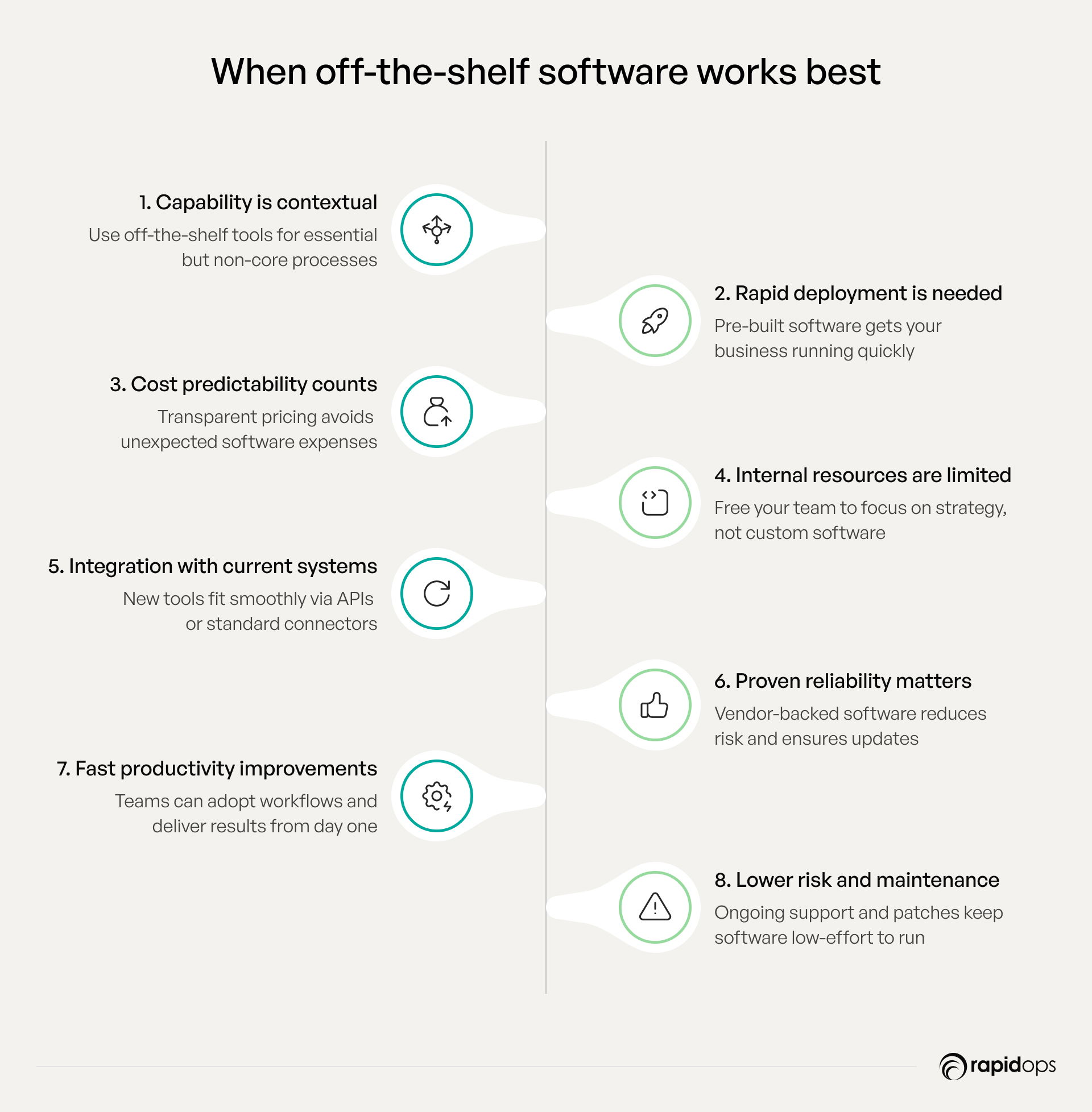
When the capability is contextual, not core
Off-the-shelf software is ideal for processes that are essential but not differentiating. Examples include HR management, payroll, finance, or compliance systems, functions that follow industry standards and don’t define your competitive edge.
When rapid deployment is needed
Businesses that require quick operational readiness benefit from ready-made software, as it is pre-tested, immediately implementable, and often supported by strong vendor ecosystems.
When cost predictability is important
SaaS or licensed solutions provide transparent subscription or licensing models, which help control expenses and avoid unpredictable costs associated with custom development.
When internal resources are limited
Organizations lacking large technical teams or development capacity find off-the-shelf solutions more practical, allowing internal talent to focus on strategic, core business activities rather than software creation.
When integration with existing systems is feasible
Buying software is a suitable option when your existing systems are capable enough to integrate new tools or platforms through available APIs, connectors, or standard interfaces. In such cases, off-the-shelf solutions can be introduced without disrupting established workflows, provided those systems already support interoperability.
When the business seeks proven reliability
Buying software ensures tested performance, vendor-backed support, and continuous updates, reducing operational risk for functions that do not require unique customization.
When immediate productivity gains are required
For standardized workflows, pre-built software can accelerate adoption and enable teams to be productive from day one. However, careful assessment ensures that the solution fits the way your teams work rather than forcing process changes.
When SaaS adoption aligns with operational scale
More than 80% of companies now use at least one SaaS application, with many deploying dozens to support business functions. This highlights that buying is suitable when standardized solutions can efficiently meet operational needs.
When minimizing risk and maintenance is a priority
Pre-built software typically includes ongoing vendor support, updates, and security patches, making it ideal for non-core capabilities where reliability and low maintenance effort are critical.
In short: Buying off-the-shelf software makes sense when the business function is standardized, cost-sensitive, ready to deploy quickly, or non-differentiating, and when the solution can fit your workflows without forcing major process changes. This ensures software serves the business rather than the business bending to software limitations.
When building software becomes a competitive advantage
Building software becomes the optimal choice when a company’s unique processes, core operations, or strategic differentiators cannot be fully supported by pre-built solutions. In 2026, businesses face increasingly complex workflows, multiple integrated systems, and evolving customer expectations. Understanding when custom product development provides a real advantage is critical to ensuring technology serves the business, not the other way around.
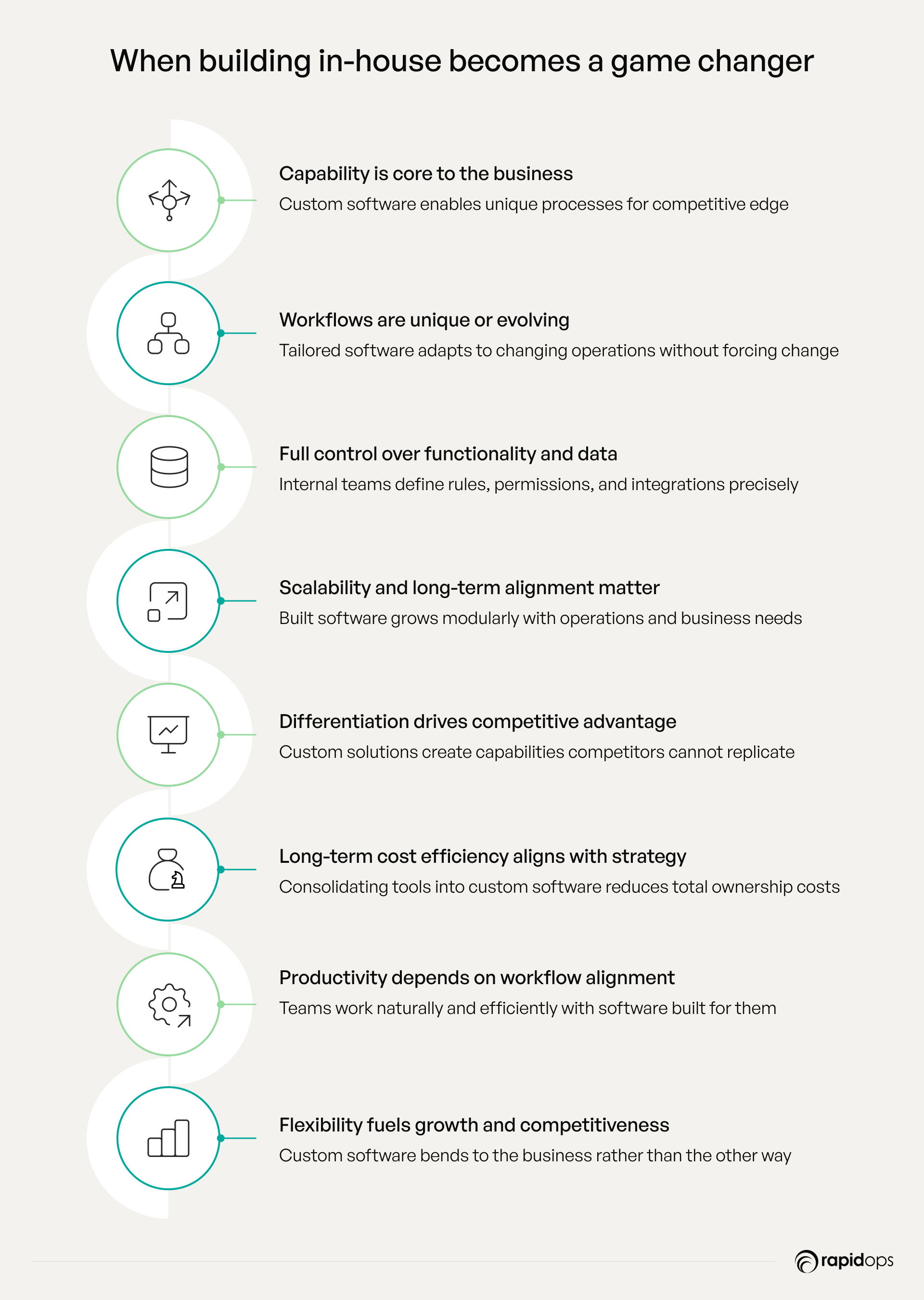
When the capability is core to the business
Custom software becomes a strategic differentiator when it supports capabilities central to how a company competes and delivers value. Core capabilities such as proprietary analytics, AI-driven insights, specialized workflows, or unique customer experiences require purpose-built systems designed around business rules, distinctive logic, and strategic objectives. Building in these areas enables organizations to codify knowledge, embed innovation, and deliver solutions and experiences competitors cannot replicate, turning software into a living extension of the business that sustains long-term competitive advantage.
When workflows are unique or rapidly evolving
Businesses with specialized processes or workflows that frequently change benefit most from custom solutions. Software tailored to the way teams actually work allows operations to evolve without forcing process adjustments. Research indicates that around 55% of organizations report improved productivity through software aligned with workflows, demonstrating the measurable impact of building software that fits business reality. Innovative product development principles are key to creating adaptable solutions that evolve alongside these processes.
When full control over functionality and data is required
Enterprises managing sensitive data, proprietary logic, or multiple data sources need complete control over the software environment. Custom-built software allows internal teams to define rules, permissions, and integrations precisely, reducing dependency on external vendors and enabling rapid adaptation to changing business needs.
When scalability and long-term alignment are priorities
As a company grows, built software can scale alongside operations, supporting new products, higher volumes, or expanded markets. Unlike pre-built solutions, custom systems can evolve modularly, ensuring that technology adapts to growth without forcing inefficient workflows.
When differentiation drives competitive advantage
Custom software becomes a strategic differentiator when it enables capabilities competitors cannot replicate. Executives report that 48% of organizations gain significant competitive advantage from custom software, demonstrating its role in creating market-leading processes, insights, and operational efficiency. (LinkedIn)
When long-term cost efficiency aligns with strategy
While building software may have higher upfront costs, the long-term benefits can be substantial. Many enterprises reduce the total cost of ownership by up to 25% over five years by consolidating multiple off-the-shelf tools into a single, custom system, eliminating licensing redundancies and minimizing integration overhead. (Peyto Soft)
When productivity and team adoption depend on workflow alignment
Standard software often forces employees to adapt their processes to the tool, creating friction. Custom software aligns with existing workflows, enabling teams to work naturally and efficiently, reducing onboarding time, operational errors, and resistance to adoption.
In short, Building software becomes a competitive advantage when the business requires flexibility, proprietary capabilities, workflow alignment, scalability, or strategic differentiation. In these scenarios, custom software bends to the business, not the other way around, ensuring that every investment directly supports growth, efficiency, and long-term competitiveness.
Key differences between buying and building software
“Each software choice carries weight beyond technology it affects speed, control, and how your business adapts to change. Some solutions offer full customization and ownership, demanding time and expertise, while others accelerate progress but limit flexibility. The path you take can shape innovation, efficiency, and your competitive edge, making this decision one of the most strategic a business can make.”
1. Control and customization: Flexibility vs limitations
Building software
Developing software in-house allows complete control and full customization, letting you embed specific functionality, custom functions, and unique business rules tailored to your operations. This ensures the software works according to your business, not the other way around. It also allows for ongoing maintenance and future additional functionality as your business grows.
Buying software
Off-the-shelf solutions, SaaS platforms, or point solutions offer limited configuration. While they cover core features, they often require your team to adapt workflows to the software. Vendor lock-in can limit full control, making long-term differentiation harder.
2. Time-to-market: Speed of buying vs development timelines
Building software
Developing custom software internally or with external software developers takes longer due to planning, design, development, and testing cycles. Projects can span months or even years, especially for multiple systems or complex integrations.
Buying software
Pre-existing solutions allow faster deployment. Businesses can leverage existing tools immediately, reducing delays in operations or project launches. Off-the-shelf software is ideal when speed is critical to business operations or revenue impact.
3. Costs: Upfront vs subscription-based
Building software
Upfront investment is higher due to software development, project management, and technical teams. However, over time, building can be cost-effective by consolidating multiple point solutions, reducing opportunity cost, and avoiding recurring subscription fees. For many companies, the total cost of ownership can be reduced by up to 25% over five years compared with managing multiple off-the-shelf tools. (Peyto Soft)
Buying software
Subscription-based models or licensing reduce initial capital expenditure. They are predictable and easier for budgeting, but costs can accumulate if multiple solutions are required to cover all business needs.
4. Maintenance and updates: Internal vs vendor-managed
Building software
Your internal support team handles ongoing maintenance, updates, and enhancements. While this requires resource allocation, it allows for full control, tailored updates, and immediate adaptation to business changes.
Buying software
Vendors provide ongoing support, updates, and security patches. This reduces the burden on your internal teams but introduces dependency on the vendor’s timelines and priorities, which may affect the flexibility of project management or the addition of custom functions.
5. Scalability and future-proofing: Flexibility and long-term adaptability
Building software
Custom solutions can be designed to scale as the company grows, integrate with multiple data sources, and adapt to changing business rules or new software needs. They are future-proofed to support growth, new workflows, and emerging technologies such as AI or low-code expansions.
Buying software
Pre-built solutions have limitations in scalability and may require multiple point solutions or replacements as the company evolves. They are best suited for non-core capabilities that do not define competitive advantage.
Pros and cons of build vs buy software at a glance
| Factor | Build (Custom software) | Buy (Off-the-shelf / SaaS) |
| Cost | Higher upfront investment, potential long-term cost savings | Lower initial cost, ongoing subscription/licensing fees |
| Time-to-market | Longer development timeline due to building in-house or custom solution design | Fast deployment with pre-existing software, suitable for immediate needs |
| Customization | Full customization, control over specific functionality | Limited customization, mostly core features, may need workflow adaptation |
| Maintenance | Managed internally; allows ongoing support and updates aligned with business goals | Vendor-managed; reduces internal burden but limits full control |
| Scalability | Designed to scale with business growth, adaptable to multiple systems | Limited by vendor constraints; may require additional tools for expansion |
| Risk | Higher initial development risk; mitigated by project management and technical teams | Lower development risk, but potential vendor lock-in and dependency |
Why choose off-the-shelf software
For many businesses, off-the-shelf software provides a practical, efficient, and low-risk solution to meet operational needs quickly. In 2026, as companies face increasingly complex processes, multiple systems, and rapid market demands, these solutions remain relevant for non-core business functions that require speed and predictability.
Rapid deployment and faster ROI
Off-the-shelf software can often be deployed in a matter of weeks or months, providing immediate operational impact. For companies that need to quickly address process gaps, ensure continuity, or standardize workflows, buying software reduces delays associated with planning, development, and testing cycles. This leads to faster realization of return on investment, allowing teams to focus on core business goals rather than software development challenges.
Prebuilt features, vendor support, and compliance
These solutions come with well-tested features, ongoing vendor updates, and compliance frameworks built in. Organizations can reduce internal workload, rely on automatic security patches, and ensure that systems remain aligned with industry regulations and data governance standards. This is especially critical for businesses operating in highly regulated industries or those managing multiple data sources.
Ease of adoption and standardization
Off-the-shelf solutions follow established workflows and best practices, minimizing change management friction. Teams can adopt the software quickly, and employee training is often streamlined because the workflows are widely understood. For businesses with limited IT resources or technical teams, this reduces the learning curve and enables consistent, reliable operational performance.
In essence, off-the-shelf software provides predictable, reliable, and fast solutions for business functions that do not require differentiation or proprietary capabilities, ensuring immediate value with minimal operational disruption.
Why opt for building custom software
Custom software is the strategic choice for businesses seeking competitive advantage, full control, and long-term adaptability. Unlike off-the-shelf options, it ensures that technology aligns perfectly with business workflows, enhances differentiation, and scales with evolving needs.
Tailored to exact business requirements
Custom-built software is designed to fit the unique workflows, business logic, and operational rules of your organization. This eliminates the need for teams to adjust processes to the software, enabling higher efficiency, problem-solving aligned with your business goals, and reduced friction across multiple systems. By designing around your operations, you ensure that the software enhances productivity and user satisfaction.
Full control over architecture, security, and integration
With custom software, organizations maintain complete control over system architecture, data management, and integrations. This allows enterprises to implement custom compliance measures, payment processing workflows, and advanced business rules, while maintaining full control over ongoing maintenance and updates. The result is a system that evolves in tandem with your business, rather than being constrained by vendor timelines.
Supports differentiation and unique workflows
Custom software enables proprietary features and processes that are difficult for competitors to replicate, creating tangible competitive advantages. From AI-driven automation to workflow optimization, these systems empower companies to offer unique experiences and optimize strategic capabilities.
Greater flexibility for scaling and future enhancements
A modular, extensible architecture ensures that custom software grows with your business. Whether integrating new tools, expanding product lines, or adapting to rapidly changing market conditions, custom solutions provide the flexibility to evolve continuously. This is particularly important in 2026, where businesses face increasingly complex multi-system environments, evolving AI workflows, and dynamic customer expectations.
In summary, building custom software ensures that your technology serves your business, supports differentiation, provides long-term scalability, and aligns perfectly with evolving operational requirements. It is an investment in both operational efficiency and strategic advantage.
Total cost of ownership (TCO) breakdown
Understanding the total cost of ownership (TCO) is crucial when deciding whether to build or buy software. TCO goes beyond the initial price tag, encompassing all direct and indirect costs over the software’s lifecycle. A thorough evaluation ensures businesses make informed investments, avoid hidden expenses, and allocate resources efficiently.
Upfront costs for building vs buying
When building software, upfront costs can include software development, design, project management, and infrastructure setup. These costs are often higher than buying off-the-shelf solutions but come with the benefit of complete control, tailored functionality, and alignment with business rules.
Buying software typically requires a license fee, subscription, or one-time purchase, which is usually lower than building custom software. However, these costs may not cover all future integrations, customizations, or scaling needs, so it’s essential to evaluate the total impact.
Ongoing maintenance, licensing, and staffing costs
TCO also includes ongoing expenses:
- Building software: you’ll need dedicated developers, support teams, and maintenance cycles. While this ensures full control over updates and enhancements, it also demands resource allocation and carries opportunity costs if internal teams are stretched thin.
- Buying software: subscription fees, vendor support, and licensing costs are predictable, but businesses are often dependent on the vendor for updates, patches, and support, which can limit flexibility and require adaptation to vendor timelines.
Hidden and long-term operational costs
Hidden costs can significantly affect TCO. For built software, this may include unanticipated development iterations, debugging, infrastructure scaling, and compliance updates. For off-the-shelf solutions, hidden costs may arise from integration with existing systems, data migration, or the need for workarounds to fit business-specific workflows. In both cases, businesses must look beyond the sticker price and consider these costs over the software’s expected lifecycle to avoid surprises that could impact budgeting and operational efficiency. For practical strategies to identify and manage these hidden expenses, businesses can refer to 11 tested & proven ways to reduce IT costs for your business, which provides actionable insights to optimize IT spending and improve cost predictability.
Short-term vs long-term cost-effectiveness
While buying software often provides short-term cost savings and faster deployment, building software can be more cost-effective over the long term, particularly when considering:
- Reduction in reliance on multiple off-the-shelf solutions
- Elimination of repetitive vendor fees
- Increased efficiency through tailored workflows
- Avoidance of ongoing customization costs
Many enterprises report that custom-built software reduces total cost of ownership by up to 25% over five years compared with using multiple off-the-shelf products, highlighting the long-term financial benefit of strategic investment.
How TCO influences the final decision
A comprehensive TCO analysis ensures leaders weigh upfront costs against long-term operational, maintenance, and opportunity costs. It provides a clear picture of resource allocation, scalability, and sustainability, helping businesses confidently decide which capabilities should be built in-house and which can be purchased.
By evaluating TCO, companies can make decisions that balance immediate needs with future growth, ensure cost-effectiveness, and maintain alignment between technology and business operations, keeping software a driver of efficiency rather than a constraint.
Building software with low-code or hybrid approaches
Low-code and hybrid approaches allow organizations to build software tailored to their business needs using pre-built, standardized components, enabling faster deployment and alignment with existing workflows. However, these approaches cannot create entirely new or unique capabilities, because the same components are available to anyone. For companies seeking truly distinctive solutions or experiences that provide competitive differentiation, the only option is to partner with a digital product development team to build software from scratch, ensuring originality and strategic advantage.
Low-code solutions: Rapid development with some customization
Low-code platforms allow businesses to create applications with minimal hand-coding, using visual interfaces, drag-and-drop modules, and prebuilt templates. This enables rapid development and deployment, often reducing timelines from months to weeks. Teams can tailor workflows, integrate data sources, and implement specific business rules without requiring full-scale software development.
For many organizations, low-code is a cost-effective way to respond quickly to changing business needs, enabling operational improvements without overburdening technical teams. However, while low-code solutions provide speed and flexibility, they may not support extremely complex, highly differentiated workflows that are core to a business’s competitive advantage.
Understanding the difference between low-code vs no-code is critical. No-code platforms are ideal for simple applications that require minimal customization, while low-code platforms offer more control and flexibility for workflows that need to align with strategic business objectives. Choosing the right approach ensures teams can respond quickly without sacrificing the capability to scale or differentiate.
Hybrid approaches: Combining off-the-shelf core with custom modules
Hybrid models blend the stability of off-the-shelf software with the flexibility of custom-built modules.
- The off-the-shelf component provides proven core functionality, vendor support, and compliance adherence, reducing risk and accelerating deployment.
- Custom modules address unique business processes, proprietary features, or integration requirements, ensuring the solution aligns with specific workflows rather than forcing the business to adapt.
- Hybrid solutions allow organizations to balance time-to-market, cost-effectiveness, and operational control, delivering the best of both worlds.
How hybrid models can offer the best of both worlds
By leveraging hybrid approaches, businesses can:
- Maintain operational continuity while implementing tailored enhancements.
- Reduce dependency on multiple off-the-shelf products, lowering TCO and simplifying maintenance.
- Ensure flexibility for scaling and future enhancements, as custom modules can evolve alongside the business.
- Achieve faster ROI compared to fully building complex custom software from scratch.
This approach is particularly valuable for enterprises managing multiple systems, integrating legacy infrastructure, or requiring rapid deployment of AI-driven workflows, ensuring technology works in service of the business, not the other way around.
Situations where low-code or hybrid is most effective
Low-code and hybrid approaches are most effective when:
- Businesses need rapid deployment without sacrificing key customization.
- There are limited internal technical resources, but a desire to maintain some control over functionality.
- Operations involve standardized processes with a few critical differentiators that require bespoke handling.
- Organizations want to reduce risk and cost compared to fully custom development while avoiding vendor lock-in.
By strategically using low-code or hybrid approaches, businesses in 2026 can accelerate innovation, improve operational efficiency, and ensure software aligns with core business goals, all while maintaining flexibility to evolve with changing market demands.
How to decide what to build and what to buy
Deciding whether to build a custom solution or buy pre-existing software is one of the most critical strategic choices your business will make in 2026. This decision goes beyond technical preference; it influences how your business competes, how efficiently you operate, and how quickly you can adapt to market changes. The right approach can unlock innovation, strengthen differentiation, and deliver measurable value. The wrong choice can create inefficiencies, slow operations, and limit your ability to scale.
To make this decision with confidence, consider the following structured framework, which blends strategic thinking with practical trade-offs:
1. Does this capability define your competitive advantage?
Identify the functions that truly differentiate your business. Ask yourself: “Will this capability allow us to create value that competitors cannot replicate?” Capabilities that directly influence revenue, customer experience, or operational uniqueness often require custom solutions. Embedding proprietary workflows, business rules, and analytics into software ensures that your technology becomes a living extension of your strategy, rather than a generic tool. Non-core or standardized functions, in contrast, may be efficiently addressed through pre-built solutions.
2. How specialized are your workflows and processes?
Evaluate the uniqueness and complexity of your internal workflows. If your processes involve specialized logic, unique compliance requirements, or multi-system orchestration, pre-existing software may force compromises that hinder efficiency or innovation. Custom-built solutions allow you to encode your business knowledge, streamline operations, and create differentiated experiences. Conversely, if workflows are largely standardized, buying or leveraging hybrid solutions can save time and resources without sacrificing outcomes.
3. What is the urgency of deployment and time-to-value?
Assess how quickly your business needs a working solution. Rapid deployment is often critical for addressing operational gaps or capitalizing on market opportunities. Buying software or leveraging low-code/hybrid approaches can provide immediate operational impact, while full custom builds take longer but ensure long-term alignment, scalability, and differentiation. The key is balancing speed with strategic value: when rapid deployment is needed, hybrid or low-code solutions may bridge the gap until a fully custom solution is feasible.
4. Do you have the internal resources and expertise?
Consider your team’s technical capacity, experience, and bandwidth. Building custom software requires skilled developers, project management, and ongoing maintenance capabilities. Pre-built or hybrid solutions reduce internal workload but often limit flexibility for unique features. Align your decision with both your current capacity and long-term operational goals, ensuring your software strategy is sustainable without overburdening your teams.
5. How dynamic or evolving is this capability?
Dynamic capabilities, those that must adapt rapidly to customer expectations, regulatory changes, or emerging technologies, benefit from custom or modular solutions designed for flexibility. Stable, predictable capabilities can often be addressed efficiently with pre-existing software. Consider future growth, integration needs, and potential scalability, ensuring your solution can evolve without constant rework.
6. What is the long-term cost and operational impact?
Beyond upfront costs, evaluate the total cost of ownership (TCO), including maintenance, updates, integration, and scalability. Custom solutions may require a higher initial investment but can reduce dependency on multiple point solutions, avoid recurring fees, and optimize workflows over time. Pre-built solutions can lower initial costs and speed deployment, but may require additional integrations or workarounds in the long term. Evaluate both financial and strategic implications to make a balanced, forward-looking decision.
Bringing it together: A repeatable framework
By systematically applying these questions, you can determine which capabilities to build, buy, or hybridize, while ensuring alignment with strategic objectives. This framework helps you:
- Focus internal resources on functions that truly drive differentiation.
- Identify where pre-existing solutions deliver efficiency without compromise.
- Balance speed, cost, control, and scalability for optimal outcomes.
- Embed innovation and unique operational logic into your technology to sustain competitive advantage.
Think of this framework as a decision compass: it doesn’t just tell you what to do, it helps you understand why, prompts reflection, and ensures your choices maximize value, mitigate risk, and support long-term growth. By applying it consistently, your software investments become strategic assets, driving operational excellence, differentiation, and enduring competitive advantage.
Turning build vs buy decisions into growth-driving strategies
After exploring the full spectrum of build vs buy decisions, from recognizing when off-the-shelf software fits, to identifying opportunities where custom solutions drive competitive advantage, evaluating total cost of ownership, and considering hybrid approaches, it’s clear that strategic alignment is key to success.
For business leaders in 2026, the real challenge is choosing software that evolves with your operations, streamlines workflows, and delivers measurable business impact. Misaligned solutions can slow teams, create hidden costs, and limit growth, while the right approach turns technology into a powerful driver of efficiency and competitive advantage.
For over 17 years, Rapidops’ global team of software experts has helped businesses build on-demand software solutions that translate strategic vision into scalable, growth-driving products. We partner with leading brands to optimize workflows, eliminate operational bottlenecks, and implement systems designed to adapt and grow with your business. The result is smoother operations, faster decision-making, measurable ROI, and a sustainable competitive edge in a rapidly evolving market.
Struggling to decide whether to build or buy software? Speak with our experts for a free assessment of your business needs, actionable insights, and clear recommendations on the most effective path forward, turning every software decision into a growth-driving strategy.

What’s Inside
- Build vs buy: Quick definitions
- When buying off-the-shelf software makes more sense
- When building software becomes a competitive advantage
- Key differences between buying and building software
- Why choose off-the-shelf software
- Why opt for building custom software
- Total cost of ownership (TCO) breakdown
- Building software with low-code or hybrid approaches
- How to decide what to build and what to buy
- Turning build vs buy decisions into growth-driving strategies

Let’s build the next big thing!
Share your ideas and vision with us to explore your digital opportunities
Similar Stories
- Strategy
- undefined Mins
- February 2017


- Transformation
- undefined Mins
- March 2022

Receive articles like this in your mailbox
Sign up to get weekly insights & inspiration in your inbox.