


Every leader eventually reaches a point where the pace of decisions outgrows the systems built to support them. Maybe you’ve felt it recently when a strategic choice demanded faster clarity, when a market shift forced you to re-evaluate assumptions, or when a critical judgment call required connecting insights across multiple functions in seconds, not days. This tension isn’t a sign of inefficiency; it’s the new normal for executives in 2025.
Organizations are generating more data than ever before, yet leaders are experiencing a widening gap between what they see and what they can act on with confidence. You already know this firsthand. You’ve invested in analytics, dashboards, forecasts, and AI pilots. You have visibility, insights, and reports flowing across teams. But even with all of it, the question remains: how do you turn all this information into consistent, high-quality, and scalable decisions?
This is precisely where decision intelligence becomes critical. It doesn’t add more data; it converts what you already have into actionable, strategic guidance. It evaluates context, simulates trade-offs, anticipates outcomes, and recommends the best next step, helping leaders act with clarity, speed, and confidence. Early adopters report up to 70% better decision accuracy, lower operational risk, and faster, more aligned execution, not because they work differently, but because their decisions are now supported by intelligent guidance.
And that brings us to the purpose of this guide. The 25 best decision intelligence tools highlighted here aren’t just software; they form the backbone of modern decision-making infrastructure. These tools help organizations turn complexity into clarity, speed into confidence, and insight into true competitive advantage.
What is decision intelligence
Decision intelligence (DI) is the discipline of structuring, analyzing, and optimizing decisions within an organization by combining data, advanced analytics, machine learning, and human expertise. It transforms structured and unstructured data into a framework that supports consistent, informed decision-making, ensuring clarity and reliability in each choice.
A decision intelligence platform captures relevant data sources, applies business rules and decision logic, and generates actionable insights that can guide decision makers and business users. It is designed to be accessible to non-technical users, enabling organizations to leverage AI-powered insights alongside human judgment without requiring specialized technical skills.
At its core, decision intelligence is not just about analyzing data; it formalizes how organizations interpret information, model potential outcomes, and structure decisions so that each action is deliberate, data-driven, and aligned with organizational objectives. It provides a systematic approach for converting complex data into clear, decision-ready guidance.
Decision intelligence vs business intelligence
Business intelligence has long served as the foundation for organizations seeking to understand historical performance. It provides dashboards, key performance indicators, and reports that allow teams to monitor trends, detect anomalies, and evaluate past actions.
Business intelligence primarily relies on structured data and often requires analysts or data scientists to interpret results for decision makers, as discussed in business intelligence shaping retail industry.
While it excels at reporting and diagnosing what has occurred, business intelligence is fundamentally retrospective, offering limited guidance on future decisions or risk mitigation, even with advancements like AI for business intelligence.
Decision intelligence, in contrast, is designed to guide what should happen. A decision intelligence platform integrates structured and unstructured data, applies decision logic, business rules, predictive analytics, and machine learning models, and combines these with human expertise.
Decision intelligence does not simply generate insights; it provides a structured framework for decision-making, evaluating potential outcomes, assessing risks, and recommending the most effective actions. This empowers decision-makers and non-technical business users to act with clarity and confidence, accelerating decision-making while maintaining rigor and consistency.
The distinctions between business intelligence and decision intelligence can be summarized across several dimensions:
| Aspect | Business intelligence | Decision intelligence |
| Purpose | Understand historical performance | Optimize decisions and model future outcomes |
| Data sources | Structured data from internal systems | Structured and unstructured data across platforms and workflows |
| Analytics | Descriptive and diagnostic | Predictive, prescriptive, and artificial intelligence-powered |
| Users | Analysts, data teams | Business leaders, decision makers, non-technical users |
| Decision support | Reports, trends, and alerts | Optimized decision-making processes, scenario simulations, and risk assessment |
| Outcome | Insights and trend understanding | Strategic, high-confidence, actionable decisions that drive measurable business value |
In practical terms, business intelligence informs, while decision intelligence directs. Business intelligence provides historical insights and visibility, whereas decision intelligence turns those insights into actionable guidance, aligning every decision with strategy and informed reasoning.
For executives navigating financial volatility or operational risk, this distinction is critical: decision intelligence converts data into consistent, high-quality, and strategic decisions, bridging the gap between insight and execution.
Together, business intelligence and decision intelligence form a comprehensive intelligence ecosystem, enabling organizations to not only understand past performance but also make faster, smarter, and more confident decisions across all business functions.
Understanding the different types of decisions
In every organization, decisions are not created equal. They differ in scope, complexity, and impact, and understanding these distinctions is critical to making data-driven decisions that enhance outcomes. Recognizing the type of decision you’re facing allows you to prioritize attention, apply the right level of analysis, and ensure human expertise is effectively aligned with strategic goals.
Have you ever paused to consider which decisions in your day-to-day operations require immediate action and which require deeper strategic thinking? Identifying these differences is the first step toward smarter, more efficient decision-making.
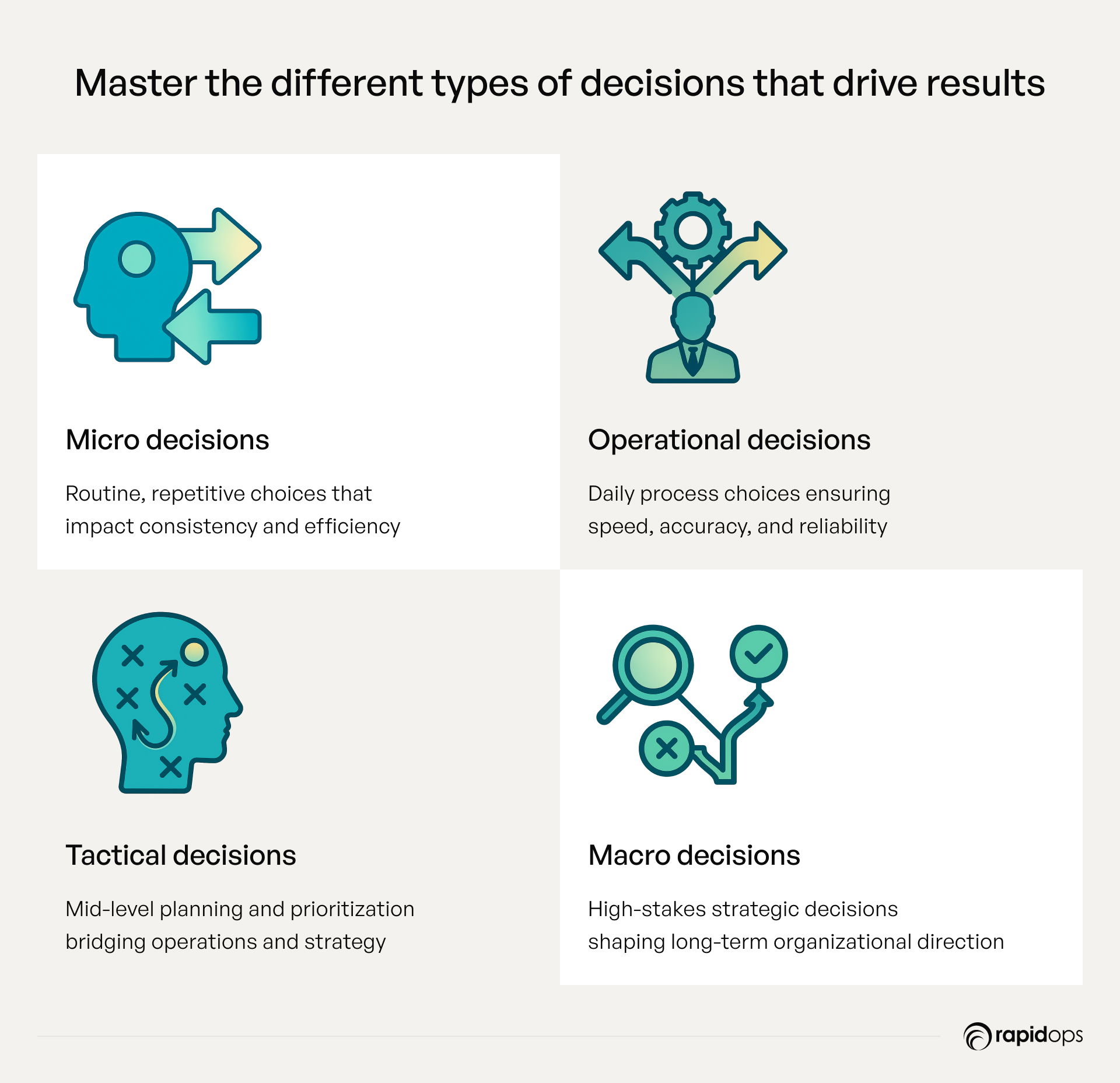
Micro decisions: Streamlining routine choices
Micro decisions are high-frequency, repetitive choices that often occur automatically, such as minor operational adjustments or standard approvals. These decisions may seem small individually, but collectively, they can consume significant time and attention. By understanding their patterns and impacts, you can ensure consistency across business functions and free up cognitive resources for more complex decisions.
Operational decisions: Managing daily processes
Operational decisions govern the essential activities that keep your organization running, production schedules, resource allocation, or order fulfillment. These decisions demand speed, accuracy, and reliability. Reflect on whether your operational choices consistently align with overall objectives and how structured and unstructured data could inform them to reduce errors and maintain steady performance.
Tactical decisions: Planning and prioritization
Tactical decisions bridge daily operations and long-term strategy. They include budgeting, workflow optimization, and team prioritization. Consider how scenario-based thinking and careful assessment of potential outcomes can guide these mid-level decisions. Tactical decisions require balance, ensuring efficiency without compromising strategic alignment.
Macro decisions: Shaping strategic direction
Macro decisions carry the highest stakes, shaping the organization's long-term trajectory. Decisions about market positioning, mergers, or major investments require integrating multiple data sources and leveraging advanced analytics to anticipate consequences. Ask yourself: are your macro choices informed by the right level of insight and structured thinking to confidently guide the organization forward?
By understanding these decision types of micro, operational, tactical, and macro, you can align your focus where it matters most, optimize decision workflows, and ensure that every choice contributes meaningfully to your organization’s goals.
Key analytics types and decision-support capabilities every business needs
Understanding your decision types is just the start. The right analytics and decision-support capabilities transform raw data into actionable insights, enabling executives to predict trends, mitigate risk, optimize operations, and make faster, smarter decisions that drive measurable business outcomes across all functions.
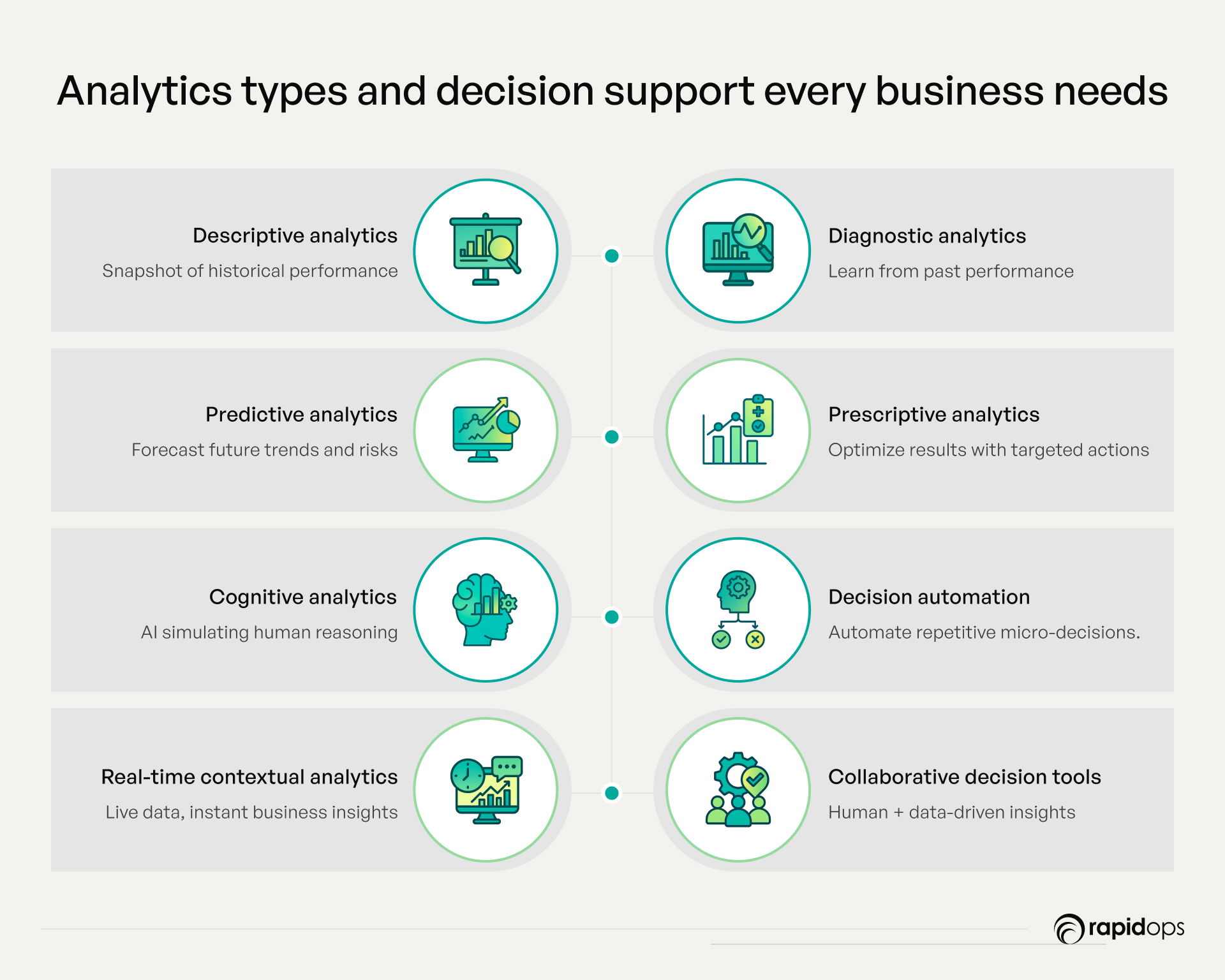
Descriptive analytics
Offers a snapshot of historical performance, allowing leaders to understand what has happened across business functions and why. It is the starting point for data-driven decision-making.
- Applications: Monthly sales and revenue reports, customer segmentation, operational performance reviews.
- Tools & techniques: Data visualization platforms, classification and clustering algorithms, business intelligence tools.
Diagnostic analytics
Investigates the reasons behind past outcomes, uncovering inaccurate or inconsistent data, operational inefficiencies, and root causes that impact strategic and tactical decisions.
- Applications: Manufacturing defect analysis, financial audit reviews, quality control investigations.
- Tools & techniques: Data mining, drill-down analytics, statistical models, and machine learning models.
Predictive analytics
Forecasts potential future outcomes using historical data, patterns, and trends. Enables executives to anticipate risks, opportunities, and operational challenges.
- Applications: Demand forecasting, sales projections, risk assessment, and financial planning.
- Tools & techniques: Regression models, neural networks, time-series analysis, AI-powered insights.
Prescriptive analytics
Moves beyond prediction to recommend specific actions that optimize outcomes, aligning decisions with organizational strategy and business rules management.
- Applications: Inventory optimization, resource allocation, route optimization, cost reduction initiatives.
- Tools & techniques: Linear programming, Monte Carlo simulations, decision trees, predictive modeling.
Cognitive analytics
Simulates human reasoning and decision logic by combining artificial intelligence, natural language processing, and advanced analytics. Supports executives in complex data-driven decisions.
- Applications: Personalized recommendations, scenario simulation in strategic planning, biotechnology pattern analysis.
- Tools & techniques: Cognitive computing platforms, neural networks, AI-powered decision-support systems.
Decision automation
Enables automated execution of high-volume micro decisions using predefined rules or algorithms, reducing manual effort and accelerating operational workflows.
- Applications: Customer service chatbots, robotic process automation in data entry, operational approvals.
- Tools & techniques: Rule-based systems, RPA, workflow automation engines.
Real-time and context-driven analytics
Provides instantaneous insights by integrating internal and external data sources, allowing leaders to respond immediately to emerging risks or opportunities.
- Applications: Social media sentiment monitoring, live campaign optimization, real-time operational dashboards.
- Tools & techniques: Stream processing platforms, cloud-based dashboards, APIs for external data integration.
Collaborative decision-making tools
Facilitates cross-functional collaboration, ensuring that human decision makers contribute their expertise while aligning with data-driven insights.
- Applications: Product development planning, corporate strategy sessions, policy formulation.
- Tools & techniques: Collaborative software platforms, feedback collection tools, integrated decision workflows.
Combined, these analytics and decision-support capabilities turn complex data into actionable insights, bridging the gap between information and execution. Leaders can anticipate outcomes, optimize strategies, reduce risk, and drive faster, smarter decisions across all business functions.
Core components that power modern decision intelligence tools
Modern decision intelligence tools are more than just software; they are sophisticated combinations of technologies, methodologies, and workflows that transform structured and unstructured data into actionable insights to support critical business decisions. These tools empower organizations to bridge the gap between information and execution, enabling faster, more confident, and scalable decision-making.
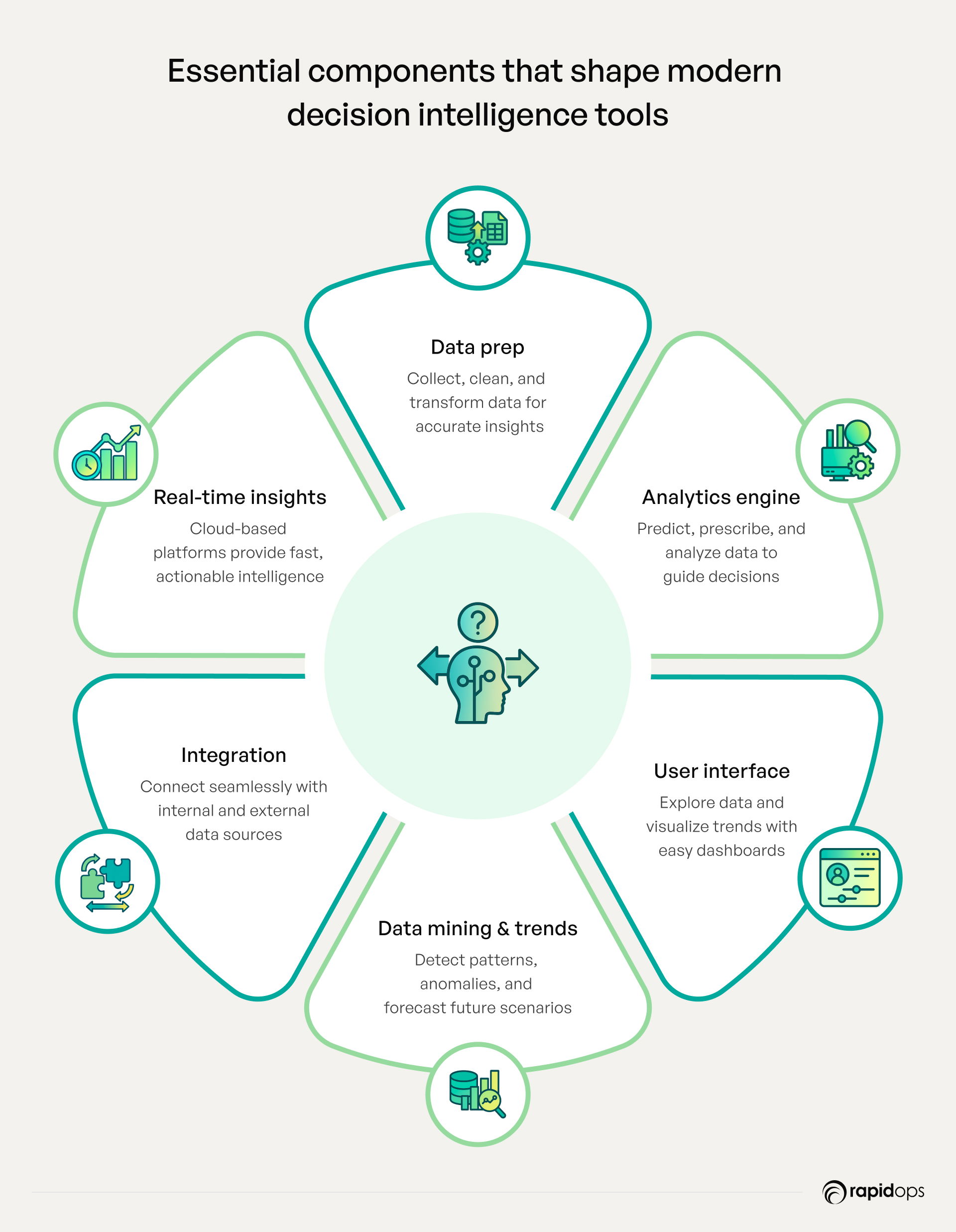
Data preparation
The foundation of decision intelligence lies in high-quality data. Data preparation involves collecting, cleaning, and transforming data from multiple sources, including enterprise systems, financial data, and operational logs. By ensuring data accuracy and consistency, organizations can rely on analytics engines to generate precise, actionable insights.
Analytics engine
The core powers are predictive, prescriptive, diagnostic, and descriptive analytics. Leveraging machine learning models, statistical techniques, and artificial intelligence, the engine identifies patterns, anticipates future outcomes, and recommends optimal actions, supporting data-driven decision making across all business functions.
User interface
A user-friendly interface enables business users, decision-makers, and analysts to explore data, visualize trends, and derive insights without technical expertise. Features like natural language processing and intuitive dashboards help translate complex analytics into clear, actionable intelligence.
Data mining and trend identification
Advanced algorithms and AI-powered insights allow organizations to detect patterns, uncover anomalies, and forecast future scenarios. These capabilities enhance risk management, optimize business processes, and ensure that decisions align with strategic objectives.
Integration with data sources
Decision intelligence tools seamlessly connect with CRM systems, enterprise resource planning platforms, and other internal and external data sources. This holistic integration ensures comprehensive visibility, enabling organizations to turn data into consistent, high-quality decisions.
Real-time insights and cloud-based delivery
Cloud-enabled platforms provide real-time data analysis, allowing organizations to respond rapidly to emerging opportunities, operational disruptions, and market shifts. By combining predictive, prescriptive, and collaborative capabilities, these tools create a resilient decision intelligence framework that drives smarter, faster, and more confident decisions.
25 decision intelligence tools driving data-driven business decisions
Every decision you make, from daily operations to long-term strategy, shapes your organization’s future. These 25 decision intelligence tools convert complex data into actionable insights, empowering leaders to make confident, data-driven decisions that optimize performance and strategic outcomes.
1. Aera decision cloud
Aera decision cloud excels in real-time orchestration of complex business processes, uniquely combining AI-driven recommendations with continuous learning across multiple functions. Its standout feature is autonomous agents that adapt based on operational outcomes, enabling proactive, data-driven decisions.
Core capabilities:
- Real-time decision orchestration
- Continuous learning AI agents
- Predictive and prescriptive analytics across structured and unstructured data
Key applications:
- Strategic scenario planning and forecasting
- Cross-functional process optimization
- Operational risk mitigation
Aera’s autonomous agents continuously learn from organizational data, reducing dependency on manual intervention and accelerating high-confidence decision-making.
2. Peak (CODI)
Peak CODI differentiates itself with agentic intelligence, allowing executives to simulate real-world scenarios dynamically and adjust strategies in real time. Unlike other platforms, CODI focuses on adaptive, operational optimization, bridging the gap between insights and execution.
Core capabilities:
- Continuous decision intelligence
- Scenario modeling with agentic AI
- Predictive analytics for operational performance
Key applications:
- Supply chain and inventory optimization
- Data-driven revenue strategies
- Real-time executive simulations
Peak’s real-time simulation engine uniquely enables leaders to test multiple operational scenarios before implementing decisions, enhancing agility.
3. Diwo
Diwo emphasizes quantifying opportunity potential and measuring the expected impact of decisions. Its prescriptive analytics not only provides recommendations but also ranks options based on projected business outcomes, helping executives prioritize high-impact actions.
Core capabilities:
- Prescriptive analytics and scenario modeling
- Opportunity identification and risk assessment
- Predictive recommendations with continuous learning
Key applications:
- Strategic and operational decision-making
- Resource allocation and process optimization
- Risk mitigation and scenario evaluation
Diwo uniquely combines outcome-driven ranking with AI insights, allowing executives to focus on decisions with the greatest potential ROI.
4. SAS Intelligent Decisioning
SAS Intelligent Decisioning focuses on governance, transparency, and regulatory compliance. Unlike other tools that emphasize predictive analytics alone, SAS ensures automated decisions adhere to corporate policies and industry regulations, providing executives with both confidence and accountability.
Core capabilities:
- Business rules management with analytics
- Real-time decision orchestration
- Scenario modeling and risk management
Key applications:
- Compliance monitoring and operational governance
- Predictive financial and operational planning
- Automated risk assessment
SAS stands out for integrating compliance and governance directly into decision workflows, critical for regulated industries.
5. Oracle Real-Time Decisions (RTD)
Oracle RTD excels in adaptive, context-aware decisioning, combining rules-based and predictive analytics to respond instantly to market and customer changes. Its strength lies in real-time intelligence for customer-facing operations, allowing proactive engagement.
Core capabilities:
- Rules-based decision automation
- Real-time predictive modeling and scenario analysis
- Risk and opportunity evaluation
Key applications:
- Customer engagement optimization
- Fraud detection and operational efficiency
- Strategic scenario simulations
Oracle RTD uniquely integrates market and customer context into automated decisions, enabling rapid response to dynamic business conditions.
6. Rainbird
Rainbird specializes in explainable AI for high-compliance environments, helping executives automate complex decisions with transparency. Its human-like reasoning models simulate expert judgment, ensuring consistency across operational and strategic choices.
Core capabilities:
- Explainable AI for regulated industries
- Scenario-based prescriptive analytics
- Decision automation mimicking human reasoning
Key applications:
- Risk management and policy enforcement
- Compliance-driven operational decisions
- Strategic scenario planning
Rainbird’s unique differentiator is its ability to replicate expert cognitive models, allowing leaders to automate decisions without losing contextual understanding in regulated settings.
7. Stemly
Stemly focuses on data-driven operational forecasting and delivers prescriptive recommendations for finance and supply chain leaders. Its AI models prioritize actionable opportunities, improving agility in dynamic markets.
Core capabilities:
- Predictive modeling for cash flow and demand
- Scenario analysis for supply chain and finance
- Integration of structured/unstructured data
Key applications:
- Resource allocation optimization
- Demand and inventory planning
- Strategic decision support
Stemly stands out for its real-time scenario simulations, which allow executives to compare multiple operational strategies before execution.
8. Silico
Silico is a no-code decision intelligence platform that empowers non-technical leaders to turn complex data into prescriptive actions. Its visual interface simplifies experimentation and scenario testing.
Core capabilities:
No-code AI experimentation
Predictive analytics and scenario simulation
AI-generated recommendations
Key applications:
- Operational workflow optimization
- Strategic decision automation
- Scenario-based planning
Its differentiator lies in enabling non-technical executives to make rapid, data-driven decisions without relying on data scientists.
9. PlanningForce
PlanningForce combines human expertise and AI optimization to address operational complexity. It converts predictive analytics into actionable prioritization, focusing on high-impact decisions.
Core capabilities:
- Predictive and prescriptive analytics
- Integration of expert experience
- Scenario modeling for complex operations
Key applications:
- Resource allocation and efficiency
- Risk assessment and mitigation
- Strategic scenario planning
PlanningForce’s strength is blending AI with expert judgment, reducing errors while aligning operational actions with strategic priorities.
10. TransVoyant
TransVoyant delivers continuous, real-time decision intelligence by analyzing streaming data. It enables leaders to detect emerging risks and market opportunities before competitors.
Core capabilities:
- Real-time predictive analytics
- Continuous decision intelligence
- Structured/unstructured data integration
Key applications:
- Supply chain risk management
- Operational performance optimization
- Strategic forecasting
Its differentiator is streaming data analytics, empowering executives to act proactively rather than reactively in volatile environments.
11. Sisu
Sisu uncovers hidden performance drivers using machine learning, enabling data-driven operational and strategic decisions. It highlights the root causes behind KPIs to optimize resource allocation.
Core capabilities:
- Automated insights via ML
- Identification of key performance drivers
- Scenario modeling
Key applications:
- Strategic decision-making
- Operational efficiency optimization
- Risk and opportunity assessment
Sisu stands out for its focus on root-cause analysis, providing executives with actionable insights beyond surface-level metrics.
12. Blue Ridge Global
Blue Ridge Global specializes in AI-powered supply chain optimization, delivering predictive insights for inventory and operational efficiency.
Core capabilities:
- Demand forecasting and inventory planning
- Predictive modeling for supply chain
- Actionable operational insights
Key applications:
- Supply chain risk mitigation
- Inventory optimization
- Operational cost reduction
Its unique differentiator is integrated supply chain intelligence, helping executives anticipate disruptions and optimize inventory dynamically.
13. Cloverpop
Cloverpop emphasizes collaborative decision intelligence, tracking historical choices and providing AI-assisted insights to improve team decision quality.
Core capabilities:
- Decision workflow tracking
- Predictive scenario modeling
- Collaborative decision-making
Key applications:
- Strategic planning and review
- Cross-functional collaboration
- Historical decision analysis
Cloverpop stands out for enhancing team-based decision consistency and leveraging past decisions to predict outcomes, strengthening governance and alignment.
14. Quantexa Decision Intelligence
Quantexa leverages graph analytics to detect hidden relationships in complex data, identifying risks, fraud, and optimization opportunities.
Core capabilities:
- Context-aware decisioning
- Risk and fraud detection
- Predictive operational insights
Key applications:
- Fraud prevention
- Strategic decision support
- Business optimization
Its differentiator is relationship-driven insights that enable executives to make contextually informed decisions in complex environments.
15. Celonis Process Intelligence
Celonis offers a powerful Process Intelligence + AI platform that builds a live digital twin of your business operations using process mining. Its differentiator is process-aware decision intelligence: by visualizing how work actually flows in real time, Celonis enables executives to uncover hidden inefficiencies, simulate “what-if” decisions, and steer their organization via intelligent automation.
Core capabilities:
- Process mining and digital twin of operations
- AI-driven orchestration and agentic decisioning
- Simulation and optimization via process context
Key applications:
- Operational improvement and workflow automation
- Real-time decision simulations
- Cross-functional process orchestration
Celonis stands out because it doesn’t just suggest decisions, it grounds them in actual process behavior, helping leaders make smarter, context-aware, and sustainable choices.
16. FICO Decision Management
FICO Decision Management specializes in risk-aware business decisioning, combining predictive and prescriptive analytics with advanced scoring models. Its differentiator lies in balancing operational growth with regulatory compliance and risk mitigation, particularly for financial services.
Core capabilities:
- Predictive and prescriptive analytics for credit, fraud, and operational risk
- Rule-based decisioning for finance and compliance
- Scenario modeling for complex risk evaluations
Key applications:
- Credit and risk assessment
- Fraud detection and mitigation
- Strategic and operational decision support
FICO integrates with ERP and analytics platforms, enabling executives to make informed, risk-balanced decisions that optimize growth while minimizing exposure.
17. 1000minds
1000minds stands out for multi-criteria decision analysis (MCDA), helping executives quantify trade-offs between competing priorities. Unlike other tools, it allows decision-makers to weigh intangible factors alongside quantitative metrics.
Core capabilities:
- Multi-criteria decision analysis and scoring
- Trade-off and prioritization modeling
- Scenario-based prescriptive recommendations
Key applications:
- Strategic project prioritization
- Operational decision evaluation
- Resource allocation and risk assessment
By integrating with workflow and analytics platforms, 1000minds equips executives to confidently prioritize initiatives with a structured, transparent methodology.
18. DecideIT
DecideIT differentiates itself by providing advanced quantitative decision modeling and Monte Carlo simulations for complex business choices. Its focus is on evaluating uncertainty and risk with numeric precision.
Core capabilities:
- Decision modeling and risk analysis
- Scenario simulation for complex decisions
- Quantitative evaluation for trade-offs
Key applications:
- Strategic planning and investment evaluation
- Risk assessment and mitigation
- Scenario-based operational optimization
Integrating with BI platforms, DecideIT empowers executives to confidently navigate high-stakes decisions with rigorously tested, data-backed insights.
19. UNICOM Focal Point
UNICOM Focal Point excels in portfolio and strategic initiative management. Its unique feature is evaluating investments across multi-dimensional criteria and linking them to organizational risk and opportunity.
Core capabilities:
- Strategic portfolio management
- Initiative prioritization and investment evaluation
- Risk and opportunity analysis
Key applications:
- Project and portfolio decision-making
- Resource allocation and operational planning
- Strategic risk management
Executives benefit from actionable insights that balance operational and strategic objectives while mitigating portfolio-level risks.
20. Camunda
Camunda distinguishes itself with process orchestration combined with AI-powered decision automation. Its strength lies in optimizing operational efficiency and standardizing workflows across diverse business functions.
Core capabilities:
- Workflow orchestration and automation
- AI-powered decision logic
- Scenario-based operational optimization
Key applications:
- Process automation for business functions
- Operational efficiency and resource optimization
- Risk mitigation and compliance
Integration with ERP and BI systems enables executives to streamline complex workflows and improve decision consistency across the enterprise.
21. Altair AI Studio
Altair AI Studio focuses on advanced simulation-driven decision-making. Its differentiator is the ability to run predictive and prescriptive analytics at scale, providing executives with detailed scenario comparisons for complex operations.
Core capabilities:
- Predictive and prescriptive analytics
- Scenario simulation for strategic planning
- Decision modeling and optimization
Key applications:
- Resource allocation and operational planning
- Risk assessment and mitigation
- Strategic scenario analysis
Executives can confidently model multiple potential outcomes and optimize operational and strategic decisions using data-driven insights.
22. DataLab (LLM-powered BI for DI)
DataLab leverages LLMs and natural language processing to provide executives with accessible, actionable insights. Its uniqueness lies in conversational analytics, allowing non-technical decision-makers to query data intuitively.
Core capabilities:
- Natural language-driven decision intelligence
- Unified BI and prescriptive analytics
- Advanced analytics for structured and unstructured data
Key applications:
- Scenario planning and operational forecasting
- Decision optimization across business functions
- Executive-level insights for strategic planning
DataLab integrates with BI and ERP systems, enabling faster, more accurate, and context-aware executive decision-making.
23. PresAIse
PresAIse differentiates through causal inference modeling, delivering explainable AI recommendations for strategic and operational decisions. Its key strength is clarifying cause-effect relationships in complex datasets.
Core capabilities:
- Prescriptive AI for strategic decisions
- Causal inference and scenario modeling
- Explainable recommendations for executives
Key applications:
- Operational and strategic decision optimization
- Scenario simulation and predictive modeling
- Business process improvement
Integration with ERP and analytics ensures executives can confidently align operational actions with long-term strategy.
24. Graphite Note
Graphite Note focuses on “what-if” scenario simulation with prescriptive analytics. Its distinct capability is to enable executives to quickly evaluate multiple operational outcomes, bridging strategy and execution.
Core capabilities:
- Prescriptive analytics and scenario modeling
- Predictive insights for strategic decisions
- Optimization of complex operational scenarios
Key applications:
- Strategic planning and resource allocation
- Scenario-based operational decisions
- Risk mitigation and process optimization
Executives gain actionable insights from structured and unstructured data to make confident, informed choices.
25. Metaphactory (Knowledge Graph DI)
Metaphactory differentiates through knowledge graph-driven continuous decision intelligence. It enables executives to visualize interconnections across data points and make context-aware, cross-functional decisions.
Core capabilities:
- Low-code knowledge graph interfaces
- Continuous, context-aware insights
- Integration of structured and unstructured data
Key applications:
- Strategic planning and operational decision-making
- Scenario modeling and predictive insights
- Knowledge-driven optimization of business processes
By integrating ERP, BI, and analytics platforms, executives can leverage relationships in complex data to drive smarter, informed decisions.
How to choose the right decision intelligence tool for your business needs
Selecting the ideal decision intelligence platform requires a disciplined, strategic approach. The right tool transforms raw and structured data into actionable insights, enabling leaders to make faster, more confident decisions while reducing operational risk and driving measurable business impact.
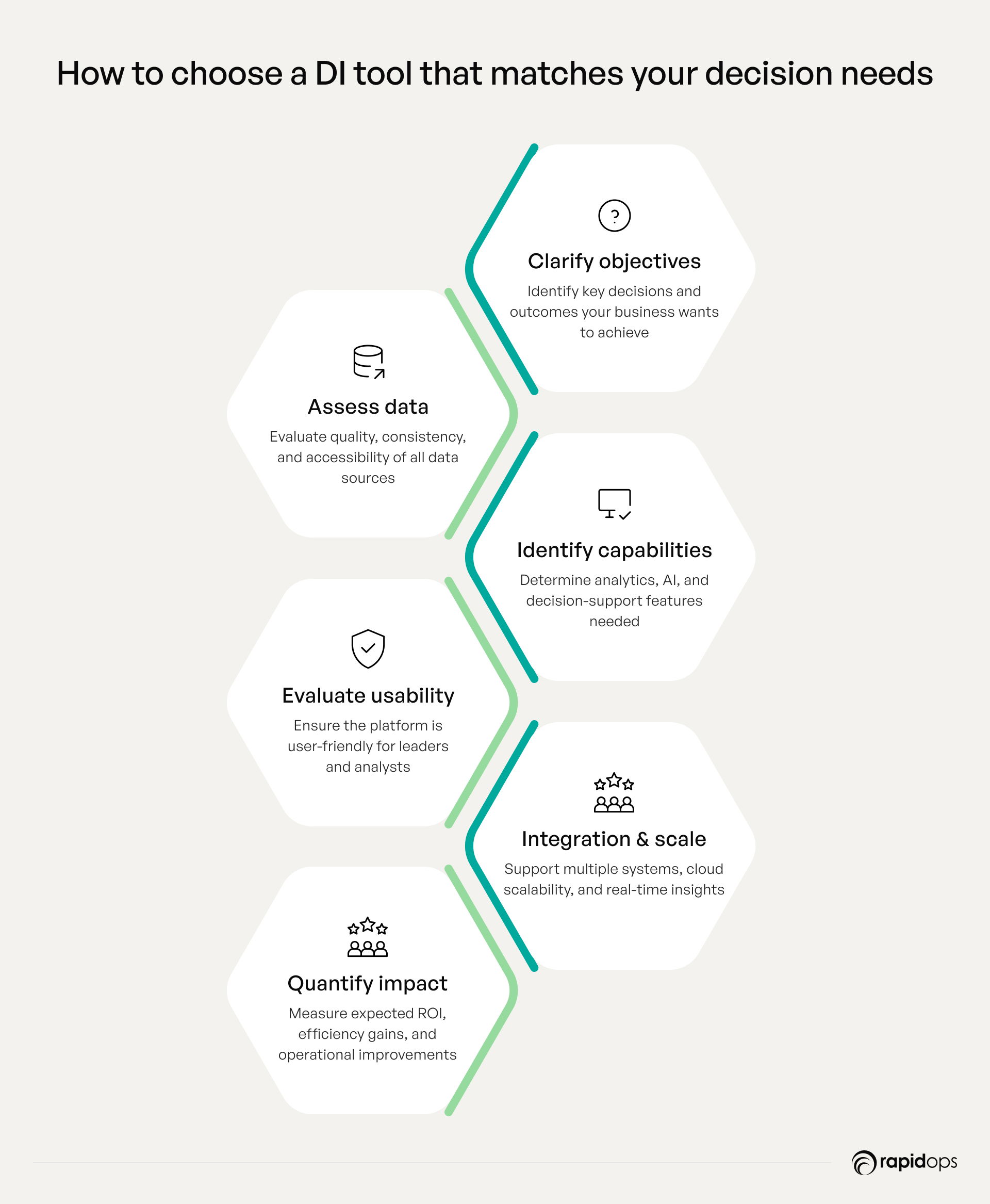
1. Clarify your decision-making objectives
Begin by identifying the key decisions you want to make. Are you aiming to improve forecast accuracy, optimize operational workflows, or mitigate financial and operational risks? Understanding the type of decisions, micro, routine decisions versus macro, high-impact strategic decisions, guides the selection of tools that provide predictive analytics, prescriptive guidance, or real-time decision support.
2. Assess your data environment
Decision intelligence platforms rely on both structured and unstructured data. Evaluate the quality, consistency, and accessibility of your historical, operational, and real-time data sources. Platforms that integrate seamlessly with enterprise systems such as ERP, CRM, and supply chain solutions ensure a complete view of the business and enable actionable, data-driven insights.
3. Identify essential analytics and decision-support capabilities
Determine the types of analytics your organization requires. Descriptive and diagnostic analytics help you understand historical performance, while predictive and prescriptive analytics anticipate future outcomes and recommend optimal actions. Additional capabilities cognitive analytics, decision automation, and collaborative decision-making features, ensure human expertise is augmented by artificial intelligence and machine learning models for smarter, faster decisions.
4. Evaluate usability for business leaders and non-technical users
A decision intelligence platform must be accessible to business users, analysts, and decision-makers without requiring advanced technical skills. An intuitive interface, natural language search, and actionable dashboards empower teams to explore data, identify patterns, and make consistent, high-quality decisions.
5. Ensure integration, scalability, and real-time performance
Modern tools must support integration across multiple internal and external data sources, provide cloud-based scalability, and offer real-time analytics, aligning closely with principles outlined in AI implementation strategy. These capabilities enable organizations to respond to dynamic market conditions, optimize operations, and gain a competitive edge through timely, evidence-backed decisions.
6. Quantify expected business impact and ROI
Finally, assess potential return on investment. Evaluate how the platform’s advanced analytics, decision modeling, and prescriptive capabilities can improve operational efficiency, enhance decision accuracy, and accelerate execution. Proof-of-concept pilots or test cases can demonstrate tangible outcomes, such as improved forecasting, reduced operational risk, and faster alignment across teams.
By following this structured approach, organizations can choose a decision intelligence tool that not only complements existing systems but also elevates decision-making maturity. The result is a data-driven enterprise where leaders consistently turn insights into confident, actionable strategies, driving sustainable growth and operational excellence.
Why decision intelligence is critical for optimizing business processes
Decision intelligence has become essential for optimizing business processes as organizations operate in environments defined by data complexity, rapid change, and rising performance expectations. It allows enterprises to move beyond static reporting and intuition-based decision-making, enabling faster, smarter, and consistently aligned decisions.
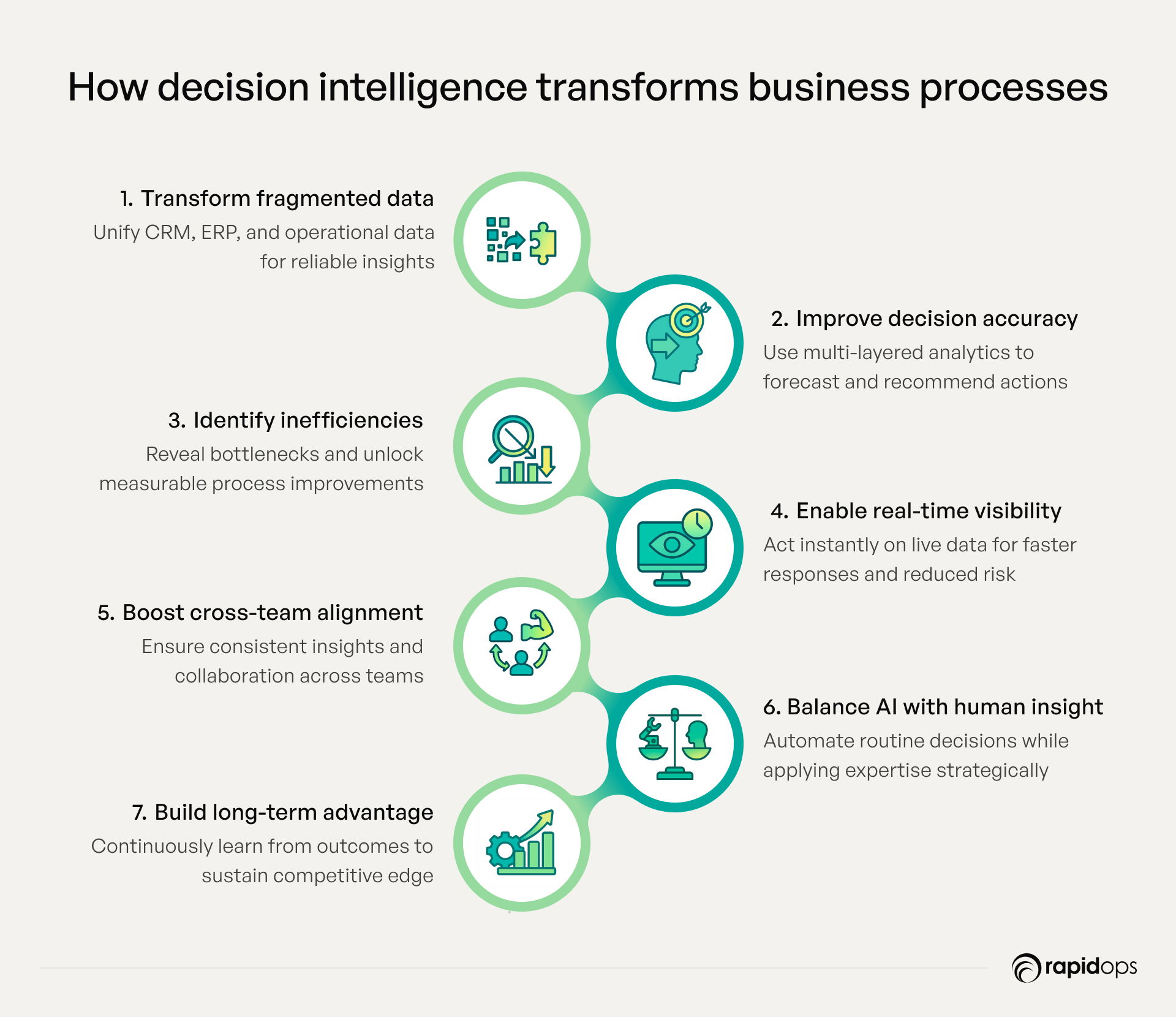
Transforms fragmented data into reliable decision foundations
Modern enterprises generate data across CRM, ERP, financial, HR, supply chain, and operational systems. Decision intelligence consolidates these distributed sources into a unified analytical environment ensuring data quality, consistency, and accessibility. This eliminates decision blind spots and gives leaders a comprehensive, accurate view of the business.
Improves decision accuracy with multi-layered analytics
Instead of simply explaining what happened, decision intelligence applies descriptive, diagnostic, predictive, and prescriptive analytics to deliver deeper value. It uncovers root causes, forecasts future outcomes, and recommends optimal actions—enhancing decision accuracy and enabling proactive rather than reactive process management.
Identifies inefficiencies and unlocks measurable process improvement
By applying machine learning, mathematical optimization, and AI-driven modeling, decision intelligence reveals performance gaps that are often invisible in traditional reporting. Business leaders can identify bottlenecks, reduce operational cost, improve throughput, and ensure processes continuously align with strategic performance targets.
Enables real-time visibility and faster response to business conditions
With cloud-based platforms, real-time dashboards, and automated decision engines, insights are generated as events occur, not weeks later. This empowers organizations to detect anomalies, respond to change instantly, reduce risk exposure, and maintain operational continuity even in volatile conditions.
Strengthens cross-functional alignment and execution
Decision intelligence democratizes analytics by providing interfaces and visualizations that non-technical users can understand and act on. Shared models and transparent logic ensure departments interpret insights consistently, improving collaboration, decision speed, and enterprise-wide execution.
Balances automation and human judgment for scalable decision-making
Routine, high-volume decisions can be automated, while human expertise is applied to complex strategic scenarios. This increases productivity, ensures repeatability, and enables organizations to make more decisions at higher quality without expanding workforce capacity.
Builds long-term competitive advantage and continuous improvement
Every decision becomes part of a learning loop. Outcomes feed back into models, improving accuracy and strengthening future decision performance. Over time, organizations become more adaptive, more efficient, and better able to sustain competitive advantage.
Find out how much money AI agents could save your company - with this instant ROI calculator!
Calculate Now
How to implement decision intelligence tools in your business
Before taking the first step, businesses must view Decision Intelligence not just as a tool, but as a strategic framework. By understanding how data flows, analytical models, and decision contexts interact, leaders can transform uncertainty into clarity, ensure every implementation generates actionable insights, and convert complexity into measurable business advantage.
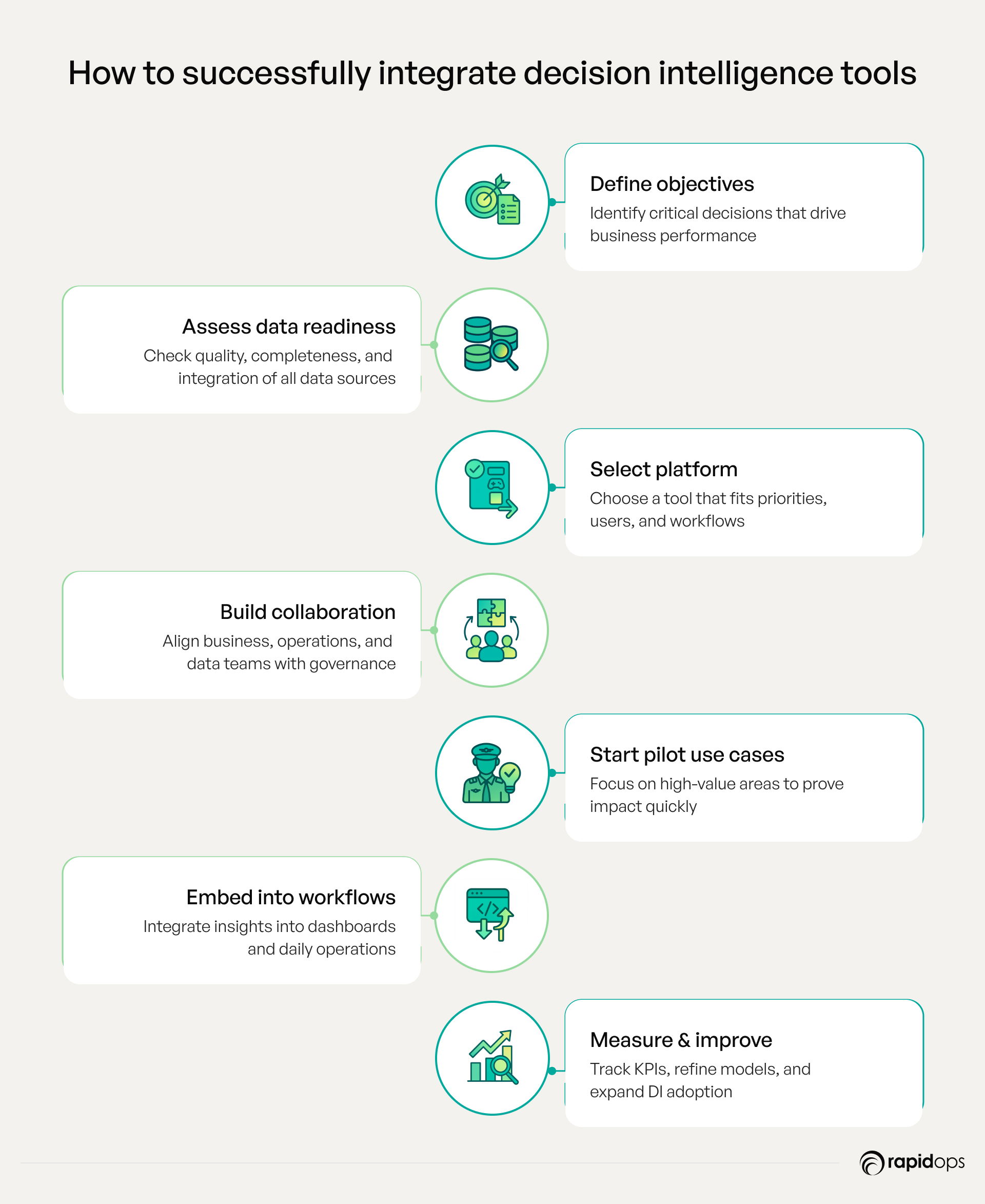
1. Define the business objectives and decision priorities
The most successful DI initiatives begin by identifying the critical decisions that directly influence financial performance, operational agility, and customer experience. Instead of adopting tools first, you start by defining which decisions matter most, such as demand forecasting, supply chain allocation, pricing, cash flow optimization, or risk mitigation. This ensures that Decision Intelligence supports outcomes that your leadership actually cares about, not just isolated analytics outputs.
2. Assess data maturity and identify integration requirements
Decision Intelligence depends on the ability to translate both structured and unstructured data into usable insights. Before adoption, organizations need a realistic assessment of:
- Data completeness
- Data accessibility across systems
- Data quality issues
- Integration readiness with ERP, CRM, SCM, manufacturing systems, or data warehouses
This step helps you understand whether your data foundation can support predictive modeling, automated rule-based systems, and prescriptive recommendations. If gaps exist, addressing them early prevents downstream disruptions.
3. Select the right decision intelligence platform
With clarity on business priorities and data readiness, you can evaluate which platform fits your organization. Here is where you evaluate:
- Scalability for enterprise workloads
- Support for real-time analytics
- Explainability and transparency
- Integration with existing business processes
- Suitability for both technical and non-technical users
- Governance and security standards
Choosing the right decision intelligence platform is not about having the most advanced technology; it is about selecting a solution that aligns with how your organization makes decisions today and how it needs to make them in the future.
4. Build cross-functional collaboration and governance
Decision Intelligence requires alignment across the business, not just within IT or data teams. Effective implementation brings together:
- Business leaders who define decision rules and priorities
- Operations teams that execute decisions daily
- Data teams that build and maintain predictive and prescriptive models
Strong governance ensures that decisions remain consistent, compliant, and auditable. This is especially critical for regulated industries, global supply chains, and distributed operations.
5. Start with high-impact pilot use cases
Organizations see the fastest value by starting with a single, high-value decision area where measurable outcomes can be proven within weeks. For example:
- Reducing inventory write-offs
- Shortening customer response cycles
- Improving demand forecasting accuracy
- Increasing production throughput
A successful pilot builds internal confidence, demonstrates ROI, and sets the stage for broader adoption. It also helps refine workflows before enterprise-wide scale.
6. Embed decision intelligence into operational workflows
Decision Intelligence delivers real results only when insight moves seamlessly into daily execution. To achieve this, organizations must ensure:
- Insights appear where work happens (dashboards, mobile apps, ERP systems)
- Recommendations are actionable and context-aware
- Frontline employees understand “why” a recommendation is made
When users can trust the logic behind predictions and recommendations, adoption accelerates, and decision quality improves.
7. Measure outcomes and continuously improve
A Decision Intelligence system should never remain static. Continuous monitoring allows you to:
- Measure impact against business KPIs
- Identify new patterns in shifting markets
- Improve machine learning and rule-based modeling
- Expand from one use case to many
Organizations that treat decision intelligence as a living capability, not a one-time deployment, see sustained competitive advantage, higher decision quality, and stronger operational resilience.
Don't think of deploying AI agents without knowing these key factors that drive success & prevent costly mistakes
Download Now
Overcoming challenges in implementing decision intelligence tools
Implementing decision intelligence tools is a transformative endeavor, but it also comes with distinct challenges that organizations must navigate to unlock the full potential of data-driven decision-making. Recognizing these hurdles is critical for executives and business leaders aiming to scale decision intelligence across complex operations.
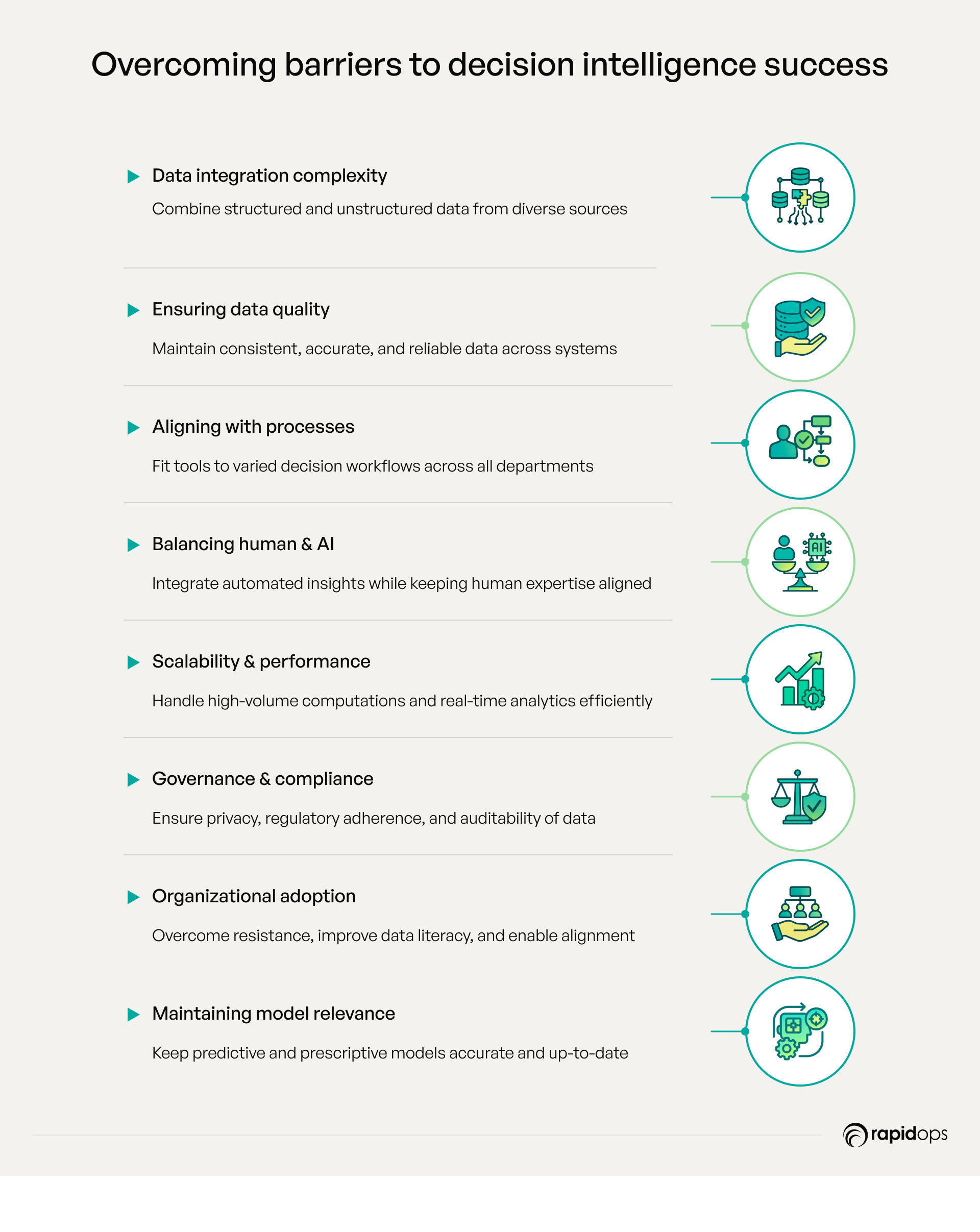
Complexity of integrating structured and unstructured data
Organizations generate vast volumes of data from diverse sources—CRM systems, enterprise resource planning platforms, operational databases, financial systems, and even unstructured sources such as emails, documents, and social media. Integrating these disparate datasets into a coherent environment is inherently complex, requiring careful attention to data consistency, accessibility, and quality.
Ensuring data quality and consistency
Even the most sophisticated analytics and predictive models are only as effective as the underlying data. Inconsistent, incomplete, or inaccurate data can propagate errors across decision workflows, resulting in unreliable insights. Maintaining data quality across historical, operational, and real-time data streams is a persistent challenge that can impact the credibility of decision intelligence outputs.
Aligning tools with diverse decision-making processes
Decision intelligence platforms must accommodate a spectrum of decisions—from routine, high-volume operational decisions to strategic, high-impact business choices. Ensuring that tools align with existing organizational decision logic, business rules, and critical workflows is a challenge, particularly in large enterprises with varied departmental processes.
Bridging the gap between human expertise and automated insights
Decision intelligence tools augment human judgment but can also disrupt established decision-making norms. Balancing automation with human expertise, while ensuring that leaders trust the models’ outputs, is a nuanced challenge. Misalignment can lead to underutilization of tools or overreliance on algorithmic recommendations without proper contextual understanding.
Scalability and performance under enterprise demands
As organizations scale, decision intelligence tools must manage high-volume, complex computations and real-time analytics without compromising performance. Meeting enterprise-level requirements for responsiveness, cloud-based scalability, and integration across multiple business units presents a significant technical and operational challenge.
Governance, security, and regulatory compliance
Decision intelligence implementation intersects with sensitive operational and financial data. Establishing governance frameworks that maintain data privacy, comply with industry regulations, and provide auditability is a critical challenge. Tools must support these requirements while still enabling timely, actionable insights.
Cultural and organizational adoption hurdles
Beyond technical considerations, adopting decision intelligence requires organizational readiness. Resistance to change, limited data literacy among business users, and misalignment between IT, analytics teams, and business leadership can impede adoption. Overcoming entrenched decision-making habits is as challenging as any technical integration.
Maintaining long-term model accuracy and relevance
Decision intelligence relies on predictive, prescriptive, and cognitive models that must evolve as business conditions shift. Ensuring ongoing model validity, accuracy, and alignment with changing strategic priorities is an ongoing challenge for organizations seeking continuous improvement.
By understanding these multi-layered challenges, technical, organizational, and operational, business leaders gain a clearer perspective on the complexity of implementing decision intelligence tools at scale. This awareness forms the foundation for strategic planning and risk mitigation, ensuring that enterprises are prepared to navigate the intricacies of data-driven transformation.
Unlocking the true potential of decision intelligence tools
What stands out from exploring these 25 decision intelligence tools is that their true power lies in uncovering patterns and insights that often remain hidden. They help organizations move from guessing to knowing, from reacting to planning, and from uncertainty to clarity, laying the foundation for smarter, faster, and more confident decisions that deliver real business impact.
Yet, the tools alone aren’t enough. True value comes from understanding how each fits within your organization’s data flows, decision contexts, and strategic priorities. Thoughtful integration ensures insights are actionable, risks are anticipated, and opportunities are identified before competitors even notice them.
At Rapidops, we leverage decades of expertise helping businesses across industries harness the full potential of decision intelligence. Rather than selecting off-the-shelf tools, we design and build custom decision intelligence solutions tailored to your unique requirements and seamlessly integrate them with your existing systems. Our practical, results-driven approach turns complex data into clarity, actionable insights, and measurable business growth.
Connect with our experts to explore a bespoke decision intelligence solution for your business built to integrate seamlessly, uncover hidden insights, and empower smarter, faster, and more confident decisions that drive lasting impact.

What’s Inside
- What is decision intelligence
- Decision intelligence vs business intelligence
- Understanding the different types of decisions
- Key analytics types and decision-support capabilities every business needs
- Core components that power modern decision intelligence tools
- 25 decision intelligence tools driving data-driven business decisions
- How to choose the right decision intelligence tool for your business needs
- Why decision intelligence is critical for optimizing business processes
- How to implement decision intelligence tools in your business
- Overcoming challenges in implementing decision intelligence tools
- Unlocking the true potential of decision intelligence tools

Let’s build the next big thing!
Share your ideas and vision with us to explore your digital opportunities
Similar Stories
- Strategy
- undefined Mins
- February 2017


- Strategy
- 19 Mins
- August 2023

Receive articles like this in your mailbox
Sign up to get weekly insights & inspiration in your inbox.