


We are living in a digital age where connected systems are no longer a good-to-have; they are a must-have. Customers expect real-time information, teams expect seamless workflows, and leadership expects data to move as fast as decisions do. Yet behind the scenes, many businesses still operate on disconnected software, manual handoffs, and siloed systems that quietly slow everything down.
This is where cracks begin to appear. Orders don’t sync with inventory. Customer data exists in multiple places. Finance, sales, operations, and supply chain teams all work with different versions of the truth. What starts as a systems issue quickly becomes a business challenge, with delayed decisions, operational inefficiencies, growing risk, and teams spending more time reconciling data than creating value. The business itself isn’t broken, but the systems powering it aren’t working together.
As organizations scale and their digital ecosystems expand, this issue becomes increasingly visible. Dozens of tools now support core business functions, but without seamless connectivity, they operate in silos. The result is slower insights, manual workarounds, inconsistent reporting, and missed opportunities at a time when speed, accuracy, and agility are critical for staying competitive in 2026 and beyond.
This is where API integration changes the equation. APIs (Application Programming Interfaces) act as the connective layer that allows systems to communicate, exchange data in real time, and trigger automated workflows securely and at scale. When implemented effectively, API integration transforms disconnected applications into a unified, intelligent ecosystem, giving leaders a single, reliable view of the business and enabling teams to act faster and with confidence.
In this blog, we break down what API integration really is, how it works in real business environments, and why it has become a foundational capability for modern, scalable enterprises, not just an IT concern, but a strategic business enabler.
What is an API
An API, or Application Programming Interface, is a structured protocol that allows software systems, enterprise applications, and digital platforms to communicate efficiently. It defines how data or functionality is requested, shared, and processed, without exposing internal system complexities. APIs enable businesses to connect disparate software components, automate workflows, and ensure consistent, accurate information across departments.
Different API types, REST, SOAP, and GraphQL serve unique purposes, from lightweight data retrieval to secure, structured exchanges in regulated environments. APIs underpin essential enterprise functions such as inventory management, ERP, CRM, marketing automation, and logistics. By providing secure, real-time access through authentication protocols and keys, APIs reduce manual entry, prevent errors, and establish a foundation for scalable, connected business ecosystems.
What is API integration
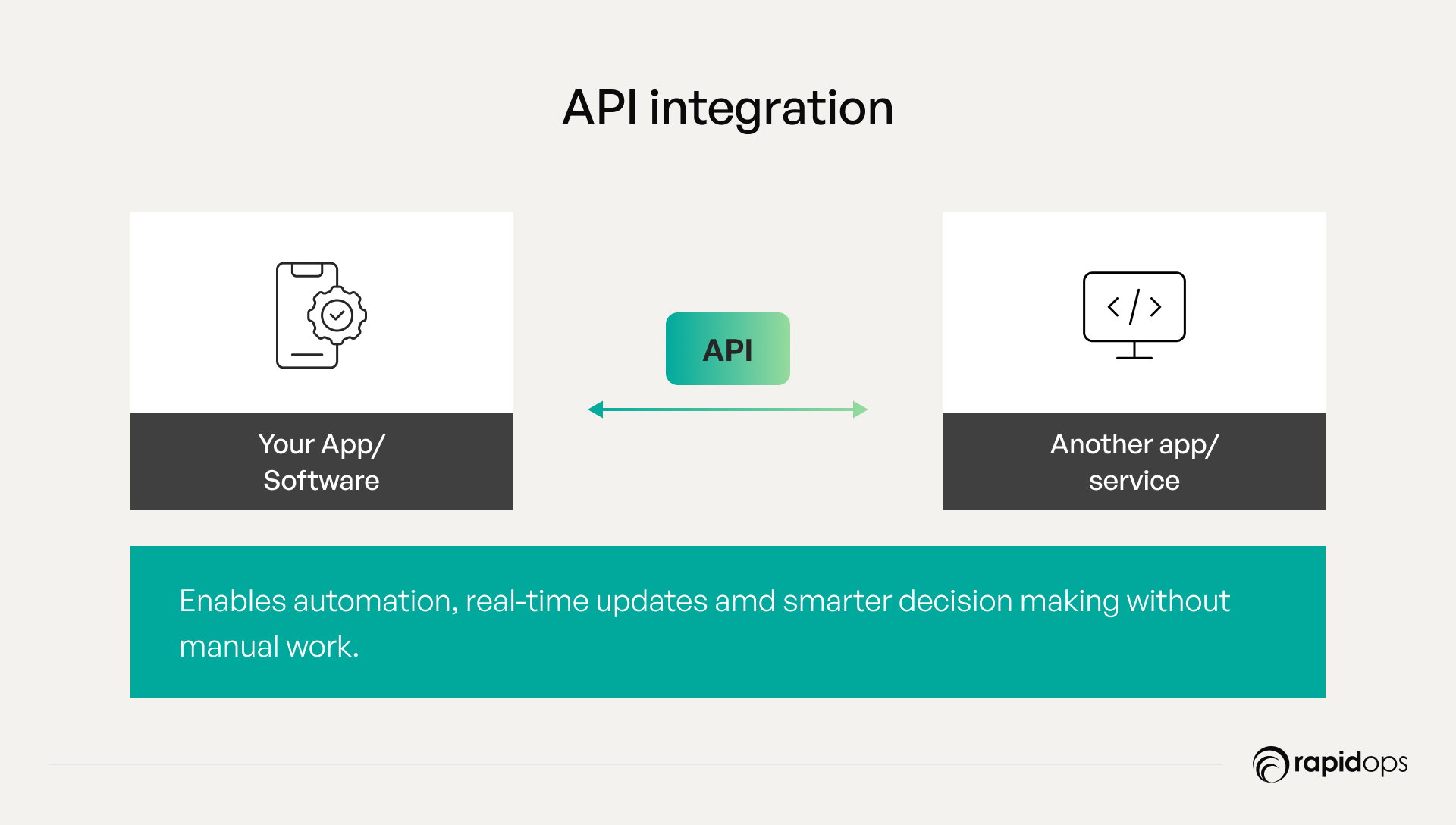
API integration is the process of connecting multiple applications, platforms, and enterprise systems through APIs to create a unified, intelligent ecosystem. Unlike individual APIs, integration focuses on orchestrating systems to automate workflows, synchronize data, and enable seamless operations across departments. It transforms fragmented software into a cohesive network where information flows in real time, enhancing operational efficiency, decision-making, and strategic agility.
Through API integration, organizations can connect ERP solutions, CRM platforms, inventory management systems, marketing tools, and logistics applications. Automated data synchronization eliminates manual processes, reduces inconsistencies, and ensures accurate reporting across the enterprise. Integration platforms and custom APIs allow businesses to scale systems without disrupting operations, quickly adapt to market changes, and maintain high-quality customer experiences.
For executives, API integration is not just technical; it’s strategic. It enables centralized visibility into operational performance, supports data-driven decisions, and uncovers opportunities for efficiency and growth. By linking systems intelligently, businesses can optimize workflows, reduce operational risk, and turn fragmented processes into a competitive advantage, ensuring that technology becomes a driver of sustainable and scalable growth.
Why API integration has become a business imperative
As businesses scale, complexity doesn’t announce itself; it surfaces as slower decisions, fragmented visibility, and growing reliance on workarounds that quietly erode momentum. Teams move faster, markets shift more quickly, and expectations rise, yet systems often pull in different directions. In this reality, integration is no longer a behind-the-scenes technical concern. It has become a business imperative because it directly determines how confidently organizations operate, adapt, and compete as complexity increases.
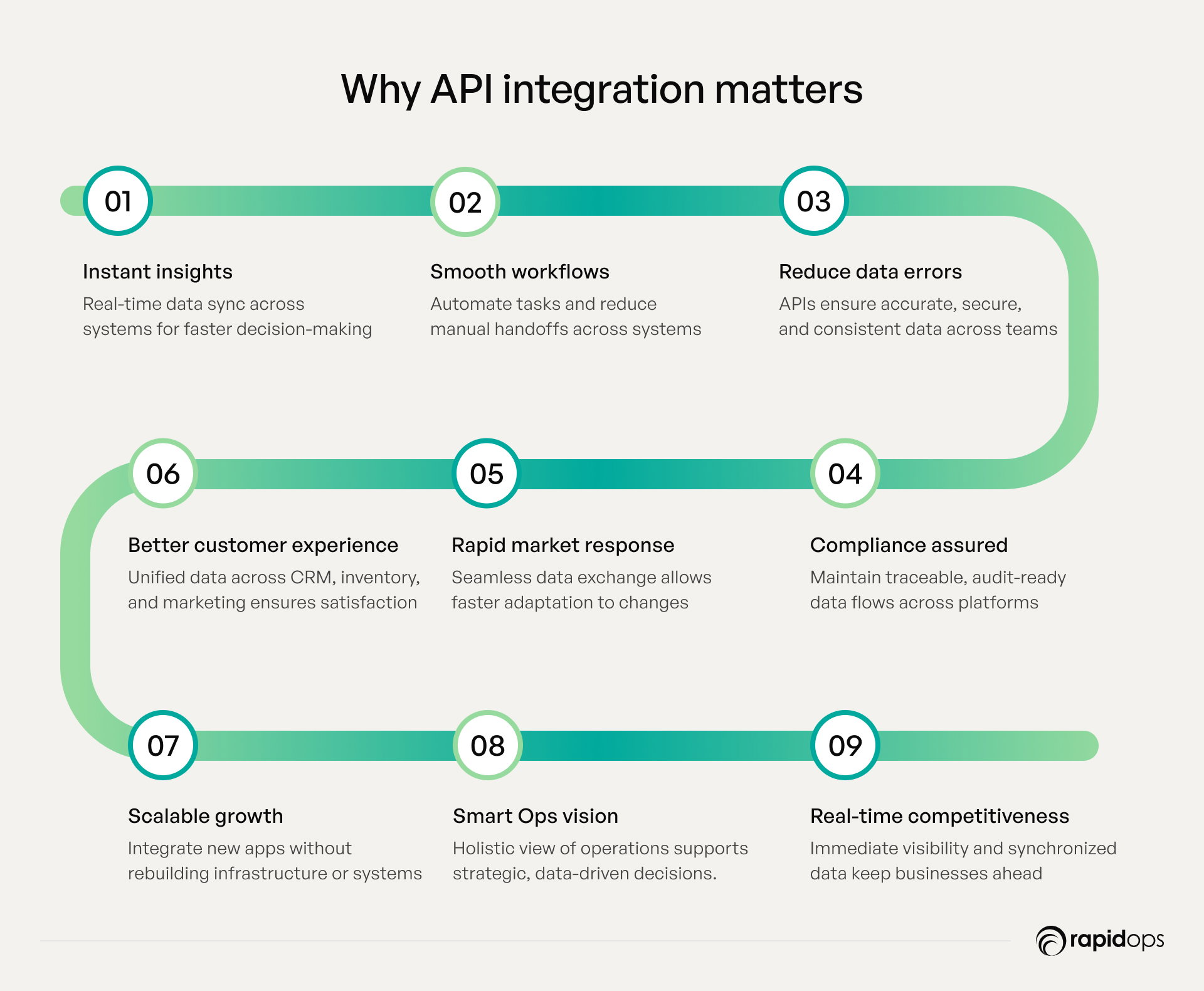
Immediate access to critical insights is non-negotiable
Disconnected systems delay access to critical information, preventing leadership from making timely, informed decisions. API integration allows real-time data synchronization across enterprise systems, software applications, and other tools, ensuring that requested data is accurate, consistent, and available when needed. Integration platforms (iPaaS) and connector applications facilitate secure and automated data exchange, providing organizations with a single, unified view of operations.
Inefficient workflows can cost your business
Fragmented workflows, manual handoffs, and reliance on manual data entry create operational bottlenecks. By leveraging API integration solutions, businesses can automate tasks, streamline processes, and share data across different systems and software components. Automated workflows reduce operational friction, improve system performance, and free up resources to focus on strategic initiatives rather than repetitive manual processes.
Manual data handling puts your business at risk
Human errors from manual data entry or inconsistent data transfer compromise accuracy and compliance. Integrating enterprise systems using APIs including REST APIs, SOAP APIs, or custom APIs, ensures secure data transfer, real-time synchronization, and consistent information across departments. API keys and robust API management provide controlled access, reducing errors and improving data integrity across business processes.
Compliance cannot be compromised
Siloed data and fragmented reporting increase the risk of regulatory and governance failures. API integration enables organizations to maintain accurate, traceable data flows across software applications, inventory management systems, and enterprise resource planning platforms. GraphQL and standardized communication protocols allow businesses to retrieve exactly what data is required for audits, regulatory compliance, and reporting.
Rapid markets wait for no one
In fast-moving markets, speed and agility are critical. API integration platforms facilitate seamless data exchange, enabling organizations to respond quickly to market trends, operational changes, and emerging opportunities. By automating data flow between systems like marketing automation, transportation management, and eCommerce platforms, businesses maintain flexibility and a competitive advantage.
Customer experience is a deal-breaker
Customers expect seamless interactions across channels. API integration ensures that systems like CRMs, inventory management, and marketing automation share data accurately in real time. This unified data provides consistent experiences, supports personalized service, and strengthens brand loyalty. Organizations can reduce errors, prevent duplicated efforts, and deliver superior customer satisfaction.
Scaling without integration is impossible
As businesses grow, independent tools and systems cannot scale efficiently. API integration allows enterprises to add new software applications, integrate APIs, and expand platforms without rebuilding infrastructure. Pre-built connectors, middleware, and integration platforms enable operational efficiency gains of up to 30% and cost savings by reducing manual data entry and automating repetitive tasks.
Strategic decisions require unified insights
Integrated systems provide a holistic view of business operations, enabling data-driven planning, forecasting, and analytics. API integration ensures that data across ERP, inventory management, and other enterprise systems is consistent, accurate, and actionable. Unified insights allow leaders to make strategic decisions with confidence and maximize ROI from existing systems and software applications.
Real-time data is critical to stay competitive
Fragmented or delayed data hinders competitiveness. API integration ensures real-time data exchange, reduces latency, and provides immediate visibility across all connected systems. Businesses can monitor system performance, synchronize data, and deliver timely information to stakeholders, ensuring decisions are made on accurate, up-to-date information, essential for sustaining a competitive edge in modern markets.
How API integration works
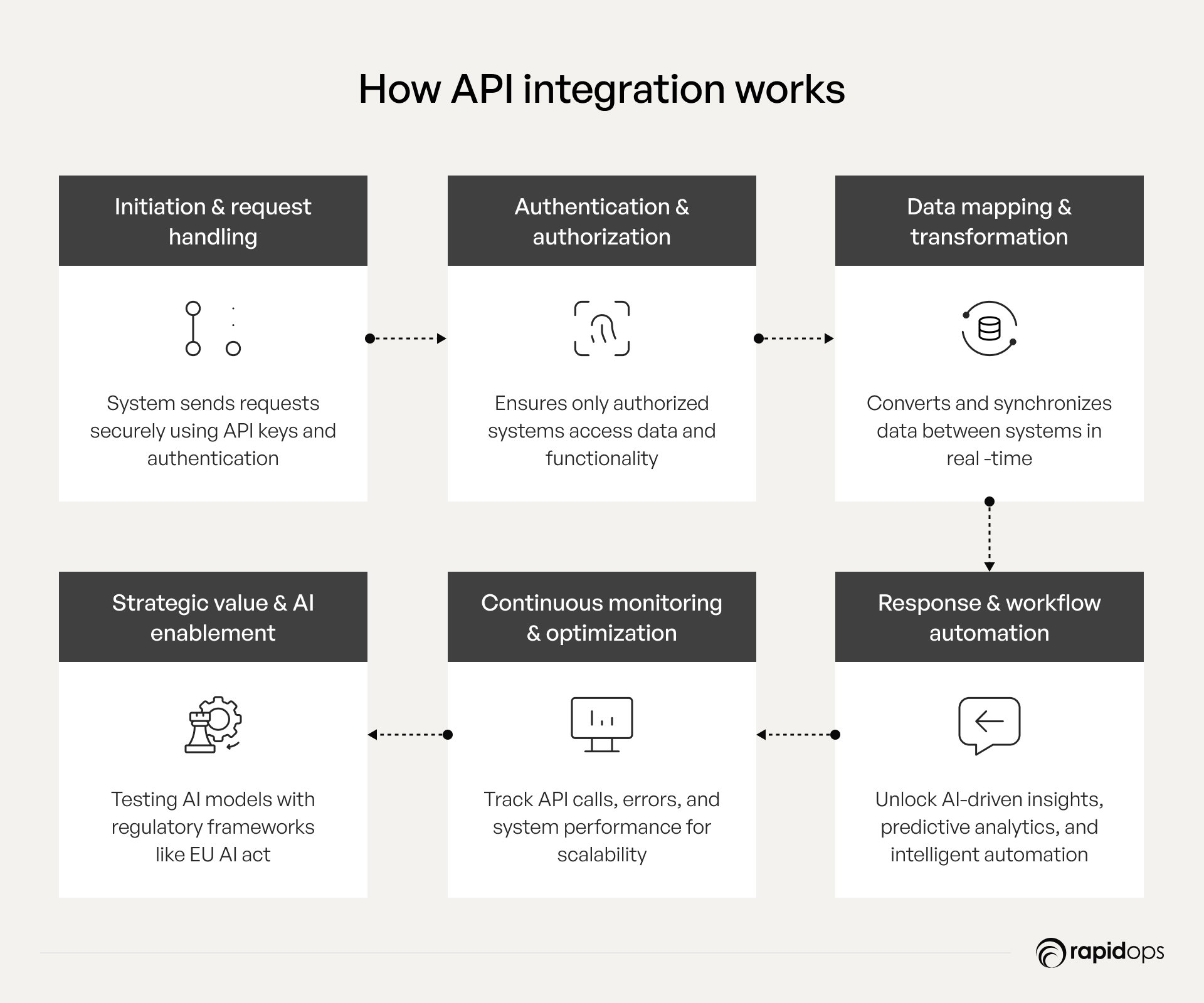
You’ve seen how disconnected systems slow decisions and frustrate teams, but how exactly do modern enterprises turn fragmentation into seamless operations? API integration is the engine that powers real-time data flow, automated workflows, and strategic agility. Understanding how it works is key for executives aiming to unlock efficiency, maintain consistency, and scale with confidence. Here’s a step-by-step breakdown.
Step 1: Initiation and request handling
The integration process begins when one system or application sends a request to another via its application programming interface (API). This request can involve retrieving requested data, triggering workflows, or accessing specific software components. API keys and authentication protocols ensure secure, authorized access. For organizations using RESTful APIs or SOAP APIs, this step guarantees that sensitive data is handled safely and complies with regulatory requirements. Over 65% of organizations now generate revenue directly from APIs, highlighting their strategic importance beyond simple connectivity.
Step 2: Authentication and authorization
Once the request is initiated, the receiving system performs strict authentication and authorization checks. This ensures only authorized systems access the data or functionality. Whether connecting ERP, transportation management systems, or inventory management systems, this step protects data integrity and maintains data consistency across all platforms.
Step 3: Processing and data transformation
After authentication, the system processes the request according to predefined rules. Data transformation ensures compatibility between disparate systems, enabling real-time data synchronization. This guarantees that information in enterprise systems, from marketing automation platforms to warehousing and logistics software, remains accurate and consistent.
Step 4: Response and workflow automation
The system then returns a response to the requesting application, which may include data, task completion confirmation, or error messages for troubleshooting. Integration platforms (iPaaS) manage these exchanges efficiently, automating workflows and reducing manual data entry. By eliminating repetitive tasks, companies enhance system performance and free teams to focus on strategic initiatives.
Step 5: Continuous monitoring and optimization
To ensure ongoing reliability, executives implement API management and performance monitoring. This includes tracking API calls, system errors, and workflow efficiency. Organizations can scale integrations by adding new tools or custom APIs without disrupting existing processes. Custom integration and modular, plug-and-play APIs allow businesses to adapt quickly to evolving market demands. Retailers connecting warehouse, ERP, and TMS systems gain a centralized operational view, enabling data-driven decisions and faster response to market changes.
Step 6: Strategic value and AI enablement
Beyond operational efficiency, API integration unlocks AI-driven insights by connecting data across systems. Executives can leverage these integrations to predict demand, optimize inventory, enhance marketing automation, and improve customer experience. The combination of real-time data synchronization, automated workflows, and AI analytics transforms fragmented systems into a cohesive, intelligent ecosystem.
Types of API integration
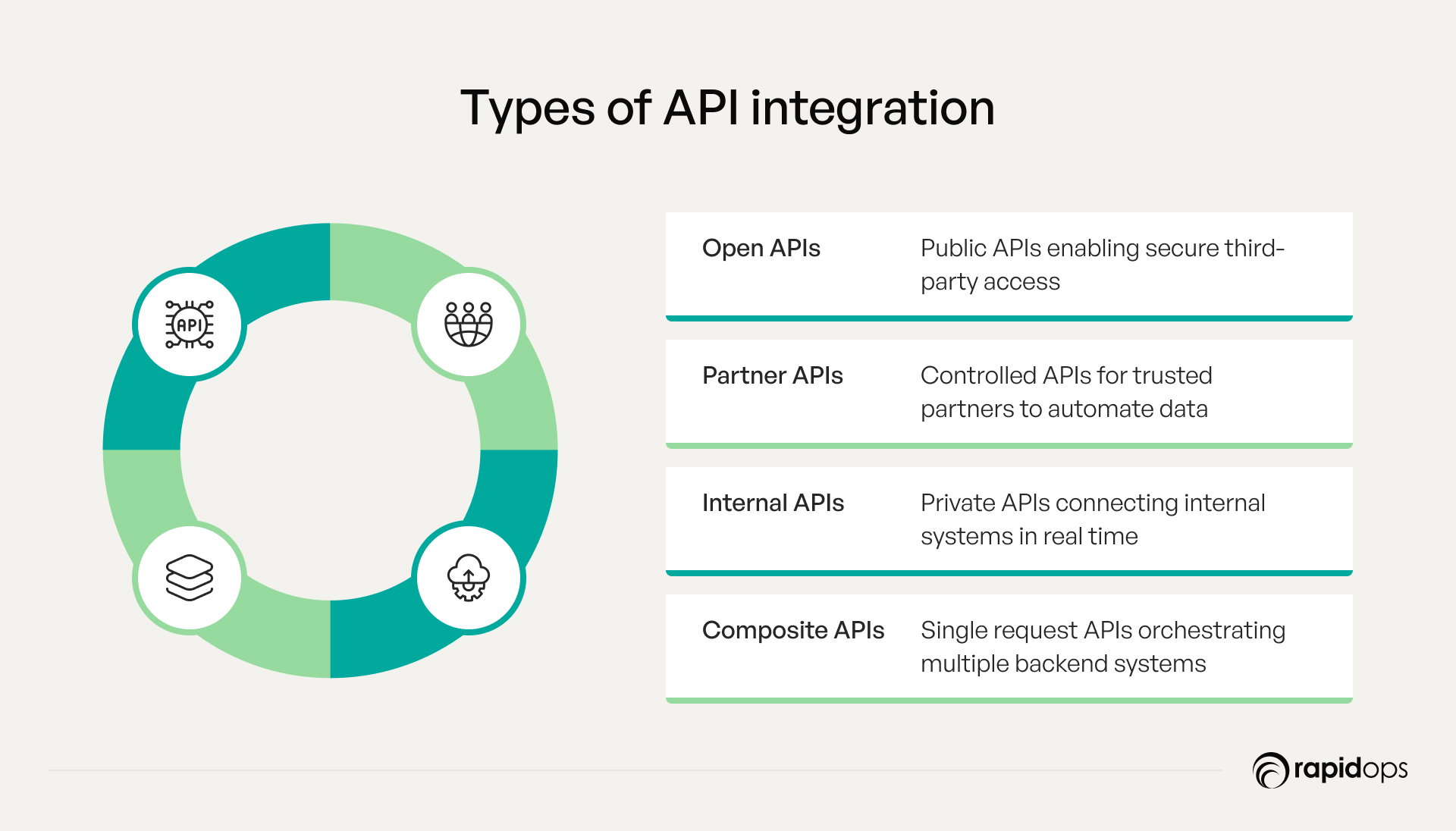
API integration can take several forms depending on the systems, workflows, and business needs involved. Understanding these types helps organizations choose the right approach for connecting applications and unlocking seamless data flow.
1. Open APIs (Public APIs)
These APIs are available to external developers and third-party applications. Open APIs facilitate secure and controlled exchange of data and functionality, enabling partnerships, integrations, and extensions beyond organizational boundaries. Typically, RESTful APIs or GraphQL interfaces are used to provide flexible, lightweight connections while ensuring data consistency and minimizing manual data entry. Organizations can generate additional revenue through pay-per-use or subscription-based access models while maintaining control via API keys and authentication protocols.
2. Partner APIs
Partner APIs are shared with specific business partners to enable collaboration and data exchange across enterprise systems. They provide secure access for integrating inventory management systems, marketing automation platforms, or transportation management systems with existing enterprise applications. Using structured protocols such as SOAP or REST APIs, these integrations automate workflows, reduce human errors, and strengthen supply chain and operational efficiency.
3. Internal APIs (Private APIs)
Used exclusively within an organization, private APIs connect internal software components and applications, ensuring seamless data flow and improved operational efficiency. They enable real-time data synchronization between ERP systems, CRM platforms, and other software systems, eliminating manual processes and enhancing system performance. Internal APIs also serve as the backbone for automation, data transformation, and integration of legacy systems with modern platforms.
4. Composite APIs
Composite APIs combine multiple API calls into a single request, allowing complex operations across different systems to be executed efficiently. For instance, a single integration request can synchronize customer data between an eCommerce platform, an ERP system, and a marketing automation tool. This approach reduces latency, ensures data integrity, and provides unified insights for faster strategic decision-making. Integration platforms (iPaaS) or middleware tools often facilitate the development and management of composite APIs, streamlining the API integration process.
By leveraging these types of API integration, organizations can automate tasks, share data seamlessly, ensure data consistency, and scale their operations without disrupting existing workflows. Successful API integration empowers businesses to build connected, intelligent ecosystems, enabling real-time visibility, improved efficiency, and strategic agility across all enterprise systems.
How API integration powers your business success
API integration drives measurable business outcomes by connecting systems, automating workflows, and enabling informed decision-making. Here’s how it powers your business.
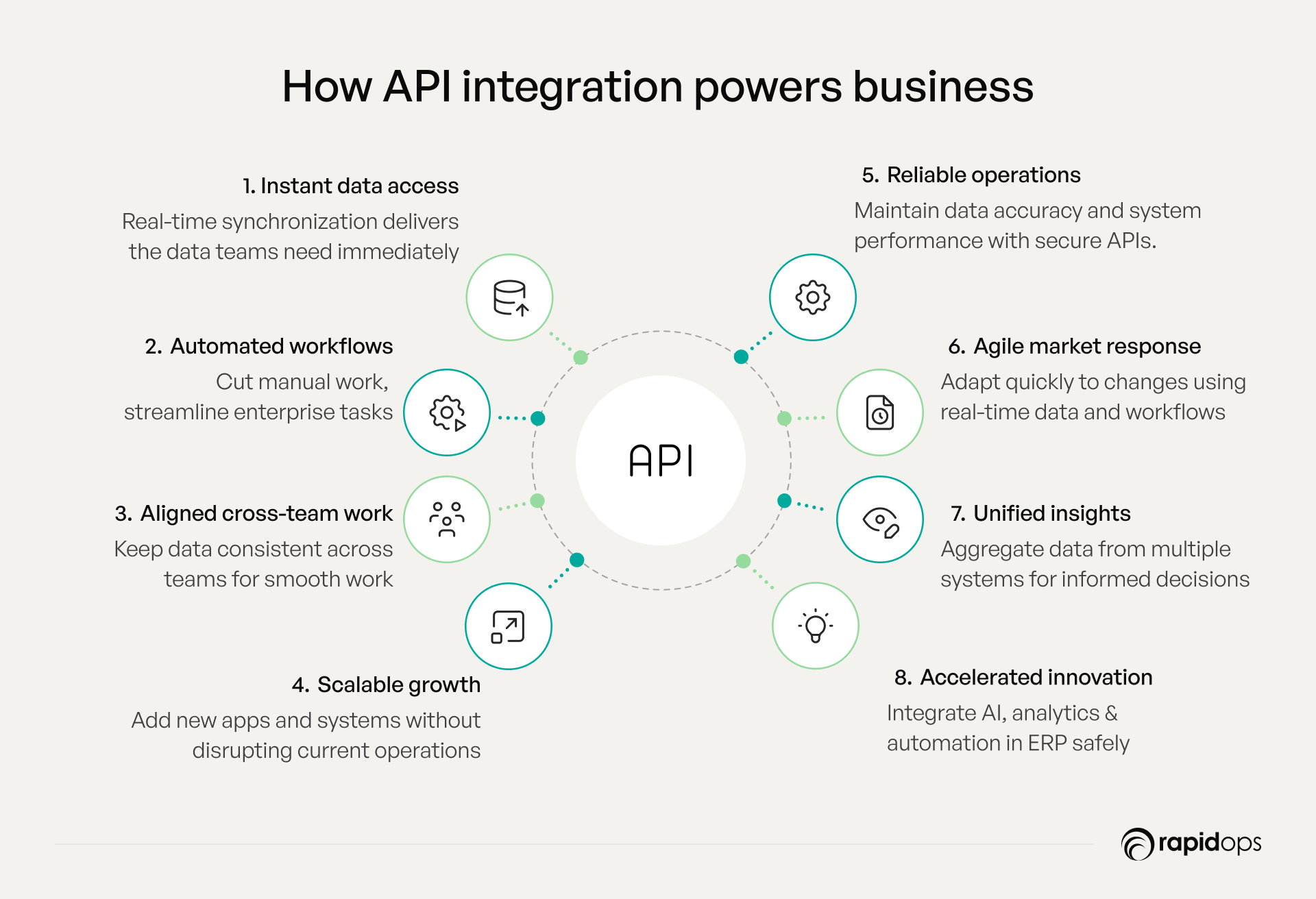
Instant access to critical data
API integration ensures that teams receive exactly what data they need when they need it. By enabling real-time data synchronization between enterprise systems, eCommerce platforms, inventory management systems, and other software applications, businesses eliminate delays caused by manual processes. Studies indicate that API integration can reduce manual data entry by up to 95%, allowing teams to focus on higher-value tasks. With consistent and accurate business data, leaders can make faster, more informed decisions that directly impact operational and strategic outcomes.
Streamlined operations and automated workflows
Integrating APIs enables the automation of repetitive tasks across software systems, reducing operational bottlenecks and minimizing errors. Automated workflows connect enterprise systems like CRM, ERP, and marketing automation platforms, ensuring data and functionality flow seamlessly across departments. This not only improves operational efficiency, with organizations prioritizing robust API strategies expected to outperform peers by 30% in 2025, but also delivers cost savings through reduced manual effort and optimized resource allocation.
Aligned cross-team workflows
Through API integration, businesses ensure that all departments operate using consistent, up-to-date information. Data consistency is maintained across different systems, preventing silos and enabling cohesive collaboration. For example, integration platforms coordinate data exchange between ERP, CRM, and other enterprise systems, improving inventory management, financial reporting, and overall business processes. When employees work with reliable, harmonized data, teams can execute initiatives more effectively and maintain alignment with broader business objectives.
Scalable growth and flexible integration
APIs allow organizations to scale their software applications and systems without disruption. Whether adding cloud-based ERP systems, integrating new enterprise systems, or connecting custom APIs, businesses can expand capabilities while maintaining stability. Integration platforms and API management tools provide flexible architectures, such as API-led or event-driven integration patterns enabling the seamless addition of new systems as business needs evolve.
Accurate, reliable operations
API integration improves system reliability by enforcing data consistency and automated validation during data transfer between systems. Organizations can eliminate errors from manual data entry and ensure system performance remains optimal. Encrypted data exchange and token-based authentication protect sensitive information, safeguarding operations against both internal and external risks.
Agile response to market changes
Businesses that implement robust API integration can respond quickly to market shifts. Real-time data flow ensures that operational and strategic decisions are based on accurate, current information. By integrating existing APIs and leveraging API integration solutions, organizations can adapt workflows, scale processes, and introduce new functionalities with minimal disruption, positioning themselves to capture emerging opportunities rapidly.
Unified business insights
Centralized integration allows for a single source of truth across the organization. By connecting multiple enterprise systems, data is aggregated and harmonized, enabling data-driven decisions and deep operational insight. API integration ensures that business leaders can evaluate market trends, monitor performance, and align initiatives across all departments, resulting in improved business performance and sustained competitive advantage.
Accelerated innovation and future-ready systems
APIs act as the backbone for innovation by enabling the integration of AI, advanced analytics, and automation tools. Organizations can implement modern ERP systems, cloud-based ERP solutions, and middleware without overhauling core systems, allowing rapid adoption of emerging technologies. Predictive analytics and automated processes help forecast demand, optimize workflows, and monitor inventory management systems in real time, ensuring operations are always aligned with strategic goals.
API integration transforms business operations by creating connected, agile, and data-driven systems. It reduces manual processes, enhances decision-making, ensures data and functionality consistency, and lays the foundation for scalable growth. By adopting robust API integration strategies, organizations unlock operational efficiency, accelerate innovation, and gain measurable improvements in performance, positioning themselves for sustained success in a complex digital landscape.
Top 5 API integration use cases
1. Retail: Unified inventory management
Keeping inventory accurate across stores, eCommerce platforms, and warehouses is a persistent challenge for retailers. API integration unifies inventory management systems, POS platforms, and warehouse databases into a single, real-time ecosystem, eliminating manual reconciliation and ensuring data consistency.
This connectivity prevents overselling, reduces stockouts, and boosts operational efficiency by automating repetitive tasks. Businesses can scale effortlessly, add new channels without disruption, and leverage integrated data for predictive analytics, smarter inventory decisions, and improved customer experiences, turning fragmented processes into a competitive advantage.
2. Retail: Personalized customer engagement
Delivering personalized experiences is key to driving customer loyalty and increasing conversion rates. Disconnected CRM systems, marketing platforms, and loyalty programs often create fragmented customer data, limiting insights and the ability to engage effectively. API integration connects these platforms, providing a unified, real-time view of each customer.
This enables retailers to deliver targeted promotions, tailored recommendations, and relevant loyalty rewards seamlessly across all channels. The result is a consistent, engaging experience that not only increases customer satisfaction but also supports scalable, data-driven marketing strategies. Unified customer data also allows teams to make smarter, faster decisions, improving operational efficiency while reducing reliance on manual data updates.
3. Manufacturing: Production workflow automation
Manufacturing operations depend on precise coordination between ERP, MES, and supply chain systems, yet manual processes often lead to inefficiencies and errors. API integration automates these workflows, connecting production scheduling, resource allocation, and supply chain systems in real-time.
By synchronizing data and tasks across platforms, manufacturers can reduce errors, accelerate production cycles, and optimize resource usage. Integrated workflows provide managers with immediate visibility into operational progress, enabling proactive decision-making and more agile responses to changes in demand. Automation ensures that repetitive coordination tasks are handled efficiently, freeing teams to focus on strategic initiatives and innovation.
4. Manufacturing: Equipment monitoring & predictive maintenance
Unplanned equipment downtime can significantly impact productivity and costs. Integrating IoT sensors with central dashboards and maintenance systems through APIs allows manufacturers to monitor machinery in real-time, capturing critical performance metrics across the production line.
This enables predictive maintenance, allowing potential issues to be addressed before they cause breakdowns. As a result, organizations experience reduced downtime, lower maintenance costs, and extended equipment lifespan. Real-time monitoring also supports compliance and safety standards while providing actionable insights to optimize maintenance schedules.
By leveraging API integration, manufacturers can transform maintenance from a reactive task into a strategic, proactive process.
5. Distribution: End-to-end order fulfillment
Large retailers that sell simultaneously to small retailers and end customers face complex fulfillment challenges. Orders flow through multiple channels, warehouses, and logistics networks, often causing delays, errors, and inventory mismatches. API integration connects order management, warehouse, and logistics systems into a single, intelligent ecosystem. Real-time data synchronization ensures accurate inventory visibility, automated order routing, and faster shipments. Combined with AI-powered insights, APIs can predict demand, prioritize shipments, and optimize inventory across channels. Executives gain a centralized view of operations, enabling data-driven decisions, improved customer satisfaction, and reduced operational risk. By creating a connected, automated ecosystem, businesses can scale fulfillment, respond quickly to market changes, and maintain service excellence, turning order management into a strategic growth lever.
API integration vs other integration methods
Integrating multiple systems is critical for modern business operations, but not all methods deliver the same agility, scalability, or real-time efficiency. Understanding the differences between API integration and alternative approaches helps leaders make informed decisions aligned with operational goals.
Manual integration
Manual integration relies on human intervention to transfer or reconcile data between systems. While simple to implement initially, it is highly prone to errors, inconsistencies, and delays. Manual processes also limit scalability, making it difficult for organizations to manage multiple enterprise systems or respond quickly to business changes. Over time, these limitations increase operational risk and reduce data reliability, impacting decision-making and overall efficiency.
ETL / Data integration
Extract, Transform, Load (ETL) or traditional data integration moves data in batches from source systems to target repositories. This method is effective for reporting, analytics, and historical trend analysis but is not suitable for real-time operational workflows. ETL processes often require complex data transformations and mappings, adding maintenance overhead. Moreover, limited flexibility in connecting multiple systems can hinder cross-departmental workflows and prevent organizations from responding swiftly to market demands or operational changes.
Middleware-only approaches
Middleware provides a centralized layer to connect disparate systems, offering a structured approach to integration. However, middleware-only strategies can be rigid and complex to maintain, potentially creating dependency on a specific vendor or platform. Updates to underlying systems may be slowed, and implementing new integrations often requires extensive configuration, limiting adaptability. While middleware is effective for some cross-system coordination, it lacks the real-time responsiveness and flexibility that API integration offers.
Why API integration stands out
API integration enables real-time data exchange and seamless workflows across multiple systems. REST APIs, web services, and custom APIs allow enterprise systems, software applications, and cloud platforms to communicate efficiently, ensuring consistent data flow, automated workflows, and improved operational efficiency.
Unlike batch or middleware-heavy approaches, API integration supports scalable growth, faster decision-making, and rapid adoption of new technologies, including AI and predictive analytics. Organizations leveraging robust API strategies are expected to outperform peers in operational efficiency by up to 30%.
Decision guidance
Choose API integration when you need:
- Real-time workflows across multiple systems.
- Scalable, flexible connectivity between enterprise systems and software applications.
- Automation of repetitive tasks and improved data consistency.
Alternative methods, such as ETL or manual processes, may still be suitable for:
- Batch reporting and analytics.
- Low-frequency tasks or legacy-heavy systems where real-time integration is not critical.
Assess each approach based on complexity, cost, adaptability, and business criticality to ensure that your integration strategy aligns with operational goals and long-term business success.
Debunking common misconceptions about API integration
API integration is a cornerstone of modern business efficiency, enabling organizations to connect to disparate software applications, enterprise systems, and operational workflows. Yet, many decision-makers operate under misconceptions that limit the strategic potential of APIs. Understanding these myths allows leaders to leverage API integration to improve operational efficiency, automate workflows, ensure data consistency, and unlock growth opportunities across all departments.
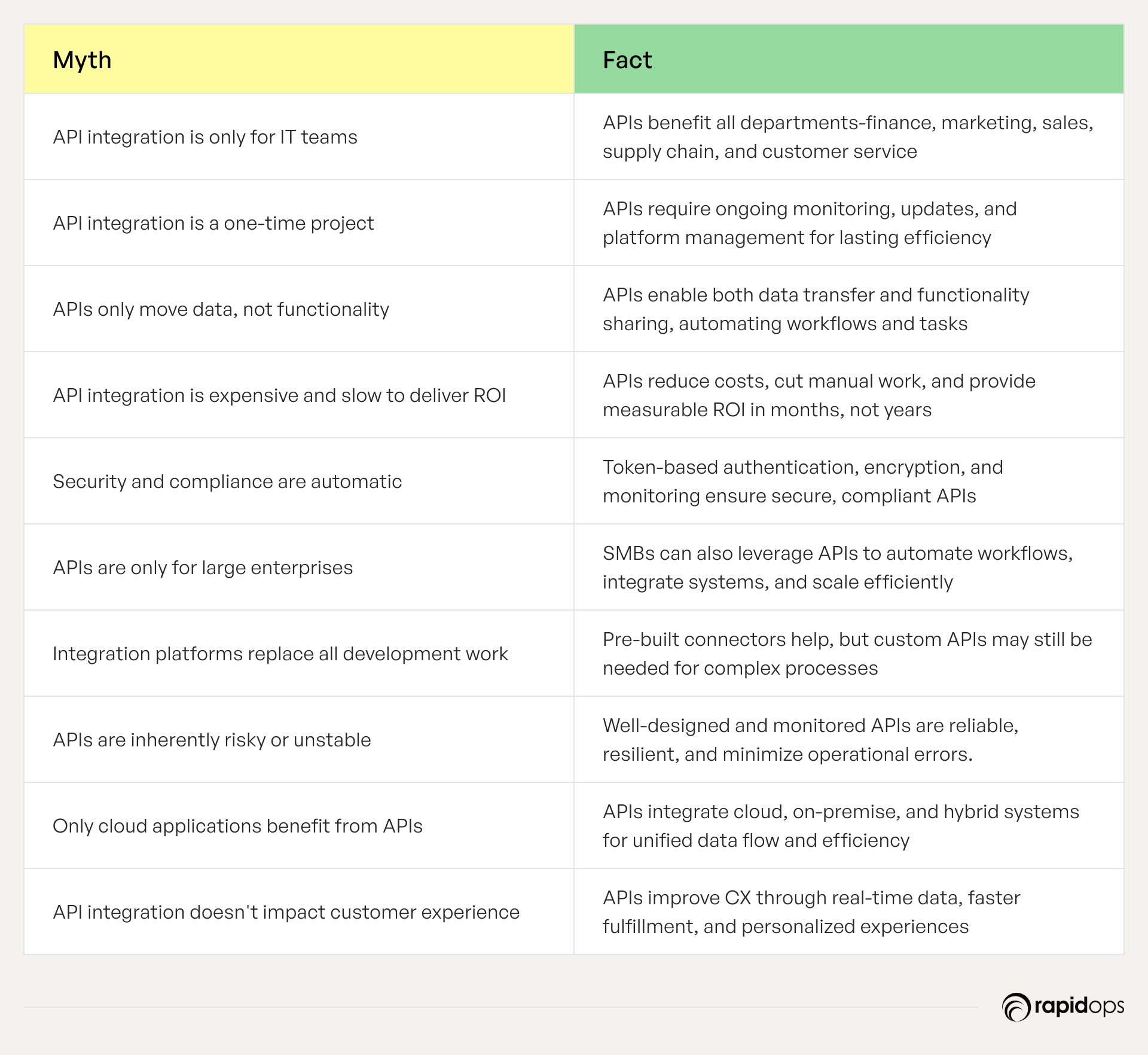
1. API integration is only for IT teams
While IT teams manage the technical aspects, API integration impacts the entire business ecosystem. Finance, marketing automation, sales, supply chain, and customer service systems can all benefit from connected software applications. By enabling real-time data exchange, automated workflows, and seamless integration across enterprise systems, organizations ensure data consistency, improved system performance, and cross-departmental collaboration.
2. API integration is a one-time project
APIs are not static connectors; they form an ongoing integration process. Achieving successful API integration requires continuous monitoring, API management, and platform updates. Integration platforms (iPaaS) and API integration tools help businesses scale operations, automate tasks, and maintain seamless data flow across multiple systems, ensuring long-term operational efficiency and adaptability to evolving business processes.
3. APIs only move data, not functionality
Modern APIs allow software systems to share both data and functionality. Beyond data transfer, APIs enable software applications and enterprise systems to trigger automated workflows, streamline business processes, and enhance system performance. Organizations can leverage these capabilities to automate repetitive tasks, reduce manual data entry, and enable intelligent, connected operations across ERP, inventory management systems, and other enterprise platforms.
4. API integration is expensive and slow to deliver ROI
An initial investment is required, but API integration reduces operational costs, minimizes manual processes, and accelerates decision-making. Studies indicate that API-driven automation can cut administrative work by up to 40% and improve operational efficiency by lowering the cost per transaction. Over time, APIs enable real-time data synchronization, predictive analytics, and improved business insights, providing measurable ROI in months rather than years.
5. Security and compliance are automatic
APIs require proactive governance. Implementing token-based authentication, encrypted data transfer, and robust monitoring ensures data security, compliance, and risk mitigation. Regularly assessing security protocols, API documentation, and error-handling procedures allows organizations to maintain operational integrity while integrating cloud, hybrid, or on-premise systems.
6. APIs are only for large enterprises
Small and mid-sized businesses can achieve significant benefits from API integration. Even SMBs can connect software systems, automate workflows, integrate existing enterprise systems, and ensure seamless data exchange. These capabilities allow smaller organizations to scale efficiently, gain real-time insights, and enhance system performance without the complexity or cost associated with enterprise-scale deployments.
7. Integration platforms replace all development work
While iPaaS platforms provide pre-built connectors, automated workflows, and API integration tools, they do not eliminate the need for custom APIs. Certain complex processes or legacy systems may require tailored API development to ensure exact functionality sharing, seamless data flow, and interoperability between software components and enterprise systems.
8. APIs are inherently risky or unstable
Properly designed, tested, and monitored APIs are reliable and resilient. Implementing best practices, robust error handling, and real-time data synchronization ensures stable communication between systems. This approach minimizes downtime, reduces errors from manual data entry, and maintains operational efficiency across different systems and integration platforms.
9. Only cloud applications benefit from APIs
APIs can integrate cloud, on-premise, and hybrid systems alike. Organizations can connect ERP, CRM, transportation management systems, inventory management systems, and other enterprise applications to achieve unified data flow. This seamless integration improves operational efficiency, supports automated workflows, and enhances system performance while maintaining data consistency across the business.
10. API integration doesn’t impact customer experience
Effective API integration directly enhances customer interactions. By enabling real-time data exchange between marketing automation, social media platforms, eCommerce platforms, and ERP systems, businesses can ensure accurate inventory, faster order fulfillment, and personalized experiences. These capabilities strengthen customer loyalty, improve operational efficiency, and drive revenue growth through seamless, connected operations.
Unlock the full potential of your systems with expert API integration
Now that you understand what API integration is, why it’s essential, and how it works, it’s clear that disconnected systems and fragmented workflows can silently undermine your business performance. Slow data flow, manual processes, and inconsistent information create friction that impacts decision-making, operational efficiency, and customer experience.
At Rapidops, we bring years of hands-on experience and deep expertise in API integration, helping organizations like yours seamlessly connect enterprise systems, software applications, and cloud platforms. By automating workflows, enabling real-time data synchronization, and reducing manual processes, we empower your teams to work smarter, faster, and more collaboratively. Our approach doesn’t just streamline operations; it uncovers hidden efficiencies and unlocks measurable growth opportunities across your business.
Interested in knowing how your systems can be integrated? Schedule a no-cost consultation with one of our API experts to learn how you can seamlessly connect your systems, determine the best approach, and utilize these integrations in the best possible way.
Frequently Asked Questions

What’s Inside
- What is an API
- What is API integration
- Why API integration has become a business imperative
- How API integration works
- Types of API integration
- How API integration powers your business success
- Top 5 API integration use cases
- API integration vs other integration methods
- Debunking common misconceptions about API integration
- Unlock the full potential of your systems with expert API integration

Let’s build the next big thing!
Share your ideas and vision with us to explore your digital opportunities
Similar Stories
- Transformation
- undefined Mins
- March 2022


- Transformation
- undefined Mins
- March 2020

Receive articles like this in your mailbox
Sign up to get weekly insights & inspiration in your inbox.